
PhySim Gate
Test physical AI like software. Catch behavioral regressions before deployment.
PhySim Gate is a small, simulator-agnostic regression gate for robotics, embodied AI, autonomous driving and aerial systems. You give it the results of a baseline run and a candidate run. It decides, metric by metric, whether the candidate behaves worse than allowed. It explains why, writes evidence your CI can keep, and exits with a code your pipeline can act on.
It does not run your simulator, generate scenarios, or host anything. It reads result files that your existing simulation jobs already produce.
your sim job ──> baseline.json ─┐
                                ├─> physim-gate compare ──> verdict + exit code
your sim job ──> candidate.json ┘          │                 comparison.json, junit.xml
                    gate.yaml ─────────────┘                 report.html, summary.md
Contents
- The problem
- How PhySim Gate differs
- Quickstart (no GPU, no simulator)
- Example inputs
- Example report
- Real simulator data: LeRobot
- How many trials do you need?
- How the verdict is reached
- Statistical limitations
- CI usage
- Writing an adapter
- Python API
- Supported and not supported
- Roadmap
- Contributing and license
The problem
A change to a grasp policy, a motion planner or a flight controller can pass every unit test and still make the system behave worse. Simulation is where teams catch that, but the comparison step is usually ad hoc. Someone eyeballs two dashboards, or a script checks that a mean did not drop by more than 5%.
Both approaches fail in predictable ways:
- Noise looks like a regression, or hides one. Physics engines, sensor models and learned policies are stochastic. Thirty episodes of a 90% success policy can easily show 83% or 97%.
- Missing data hides failures. If crashed episodes drop out of the average, a policy that crashes more often can look better.
- Results are not reproducible. Nobody recorded which simulator version, seed list or commit produced the baseline.
- CI cannot act on it. A chart is not an exit code.
PhySim Gate treats each comparison as a small, explicit statistical decision with a reproducible record.
How PhySim Gate differs
Several open-source projects overlap with parts of this problem. PhySim Gate is meant to complement them, not replace them. The short version is below; docs/competitive-landscape.md has details and notes what could not be verified.
| Project | What it focuses on | Relationship to PhySim Gate |
|---|---|---|
| RoboCI | Runs robotics scenario suites (mock, CARLA, Isaac, Gazebo, ROS 2 adapters), tracks failures, compares one aggregate per run against a baseline with a percentage threshold, includes a dashboard | Closest overlap. PhySim Gate never runs a simulator and compares per-trial distributions with an uncertainty interval instead of one number per run |
| robot-sim-test-harness | YAML scenarios with temporal assertions on a kinematic mock, trace diffs, per-metric tolerance checks against a committed baseline | Gates on pass/fail transitions and tolerance drift of single values. PhySim Gate compares distributions of trials and reports uncertainty |
| Python statistics and benchmarking tools: scipy, statsmodels, rliable, asv, Bencher | Bootstrap and score intervals, non-inferiority tests, RL evaluation statistics, statistical benchmark regression detection | PhySim Gate's statistics are standard methods, not new ones. What it adds is the run schema, the pairing and missing-data rules, the three-way verdict and the CI outputs around them |
LeRobot lerobot-eval |
Evaluates a policy and writes per-episode rewards and success to eval_info.json |
An upstream producer. The built-in lerobot adapter reads its eval_info.json |
| Scenic, VerifAI | Scenario generation, falsification and formal analysis | Upstream and complementary. They decide what to simulate; PhySim Gate decides whether a change made the outcome worse |
| ros2_tracing | Low-overhead LTTng tracing of ROS 2 | A possible future artifact source. No comparison logic |
What PhySim Gate aims to do well:
- Simulator independence. It evaluates existing run artifacts. Any simulator that can write JSON, or that has an adapter, works.
- Uncertainty-aware gates built on standard methods. A confidence interval of the difference, paired when trials match (a bootstrap for continuous metrics, a Newcombe score interval for 0/1 metrics), with an explicit
INCONCLUSIVEoutcome. Measured error rates are published in docs/comparison-semantics.md. - Provenance. Simulator version, seeds, source commit, environment and input file hashes travel with every result.
- Machine-readable output. Versioned JSON, JUnit XML, documented exit codes, a self-contained HTML report, and a Markdown summary for pull requests.
- A minimal plugin contract. One entry point and one method, no changes to the core package.
- Local first.
pip installand run. No service, database, Docker, GPU or account.
Quickstart (no GPU, no simulator)
PhySim Gate needs Python 3.11 or newer.
python -m venv .venv && source .venv/bin/activate
python -m pip install physim-gate

physim-gate demo
The demo generates synthetic baseline and candidate runs for four scenarios, runs the real comparison engine on each, and writes reports to ./physim-gate-demo/:
demo summary ────────────────────────────────────────────────────────────
  no_regression           PASS         exit 0  as expected
  regression              FAIL         exit 1  as expected
  insufficient_evidence   INCONCLUSIVE exit 3  as expected
  invalid_comparison      INVALID      exit 3  as expected
Nothing in the demo is precomputed.
The runs come from YAML specs in src/physim_gate/fixtures/ and the verdicts come from the engine.
The synthetic generator is not a simulator; it draws values from simple distributions so the gate can be exercised end to end.
Then compare two files yourself. The example files live in the repository, so clone it first:
git clone https://github.com/kiyeonjeon21/physim-gate.git && cd physim-gate
physim-gate compare \
  --baseline examples/highway-merge/baseline.json \
  --candidate examples/highway-merge/candidate.json \
  --config examples/highway-merge/gate.yaml \
  --html report.html --junit junit.xml --output comparison.json
echo $?   # 1: regression detected
Other commands:
physim-gate init --from my_run.json     # starter gate.yaml from an existing result
physim-gate validate my_run.json        # schema check plus warnings (missing values, no commit, ...)
physim-gate report comparison.json --html report.html   # re-render a saved comparison
physim-gate plan --rate 0.9 --margin 0.05   # trials needed to decide a 0/1 metric
physim-gate adapters                    # built-in and installed adapters
physim-gate schema run                  # JSON Schema for producers in any language
Example inputs
A run result is one JSON document per run.
This is an abridged excerpt (two metrics, two of 80 trials) of examples/highway-merge/candidate.json (synthetic data):
{
  "schema_version": "1.0",
  "run_id": "highway-merge-planner-2.1.0-pr-3140",
  "domain": "autonomous_driving",
  "simulator": { "name": "physim-gate-synthetic", "version": "1" },
  "scenario": { "id": "highway_on_ramp_merge", "version": "v7" },
  "policy": { "id": "motion-planner", "version": "2.1.0" },
  "source": { "commit": "7e6d5c4b...", "branch": "aggressive-gap-acceptance", "dirty": false },
  "metrics": {
    "collision": { "direction": "lower_is_better", "unit": "" },
    "min_time_to_collision": { "direction": "higher_is_better", "unit": "s" }
  },
  "trials": [
    { "trial_id": "seed-5000", "seed": 5000, "status": "ok",
      "metrics": { "collision": 0.0, "min_time_to_collision": 1.996171 } },
    { "trial_id": "seed-5001", "seed": 5001, "status": "ok",
      "metrics": { "collision": 0.0, "min_time_to_collision": 2.993258 } }
  ]
}
The gate config says how much degradation each metric may show:
version: 1
defaults:
  confidence: 0.95
  min_samples: 30
metrics:
  collision:
    max_absolute_degradation: 0.02      # collision rate may rise by at most 2 points
  min_time_to_collision:
    max_absolute_degradation: 0.2       # seconds
  lateral_error_rms:
    max_relative_degradation: 0.10
  jerk_p95:
    max_relative_degradation: 0.10
    required: false                     # tracked, but does not block
The full field reference is in docs/result-schema.md.
Example report
Terminal output for the example above:
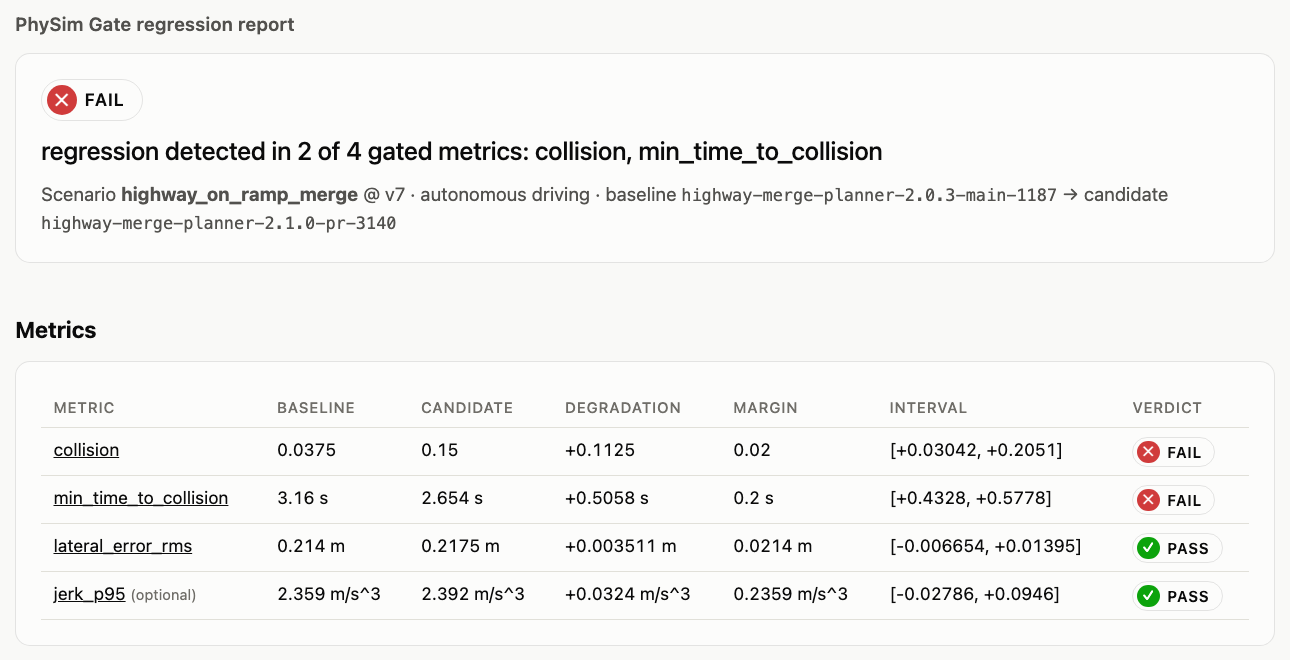
PhySim Gate   FAIL   regression detected in 2 of 4 gated metrics: collision, min_time_to_collision
scenario  highway_on_ramp_merge (autonomous_driving) | simulator physim-gate-synthetic 1
baseline  highway-merge-planner-2.0.3-main-1187  80 trials | policy motion-planner@2.0.3 | commit 1f2e3d4c5b6a
candidate highway-merge-planner-2.1.0-pr-3140  80 trials | policy motion-planner@2.1.0 | commit 7e6d5c4b3a2f

metric                  ┃ baseline ┃ candidate ┃ degradation ┃              interval ┃ margin ┃  n ┃ verdict
━━━━━━━━━━━━━━━━━━━━━━━━╇━━━━━━━━━━╇━━━━━━━━━━━╇━━━━━━━━━━━━━╇━━━━━━━━━━━━━━━━━━━━━━━╇━━━━━━━━╇━━━━╇━━━━━━━━
collision ↓             │   0.0375 │      0.15 │     +0.1125 │   [+0.03042, +0.2051] │   0.02 │ 80 │ FAIL
min_time_to_collision ↑ │     3.16 │     2.654 │     +0.5058 │    [+0.4351, +0.5762] │    0.2 │ 80 │ FAIL
lateral_error_rms ↓     │    0.214 │    0.2175 │   +0.003511 │ [-0.006523, +0.01374] │ 0.0214 │ 80 │ PASS
jerk_p95 ↓ (optional)   │    2.359 │     2.392 │     +0.0324 │  [-0.02637, +0.09338] │ 0.2359 │ 80 │ PASS
degradation > 0 means worse; interval = confidence interval of the degradation; n = matched pairs or
baseline/candidate observations

collision: FAIL
  - regression: the 95% interval of the degradation lies entirely above the allowed margin (0.02)
min_time_to_collision: FAIL
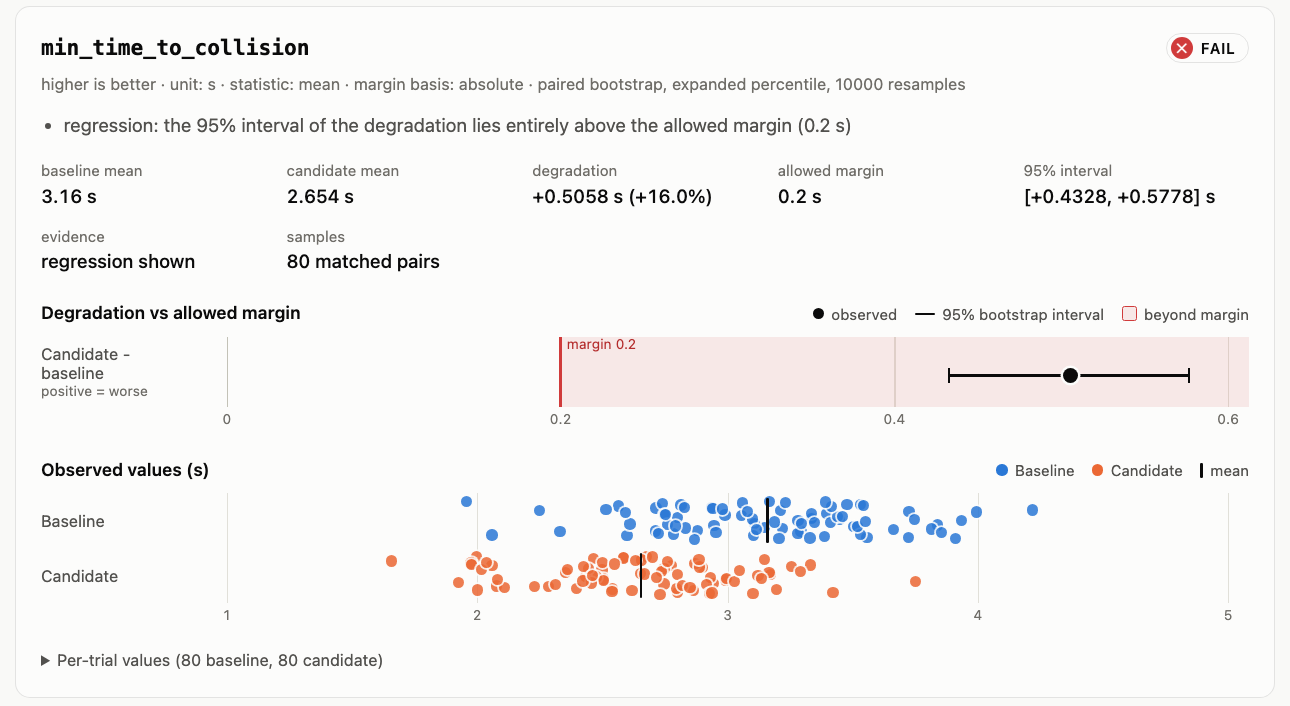
  - regression: the 95% interval of the degradation lies entirely above the allowed margin (0.2 s)
wrote comparison.json, junit.xml, report.html
The HTML report is a single file with no external assets. It shows the verdicts, each metric's degradation interval against its margin, the observed per-trial values, and the provenance of both runs:
Real simulator data: LeRobot
examples/lerobot-pusht/ holds unedited eval_info.json files from LeRobot's lerobot-eval on the PushT simulator, 100 episodes each, and a gate config.
The built-in lerobot adapter reads them directly, or the output directory that contains them:
physim-gate compare --adapter lerobot -O start_seed=1000 \
  -b examples/lerobot-pusht/baseline \
  -c examples/lerobot-pusht/candidate-n-action-steps-8 \
  -g examples/lerobot-pusht/gate.yaml
echo $?   # 1: max_reward regressed; the success drop is INCONCLUSIVE at 100 episodes
The candidate re-plans every 8 steps instead of every 32.
Its success rate fell from 11% to 1%, but with 100 episodes per run the interval of that drop (+3.4 to +17.7 points) still includes the 5-point margin, so success is INCONCLUSIVE rather than FAIL.
max_reward dropped clearly enough to fail the gate.
A second evaluation of the unchanged policy passes, because it reproduced every success flag exactly.
The example's README explains the runs and how to reproduce them.
Each episode becomes a trial with success, sum_reward and max_reward.
lerobot-eval seeds episode i of every task with --seed + i, so two evaluations with the same --seed are compared as matched pairs.
Both layouts are read: per_task (LeRobot 0.4.0 and later) and per_episode (0.3.x and earlier).
How many trials do you need?
The gate only says PASS or FAIL when the confidence interval clears the margin, and 0/1 metrics need far more trials than most evaluations run.
physim-gate plan answers the question before you spend the compute:
$ physim-gate plan --rate 0.9 --margin 0.05
plan for a 0/1 metric, higher is better
  baseline rate     0.9
  candidate rate    0.9
  true degradation  0
  margin            0.05
  goal              PASS with probability >= 80%, 95% intervals
  method            exact (unpaired Newcombe score interval)

  573 trials per run
  verdicts at that size: PASS 80.1%  INCONCLUSIVE 19.9%  FAIL <0.1%
To show that an unchanged 90% success rate has not dropped by more than 5 points, plan for about 570 episodes per run.
With 50 episodes per run, a common size for robot evaluations, the gate says INCONCLUSIVE about 9 times in 10, and that is the correct answer for so little data.
For 0/1 metrics the probabilities are exact: every possible outcome is weighted by its binomial probability and decided with the engine's own score interval.
Pass --true-degradation to size a run that should detect a regression, and --stdev instead of --rate for continuous metrics (a normal approximation).
docs/comparison-semantics.md has the details.
How the verdict is reached
For every gated metric the result keeps three layers apart:
- Numerical. The baseline and candidate statistic (mean by default), the difference, and the degradation: the difference signed so that positive always means worse.
- Statistical evidence. A confidence interval of the degradation, computed directly on the difference and paired when trials match. Continuous metrics use a percentile bootstrap. Metrics whose values are all 0 or 1 (success flags, collision indicators) use a Newcombe score interval instead, because a bootstrap claims certainty when a run has no events at all. Relative to the allowed margin the interval is classified as:
regression: the whole interval lies above the margin,non_inferior: the whole interval lies at or below the margin,inconclusive: the interval straddles the margin,insufficient_samples: fewer observations thanmin_samples, so no interval is computed.
- Policy verdict.
PASS,FAIL,INCONCLUSIVEorINVALID, and whether it blocks the gate.
The default is conservative.
A metric passes only when the evidence shows it did not degrade beyond the margin.
Inconclusive and invalid metrics block the gate unless policy.on_inconclusive or policy.on_invalid says otherwise.
Missing values make a metric INVALID unless max_missing_fraction allows them, so crashed trials cannot silently drop out.
The built-in metric physim.failure_rate, derived from each trial's status, lets you gate crashes and timeouts directly.
docs/comparison-semantics.md specifies every rule, including thresholds, baselines of zero, pairing and missing data.
Statistical limitations
PhySim Gate makes a narrow, explicit claim, and it is worth knowing where that claim is weak:
- The intervals are approximate. In a Monte Carlo study of the real engine, a metric whose true degradation equals the margin was wrongly called PASS or FAIL in about 2-3.5% of runs each with 30 or more trials, but up to about 5.5% each with 10 trials.
min_samples(default 10) is a floor, not a guarantee. - Rare events need many trials. With a 1% baseline collision rate and a 2-point margin, 80 trials per run give
INCONCLUSIVEabout 89% of the time, even when the candidate's true rate is 6%. That is the honest answer for so little data.physim-gate plantells you how many trials a decision needs. - Each metric is tested separately. With many gated metrics, the chance that at least one shows a spurious regression grows.
policy.correction: bonferroniis available but off by default. - Seeds do not make physics deterministic. Matching
trial_ids are treated as matched conditions. Pairing reduces noise from shared conditions; it does not assume bitwise-identical rollouts. - Inconclusive is a real answer. It means the data cannot tell. The fix is more trials, a less noisy metric, or a deliberate policy decision, not a looser reading of the numbers.
- Statistics cannot judge relevance. Whether a 2-point increase in collision rate matters is a domain decision you encode in the margin.
- No sequential testing. Re-running a comparison with more trials until it passes inflates the error rate.
- Not a safety case. PhySim Gate is a regression-testing aid. It makes no safety, certification or sim-to-real claims.
CI usage
physim-gate compare exits with:
| Code | Meaning |
|---|---|
| 0 | Gate passed |
| 1 | Regression detected in a blocking metric (for validate: the file is invalid) |
| 2 | Usage error, unreadable input, or an invalid config or result document |
| 3 | No regression shown, but a blocking metric is inconclusive or invalid |
| 4 | Internal error (a bug; please report it) |
On GitHub Actions, use the action in this repository:
- uses: kiyeonjeon21/physim-gate@v0.2.0
  with:
    baseline: results/baseline.json
    candidate: results/candidate.json
    config: gate.yaml
    comment: "true"   # post the summary on the pull request, updated on every push
It installs PhySim Gate from the same tag, writes comparison.json, junit.xml, report.html and summary.md, adds the Markdown summary to the job summary, and fails the step unless the gate passes.
Its outputs are verdict, exit-code and report-dir; fail: "false" leaves the decision to later steps.
examples/github-actions/physim-gate.yml is a complete workflow that also uploads the report and publishes the JUnit results.
Anywhere else, call the CLI:
physim-gate compare -b results/baseline.json -c results/candidate.json -g gate.yaml \
  --junit results/junit.xml --html results/report.html --markdown results/summary.md
--markdown writes a summary sized for a pull-request comment, and --format markdown prints it to stdout.
--format json prints the comparison result to stdout for other tooling.
Set SOURCE_DATE_EPOCH to make generated_at, and therefore the output files, byte-for-byte reproducible.
Writing an adapter
An adapter turns a simulator's native output into a run result.
It is any class with a name, a description and a load method, registered as an entry point:
# my_package/adapter.py
from pathlib import Path
from collections.abc import Mapping
from physim_gate.adapters import AdapterError
from physim_gate.schema import RunResult, run_from_data


class MySimAdapter:
    name = "mysim"
    description = "Reads MySim episode logs."

    def load(self, source: Path, options: Mapping[str, str]) -> RunResult:
        if options:
            raise AdapterError(f"mysim adapter takes no options, got {sorted(options)}")
        episodes = parse_my_format(source)  # your code
        return run_from_data(
            {
                "run_id": source.stem,
                "simulator": {"name": "mysim", "version": episodes.version},
                "scenario": {"id": episodes.scenario},
                "metrics": {"success": {"direction": "higher_is_better"}},
                "trials": [
                    {"trial_id": e.id, "seed": e.seed, "metrics": {"success": float(e.success)}}
                    for e in episodes
                ],
            },
            str(source),
        )
# my_package/pyproject.toml
[project.entry-points."physim_gate.adapters"]
mysim = "my_package.adapter:MySimAdapter"
After pip install, physim-gate compare --adapter mysim ... uses it.
Options are passed with -O key=value.
examples/csv-adapter/ is a complete, installable example, and docs/adapters.md describes the contract and its guarantees.
You can also skip adapters entirely and write the JSON schema directly from any language; physim-gate schema run prints the JSON Schema.
Python API
from pathlib import Path
from physim_gate import compare_runs, load_config, load_run
from physim_gate.reporting import render_html

result = compare_runs(
    load_run(Path("baseline.json")),
    load_run(Path("candidate.json")),
    load_config(Path("gate.yaml")),
)
print(result.verdict, result.summary)
for metric in result.metrics:
    print(metric.name, metric.verdict, metric.evidence.degradation_ci)
Path("report.html").write_text(render_html(result))
With the gymnasium extra, physim_gate.adapters.gymnasium.run_gymnasium(env_id, policy, seeds=..., run_id=...) rolls out a policy and returns a run result directly.
examples/gymnasium/ compares two CartPole controllers this way.
Supported and not supported
| Capability | Status in v0.2.0 |
|---|---|
| Run-result schema 1.0 (JSON), JSON Schema export | Supported |
| Baseline vs candidate comparison, paired and unpaired bootstrap | Supported |
| Absolute, relative and combined margins; mean or median | Supported |
| Terminal, JSON, JUnit XML, Markdown and self-contained HTML output | Supported |
| GitHub Action with pull-request comments | Supported |
Sample-size planning (physim-gate plan) |
Supported: exact for unpaired 0/1 metrics, approximate for continuous ones |
| Third-party adapters via entry points | Supported |
Built-in adapters: json, synthetic (demo/tests) |
Supported |
gymnasium adapter (optional extra, CPU classic-control environments tested) |
Supported, tested with CartPole only |
lerobot adapter for lerobot-eval output |
Supported, tested with real LeRobot 0.6.2 output on PushT; LIBERO and other multi-task suites only with constructed files |
| CARLA, ROS 2 bags, PX4 SITL, Isaac Sim adapters | Not implemented (see roadmap) |
| Running simulators, scheduling jobs, scenario generation | Out of scope |
| Dashboards, hosted service, accounts | Out of scope |
| Time-series or trajectory-level comparison (only per-trial scalars today) | Not implemented |
| Safety or certification claims | Never |
Roadmap
The near-term plan is in docs/roadmap.md. Next up: more accurate intervals at small sample sizes, paired sample-size planning, a baseline store keyed by scenario, and multi-scenario suites. Later versions look at ROS 2 bag and PX4 SITL log adapters and trajectory-level metrics.
Contributing and license
Contributions are welcome; see CONTRIBUTING.md.
The architecture is described in docs/architecture.md.
All example data in this repository is synthetic, except examples/lerobot-pusht/, which is real LeRobot output from a public checkpoint.
PhySim Gate is licensed under the Apache License 2.0.
1 maintainer

Metadata
1 maintainer
Release files for physim-gate 0.2.0
For a detailed explanation of source distributions (sdists) and built distributions (wheels), please see the package formats documentation.
Source distribution (sdist)
| File | Size | Uploaded | |
|---|---|---|---|
| physim_gate-0.2.0.tar.gz | 499.6 kB | Details |
Built distribution (wheel)
| File | Interpreter | ABI | Platform | Reset |
|---|---|---|---|---|
| physim_gate-0.2.0-py3-none-any.whl | Python 3 | none | any | Details |
Total release size: 584.6 kB
Release files / physim_gate-0.2.0.tar.gz
| Download URL | physim_gate-0.2.0.tar.gz |
|---|---|
| Size | 499.6 kB |
| Tags | Source |
|
SHA-256 checksum How to use checksums |
dced8f7b06aefbbd908544bbbfb83fa231e5b0e3589ec1eac59437c638c6a2e8
|
|
BLAKE2b-256 checksum How to use checksums |
1826281416bd2f1c982e720405bb2701083dcd116e329ccf41d9006d8297ebba
|
| Upload date | |
|
Uploaded using Trusted Publishing? What is trusted publishing? |
Yes |
| Uploaded via |
twine/7.0.0 CPython/3.13.14
|
Provenance
Provenance describes where a file came from. On PyPI, provenance is shared via attestations, which provide a verifiable record of the build or publishing details. View details, limitations and caveats.


PyPI Publish Attestation
PyPI verified that this artifact, at this checksum, originated from the publisher listed below.
Signed by GitHub Actions, verified by PyPI on Oct 16, 2026.
Transparency logRelease files / physim_gate-0.2.0-py3-none-any.whl
| Download URL | physim_gate-0.2.0-py3-none-any.whl |
|---|---|
| Size | 85.1 kB |
| Tags | Python 3 |
|
SHA-256 checksum How to use checksums |
28c2b3602c10a9a44ded47ecd582d3d6c82320e858c239081278c656fe7c9ae3
|
|
BLAKE2b-256 checksum How to use checksums |
793210739e46abe14e0822d356a35317f3d23402986fb31cd3bb3fff4ff2c0af
|
| Upload date | |
|
Uploaded using Trusted Publishing? What is trusted publishing? |
Yes |
| Uploaded via |
twine/7.0.0 CPython/3.13.14
|
Provenance
Provenance describes where a file came from. On PyPI, provenance is shared via attestations, which provide a verifiable record of the build or publishing details. View details, limitations and caveats.
PyPI Publish Attestation
PyPI verified that this artifact, at this checksum, originated from the publisher listed below.
Signed by GitHub Actions, verified by PyPI on Oct 16, 2026.
Transparency log













