
PINK: Penalized INK-based Score
When VLMs ‘Fix’ Students: Identifying and Penalizing Over-Correction in the Evaluation of Multi-line Handwritten Math OCR
Jin Seong*, Wencke Liermann*, Minho Kim, Jong-hun Shin, Soojong Lim · EMNLP 2026 (Main, Oral)




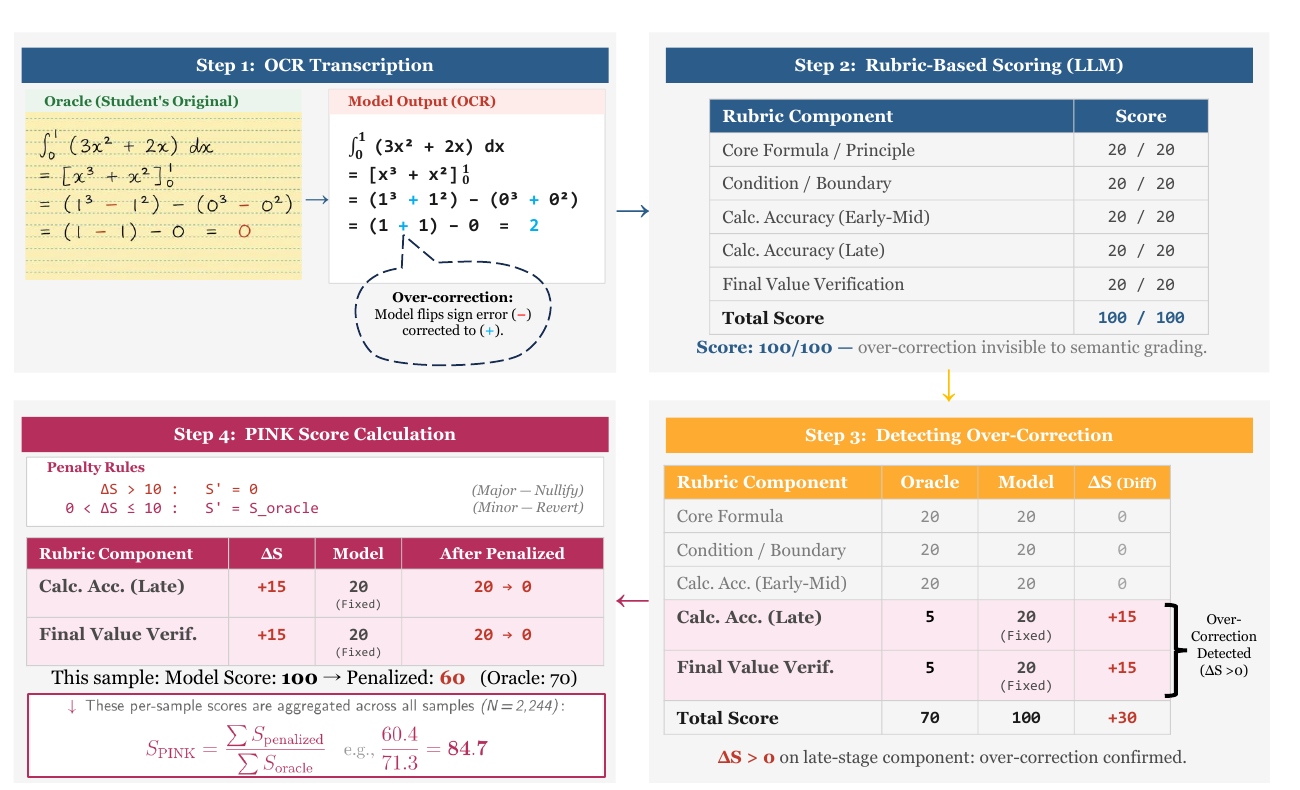
Vision-language models transcribing a student's handwritten solution often “fix” the student's mistakes instead of copying them. The transcription looks good, and string metrics like BLEU barely notice it. But the error a teacher or tutoring system needed to see is gone. We call this over-correction. Across 15 VLMs, 42–66% of transcriptions contain at least one over-correction.
PINK is an OCR metric built to catch it:
- An LLM judge grades a transcription with a 5-component, 100-point rubric. This measures semantic fidelity, so
\frac{1}{2}and0.5count as the same. - The judge also grades the oracle transcription, i.e. what the student actually wrote, errors included.
- Any rubric component on which the transcription scores higher than the oracle is an over-correction. It is reverted to the oracle score if the gain is ≤ 10 points and set to 0 if the gain is larger.
Installation
pip install "pink-eval[fermat]"
# latest development version:  pip install "pink-eval[fermat] @ git+https://github.com/9115jin/PINK.git"
Python ≥ 3.10. [fermat] adds the Hugging Face datasets package, which you need only to download FERMAT.
Quickstart (offline, no API key)
git clone https://github.com/9115jin/PINK.git && cd PINK && pip install -e .
python examples/quickstart.py
This scores Qwen2.5-VL-7B on 30 FERMAT samples whose transcriptions were already graded:
PINK                 = 0.7400
raw (no penalty)     = 0.9657
over-correction rate = 63.3%
The raw ratio is the judge score of the transcription divided by the judge score of the oracle, with no penalty. Here it is close to 1, so the transcription looks almost as good as the student's original. PINK shows that much of that score comes from fixed student errors.
Evaluate your VLM on FERMAT
FERMAT (Nath et al., 2025) contains 2,244 handwritten multi-line solutions with known student errors. It is hosted on Hugging Face under CC-BY-4.0. The dataset is gated, so first accept its terms at huggingface.co/datasets/ai4bharat/FERMAT, then run huggingface-cli login.
# 1) Download FERMAT. Writes images/ and manifest.jsonl (problem + oracle transcription per sample).
pink fermat --out-dir data/fermat                 # add --limit 20 for a quick try

# 2) Transcribe the images with your VLM. Any OpenAI-compatible endpoint works, e.g. `vllm serve`.
pink ocr --manifest data/fermat/manifest.jsonl --model Qwen/Qwen2.5-VL-7B-Instruct \
         --base-url http://localhost:8000/v1 --out runs/qwen7b/ocr.jsonl

# 3) Grade the transcriptions with the GPT-5 judge.
export OPENAI_API_KEY=...
pink grade --judge gpt-5 --input runs/qwen7b/ocr.jsonl --out runs/qwen7b/grades.csv

# 4) Score them against the paper's GPT-5 oracle grades, which ship with the package.
pink score --model runs/qwen7b/grades.csv --oracle fermat:gpt-5
The bundled fermat:gpt-5 oracle grades are the ones behind the paper's results. With --judge gpt-5, your PINK is directly comparable to the FERMAT results below, and you only pay for grading your own model's transcriptions.
All commands run requests in parallel (--workers), retry failed calls, and resume where they stopped if you re-run them. Already-finished samples are skipped. You can also transcribe with your own pipeline: pink grade only needs a JSONL file with sample_id, problem and solution (your transcription).
Grade the model and the oracle with the same judge and prompt. PINK compares the two scores component by component. For any judge other than the two bundled ones, grade the oracle once and reuse the result for every VLM:
pink grade --judge <judge> --input data/fermat/manifest.jsonl --out runs/oracle_grades.csv. For this you can export the text without the images:pink fermat --text-only.
Judges
--judge |
Model | Notes |
|---|---|---|
gpt-5 |
gpt-5-2025-08-07, reasoning effort medium |
Main judge in the paper. Uses the OpenAI API with the exact instructions of the paper's runs. Bundled oracle grades: fermat:gpt-5. |
qwen3-next-80b |
Qwen/Qwen3-Next-80B-A3B-Thinking (temperature 0.6, top-p 0.95) |
Open-source judge. VLM-level PINK agrees with GPT-5 at r = 0.99 and Kendall τ = 0.90 (paper App. E). Serve it with scripts/serve_qwen3_judge.sh. Bundled oracle grades: fermat:qwen3-next-80b. |
Any other chat model also works, e.g. --model <name> --base-url <url>. PINK values are comparable only when they come from the same judge.
To run the open-source judge yourself:
bash scripts/serve_qwen3_judge.sh                                          # 8x 80GB GPUs (BF16)
MODEL=Qwen/Qwen3-Next-80B-A3B-Thinking-FP8 TP=4 bash scripts/serve_qwen3_judge.sh   # 4x 48GB GPUs (FP8)
pink grade --judge qwen3-next-80b --input runs/qwen7b/ocr.jsonl --out runs/qwen7b/grades_qwen.csv
pink score --model runs/qwen7b/grades_qwen.csv --oracle fermat:qwen3-next-80b
The judge reasons for several thousand tokens per sample. If grades fail with finish_reason=length, give the server a longer context (MAX_LEN, default 16384).
Use PINK on your own data
PINK is not tied to FERMAT. For each sample you need the problem, the oracle transcription (what is actually written) and the model transcription:
{"sample_id": "q1", "problem": "Factorise 4y^2 - 12y + 9.", "solution": "<oracle transcription>"}
Write one such file for the oracle and one for the model (same sample_ids), run pink grade on each, then run pink score. From Python:
from pink import compute_pink, penalize

result = compute_pink("runs/model_grades.csv", "runs/oracle_grades.csv")
print(result.pink, result.over_correction_rate)

penalize(model_scores=[20, 20, 12], oracle_scores=[20, 5, 10])  # -> [20, 0, 10]
FERMAT results (GPT-5 judge, paper Table 1)
| # | Model | PINK ↑ | Over-correction rate |
|---|---|---|---|
| 1 | Gemini 2.5 Flash | 0.935 | 59.3% |
| 2 | Qwen2.5-VL 72B | 0.920 | 65.7% |
| 3 | Qwen2.5-VL 32B | 0.919 | 66.2% |
| 4 | Ovis2 34B | 0.916 | 62.5% |
| 5 | InternVL3 78B | 0.911 | 58.5% |
| 6 | GPT-4o | 0.907 | 62.3% |
| 7 | InternVL3 38B | 0.905 | 58.8% |
| 8 | Ovis2 8B | 0.887 | 53.6% |
| 9 | InternVL3 8B | 0.873 | 50.8% |
| 10 | Pixtral Large (124B) | 0.850 | 56.1% |
| 11 | Qwen2.5-VL 7B | 0.832 | 54.6% |
| 12 | Llama 3.2 90B Vision | 0.814 | 50.1% |
| 13 | GPT-4o mini | 0.787 | 49.6% |
| 14 | Pixtral 12B | 0.722 | 43.9% |
| 15 | Llama 3.2 11B Vision | 0.676 | 42.1% |
Over-correction rate = share of transcriptions with at least one over-corrected rubric component (paper Fig. 14). pink score recomputes these numbers from the paper's grade files with --oracle fermat:gpt-5 (max. difference 5e-5).
The printed Table 1 in the paper has the two Pixtral PINK values swapped. The values above are the correct ones, consistent with Figures 3, 6 and 15 of the paper.
Notes
- Prompts. The OCR prompt (
pink.ocr.PROMPTS["default"]) is Fig. 18.--prompt faithfulselects the faithfulness-instructed variant from Fig. 19 (App. F). - Judge prompts. The
gpt-5preset sendspink.rubric.GPT5_PAPER_INSTRUCTIONS, byte-for-byte the instructions of the paper's GPT-5 runs: the rubric and output format of Fig. 16, without its "Grading Guidelines" block. Theqwen3-next-80bpreset and custom judges use the full Fig. 16 prompt (pink.rubric.GRADING_INSTRUCTIONS). - Bundled oracle grades.
fermat:gpt-5contains the GPT-5 oracle grades from the paper.fermat:qwen3-next-80bwas graded with this package'sqwen3-next-80bpreset: official FP8 weights, vLLM 0.13.0,--max-model-len 16384, all 2,244 samples graded. Its sample-level agreement with GPT-5 is r = 0.78, the same as reported in the paper. - Oracle transcription. We use FERMAT's
pert_a(the student's erroneous solution) and remove its\textcolor{red}{…}error markers. Otherwise the judge would see where the error is. - Formula. PINK = Σn Spenalized,n / Σn Soracle,n (paper Eq. 4). Here Soracle,n is the sum of the oracle's component scores. A transcription that scores the same as the oracle gets exactly 1.0. Samples that the judge could not grade are left out (
--missing zerocounts them as 0 instead).
Citation
@inproceedings{seong-etal-2026-vlms,
    title = "When {VLM}s `Fix' Students: Identifying and Penalizing Over-Correction in the Evaluation of Multi-line Handwritten Math {OCR}",
    author = "Seong, Jin and Liermann, Wencke and Kim, Minho and Shin, Jong-hun and Lim, Soojong",
    booktitle = "Proceedings of the 2026 Conference on Empirical Methods in Natural Language Processing",
    month = oct,
    year = "2026",
    address = "Budapest, Hungary",
    publisher = "Association for Computational Linguistics",
    url = "https://aclanthology.org/2026.emnlp-main.476/",
    doi = "10.18653/2026.emnlp-main.476",
    pages = "10932--10953"
}
If you evaluate on FERMAT, please also cite the dataset:
@inproceedings{nath-etal-2025-vision,
    title = "Can Vision-Language Models Evaluate Handwritten Math?",
    author = "Nath, Oikantik and Bathina, Hanani and Khan, Mohammed Safi Ur Rahman and Khapra, Mitesh M",
    booktitle = "Proceedings of the 63rd Annual Meeting of the Association for Computational Linguistics (Volume 1: Long Papers)",
    year = "2025",
    address = "Vienna, Austria",
    publisher = "Association for Computational Linguistics",
    url = "https://aclanthology.org/2025.acl-long.720/",
    doi = "10.18653/v1/2025.acl-long.720",
    pages = "14784--14814"
}
License
Code: BSD-3-Clause, © 2026 Electronics and Telecommunications Research Institute (ETRI).
The bundled oracle grades (src/pink/resources/oracle_grades/) are judge scores of FERMAT samples. The example grade files in examples/sample/ also contain judge justifications that quote FERMAT samples. FERMAT is © its authors and licensed under CC-BY-4.0.
1 maintainer

Metadata
1 maintainer
Release files for pink-eval 1.2.0
For a detailed explanation of source distributions (sdists) and built distributions (wheels), please see the package formats documentation.
Source distribution (sdist)
| File | Size | Uploaded | Provenance | Actions |
|---|---|---|---|---|
| pink_eval-1.2.0.tar.gz | 58.3 kB | With provenance | Details for pink_eval-1.2.0.tar.gz |
Built distribution (wheel)
| File | Interpreter | ABI | Platform | Actions Reset |
|---|---|---|---|---|
| pink_eval-1.2.0-py3-none-any.whl | Python 3 | none | any | Details for pink_eval-1.2.0-py3-none-any.whl |
Total release size: 111.3 kB
Release files / pink_eval-1.2.0.tar.gz
| Download URL | pink_eval-1.2.0.tar.gz |
|---|---|
| Size | 58.3 kB |
| Tags | Source |
|
SHA-256 checksum How to use checksums |
d89e1d6cd60afc2985a948f3da86a1ec70e97d2166df7ff452618a09dc7b5b3a
|
|
BLAKE2b-256 checksum How to use checksums |
09ae18d4c21c703993ffd7386dfe62ecac764866581ac1e2133c3ad93b044f47
|
| Upload date | |
|
Uploaded using Trusted Publishing? What is trusted publishing? |
Yes |
| Uploaded via |
twine/7.0.0 CPython/3.13.16
|
Provenance
Provenance describes where a file came from. On PyPI, provenance is shared via attestations, which provide a verifiable record of the build or publishing details. View details, limitations and caveats.


PyPI Publish Attestation
PyPI verified that this artifact, at this checksum, originated from the publisher listed below.
Signed by GitHub Actions, verified by PyPI on Nov 13, 2026.
Transparency logRelease files / pink_eval-1.2.0-py3-none-any.whl
| Download URL | pink_eval-1.2.0-py3-none-any.whl |
|---|---|
| Size | 53.0 kB |
| Tags | Python 3 |
|
SHA-256 checksum How to use checksums |
287eba59b1a8565bf229d3f49366db90007101f6006dc49e122ad9a88cb5496d
|
|
BLAKE2b-256 checksum How to use checksums |
737e468ca6e13d7c0a1a466874680e2392dcd78cac7064ef8340fae3830866e5
|
| Upload date | |
|
Uploaded using Trusted Publishing? What is trusted publishing? |
Yes |
| Uploaded via |
twine/7.0.0 CPython/3.13.16
|
Provenance
Provenance describes where a file came from. On PyPI, provenance is shared via attestations, which provide a verifiable record of the build or publishing details. View details, limitations and caveats.
PyPI Publish Attestation
PyPI verified that this artifact, at this checksum, originated from the publisher listed below.
Signed by GitHub Actions, verified by PyPI on Nov 13, 2026.
Transparency logSecurity for pink-eval 1.2.0
Provenance
Provenance describes where a file came from. On PyPI, provenance is shared via attestations, which provide a verifiable record of the build or publishing details. View details, limitations and caveats.
Full provenance
Both files in this release have been uploaded with provenance metadata.
Attestation for pink_eval-1.2.0.tar.gz
PyPI Publish Attestation
PyPI verified that this artifact, at this checksum, originated from the publisher listed below.
Signed by GitHub Actions, verified by PyPI on Nov 13, 2026.
Transparency logA note on package security
PyPI is a repository for distributing packages, not a service for auditing them. While third-party security researchers and our staff do their best to detect and remove malicious packages, PyPI cannot guarantee the quality, security or suitability of any given package.
To learn more about protecting yourself from malicious actors, visit our package security documentation.














