
pip-blame
finds packages that prevent upgrading a transitive dependency
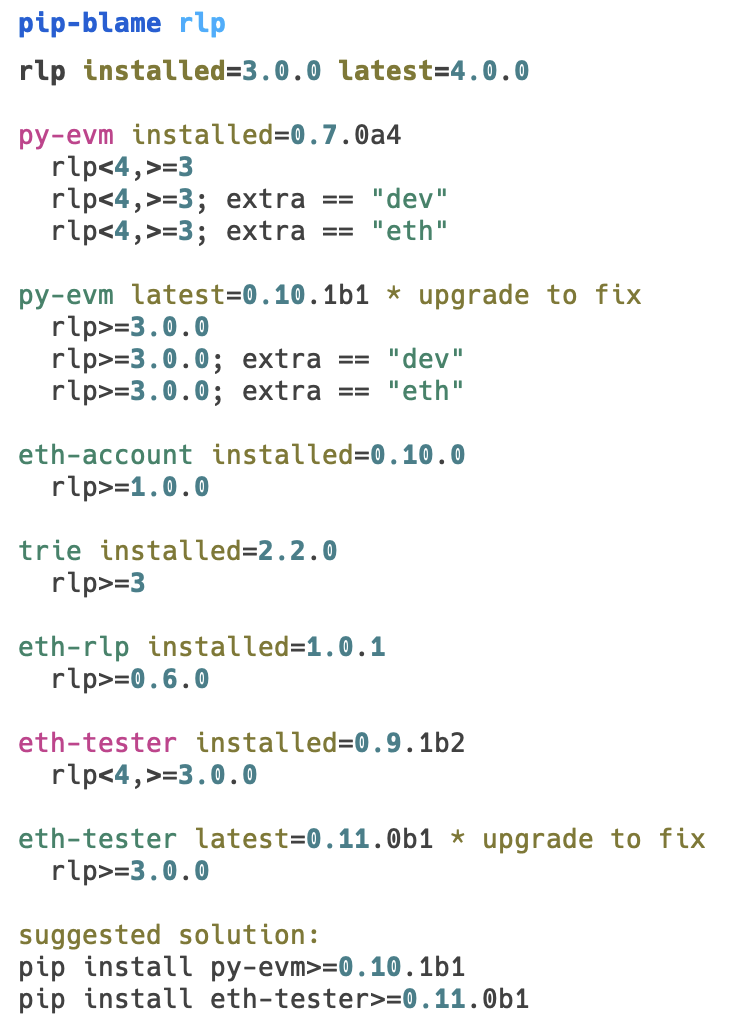
install
pip install pip-blame
usage
pip-blame NAME
it will fetch the latest version of the package from pypi and compare it against the requirement specifiers declared by the installed packages.
then it will highlight the dependencies that need relaxing their requirements, as well as provide links to open new issues where repo links can be found in the metadata.
philosophy
when making a library, prefer >= specifiers for requirements.
capping dependencies scales poorly when you build a project with dependencies by multiple maintainers. everyone has been through the dependency hell.
every person has a different understanding of semver.
you simply cannot predict that your library breaks with a patch release from a change so small it didn't make it to the changelog, or that it would still function with the next major release.
swim upstream to freshness.
not capping requirements allows you to find out when things break earlier and keep the requirements fresh. people who rely on your work as a building block will be thankful as they spend less time pulling their hair.
overrides as a last resort.
if you struggle with a transitive dependency, use depencency overrides feature of uv. it allows you to lie to the resolver and install the version you know that works.
1 maintainer

Metadata
1 maintainer
Release files for pip-blame 0.2.4
For a detailed explanation of source distributions (sdists) and built distributions (wheels), please see the package formats documentation.
Source distribution (sdist)
| File | Size | Uploaded | Provenance | Actions |
|---|---|---|---|---|
| pip_blame-0.2.4.tar.gz | 2.8 kB | Without provenance | Details for pip_blame-0.2.4.tar.gz |
Built distribution (wheel)
| File | Interpreter | ABI | Platform | Actions Reset |
|---|---|---|---|---|
| pip_blame-0.2.4-py3-none-any.whl | Python 3 | none | any | Details for pip_blame-0.2.4-py3-none-any.whl |
Total release size: 6.0 kB
Release files / pip_blame-0.2.4.tar.gz
| Download URL | pip_blame-0.2.4.tar.gz |
|---|---|
| Size | 2.8 kB |
| Tags | Source |
|
SHA-256 checksum How to use checksums |
309da5f7dec5b77e92d5b287d2ebf221538fc67f0db611f37fe9a61151967a27
|
|
BLAKE2b-256 checksum How to use checksums |
9e2759530ad3930fc3da78f8667c296e6006b3d17946d0e550a2ff4ee44de0d8
|
| Upload date | |
|
Uploaded using Trusted Publishing? What is trusted publishing? |
No |
| Uploaded via |
python-requests/2.31.0
|
Release files / pip_blame-0.2.4-py3-none-any.whl
| Download URL | pip_blame-0.2.4-py3-none-any.whl |
|---|---|
| Size | 3.3 kB |
| Tags | Python 3 |
|
SHA-256 checksum How to use checksums |
4bc2765844f4f11484606e7be02008e0127bc84bfa2f0a4a40b40a571a6b1c46
|
|
BLAKE2b-256 checksum How to use checksums |
02b088b8f6f9706f357702149ef8d87b770a17948f03906cf5fc47a67b3d29c3
|
| Upload date | |
|
Uploaded using Trusted Publishing? What is trusted publishing? |
No |
| Uploaded via |
python-requests/2.31.0
|
Security for pip-blame 0.2.4
Provenance
Provenance describes where a file came from. On PyPI, provenance is shared via attestations, which provide a verifiable record of the build or publishing details. View details, limitations and caveats.
No provenance found
None of the files in this release were uploaded with provenance metadata.
A note on package security
PyPI is a repository for distributing packages, not a service for auditing them. While third-party security researchers and our staff do their best to detect and remove malicious packages, PyPI cannot guarantee the quality, security or suitability of any given package.
To learn more about protecting yourself from malicious actors, visit our package security documentation.














