
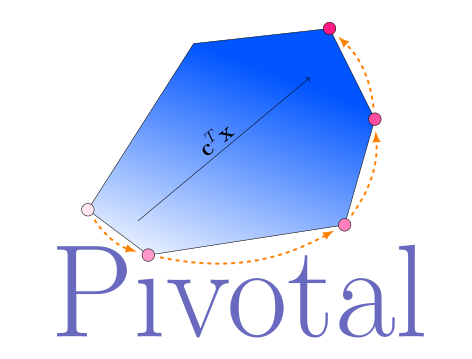
No fuss Linear & Integer Programming solver
from pivotal import minimize, maximize, Variable

x = Variable("x")
y = Variable("y")
z = Variable("z")

objective = 2*x + y + 3*z
constraints = (
    x - y == 4,
    y + 2*z == 2
)

minimize(objective, constraints)
# -> value: 11.0
# -> variables: {'x': 4.0, 'y': 0.0, 'z': 1.0}

maximize(objective, constraints)
# -> value: 14.0
# -> variables: {'x': 6.0, 'y': 2.0, 'z': 0.0}
About
Pivotal is not aiming to compete with commerical solvers like Gurobi. Rather, it is aiming to simplify the process of creating and solving linear programs thanks to its very simple and intuitive API. The LP solver uses a 2-phase Simplex algorithm, and MILP problems are solved using branch & bound with LP relaxations.
Installation
Python >=3.12 is required.
Install via pip:
pip install pivotal-solver
API
Variables
Variable instances implement __add__, __sub__ and other magic methods, so you can use them directly in expressions such as 2*x + 10 - y.
Here are some examples of what you can do with them:
x = Variable("x")
y = Variable("y")
z = Variable("z")

2*x + 10 - y
x + (y - z)*10
-x
-(x + y)
sum([x, y, z])
abs(x)
abs(x - 2)

X = [Variable(f"x{i}") for i in range(5)]
sum(X)
Note that variables are considered equal if they have the same name, so for example this expression:
Variable("x") + 2 + Variable("x")
will be treated as simply 2*x+2.
The first argument to minimize and maximize is the objective function which must be either a single variable or a linear combination as in the examples above.
Variable bounds
By default, variables are assumed to be nonnegative, but arbitrary lower and upper bounds are supported:
# Default: x >= 0, same as (lower=0, upper=None)
x = Variable("x")

# Lower bound: x >= 5
y = Variable("y", lower=5)

# Upper bound: 0 <= z <= 10
z = Variable("z", upper=10)

# Both bounds: -5 <= w <= 5
w = Variable("w", lower=-5, upper=5)

# Free variable (unbounded): -∞ < v < ∞
v = Variable("v", lower=None, upper=None)
Example:
from pivotal import minimize, Variable

# Minimize 2*x + y subject to x + y >= 10
# with bounds: 3 <= x <= 7, y >= 0
x = Variable("x", lower=3, upper=7)
y = Variable("y")

result = minimize(2*x + y, (x + y >= 10,))
# -> value: 13.0
# -> variables: {'x': 3.0, 'y': 7.0}
Integer & binary variables
Variables can be declared as integer or binary for mixed-integer linear programming (MILP):
# Integer variable: must take integer values
n = Variable("n", var_type="integer")

# Integer variable with bounds: 0 <= k <= 10, integer
k = Variable("k", var_type="integer", upper=10)

# Binary variable: 0 or 1 (bounds are enforced automatically)
b = Variable("b", var_type="binary")
When any variable in the problem is integer or binary, the solver automatically switches to branch & bound. The existing minimize/maximize API works unchanged:
from pivotal import minimize, Variable

x = Variable("x", var_type="integer")
y = Variable("y")  # continuous

minimize(x + y, (x + y >= 3.5, y <= 1))
# -> value: 3.5
# -> variables: {'x': 3.0, 'y': 0.5}
A classic 0-1 knapsack:
from pivotal import maximize, Variable

items = [Variable(f"x{i}", var_type="binary") for i in range(4)]
weights = [2, 3, 4, 5]
values = [3, 4, 5, 6]

maximize(
    sum(values[i] * items[i] for i in range(4)),
    (sum(weights[i] * items[i] for i in range(4)) <= 8,),
)
# -> value: 10.0
# -> variables: {'x0': 0.0, 'x1': 1.0, 'x2': 0.0, 'x3': 1.0}
Constraints
There are three supported constraints: == (equality), >= (greater than or equal) and <= (less than or equal). You create a constraint simply by using these comparisons in expressions involving Variable instances. For example:
x = Variable("x")
y = Variable("y")
z = Variable("z")

x == 4
2*x - y == z + 7
y >= -x + 3*z
x <= 0
There is no need to convert your constraints to the canonical form which uses only equality constraints. This is done automatically by the solver.
minimize and maximize expect a list of constraints as the second argument.
Output
The return value of minimize and maximize is a 2-tuple containing the value of the objective function and a dictionary of variables and their values.
The functions may raise pivotal.Infeasible if the program is over-constrained (no solution exists) or pivotal.Unbounded if the program is under-constrained (the objective can be made arbitrarily small):
from pivotal import minimize, maximize, Variable, Infeasible

x = Variable("x")
y = Variable("y")

objective = 2*x + y
constraints = (
    x + 2*y == 4,
    x + y == 10
)

try:
    minimize(objective, constraints)
except Infeasible:
    print("No solution")
Absolute values
Absolute values are supported in both the objective and constraints. You can use:
min |expr|andmax |-expr|in the objective (min -|expr|andmax |expr|cannot be solved with pure LP solvers and require MILP solvers instead, see link)|expr| ≤ Cand|expr| = 0in the constraints (|expr| ≥ Cand|expr| = Ccannot be solved with pure LP solvers and require MILP solvers instead, see link)
from pivotal import minimize, Variable

x = Variable("x")

objective = abs(x - 5)
constraints = (
    abs(x) <= 5,
)

minimize(objective, constraints)
# -> value: 0.0
# -> variables: {'x': 5.0}
Iterations, Tolerance & Node Limit
minimize and maximize take the following keyword arguments:
max_iterations(defaultmath.inf): maximum number of iterations of the second phase of the Simplex algorithm. If the maximum number of iterations is reached, a potentially non-optimal solution is returned.tolerance(default1e-6): precision of floating point comparisons, e.g. when comparing against zero. Instead ofx == 0.0, the algorithm considers a value to be zero when it is within the given tolerance:abs(x) <= tolerance. Also used for integrality checks in MILP.node_limit(default10_000): maximum number of branch & bound nodes to explore when solving MILPs. If the limit is reached and a feasible solution has been found, the best solution so far is returned. Otherwise,pivotal.NodeLimitReachedis raised.
Development
Setting up
git clone https://github.com/tomasr8/pivotal.git
cd pivotal
uv sync --group dev
Running tests
pytest
1 maintainer

Metadata
1 maintainer
Release files for pivotal-solver 1.0.0
For a detailed explanation of source distributions (sdists) and built distributions (wheels), please see the package formats documentation.
Source distribution (sdist)
| File | Size | Uploaded | |
|---|---|---|---|
| pivotal_solver-1.0.0.tar.gz | 3.3 MB | Details |
Built distribution (wheel)
| File | Interpreter | ABI | Platform | Reset |
|---|---|---|---|---|
| pivotal_solver-1.0.0-py3-none-any.whl | Python 3 | none | any | Details |
Total release size: 3.3 MB
Release files / pivotal_solver-1.0.0.tar.gz
| Download URL | pivotal_solver-1.0.0.tar.gz |
|---|---|
| Size | 3.3 MB |
| Tags | Source |
|
SHA-256 checksum How to use checksums |
11295d73423c3290bfd5779598d4d38e3d79658cd5e7f4976fde03421b109495
|
|
BLAKE2b-256 checksum How to use checksums |
1f0f811e919c1fbc6be35f8fc2cc975671c5936cfe35fd7410e2bd7c28ba1e0d
|
| Upload date | |
|
Uploaded using Trusted Publishing? What is trusted publishing? |
Yes |
| Uploaded via |
twine/6.1.0 CPython/3.13.7
|
Provenance
Provenance describes where a file came from. On PyPI, provenance is shared via attestations, which provide a verifiable record of the build or publishing details. View details, limitations and caveats.


PyPI Publish Attestation
PyPI verified that this artifact, at this checksum, originated from the publisher listed below.
Signed by GitHub Actions, verified by PyPI on Feb 22, 2026.
Transparency logRelease files / pivotal_solver-1.0.0-py3-none-any.whl
| Download URL | pivotal_solver-1.0.0-py3-none-any.whl |
|---|---|
| Size | 18.8 kB |
| Tags | Python 3 |
|
SHA-256 checksum How to use checksums |
6f7b290fe7fc7cba9f6296cf747b9cfa97aa927026f0f5a09d4c869581535684
|
|
BLAKE2b-256 checksum How to use checksums |
327a12aa2393c81324e3d74b7b2165d204d52dcc18617e1771842f02254ee363
|
| Upload date | |
|
Uploaded using Trusted Publishing? What is trusted publishing? |
Yes |
| Uploaded via |
twine/6.1.0 CPython/3.13.7
|
Provenance
Provenance describes where a file came from. On PyPI, provenance is shared via attestations, which provide a verifiable record of the build or publishing details. View details, limitations and caveats.
PyPI Publish Attestation
PyPI verified that this artifact, at this checksum, originated from the publisher listed below.
Signed by GitHub Actions, verified by PyPI on Feb 22, 2026.
Transparency log













