





Pixelagent: An Agent Engineering Blueprint
We see agents as the intersection of an LLM, storage, and orchestration. Pixeltable unifies this interface into a single declarative framework, making it the de-facto choice for engineers to build custom agentic applications with build-your-own functionality for memory, tool-calling, and more.
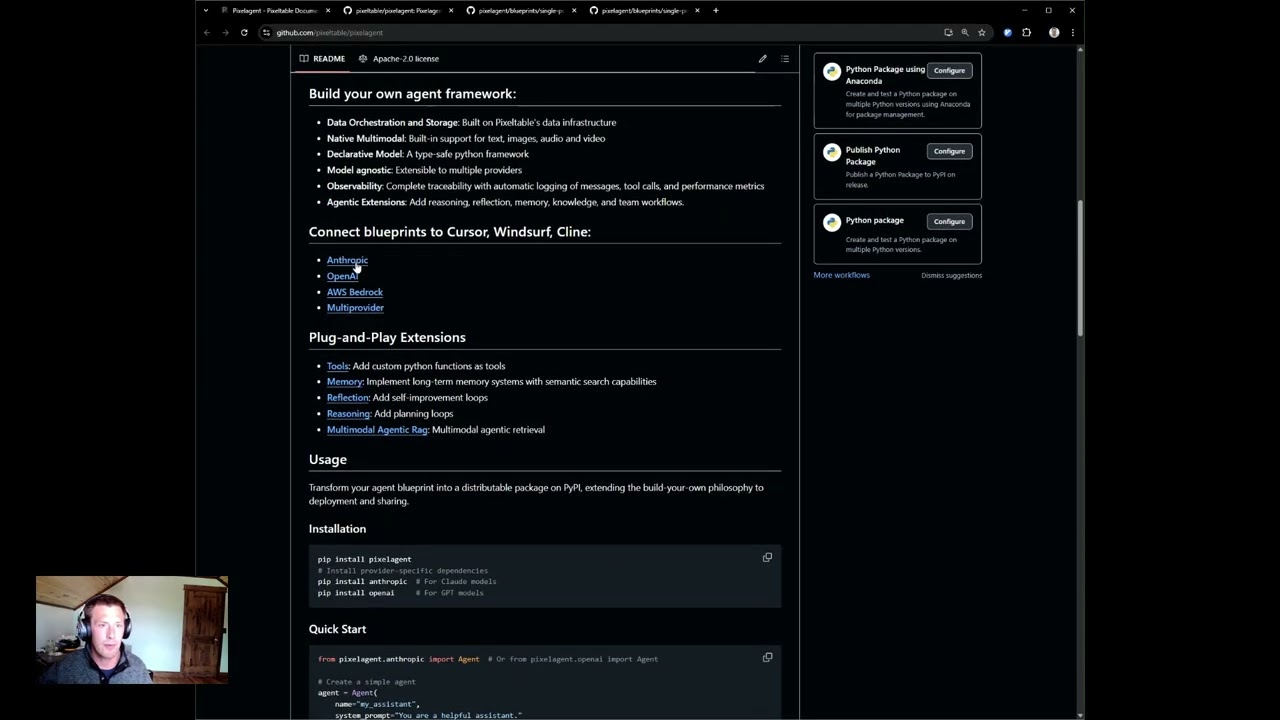
Build your own agent framework:
- Data Orchestration and Storage: Built on Pixeltable's data infrastructure
- Native Multimodal:
chat()takes text and an image - Declarative Model: A type-safe python framework
- Model agnostic: Extensible to multiple providers
- Observability: Messages and tool calls are stored in tables
- Agentic Extensions: Examples for reasoning, reflection, and memory
Use with Cursor, Windsurf, Cline
Install the package and point your editor at it:
pip install pixelagent
All four providers ship in the package:
from pixelagent.openai import Agent   # or .anthropic, .bedrock, .gemini

agent = Agent(name="my_agent", system_prompt="You are a helpful assistant.")
print(agent.chat("Hello"))
Plug-and-Play Extensions
- Tools: Add custom python functions as tools
- Memory: Implement long-term memory systems with semantic search capabilities
- Reflection: Add self-improvement loops
- Reasoning: Add planning loops
- Multimodal Agentic Rag: Multimodal agentic retrieval
Usage
Transform your agent blueprint into a distributable package on PyPI, extending the build-your-own philosophy to deployment and sharing.
Installation
pip install "pixeltable>=0.7.15,<0.8" "pixelagent[openai]"
# or pixelagent[anthropic], pixelagent[gemini], pixelagent[bedrock]
Quick Start
from pixelagent.anthropic import Agent  # Or from pixelagent.openai import Agent

# Create a simple agent
agent = Agent(
    name="my_assistant",
    system_prompt="You are a helpful assistant."
)

# Chat with your agent
response = agent.chat("Hello, who are you?")
print(response)
Adding Tools
# tools.py — Pixeltable stores a UDF by its import path, so it lives in a module.
import pixeltable as pxt
import yfinance as yf


@pxt.udf
def stock_price(ticker: str) -> dict:
    """Get stock information for a ticker symbol"""
    stock = yf.Ticker(ticker)
    return stock.info
import pixeltable as pxt
from pixelagent.anthropic import Agent

from tools import stock_price

agent = Agent(
    name="financial_assistant",
    system_prompt="You are a financial analyst assistant.",
    tools=pxt.tools(stock_price),
)

# Use tool calling
result = agent.tool_call("What's the current price of NVDA?")
print(result)
State management
import pixeltable as pxt

# Agent memory is automatically persisted in tables
memory = pxt.get_table("my_assistant.memory")
conversations = memory.collect()

# Access tool call history
tools_log = pxt.get_table("financial_assistant.tools")
tool_history = tools_log.collect()

# cusomatizable memory database
conversational_agent = Agent(
    name="conversation_agent",
    system_prompt="Focus on remebering the conversation",
    n_latest_messages=14
)
Custom Agentic Strategies
# ReAct pattern for step-by-step reasoning and planning
import re
from datetime import datetime

import pixeltable as pxt

# Tools live in a module, not beside the agent: pixeltable needs a UDF to be
# importable by name so a stored computed column can find it again.
from react_tools import stock_info

from pixelagent.openai import Agent

REACT_PROMPT = """
Today is {date}

IMPORTANT: You have {max_steps} maximum steps. You are on step {step}.

1. THOUGHT: Think about what information you need to answer the question.
2. ACTION: Either use a tool OR write "FINAL" if you are ready to answer.

Available tools:
{tools}

THOUGHT: [your reasoning]
ACTION: [tool_name] OR simply write "FINAL"
"""


def extract_section(text, section_name):
    pattern = rf'{section_name}:?\s*(.*?)(?=\n\s*(?:THOUGHT|ACTION):|$)'
    match = re.search(pattern, text, re.DOTALL | re.IGNORECASE)
    return match.group(1).strip() if match else ""


# One agent, built once. The system prompt is per-turn data, so a step that
# needs a different prompt passes it to chat().
agent = Agent(
    name="financial_planner",
    system_prompt="You are a financial analyst.",
    tools=pxt.tools(stock_info),
    reset=True,
)


def run_react_loop(question, max_steps=5):
    for step in range(1, max_steps + 1):
        response = agent.chat(
            question,
            system_prompt=REACT_PROMPT.format(
                date=datetime.now().strftime("%Y-%m-%d"),
                tools=["stock_info"],
                step=step,
                max_steps=max_steps,
            ),
        )
        action = extract_section(response, "ACTION")
        if "FINAL" in action.upper():
            break
        if "stock_info" in action.lower():
            agent.tool_call(question)

    return agent.chat(question)


recommendation = run_react_loop("Create an investment recommendation for AAPL")
Check out our tutorials for more examples including reflection loops, planning patterns, and multi-provider implementations.
Migrating from 0.1.x
0.2.0 requires Pixeltable >= 0.7.15, < 0.8 and Python 3.11+. Upgrade with
pip install -U "pixeltable>=0.7.15,<0.8" pixelagent.
What changed for callers:
- A different
modelupdates the chat pipeline. Existing rows keep their previous responses.reset=Truedrops the directory and rebuilds it.SchemaConflictis raised when Pixeltable refuses the edit, for example a toolset or column type it cannot reconcile. chat()takessystem_prompt,model_kwargs,max_tokens, andconversation_id.n_latest_messagesis a constructor argument. The history window is fixed when the agent is built.- Memory rows carry
conversation_id(default"default"), so one agent can hold several threads. The agent table also storessystem_prompt,model_kwargs,max_tokens,n_latest, andimage.
A failed turn leaves memory empty. chat() reads the reply from the insert.
Tutorials and Examples
- Basics: Check out Getting Started for a step-by-step introduction to core concepts
- Advanced Patterns: Explore Reflection and Planning for more complex agent architectures
- Specialized Directories: Browse our example directories for deeper implementations of specific techniques
Ready to start building? pip install pixelagent, work through the examples, and let Pixeltable handle the AI data infrastructure while you focus on your agent.


Release files for pixelagent 0.2.0
For a detailed explanation of source distributions (sdists) and built distributions (wheels), please see the package formats documentation.
Source distribution (sdist)
| File | Size | Uploaded | |
|---|---|---|---|
| pixelagent-0.2.0.tar.gz | 21.1 kB | Details |
Built distribution (wheel)
| File | Interpreter | ABI | Platform | Reset |
|---|---|---|---|---|
| pixelagent-0.2.0-py3-none-any.whl | Python 3 | none | any | Details |
Total release size: 47.0 kB
Release files / pixelagent-0.2.0.tar.gz
| Download URL | pixelagent-0.2.0.tar.gz |
|---|---|
| Size | 21.1 kB |
| Tags | Source |
|
SHA-256 checksum How to use checksums |
7298e801fccc023aee84ac802fdc5c6efb08ddb39f6904f23654ecb327bdad19
|
|
BLAKE2b-256 checksum How to use checksums |
c2d1c09dff8afdad610e7cd2c951cd8768d0ac1cd146a31a032419453dc3a516
|
| Upload date | |
|
Uploaded using Trusted Publishing? What is trusted publishing? |
Yes |
| Uploaded via |
twine/7.0.0 CPython/3.13.14
|
Provenance
Provenance describes where a file came from. On PyPI, provenance is shared via attestations, which provide a verifiable record of the build or publishing details. View details, limitations and caveats.


PyPI Publish Attestation
PyPI verified that this artifact, at this checksum, originated from the publisher listed below.
Signed by GitHub Actions, verified by PyPI on Oct 16, 2026.
Transparency logRelease files / pixelagent-0.2.0-py3-none-any.whl
| Download URL | pixelagent-0.2.0-py3-none-any.whl |
|---|---|
| Size | 25.9 kB |
| Tags | Python 3 |
|
SHA-256 checksum How to use checksums |
5c1c650dc0abe09b79b2cd72afa73fee5cc4d1600bbed4020af95dce38669968
|
|
BLAKE2b-256 checksum How to use checksums |
60236330632ab7047464138b09154baaeca992ba18dcdeec7a21b6607cb91963
|
| Upload date | |
|
Uploaded using Trusted Publishing? What is trusted publishing? |
Yes |
| Uploaded via |
twine/7.0.0 CPython/3.13.14
|
Provenance
Provenance describes where a file came from. On PyPI, provenance is shared via attestations, which provide a verifiable record of the build or publishing details. View details, limitations and caveats.
PyPI Publish Attestation
PyPI verified that this artifact, at this checksum, originated from the publisher listed below.
Signed by GitHub Actions, verified by PyPI on Oct 16, 2026.
Transparency log













