
fractal







Hierarchical agent loops with recursive self-organization.
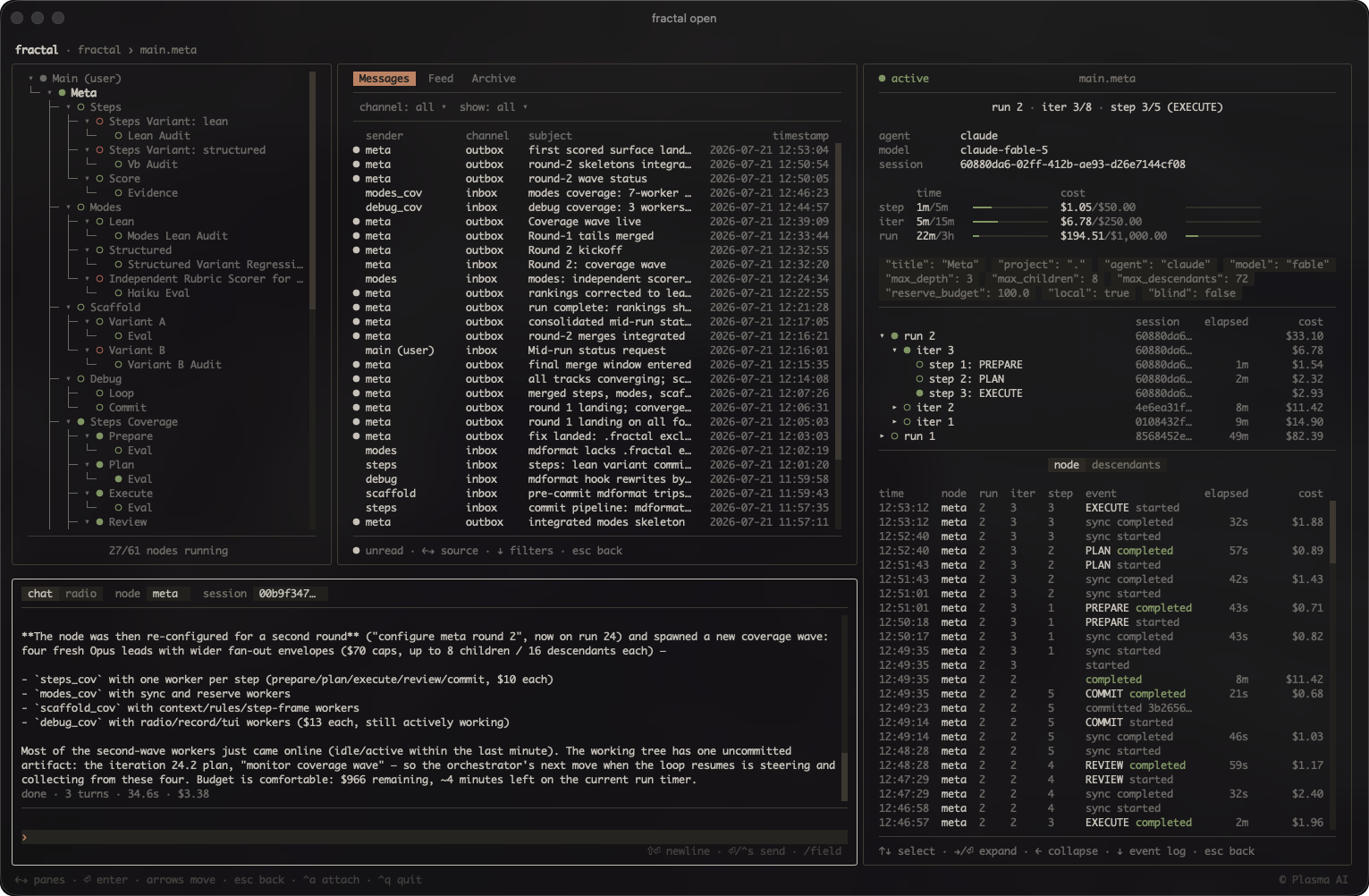
In a fractal, autonomous agent loops arrange themselves into a tree: a node
iterates toward a goal in its own git worktree and spawns child nodes for
separable subtasks, so the tree grows to fit the problem rather than a fixed
plan. Hard caps (iterations, depth, children, cost, time) keep each loop
bounded, and an operator can steer or stop it at any point. Run metadata
(including cost) lands in one local SQLite database, which can be interacted
with live in a terminal UI.
[!WARNING] Nodes run their agent without permission prompts by default. Unattended loops cannot stop to ask, so every seeded agent config disables the approval gate — Claude
bypassPermissions, Codexdanger-full-access, Grok--always-approve, opencode--auto, omp--yolo. A node can therefore run any command its agent decides to run, with your credentials and your machine's reach. The per-nodegit worktreeisolates the branch it commits to, not the filesystem, the network, or anything else outside it. Only launch nodes whose task you would trust to run unsupervised, and prefer a sandboxed or otherwise disposable host for anything else.
Source: https://github.com/plasma-ai/fractal
Package: https://pypi.org/project/plasma-fractal/
Documentation: https://docs.plasma.ai/fractal
Installation
Install the fractal package from PyPI:
pip install plasma-fractal
or
pip install fractal
Use pipx install or uv tool install to install the package in an isolated
environment. If you use one of these two methods, you must also install
plasma-wiki (a plain pip install pulls plasma-wiki and puts wiki on your
PATH, but this is not the case when using pipx install or
uv tool install).
uv tool install plasma-fractal --with-executables-from plasma-wiki does the
same in one command.
Open the dashboard from your project root with fractal open (requires an
initialized fractal). Pass --light if your terminal uses a light color scheme.
Skill
Install the skill for your agent via the plugin marketplace (Claude Code and Codex):
# Claude Code
/plugin marketplace add plasma-ai/plugins
/plugin install fractal@plasma

# Codex
codex plugin marketplace add plasma-ai/plugins
codex plugin add fractal@plasma
Another install route is from the CLI, which copies (or symlinks) the fractal
and wiki skills into ~/.claude/skills and ~/.agents/skills (add --project
for the current project only):
fractal install [--link]
After upgrading the package, re-run fractal install to refresh the copied
skills (pass --link for symlinked install).
Usage
A fractal is a tree of git worktrees, each running an autonomous agent loop. The root node branches from your working tree, and child nodes branch from their parent. Agents iterate in tmux sessions, and all state (runs, iters, steps, costs, signals) is tracked in a local SQLite database.
Five agent backends are supported — Claude Code (claude), Codex (codex),
Grok Build (grok), OpenCode (opencode), and Oh My Pi (omp) — selected per
node with --agent (children inherit it). Claude and Codex can additionally
route through OpenRouter with --provider=openrouter, which authenticates via
OPENROUTER_API_KEY from the launching shell; OpenCode and Oh My Pi reach
OpenRouter natively through their own openrouter/<author>/<model> model ids.
Use the /fractal skill to spawn and manage agent nodes. The fractal CLI is
also available directly — run fractal --help and fractal <command> --help to
explore.
The skill is invoked as /fractal [directive] and takes plain-language
instructions. The agent interprets the directive and prints any suggested
NODE.md instructions and completion requirement it can distill from the
directive, plus a table of every parameter (empty where the directive said
nothing), then asks for anything it could not infer. From there it walks you
through refining the node's definition and, once you approve, launches the node
in a tmux session.
Parameters the skill interprets from the directive:
name: node name (required; letters, digits, and_only — no-)path: project root, repo root or monorepo sub-project (default:.)title: human-readable display name (default: de-slugged node name)scope: restrict commits to subdirectories within the worktree (comma-separated, e.g.parent/child,tests)base: branch to start from (default: current branch)meta: target node branch for meta-configurationinherit: seed surfaces from the parent node instead of the package seed (comma-separated:steps,scripts,skills,config, orall); agent config always inherits. A top-level spawn's parent is the user node, which carries no steps, scripts, or skills — the parameter is for configured nodes spawning childrenagent: agent command; inherits the user node's default when omittedprovider: provider route for the agent (e.g.openrouter); inherits the user node's default when omittedmodel: model override; when omitted, the agent uses its own default modeleffort: reasoning-effort override; when omitted, each agent seed's own pinned level applies, not the vendor defaultmax-iters: per-run iteration capmax-depth: maximum child node nesting depthmax-children: maximum direct child nodesmax-descendants: maximum total descendant nodestimeout: per-run time limit (e.g.30m,1.5h)iter-timeout: per-iteration time limit (e.g.30m,1.5h)step-timeout: per-step time limit (e.g.30s,10m); caps each stepinterval: fixed iteration schedule (e.g.1h)sleep: delay between iterations (e.g.10s)wait: sleep between approval-wait sync invocations (default:1m)max-cost: cost ceiling in USD per run — runs are isolated, so each launch arms the cap anew; after a budget-ended run,node start --continuerefuses without an explicit--max-costmax-iter-cost: per-iteration cost ceiling in USDmax-step-cost: per-step cost ceiling in USD (warn-only when unenforceable)reserve-budget: budget reserved for cleanup; USD or N% ofmax-cost(default: 10%)sync: enable (default) or disable radio sync before each stepdetached: run each step as a separate agent session (default: one continuous session)local: skip pushing to remote after each commit
Development
Install
Run install.sh in the package root. With no environment active it creates and
uses a local .venv; with one active (e.g. pyenv) it installs into that
environment (editable), without recreating it:
./install.sh --all-extras --groups=test,lint,type
Run ./install.sh --help for all options. Alternatively, run
uv sync --all-extras --group test --group lint --group type and
uv run pre-commit install to set up the environment manually.
Installing a dependency as editable (e.g. a sibling package) is left to the
caller: uv pip install --editable <path>.
With an editable install, fractal install --link symlinks the bundled skill
into the agent skill directories instead of copying it, so skill edits apply
without re-running the install.
Once installed, run tools with uv run --no-sync <command>, or activate the
environment first (source .venv/bin/activate).
Tests
Run the test suite:
pytest .
The suite runs with --doctest-modules enabled, and the integration tests
create real git repositories and worktrees.
Linting
Run linters and formatters:
pre-commit run --all-files
Contributing
The contribution workflow, repository conventions, and release process (version sources, tagging, CI guard) are documented in:
- Contribution workflow (organization-wide): CONTRIBUTING.md
- Repository conventions: AGENTS.md
- Release process (organization-wide): RELEASING.md
License
Licensed under the Apache License 2.0 — see LICENSE.
Copyright © 2026 Plasma AI
1 maintainer

Download files
Download the file for your platform. If you're not sure which to choose, learn more about installing packages.
Source Distribution
Built Distribution
Filter files by name, interpreter, ABI, and platform.
If you're not sure about the file name format, learn more about wheel file names.
Copy a direct link to the current filters
File details
Details for the file plasma_fractal-1.1.0.tar.gz.
File metadata
- Download URL: plasma_fractal-1.1.0.tar.gz
- Upload date:
- Size: 418.0 kB
- Tags: Source
- Uploaded using Trusted Publishing? Yes
- Uploaded via:
twine/6.1.0 CPython/3.13.14
File hashes
| Algorithm | Hash digest | |
|---|---|---|
| SHA256 |
683111f2e8e4cd23cabe50aab96c5519350b3463e029fc660ef9b13f8b5a0a09
|
|
| MD5 |
118b326bca3c0e3fd921b6933d623410
|
|
| BLAKE2b-256 |
4adbac5dd737c237cb96efd7b4dfc272031df626e9ab171ee8da1739ec432470
|
Provenance
The following attestation bundles were made for plasma_fractal-1.1.0.tar.gz:
Publisher:
build.yaml on plasma-ai/fractal
-
Statement:
-
Statement type:
https://in-toto.io/Statement/v1 -
Predicate type:
https://docs.pypi.org/attestations/publish/v1 -
Subject name:
plasma_fractal-1.1.0.tar.gz -
Subject digest:
683111f2e8e4cd23cabe50aab96c5519350b3463e029fc660ef9b13f8b5a0a09 - Sigstore transparency entry: 2279491001
- Sigstore integration time:
-
Permalink:
plasma-ai/fractal@73ce05adcd73d52c69afb394447d7ab95880d321 -
Branch / Tag:
refs/tags/v1.1.0 - Owner: https://github.com/plasma-ai
-
Access:
public
-
Token Issuer:
https://token.actions.githubusercontent.com -
Runner Environment:
github-hosted -
Publication workflow:
build.yaml@73ce05adcd73d52c69afb394447d7ab95880d321 -
Trigger Event:
push
-
Statement type:
File details
Details for the file plasma_fractal-1.1.0-py3-none-any.whl.
File metadata
- Download URL: plasma_fractal-1.1.0-py3-none-any.whl
- Upload date:
- Size: 473.7 kB
- Tags: Python 3
- Uploaded using Trusted Publishing? Yes
- Uploaded via:
twine/6.1.0 CPython/3.13.14
File hashes
| Algorithm | Hash digest | |
|---|---|---|
| SHA256 |
61f2489990f1dece37a2cc85865ec1017cfe86f7d57e703d0fe70d63e3f886b9
|
|
| MD5 |
b96ab449d75cf3c554612a9b595511ba
|
|
| BLAKE2b-256 |
e53dccf840aa7d45dfa0f2e388656271d0eeb5d3ec197549779467a3622651e7
|
Provenance
The following attestation bundles were made for plasma_fractal-1.1.0-py3-none-any.whl:
Publisher:
build.yaml on plasma-ai/fractal
-
Statement:
-
Statement type:
https://in-toto.io/Statement/v1 -
Predicate type:
https://docs.pypi.org/attestations/publish/v1 -
Subject name:
plasma_fractal-1.1.0-py3-none-any.whl -
Subject digest:
61f2489990f1dece37a2cc85865ec1017cfe86f7d57e703d0fe70d63e3f886b9 - Sigstore transparency entry: 2279491041
- Sigstore integration time:
-
Permalink:
plasma-ai/fractal@73ce05adcd73d52c69afb394447d7ab95880d321 -
Branch / Tag:
refs/tags/v1.1.0 - Owner: https://github.com/plasma-ai
-
Access:
public
-
Token Issuer:
https://token.actions.githubusercontent.com -
Runner Environment:
github-hosted -
Publication workflow:
build.yaml@73ce05adcd73d52c69afb394447d7ab95880d321 -
Trigger Event:
push
-
Statement type:














