
A package for simulated social ensembles.

Project description
Plurals: A System for Guiding LLMs Via Simulated Social Ensembles
Package Stats 📊



Package Build (Tests/Doc Creation/PyPi Releases) 👌



Paper 📜 (Click here!)
Documentation 📋 (Click here!)
Cite ℹ️
If you use Plurals in your research, please cite the following paper appearing at CHI 25 (Honorable Mention):
Bibtex:
@inproceedings{ashkinaze2025plurals,
  author = {Ashkinaze, Joshua and Fry, Emily and Edara, Narendra and Gilbert, Eric and Budak, Ceren},
  title = {Plurals: A System for Guiding LLMs Via Simulated Social Ensembles},
  booktitle = {CHI Conference on Human Factors in Computing Systems},
  series = {CHI '25},
  year = {2025},
  month = may,
  location = {Yokohama, Japan},
  publisher = {Association for Computing Machinery},
  address = {New York, NY, USA},
  pages = {1--27},
  numpages = {27},
  doi = {10.1145/3706598.3713675},
  url = {https://doi.org/10.1145/3706598.3713675}
}
APA:
Ashkinaze, J., Fry, E., Edara, N., Gilbert, E., & Budak, C. (2025). Plurals: A system for guiding LLMs via simulated social ensembles. In CHI Conference on Human Factors in Computing Systems (CHI '25, pp. 1-27). Association for Computing Machinery. https://doi.org/10.1145/3706598.3713675
Overview 🌌
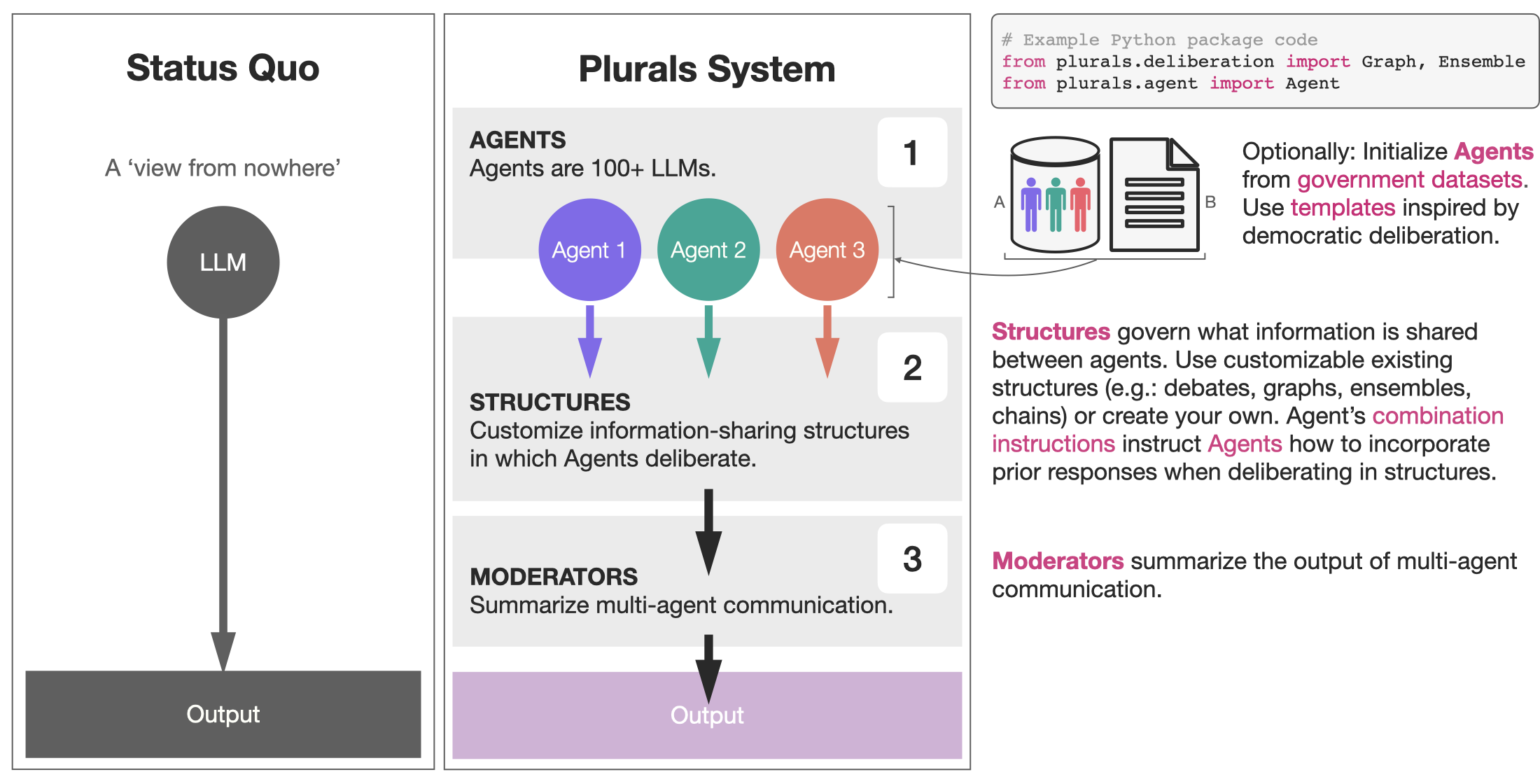
Plurals is an end-to-end generator of simulated social ensembles. (1) Agents complete tasks within (2) Structures, with communication optionally summarized by (3) Moderators. Plurals integrates with government datasets (1a) and templates, some inspired by democratic deliberation theory (1b).
The building block is Agents, which are large language models (LLMs) that have system instructions and tasks. System instructions can be generated from user input, government datasets (American National Election Studies; ANES), or persona templates. Agents exist within Structures, which define what information is shared. Combination instructions tell Agents how to combine the responses of other Agents when deliberating in the Structure. Users can customize an Agent's combination instructions or use existing templates drawn from deliberation literature and beyond. Moderators aggregate responses from multi-agent deliberation.
Plurals includes support for multiple information-sharing structures (e.g., chains, graphs, debates, ensembles) and templates for customizing LLM deliberation within these.
Detailed Documentation 📋
https://josh-ashkinaze.github.io/plurals/
Quick Start ⚡
Installation
pip install plurals
Set environment variables
import os
os.environ["OPENAI_API_KEY"] = 'your_openai_key'
os.environ["ANTHROPIC_API_KEY"] = 'your_anthropic_key'
Create a nationally representative ensemble of Agents portrayed by different LLMs
from plurals.agent import Agent
from plurals.deliberation import Ensemble, Moderator

task = "What, specifically, would make commuting on a bike more appealing to you? Answer from your perspective. Be specific. You are in a focus group."
agents = [Agent(persona='random', model='gpt-4o') for _ in range(20)]
ensemble = Ensemble(agents=agents, task=task)
ensemble.process()
for r in ensemble.responses:
    print(r)
Create a directed acyclic graph of Agents for story development

from plurals.agent import Agent
from plurals.deliberation import Graph, Moderator


story_prompt = """
Craft a mystery story set in 1920s Paris.
The story should revolve around the theft of a famous artwork from the Louvre.
"""

agents = {
    'plot': Agent(
        system_instructions="You are a bestselling author specializing in mystery plots",
        model="gpt-4",
        combination_instructions="Develop the plot based on character and setting inputs: <start>${previous_responses}</end>"
    ),
    'character': Agent(
        system_instructions="You are a character development expert with a background in psychology",
        model="gpt-4",
        combination_instructions="Create compelling characters that fit the plot and setting: <start>${previous_responses}</end>"
    ),
    'setting': Agent(
        system_instructions="You are a world-building expert with a focus on historical accuracy",
        model="gpt-4",
        combination_instructions="Design a rich, historically accurate setting that enhances the plot: <start>${previous_responses}</end>"
    )
}

# Create a creative writing moderator
moderator = Moderator(
    persona="an experienced editor specializing in mystery novels",
    model="gpt-4",
    combination_instructions="Synthesize the plot, character, and setting elements into a cohesive story outline: <start>${previous_responses}</end>"
)

# Define edges to create a simple interaction pattern
edges = [
    ('setting', 'character'),
    ('setting', 'plot'),
    ('character', 'plot')
]

# Create the DAG structure
story_dag = Graph(
    agents=agents,
    edges=edges,
    task=story_prompt,
    moderator=moderator
)

# Process the DAG
story_dag.process()

# Print the final story outline
print(story_dag.final_response)
Issues and Features 📝
Plurals is run by a small and energetic team of academics doing the best they can [1]. To report bugs or feature requests, open a GitHub issue. We strongly encourage you to use our Bug or Feature Request issue templates; these make it easy for us to respond effectively to the issue.
[1] Language adopted from (https://github.com/davidjurgens/potato).
Some Potential Uses 🔨🔭🔦✂️
-
Persona-based experiments (Ex: Create a panel of nationally representative personas)
-
Deliberation structure experiments (What are optimal information-sharing structures?)
-
Deliberation instruction experiments (What are optimal instructions for combining information?)
-
Agent-based models (Ex: understanding contagion in AI networks)
-
Curation (Ex: To what extent can Moderator LLMs filter and select the best outputs from other LLMs?)
-
Steerable guardrails (Ex: Can LLM deliberation steer abstentions?)
-
Persuasive messaging (Use many LLMs to collaboratively brainstorm and refine persuasive messaging for different audiences; Experiment with simulated focus groups)
-
Viewpoint augmentation (Provide varied perspectives and information from multiple agents)
-
Creative ideation (e.g., get ideas from multiple LLMs with different perspectives/roles for hypothesis generation, creative ideas, or product design)
Collaborators 🤝
If you are interested in collaborating, please reach out to Joshua Ashkinaze (jashkina@umich.edu). We are actively running both human and AI experiments around (1) how and when simulated social ensembles augment humans; (2) using Plurals for moderation.
Updates 🆕
- Paper to appear at CHI 2025!
Release history Release notifications | RSS feed


Download files
Download the file for your platform. If you're not sure which to choose, learn more about installing packages.
Source Distribution
Built Distribution
Filter files by name, interpreter, ABI, and platform.
If you're not sure about the file name format, learn more about wheel file names.
Copy a direct link to the current filters
File details
Details for the file plurals-0.2.33.2.tar.gz.
File metadata
- Download URL: plurals-0.2.33.2.tar.gz
- Upload date:
- Size: 3.7 MB
- Tags: Source
- Uploaded using Trusted Publishing? No
- Uploaded via: twine/6.1.0 CPython/3.9.23
File hashes
| Algorithm | Hash digest | |
|---|---|---|
| SHA256 |
78ddc215f4021f26d7a283d4a813fec0b8063062a75d173ef365361e77e51754
|
|
| MD5 |
2dcc39989f8e911d2836d5586ccbf7df
|
|
| BLAKE2b-256 |
faba62b956bb2c1d4cfe2a42eb8928274a63ee86a1631f01805fee83e152d94c
|
File details
Details for the file plurals-0.2.33.2-py3-none-any.whl.
File metadata
- Download URL: plurals-0.2.33.2-py3-none-any.whl
- Upload date:
- Size: 3.7 MB
- Tags: Python 3
- Uploaded using Trusted Publishing? No
- Uploaded via: twine/6.1.0 CPython/3.9.23
File hashes
| Algorithm | Hash digest | |
|---|---|---|
| SHA256 |
d583a51e1f75bf463099d9eb7627c152a90ea84489dfa378fee7f19c20c48b04
|
|
| MD5 |
e47ca5424c551bfb78843e3ccf531f7e
|
|
| BLAKE2b-256 |
33639c977747ab0278ee81beaec9b4bf7e26098e29e1579965a49745cd3732f3
|






