
pocket-tts-turkish
Turkish text-to-speech that runs on an ordinary CPU. This package runs the Pocket TTS Turkish model, a 6-layer Turkish version of Kyutai's Pocket TTS.
- About 5 times faster than real time on a single CPU thread, about 20 times on a GPU
- About 110 million parameters, 24 kHz output
- Six built-in voices, or clone a voice from a short recording
- Five emotion tags:
mutlu,üzgün,kızgın,şaşkın,sakin
Installation
pip install pocket-tts-turkish
Python 3.10 or newer. On Linux, pip installs the CUDA build of PyTorch by default. For a smaller, CPU-only setup, install PyTorch first:
pip install torch --index-url https://download.pytorch.org/whl/cpu
pip install pocket-tts-turkish
Quick start
from pocket_tts_turkish import TurkishTTS, save_wav

tts = TurkishTTS.from_pretrained()  # downloads the model once, about 440 MB
audio = tts.generate("Randevunuz 15.10.2026 saat 14:30'da. Ücret 1.250 TL.", voice="female_1", emotion="sakin")
save_wav("randevu.wav", audio, tts.sample_rate)
generate returns a NumPy float32 array at tts.sample_rate (24000 Hz). Pass device="cpu" or
device="cuda" to from_pretrained to choose where the model runs; the default uses a GPU when one
is available. Pass seed= to generate to get the same audio every time.
From the command line:
pocket-tts-turkish generate --text "Merhaba, size nasıl yardımcı olabilirim?" --voice male_1 -o merhaba.wav
pocket-tts-turkish generate --text-file metin.txt --emotion mutlu -o metin.wav
pocket-tts-turkish voices
Streaming
stream yields the audio in short pieces while it is being generated, so playback can start at
once: the first piece is ready in under 0.1 seconds on one CPU thread and under 0.02 seconds on a
GPU. The very first call takes a little longer, about 0.4 seconds on a CPU, while the voice is
prepared. Joined together, the pieces are exactly the audio generate returns.
for chunk in tts.stream("Randevunuz 15.10.2026 saat 14:30'da. Ücret 1.250 TL.", voice="female_1"):
    ...  # a NumPy float32 array at 24 kHz; send it to your audio output
It takes the same options as generate. Leaving the loop early, for example when the listener
interrupts, stops generating the rest of the text.
Voices
| voice | character |
|---|---|
female_1 |
bright and energetic (default) |
female_2 |
warm, clear and friendly |
female_3 |
confident, clear articulation |
male_1 |
calm and deep, narrator style |
male_2 |
energetic and bright |
male_3 |
confident, crisp articulation |
The built-in voices are synthetic. They were designed from text descriptions and are not recordings of real people.
Emotions
| tag | English name |
|---|---|
mutlu |
happy |
üzgün |
sad |
kızgın |
angry |
şaşkın |
surprised |
sakin |
calm |
Pass the tag or its English name as emotion; leave it out for a neutral voice. A tag can also
start the text itself, for example "[mutlu] Harika bir haber aldım!".
Using your own voice
Give the package a short recording of a voice, and it speaks any text in that voice. Use 5 to 10 seconds of clear speech from one person, in WAV, FLAC, OGG or MP3.
voice = tts.voice_from_file("kayit.wav")
audio = tts.generate("Bu cümleyi benim sesimle okuyun.", voice=voice)
From the command line:
pocket-tts-turkish generate --text "Bu cümleyi benim sesimle okuyun." --voice-file kayit.wav -o sesim.wav
The recording is prepared automatically. Natural speech with short pauses between words works best; if the recording cannot be prepared well, you get a warning.
Only clone a voice with its owner's permission; see Responsible use.
Writing the text
Write Turkish text as you normally would. Numbers, dates, times, prices, units, phone numbers and common abbreviations are read correctly:
| you write | it is read as |
|---|---|
1.250,50 TL |
bin iki yüz elli virgül elli Türk lirası |
15.10.2026 |
on beş Ekim iki bin yirmi altı |
14:30 |
on dört otuz |
%25 |
yüzde yirmi beş |
60 km/sa |
saatte altmış kilometre |
0555 123 45 67 |
sıfır beş yüz elli beş, yüz yirmi üç, kırk beş, altmış yedi |
Dr. Ayşe Yılmaz |
Doktor Ayşe Yılmaz |
To check how a text will be read, without loading the model:
pocket-tts-turkish normalize --text "Toplam 2.345 TL, son ödeme 30.09.2026."
# Toplam iki bin üç yüz kırk beş Türk lirası, son ödeme otuz Eylül iki bin yirmi altı.
If a word is pronounced wrongly, for example a brand name, tell the package how it sounds:
tts = TurkishTTS.from_pretrained(pronunciations={"iPhone": "ayfon"})
Evaluation
The model was compared with eight public Turkish-capable systems: FreyaTTS-small, Piper
(tr_TR-dfki-medium), MMS-TTS, VoxCPM2, Trendyol-TTS, Chatterbox Multilingual, Qwen3-TTS 0.6B Turkish
and XTTS-v2. Two public test sets were used: Freya-TR-Eval (T1, 495 everyday conversational
sentences) and the FLEURS Turkish test set (T2, 200 long read sentences). Every system received the
same text, with numbers already written as words. The word error rate (WER) is the share of words
that Whisper large-v3 transcribes differently from the input text, measured on audio band-limited to
8 kHz as in the Freya-TR-Eval recipe; lower is better. Speed was measured on one RTX 5090.
Speed and accuracy
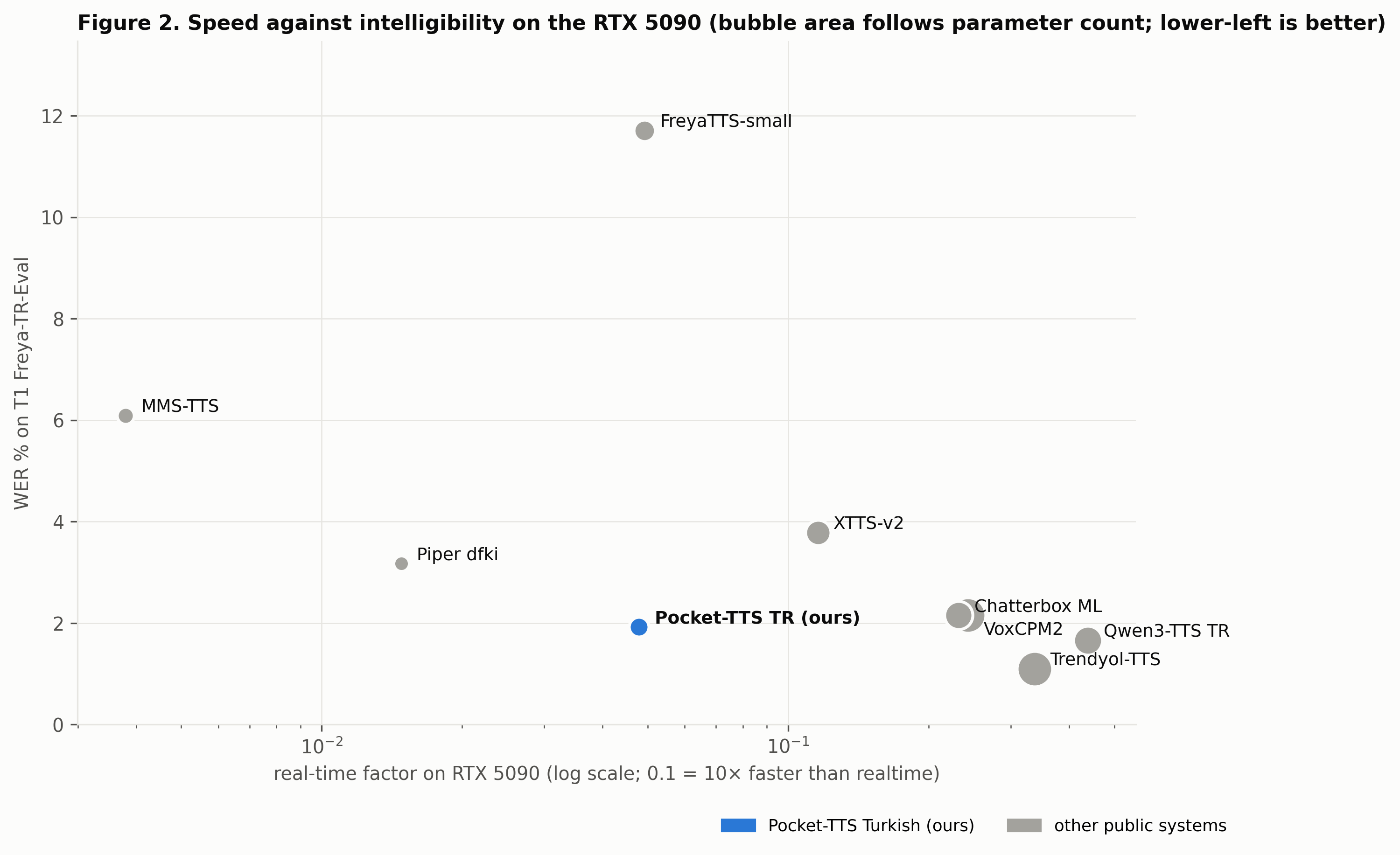
Each bubble is one system. Its horizontal position is the real-time factor, the synthesis time divided by the length of the audio, on a log scale: further left is faster, and 0.1 means ten times faster than real time. Its height is the WER on T1, and its area follows the number of parameters. The best place to be is the lower left.
Pocket TTS Turkish reaches 1.9% WER at a real-time factor of 0.048, about 20 times faster than real time, with 110 million parameters. The two systems with a lower WER, Trendyol-TTS (1.1%) and Qwen3-TTS (1.7%), are 8 to 22 times larger and 7 to 9 times slower. The two systems that are faster, Piper and MMS-TTS, make more errors (3.2% and 6.1%) and cannot clone a voice.
What a real-time voice agent needs
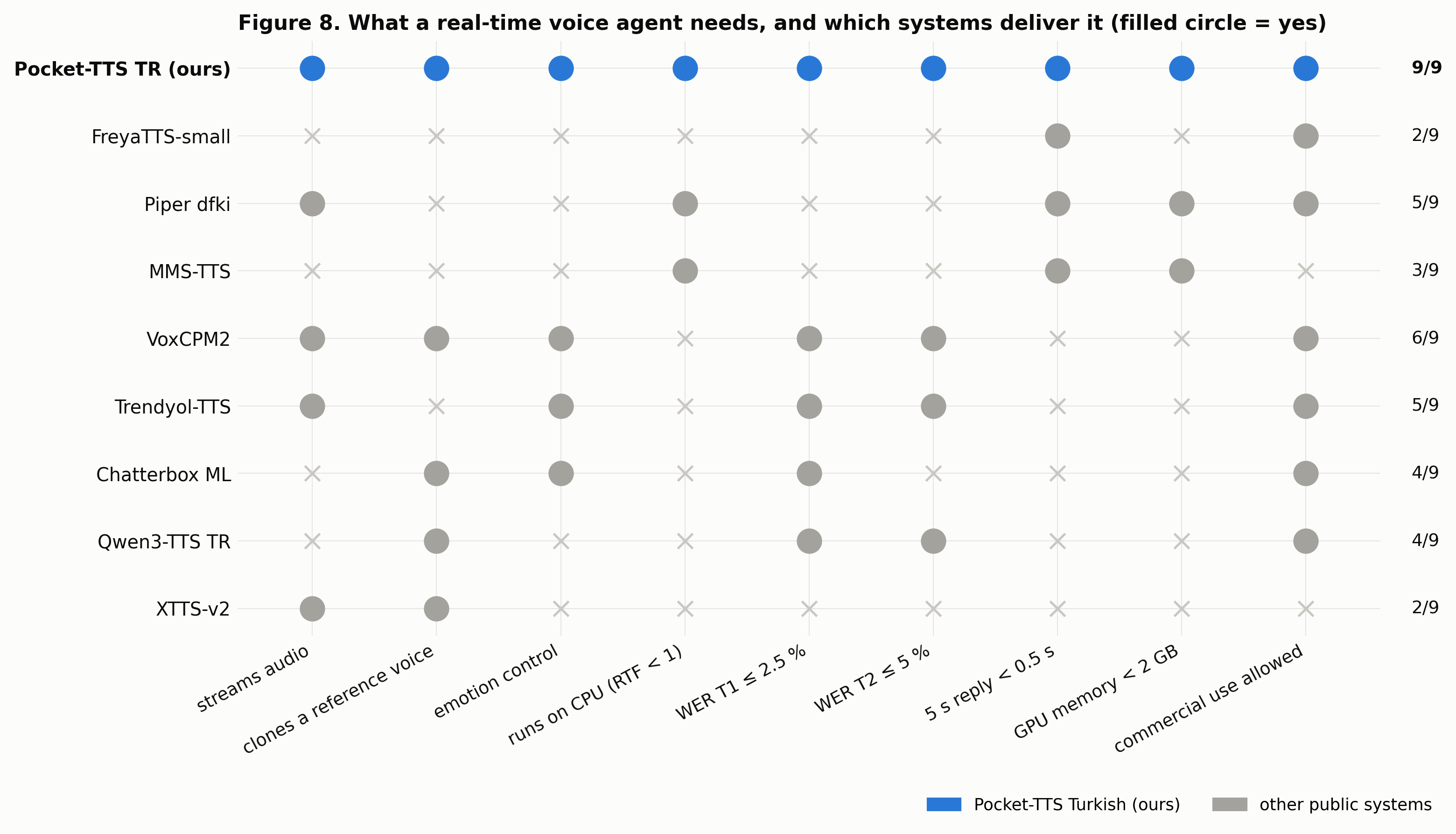
The columns are nine requirements for a voice agent that answers in real time: it streams audio, clones a reference voice, has an emotion control, runs on a CPU faster than real time, keeps the WER at or below 2.5% on T1 and 5% on T2, synthesizes a 5-second reply in under half a second, uses less than 2 GB of GPU memory, and has a licence that allows commercial use. A filled circle means the system meets the requirement and a cross means it does not; the number on the right is the total.
Pocket TTS Turkish is the only system that meets all nine; the next best, VoxCPM2, meets six. A requirement counts as met only where it was measured, so systems that were not run on a CPU are marked as not running on one.
Limitations
- Turkish only.
Responsible use
The model can imitate a voice from a few seconds of audio. Only clone a voice with the explicit consent of the person it belongs to. Do not use the model for impersonation, fraud, fraudulent calls or misinformation, or to present generated speech as a real recording of a person. The same terms apply to the upstream Pocket TTS model.
License
The code in this repository is released under the Apache License 2.0 (see LICENSE). The model weights are published on Hugging Face under CC-BY-4.0; they are derived from Kyutai's Pocket TTS, which is also released under CC-BY-4.0.
Citation
@misc{pocket_tts_turkish_2026,
  title  = {Pocket TTS Turkish},
  author = {Khaled Moawad and Ammar Rashed and Ekrem Çetinkaya},
  year   = {2026},
  url    = {https://huggingface.co/wite-tech/pocket-tts-turkish}
}
Please also cite the work this model is built on:
@article{rouard2025continuous,
  title         = {Continuous Audio Language Models},
  author        = {Rouard, Simon and Orsini, Manu and Roebel, Axel and Zeghidour, Neil and D\'efossez, Alexandre},
  year          = {2025},
  eprint        = {2509.06926},
  archivePrefix = {arXiv},
  primaryClass  = {cs.SD}
}
1 maintainer

Metadata
1 maintainer
Release files for pocket-tts-turkish 0.1.0
For a detailed explanation of source distributions (sdists) and built distributions (wheels), please see the package formats documentation.
Source distribution (sdist)
| File | Size | Uploaded | |
|---|---|---|---|
| pocket_tts_turkish-0.1.0.tar.gz | 468.3 kB | Details |
Built distribution (wheel)
| File | Interpreter | ABI | Platform | Reset |
|---|---|---|---|---|
| pocket_tts_turkish-0.1.0-py3-none-any.whl | Python 3 | none | any | Details |
Total release size: 497.8 kB
Release files / pocket_tts_turkish-0.1.0.tar.gz
| Download URL | pocket_tts_turkish-0.1.0.tar.gz |
|---|---|
| Size | 468.3 kB |
| Tags | Source |
|
SHA-256 checksum How to use checksums |
d6b4d30c72e62c59506385bc7435f478609d56cba7b4f9fdd99dfb4b3ac02a05
|
|
BLAKE2b-256 checksum How to use checksums |
badbb854db2fc5e6346a16b1f0095d5af1bdb842318ac10817b4d3b2585e628e
|
| Upload date | |
|
Uploaded using Trusted Publishing? What is trusted publishing? |
No |
| Uploaded via |
uv/0.9.12 {"installer":{"name":"uv","version":"0.9.12"},"python":null,"implementation":{"name":null,"version":null},"distro":{"name":"Ubuntu","version":"24.04","id":"noble","libc":null},"system":{"name":null,"release":null},"cpu":null,"openssl_version":null,"setuptools_version":null,"rustc_version":null,"ci":null}
|
Release files / pocket_tts_turkish-0.1.0-py3-none-any.whl
| Download URL | pocket_tts_turkish-0.1.0-py3-none-any.whl |
|---|---|
| Size | 29.5 kB |
| Tags | Python 3 |
|
SHA-256 checksum How to use checksums |
4381b832347286623b1d2eea3f9d0dbfd938b43ed84414ed9f1be07912a09a0c
|
|
BLAKE2b-256 checksum How to use checksums |
6edc3dfaf9e8e4a898b728c3e7e430833c4931cdcb58a7e45e20641a2aa3c901
|
| Upload date | |
|
Uploaded using Trusted Publishing? What is trusted publishing? |
No |
| Uploaded via |
uv/0.9.12 {"installer":{"name":"uv","version":"0.9.12"},"python":null,"implementation":{"name":null,"version":null},"distro":{"name":"Ubuntu","version":"24.04","id":"noble","libc":null},"system":{"name":null,"release":null},"cpu":null,"openssl_version":null,"setuptools_version":null,"rustc_version":null,"ci":null}
|













