
pockit: Python Optimal Control KIT




Pockit is a SymPy-native toolkit for research in numerical optimal control. It is designed for workflows where models evolve: change dynamics, objectives, constraints, free parameters, or discretization settings, then solve again and compare results without manually maintaining derivative code. Pockit is distributed under the permissive MIT License.
Pockit 是一个面向数值最优控制研究的 SymPy 原生工具包,适合模型持续变化的工作流: 调整动力学、目标函数、约束、自由参数或离散设置后即可重新求解并比较结果,无需手工 维护导数代码。Pockit 使用宽松的 MIT 许可证发布。
Overview / 概览
-
SymPy-native modeling: Write dynamics, objectives, and constraints as symbolic expressions that remain readable and easy to modify.
-
Research-oriented iteration: Vary equations, parameters, phases, and mesh settings without rewriting low-level callbacks or derivative routines.
-
Flexible problem structure: Build multiphase systems with path, algebraic, boundary, and integral constraints.
-
Open and extensible: The MIT License permits use, modification, and redistribution in academic, personal, and commercial work.
-
Numerical pipeline: Use Legendre-Gauss-Lobatto (LGL) or Legendre-Gauss-Radau (LGR) pseudospectral methods, symbolic differentiation, Numba-compiled vectorized evaluation, and Ipopt or SciPy solver backends.
-
SymPy 原生建模: 使用清晰、易修改的符号表达式编写动力学、目标函数和约束。
-
面向研究迭代: 调整方程、参数、阶段和网格设置时,无需重写底层回调或导数程序。
-
灵活的问题结构: 支持包含路径、代数、边界和积分约束的多阶段系统。
-
开放且便于扩展: MIT 许可证允许在学术、个人和商业项目中使用、修改和再发布。
-
数值计算流程: 支持 Legendre-Gauss-Lobatto(LGL)和 Legendre-Gauss-Radau(LGR)伪谱法、符号微分、Numba 编译的向量化计算,以及 Ipopt 和 SciPy 求解器后端。
Installation / 安装
Pockit requires Python 3.11 or later. The core package is available from PyPI;
the ipopt and examples extras add the Ipopt backend and plotting dependencies
used by the examples.
cyipopt may require a native Ipopt installation when a compatible wheel is not
available. See the
cyipopt installation guide
for platform-specific instructions.
Pockit 需要 Python 3.11 或更高版本。基础包可从 PyPI 安装;ipopt 和 examples
可选依赖分别提供 Ipopt 后端和示例所需的绘图依赖。
如果当前平台没有兼容的 cyipopt wheel,则可能需要先安装原生 Ipopt 库。具体步骤请参考
cyipopt 安装指南。
| Purpose / 用途 | Command / 命令 |
|---|---|
| Core package / 基础包 | pip install pockit-optimal-control |
| Ipopt and examples / Ipopt 与示例依赖 | pip install "pockit-optimal-control[ipopt,examples]" |
Examples / 示例
The repository includes 33 maintained examples across 23 application areas. They range from classical benchmarks to multiphase aerospace, robotics, chemistry, energy, epidemiology, neuroscience, quantum control, finance, and scientific machine learning. Each standalone program follows a consistent build, solve, and plot structure, making it practical to start from a nearby problem and change its equations or parameters for new research.
Browse the
complete example catalog,
or run any script with --no-show, --save [PATH], and, where available,
--quick.
仓库包含覆盖 23 个应用领域的 33 个维护示例,既有经典数值算例,也包括多阶段航天、 机器人、化学、能源、流行病学、神经科学、量子控制、金融和科学机器学习等问题。每个独立 程序均采用一致的建模、求解和绘图结构,便于从相近问题出发,修改方程或参数开展新的研究。
可查看
完整示例目录,
也可使用 --no-show、--save [PATH] 以及部分示例提供的 --quick 参数运行脚本。
LQR in 1 Minute / 一分钟 LQR
This minimal example shows how symbolic expressions map directly to an optimal-control model, solution, and plot.
这个最小示例展示符号表达式如何直接对应到最优控制模型、求解过程和结果图。
import matplotlib.pyplot as plt

from pockit.lobatto import System, constant_guess
from pockit.optimizer import ipopt

# min integral_0^1 (q * x^2 + r * u^2) dt + s * x_f^2 / 2
# subject to x' = a * x + b * u and x(0) = 1
a, b, s, q, r = -1, 1, 1, 1, 0.1

system = System(["x_f"])
x_f, = system.s
phase = system.new_phase(["x"], ["u"])
x, = phase.x
u, = phase.u

phase.set_dynamics([a * x + b * u])
phase.set_integral([q * x**2 + r * u**2])
phase.set_boundary_condition([1], [x_f], 0, 1)
phase.set_discretization(10, 10)

system.set_phase([phase])
system.set_objective(phase.I[0] + s * x_f**2 / 2)

guess_p = constant_guess(phase, 0)
guess_s = [0.0]
[var_p, var_s], info = ipopt.solve(system, [guess_p, guess_s])

print("status:", info["status_msg"].decode())
print("objective:", info["obj_val"])

plt.plot(var_p.t_x, var_p.x[0], label="x")
plt.plot(var_p.t_u, var_p.u[0], label="u")
plt.legend()
plt.minorticks_on()
plt.grid(linestyle="--")
plt.show()
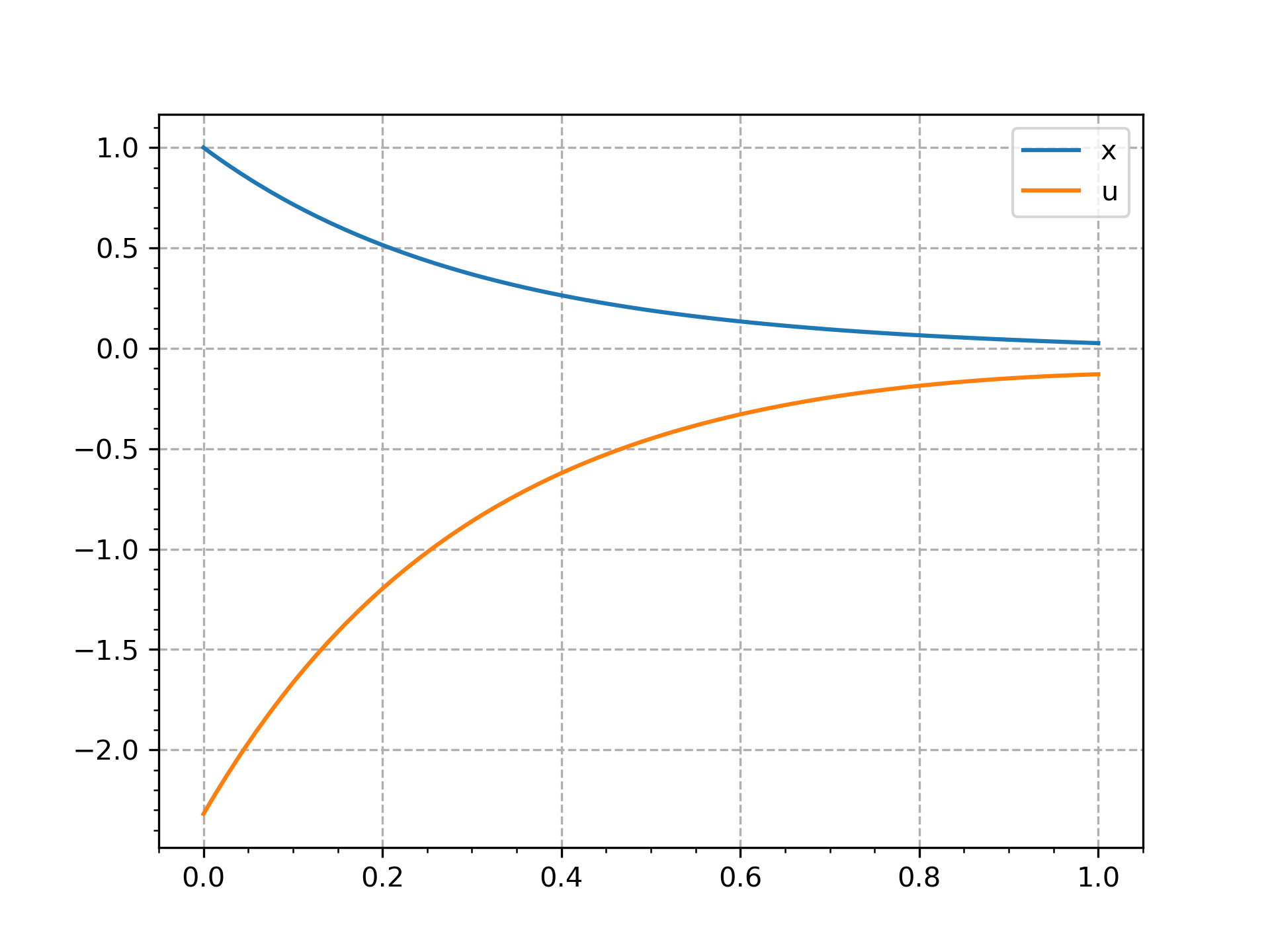
Change the coefficients, symbolic equations, constraints, or mesh settings to turn this example into a new experiment.
可以继续修改系数、符号方程、约束或网格设置,将这个示例扩展为新的实验。
Real-time C++: naive-planner / 实时 C++:naive-planner
Pockit prioritizes model exploration and repeated research iterations. When a model needs a compact C++20 runtime for real-time or performance-sensitive use, see naive-planner.
naive-planner also uses symbolic model definitions and generates sparse analytic derivatives and C++ evaluation code. Because both projects follow a symbolic modeling approach, equations remain recognizable and a stabilized pockit research model is typically straightforward to migrate. The projects serve different execution needs: pockit preserves modeling flexibility while naive-planner focuses on real-time performance.
Pockit 优先服务于模型探索和反复研究迭代。当模型需要用于实时或性能敏感场景的精简 C++20 运行时时,可以使用 naive-planner。
naive-planner 同样使用符号化模型定义,并生成稀疏解析导数和 C++ 求值代码。两个项目 采用相近的符号建模思路,因此方程形式易于对应,已稳定的 pockit 研究模型通常可以方便地 迁移。二者分别服务于不同的执行需求:pockit 保留研究阶段的建模灵活性,naive-planner 专注于实时性能。
Documentation and Support / 文档与支持
Detailed guides are available in the
documentation, with generated interfaces in the
API reference and runnable programs in
examples.
Questions and bug reports are welcome in the GitHub issue tracker. Both Chinese and English are welcome.
You can support the project by starring it on GitHub or through GitHub Sponsors.
使用指南请参阅 pockit 文档,接口定义请参阅
API 文档,完整程序可在
examples
目录中查看。
问题和错误报告请提交到 GitHub Issues, 中文和英文均可。
可以通过在 GitHub 上为项目点 Star,或通过 GitHub Sponsors 支持项目维护。
License / 许可证
Pockit is distributed under the permissive MIT License, allowing use, modification, and redistribution in research and commercial projects.
Pockit 使用宽松的 MIT 许可证 发布, 允许在科研和商业项目中使用、修改和再发布。
1 maintainer

Metadata
1 maintainer
Release files for pockit-optimal-control 0.1.1
For a detailed explanation of source distributions (sdists) and built distributions (wheels), please see the package formats documentation.
Source distribution (sdist)
| File | Size | Uploaded | |
|---|---|---|---|
| pockit_optimal_control-0.1.1.tar.gz | 217.7 kB | Details |
Built distribution (wheel)
| File | Interpreter | ABI | Platform | Reset |
|---|---|---|---|---|
| pockit_optimal_control-0.1.1-py3-none-any.whl | Python 3 | none | any | Details |
Total release size: 278.9 kB
Release files / pockit_optimal_control-0.1.1.tar.gz
| Download URL | pockit_optimal_control-0.1.1.tar.gz |
|---|---|
| Size | 217.7 kB |
| Tags | Source |
|
SHA-256 checksum How to use checksums |
88d83f3aa7b8a02a152a26174637e69343c7dddd6e3366818ce8fc66665fbcf0
|
|
BLAKE2b-256 checksum How to use checksums |
a48666d733e8213b3425529af27e155af7400b3ab2dbd32d5521f75ac23b470e
|
| Upload date | |
|
Uploaded using Trusted Publishing? What is trusted publishing? |
Yes |
| Uploaded via |
twine/7.0.0 CPython/3.13.14
|
Provenance
Provenance describes where a file came from. On PyPI, provenance is shared via attestations, which provide a verifiable record of the build or publishing details. View details, limitations and caveats.


PyPI Publish Attestation
PyPI verified that this artifact, at this checksum, originated from the publisher listed below.
Signed by GitHub Actions, verified by PyPI on Aug 11, 2026.
Transparency logRelease files / pockit_optimal_control-0.1.1-py3-none-any.whl
| Download URL | pockit_optimal_control-0.1.1-py3-none-any.whl |
|---|---|
| Size | 61.2 kB |
| Tags | Python 3 |
|
SHA-256 checksum How to use checksums |
cc1c22e98bb19888b35de65c753af0399cf7c095a395d85e5b3b0baa41f5bd15
|
|
BLAKE2b-256 checksum How to use checksums |
266b5474e3098804261100fbee8110256f9be7ec207995f57716b491fa2f261e
|
| Upload date | |
|
Uploaded using Trusted Publishing? What is trusted publishing? |
Yes |
| Uploaded via |
twine/7.0.0 CPython/3.13.14
|
Provenance
Provenance describes where a file came from. On PyPI, provenance is shared via attestations, which provide a verifiable record of the build or publishing details. View details, limitations and caveats.
PyPI Publish Attestation
PyPI verified that this artifact, at this checksum, originated from the publisher listed below.
Signed by GitHub Actions, verified by PyPI on Aug 11, 2026.
Transparency log













