



A script to convert a Python project declared on a pyproject.toml to a conda environment.
This is not an attempt to move away from pyproject.toml to conda. It is a tool to help teams maintain a single file for dependencies when there are collaborators that prefer regular Python/PyPI and others that prefer conda.
Features
Set conda channels for each dependency.
Rename conda dependencies.
Convert tilde and caret dependencies to regular version specifiers.
Handle pure pip dependencies.
Installation
You will be able to install poetry2conda by running:
$ pip install poetry2condaUsage
The most straightforward use-case for poetry2conda is to convert a pyproject.toml that uses poetry. This can be achieved by adding the following section to your pyproject.toml:
[tool.poetry.dependencies]
foo = "^1.2.3"
# ...

[tool.poetry2conda]
name = "some-name-env"
Then, use the command line to create a conda environment file:
$ poetry2conda pyproject.toml environment.yaml

# or if you want to see the contents but not write the file:
$ poetry2conda pyproject.toml -
This will create a yaml file like:
name: some-name-env
dependencies:
  - foo>=1.2.3,<2.0.0
  # ...
If you want to include extras in the created environment, you can use the –extra or -E arguments. They can be used multiple times to specify multiple extras
If you also want to include development dependencies, the –dev argument will do that.
Sometimes, a dependency is handled differently on conda. For this case, the section tool.poetry2conda.dependencies can be used to inform on specific channels, or package names.
For example, if a dependency should be installed from a specific channel, like conda-forge, declare it as follows:
[tool.poetry.dependencies]
foo = "^1.2.3"
# ...

[tool.poetry2conda]
name = "my-env-with-channels"

[tool.poetry2conda.dependencies]
foo = { channel = "conda-forge" }
After conversion, the yaml file will look like:
name: my-env-with-channels
dependencies:
  - conda-forge::foo>=1.2.3,<2.0.0
  # ...
Sometimes, a package on PyPI does not have the same name on conda (why? why not? confusion!). For example, tables and pytables, docker and docker-py. To change the name when converting to a conda environment file, you can set it as:
[tool.poetry.dependencies]
docker = "^4.2.0"
# ...

[tool.poetry2conda]
name = "another-example"

[tool.poetry2conda.dependencies]
docker = { name = "docker-py" }
The converted yaml file will look like:
name: another-example
dependencies:
  - docker-py>=4.2.0,<5.0.0
  # ...
When a package does not exist on conda, declare it on the pip channel:
[tool.poetry.dependencies]
quetzal-client = "^0.5.2"
# ...

[tool.poetry2conda]
name = "example-with-pip"

[tool.poetry2conda.dependencies]
quetzal-client = { channel = "pip" }
Which would give:
name: example-with-pip
dependencies:
  - pip
  - pip:
    - quetzal-client>=0.5.2,<0.6.0
Not all poetry dependency types are supported, only regular ones and git dependencies:
[tool.poetry.dependencies]
my_private_lib = { git = "https://github.com/company/repo.git", tag = "v1.2.3" }
# ...

[tool.poetry2conda]
name = "example-with-git"
This is handled like a pure pip dependency:
name: example-with-git
dependencies:
  - pip
  - pip:
    - git+https://github.com/company/repo.git@v1.2.3#egg=my_private_lib
Packages with extras are supported on a pyproject.toml, but conda does not support extras. For the moment, this information is dropped:
[tool.poetry.dependencies]
dask = { extras = ["bag"], version = "^2.15.0" }
# ...

[tool.poetry2conda]
name = "example-with-extras"
Which will be translated to:
name: example-with-extras
dependencies:
  - dask>=2.15.0,<3.0.0
Sometimes (very rarely) a package is not available on PyPI but conda does have it. Poetry can handle this with a git dependency and poetry2conda can keep these as pip installable packages. But if you prefer to transform it to its conda package, use the following configuration:
[tool.poetry.dependencies]
weird = { git = "https://github.com/org/weird.git", tag = "v2.3" }

[tool.poetry2conda]
name = "strange-example"

[tool.poetry2conda.dependencies]
weird = { name = "bob", channel = "conda-forge", version = "^2.3" }  # You need to declare the version here
Which will be translated to:
name: strange-example
dependencies:
  - conda-forge::bob>=2.3.0,<3.0.0
Contribute
Issue Tracker: https://github.com/dojeda/poetry2conda/issues
Source Code: https://github.com/dojeda/poetry2conda
License
The project is licensed under the BSD license.
Why poetry2conda?
This part is an opinion.
Python is a great language with great libraries, but environment management has been notoriously bad. Bad enough to have its own XKCD comic:
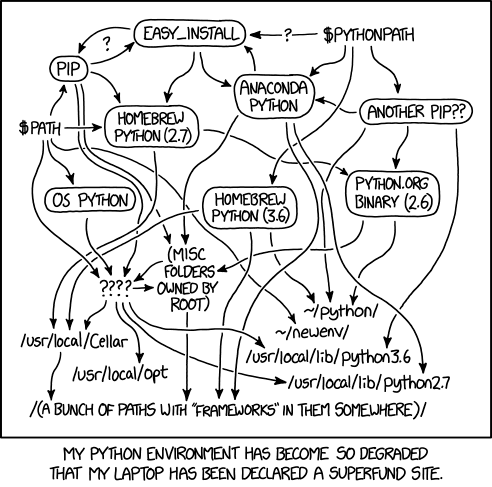
There is a lack of agreement on how and where to declare dependencies. setup.py contains abstract dependencies (but only apply to packages), and requirements.txt file has concrete dependencies (with version specifications). But development dependencies go somewhere else in requirements-dev.txt and testing dependencies in requirements-test.txt. Because dependencies are now declared in two or more separate files, this is a burden. Some people read and parse requirements-*.txt files on their setup.py. Others say that this is a bad practice.
Then, there is the environment management problem. virtualenv was created a long time ago to isolate environments so you one does end up with the dependencies of another project. I do not know why, this was not enough, venv was created. And then some other ones that can handle different Python versions.
At some point on this story, a new generation of clever developers brought ideas from other package managers to improve on how packages, environments, etc. should be managed. requirements.txt were replaced (in theory) by Pipfile and Pipfile.lock. New tools were created to manage packages and environments, such as Pipenv and poetry, tackling even more problems such as virtual environments, Python versions, and many other distribution problems.
Dependencies, environemnts, package managers… this confused a lot of people (including me).
Eventually, I decided to give the PEP 5128 and poetry a try. It was not easy: a new markup language, TOML (Tom’s Obvious Markup Language, which has this strange old man smell, like naphtalene, because it looks like a new INI file). I encountered many new problems with poetry. I abandoned many times but always came back because at least it helps me define my dependencies in only file. After two or three tries, I decided to migrate my code base to poetry and drop the requirement and setup files.
But wait…
To add a bit of entropy to the Python situation, a company called Continuum Analytics (later renamed Anaconda) created a different Python distribution and package management, Anaconda (and its less obese brother, Miniconda). I think they were tired of the current Python situation, and they were right. They replaced all of the virtual environment problems with their own environments and they distribute their own packages without using the current Python package authority, PyPI. This worked well, in my opinion, because Anaconda distributes compiled versions of some packages, giving massive performance improvements in some cases (like NumPy), because it is easier to setup on Windows, but more importantly because Anaconda was targeted for the scientific computing community (e.g. data scientists).
Cool! I should migrate to conda then! Alas, some people (like me), who used Python before Anaconda ever existed, tried it and got confused.
I have three main problems with conda: First, not all packages are distributed by Anaconda, so you eventually need to mix conda and pip to work together. It is difficult to summarize how many problems I have encountered when mixing these two. Second, every single day I use conda, I ran into problems: maybe something was installed on the root environment (this also happens without conda), maybe I wrote a command the wrong way (errors are often misleading), maybe the command syntax changed recently, maybe my network is slow and that explains why adding a new dependency takes ages (among other examples). I can go on. Third, I said to myself, if you are going to use conda, you should go all the way and write packages for their conda repositories. Oh boy, I tried that and it is very complicated and the documentation is so confusing. I eventually managed to do it, but I have PTSD.
So to summarize, I am not convinced by Anaconda, buy I have colleagues or collaborators that do use it. I don’t understand why (yes, apparently tensorflow is faster with anaconda, sigh…). But I have to admit that conda is not going to go anywhere.
This leaves me in an uncomfortable situation: I want to use poetry, but I don’t like forcing others to use it to. And by others I mean my conda friends. I searched for some tool to auto-convert from one to another. Dephell does this, but it does not address all of my use-cases. There is an open issue for some of them. I saw that changing dephell was going to be a complicated endeavor, so I decided to just write a new tool to do it.
So that’s why poetry2conda exists.
1 maintainer

Release files for poetry2conda 0.3.0
For a detailed explanation of source distributions (sdists) and built distributions (wheels), please see the package formats documentation.
Source distribution (sdist)
| File | Size | Uploaded | |
|---|---|---|---|
| poetry2conda-0.3.0.tar.gz | 10.7 kB | Details |
Built distribution (wheel)
| File | Interpreter | ABI | Platform | Reset |
|---|---|---|---|---|
| poetry2conda-0.3.0-py3-none-any.whl | Python 3 | none | any | Details |
Total release size: 20.8 kB
Release files / poetry2conda-0.3.0.tar.gz
| Download URL | poetry2conda-0.3.0.tar.gz |
|---|---|
| Size | 10.7 kB |
| Tags | Source |
|
SHA-256 checksum How to use checksums |
574b6295ff877ff8fb56fe2034160ff9ee9db55a3f3c2faec65458e69125491b
|
|
BLAKE2b-256 checksum How to use checksums |
9b9e0a6613830ca6ba96c4d6b243dd8a142aad5aa481e8ee0e744fb30a669b97
|
| Upload date | |
|
Uploaded using Trusted Publishing? What is trusted publishing? |
No |
| Uploaded via |
poetry/1.0.5 CPython/3.8.3 Darwin/19.4.0
|
Release files / poetry2conda-0.3.0-py3-none-any.whl
| Download URL | poetry2conda-0.3.0-py3-none-any.whl |
|---|---|
| Size | 10.1 kB |
| Tags | Python 3 |
|
SHA-256 checksum How to use checksums |
218618d37331bd6d3d3007edcf21d71802990a0ce9c27e8bb23f739cfa82ed03
|
|
BLAKE2b-256 checksum How to use checksums |
5a6287aae5a3192ea232597f3b767df4f02885850f4cc7e66f043a0c63c787bf
|
| Upload date | |
|
Uploaded using Trusted Publishing? What is trusted publishing? |
No |
| Uploaded via |
poetry/1.0.5 CPython/3.8.3 Darwin/19.4.0
|














