
poincare-memory
Hierarchy-aware, time-aware memory for LLM agents and RAG, on the Poincaré ball.



poincare-memory is the official open-source reference implementation of the geometry-aware memory component of
D. Mojila, "LLM Orchestration with Geometry-Aware Memory," 2026 2nd International Conference on Big Data & Machine Learning (ICBDML), Bhopal, India, Feb. 2026, pp. 1–7. doi:10.1109/ICBDML68582.2026.11544690
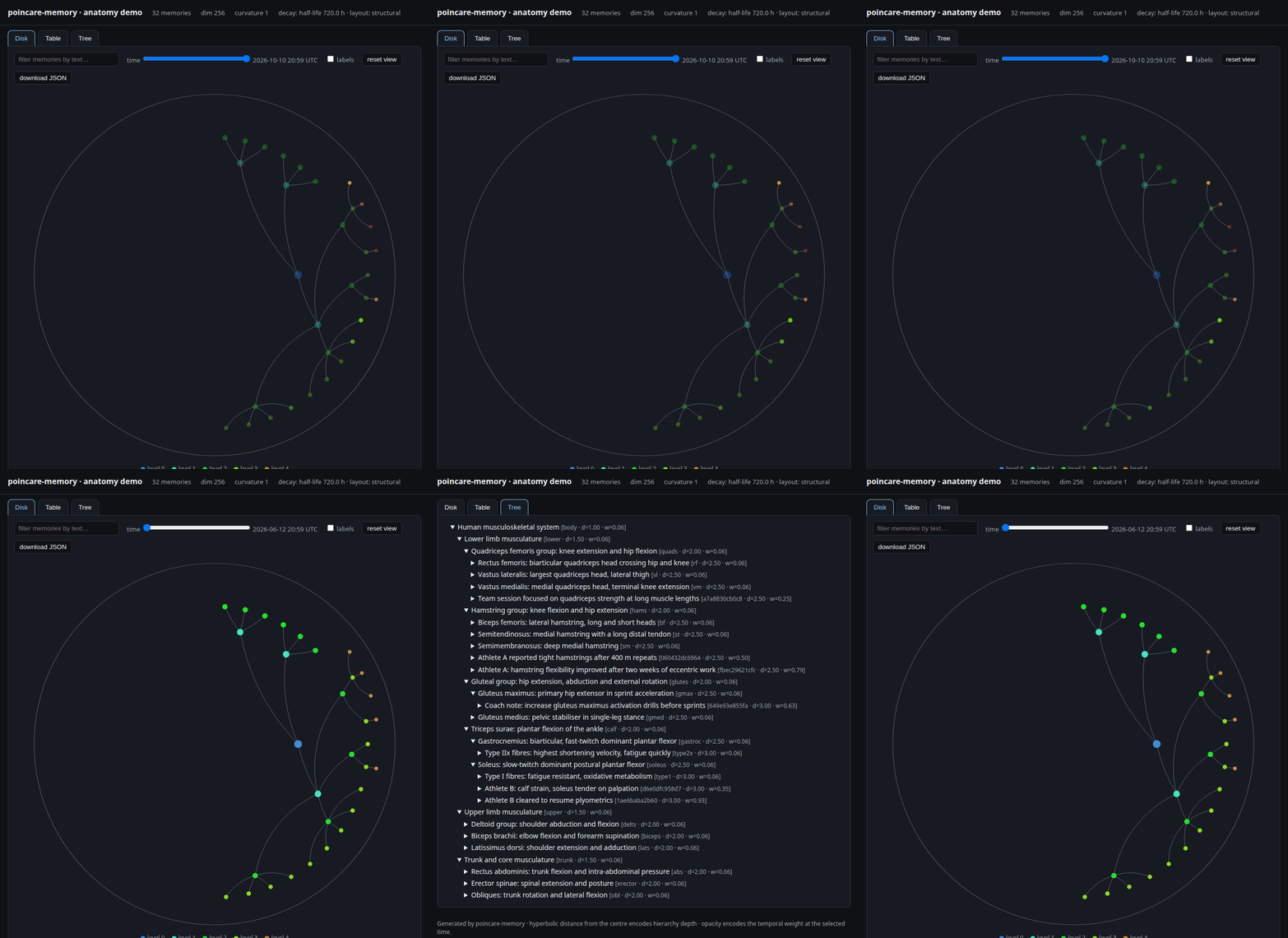
Vector stores treat every memory as a point in flat space, so a taxonomy of a few thousand concepts ends up crowded and shapeless. Hyperbolic space has exponentially more room near its boundary, which is exactly the shape of a hierarchy: this library puts each memory in the Poincaré ball with its direction from the text embedding and its depth from its place in the hierarchy, weights it by age at query time, and lets you see all of it.
Provenance. This package was written after the paper, from the paper's description and the primary literature. The system used for the paper's experiments is not released, and the numbers in this repository's benchmarks come only from the code here.
Install
pip install poincare-memory                 # NumPy only
pip install "poincare-memory[embed]"        # + sentence-transformers embedder
pip install "poincare-memory[viz,pandas]"   # + matplotlib plot, DataFrame export
Python ≥ 3.10. No GPU, no services.
Thirty seconds
from datetime import datetime, timedelta, timezone
from poincare_memory import Memory, HalfLife

mem = Memory(decay=HalfLife(hours=24 * 30))  # memories lose weight with a 30-day half-life

body = mem.add("Human musculoskeletal system")
lower = mem.add("Lower limb musculature", parent=body)
hams = mem.add("Hamstring group: knee flexion and hip extension", parent=lower)
bf = mem.add("Biceps femoris: lateral hamstring", parent=hams)
mem.add(
    "Athlete A reported tight hamstrings after 400 m repeats",
    parent=hams,
    t=datetime.now(timezone.utc) - timedelta(days=30),
)
mem.add(
    "Athlete A: flexibility improved after two weeks of eccentric work",
    parent=hams,
    t=datetime.now(timezone.utc) - timedelta(days=3),
)

for r in mem.search("hamstring tightness", k=3):
    print(f"{r.score:6.2f}  depth={r.depth:.1f}  w={r.time_weight:.2f}  {r.text}")

mem.search("knee", mode="subtree", root=lower)  # only the lower-limb branch
mem.search(mode="ancestors", root=bf)  # hams → lower → body
mem.inspect("memory.html", open_browser=True)  # disk + table + tree, offline, self-contained
mem.save("memory.db")  # SQLite; Memory.load("memory.db")
The default embedder is a deterministic hashing embedder so everything runs offline; pass embedder=SentenceTransformerEmbedder() or any callable for real semantics.
What you get
| Need | How |
|---|---|
| Hierarchy encoded in geometry | depth = hyperbolic distance from the origin; children sit at depth_step beyond their parent, pulled toward its direction by inherit |
| Structural retrieval | mode="subtree" / "children" / "ancestors" / "siblings" and mode="cone" (entailment cones, Ganea et al. 2018) |
| Temporal weighting | named policies: HalfLife, Ebbinghaus (access-strengthened), ValidityWindow, Product; evaluate at any at_time |
| Visual inspection | mem.inspect() → one HTML file with an interactive Poincaré disk, a sortable table and a collapsible tree; mem.plot() for matplotlib; mem.tree() / mem.table() / mem.to_dataframe() in the terminal; Jupyter renders mem inline |
| Exact tree embedding | sarkar_layout(edges): Sarkar's training-free construction (2-D exact, n-D spread) with a float64 safety check |
| Learned embeddings | fit_poincare_embeddings(closure): Riemannian SGD (Nickel & Kiela 2017) in NumPy, plus a Euclidean twin for fair baselines, and reconstruction() (MAP, mean rank) |
| Any vector database | to_lorentz + to_mips_vectors turn hyperbolic nearest-neighbour search into a plain dot-product query |
| Persistence | save() / load() to a single SQLite file; to_json() / from_json() for portability |
| Scale | build_index() with NumPy or FAISS; add_many() embeds in one batch; update(), stats(); thread-safe |
How scoring works (and why not raw hyperbolic distance)
search ranks by -distance + depth_bias * depth + time_coef * log(time_weight).
By default distance is measured on a reference shell: the query and the memory are both moved to the root depth and the hyperbolic distance between them measures semantic mismatch in hyperbolic units, comparable across levels. The raw distance to a memory's real point (metric="hyperbolic") is also available, but be aware of the geometry: a root at depth 1 is close to everything, and a leaf at depth 3 only beats it when the query's direction is within roughly 25° of the leaf's. With off-the-shelf text embeddings that almost never happens, so raw hyperbolic distance degenerates into "return the most general memory". The shell metric keeps semantics in charge and leaves generality versus specificity to depth_bias and to the structural modes, which is where hyperbolic geometry earns its keep. Use metric="hyperbolic" with embedders that are themselves hyperbolic (for example Hierarchy Transformers).
Mapping to the paper
| Paper (Section III–IV) | Here |
|---|---|
| Poincaré ball, metric tensor, distance (eq. 1–3) | PoincareBall.distance, distance_arcosh, conformal_factor |
| Structured knowledge representation with hierarchy | Memory.add(parent=…), sarkar_layout, fit_poincare_embeddings |
| Temporal context management, time-weighted embeddings | temporal.HalfLife / Ebbinghaus / ValidityWindow, search(at_time=…) |
| Efficient retrieval over hierarchical structure | search(mode=…), entailment cones, Lorentz dot-product trick |
| Cross-domain integration in one geometric space | one ball, many roots: Memory.roots() |
The metacognitive controller, provider-agnostic ensemble and response synthesis of the paper live in the companion package poincare-orchestra.
Benchmarks
benchmarks/wordnet_reconstruction.py reproduces the classic WordNet reconstruction protocol (transitive closure, MAP and mean rank) for Poincaré versus Euclidean embeddings at equal dimension, with this library's NumPy trainer. On the mammal.n.01 subtree (1,170 nodes, 200 epochs, 2026-10-10):
| dim | Poincaré MAP | Euclidean MAP |
|---|---|---|
| 2 | 0.779 | 0.533 |
| 5 | 0.975 | 0.802 |
| 10 | 0.957 | 0.837 |
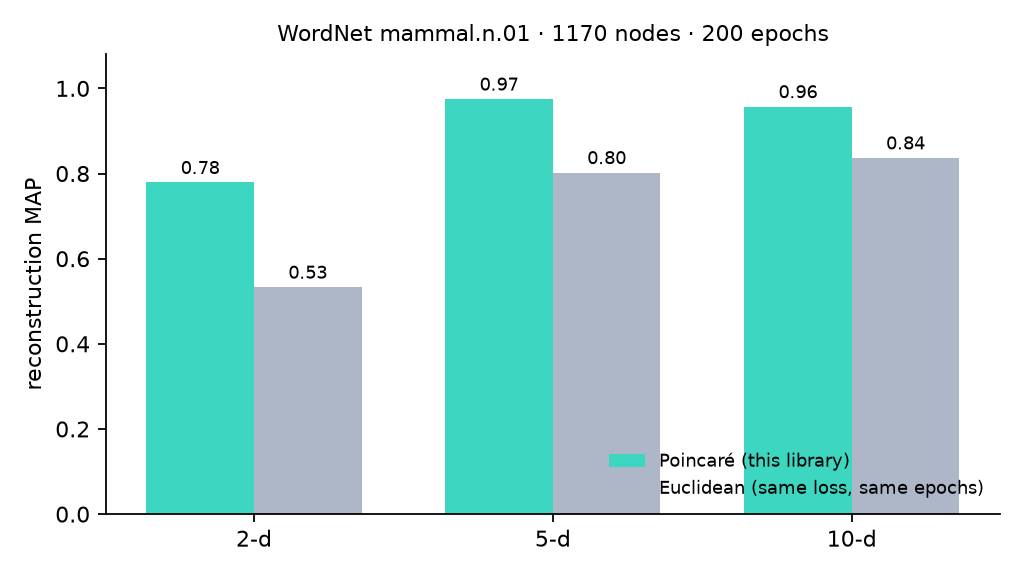
Full table, environment and raw JSON in benchmarks/README.md; run it yourself with pip install "poincare-memory[bench]".
Documentation
Full docs at https://dhruvmojila.github.io/poincare-memory (getting started, concepts, guides, API, FAQ). Every code example in the docs is executed in CI.
Command line
poincare-memory demo -o demo --open    # build the anatomy demo, save demo.db, open demo.html
poincare-memory inspect memory.db      # write memory.html
poincare-memory tree memory.db
poincare-memory search memory.db "calf strain" -k 5 --mode subtree --root lower
poincare-memory stats memory.db
poincare-memory export memory.db memory.json
Citing
If you use this library, please cite the paper (and, for the software itself, the Zenodo release in CITATION.cff):
@inproceedings{mojila2026llmorchestration,
  author    = {Mojila, Dhruv},
  title     = {{LLM} Orchestration with Geometry-Aware Memory},
  booktitle = {2026 2nd International Conference on Big Data \& Machine Learning (ICBDML)},
  year      = {2026},
  pages     = {1--7},
  publisher = {IEEE},
  address   = {Bhopal, India},
  doi       = {10.1109/ICBDML68582.2026.11544690}
}
Development
git clone https://github.com/dhruvmojila/poincare-memory && cd poincare-memory
uv venv && uv pip install -e ".[dev,viz,pandas]"
pytest            # property-based geometry tests + store tests
ruff check . && mypy
mkdocs serve      # docs
Clean-room note for contributors: implement from the papers cited in the docstrings. Several canonical hyperbolic-embedding repositories are unlicensed or non-commercial; do not copy from them.
Licence
Apache-2.0. © 2026 Dhruv Mojila.
1 maintainer

Metadata
1 maintainer
Release files for poincare-memory 0.1.1
For a detailed explanation of source distributions (sdists) and built distributions (wheels), please see the package formats documentation.
Source distribution (sdist)
| File | Size | Uploaded | Provenance | |
|---|---|---|---|---|
| poincare_memory-0.1.1.tar.gz | 56.6 kB | With provenance | Details |
Built distribution (wheel)
| File | Interpreter | ABI | Platform | Reset |
|---|---|---|---|---|
| poincare_memory-0.1.1-py3-none-any.whl | Python 3 | none | any | Details |
Total release size: 115.6 kB
Release files / poincare_memory-0.1.1.tar.gz
| Download URL | poincare_memory-0.1.1.tar.gz |
|---|---|
| Size | 56.6 kB |
| Tags | Source |
|
SHA-256 checksum How to use checksums |
a37ce396aa18b5ac89ab5645251b80ff87e7aee85e253eb0fda62649bd5cfe8b
|
|
BLAKE2b-256 checksum How to use checksums |
7aa580fc9dfd4453d843f8587c5462107894051a6fb0fc9e6813840f0d882416
|
| Upload date | |
|
Uploaded using Trusted Publishing? What is trusted publishing? |
Yes |
| Uploaded via |
twine/7.0.0 CPython/3.13.16
|
Provenance
Provenance describes where a file came from. On PyPI, provenance is shared via attestations, which provide a verifiable record of the build or publishing details. View details, limitations and caveats.


PyPI Publish Attestation
PyPI verified that this artifact, at this checksum, originated from the publisher listed below.
Signed by GitHub Actions, verified by PyPI on Oct 22, 2026.
Transparency logRelease files / poincare_memory-0.1.1-py3-none-any.whl
| Download URL | poincare_memory-0.1.1-py3-none-any.whl |
|---|---|
| Size | 59.1 kB |
| Tags | Python 3 |
|
SHA-256 checksum How to use checksums |
684e2797c13a23f132b854a924962e63a8cafd81ad205656affd954b45b0564b
|
|
BLAKE2b-256 checksum How to use checksums |
a28a63e276cd2c8d4c9d7ef984a2ba540a56328873bffc39f32e3c5b5e786aa7
|
| Upload date | |
|
Uploaded using Trusted Publishing? What is trusted publishing? |
Yes |
| Uploaded via |
twine/7.0.0 CPython/3.13.16
|
Provenance
Provenance describes where a file came from. On PyPI, provenance is shared via attestations, which provide a verifiable record of the build or publishing details. View details, limitations and caveats.
PyPI Publish Attestation
PyPI verified that this artifact, at this checksum, originated from the publisher listed below.
Signed by GitHub Actions, verified by PyPI on Oct 22, 2026.
Transparency logSecurity for poincare-memory 0.1.1
Provenance
Provenance describes where a file came from. On PyPI, provenance is shared via attestations, which provide a verifiable record of the build or publishing details. View details, limitations and caveats.
Full provenance
All 2 files in this release have been uploaded with provenance metadata.
Attestation for poincare_memory-0.1.1.tar.gz
PyPI Publish Attestation
PyPI verified that this artifact, at this checksum, originated from the publisher listed below.
Signed by GitHub Actions, verified by PyPI on Oct 22, 2026.
Transparency logA note on package security
PyPI is a repository for distributing packages, not a service for auditing them. While third-party security researchers and our staff do their best to detect and remove malicious packages, PyPI cannot guarantee the quality, security or suitability of any given package.














