
polalign
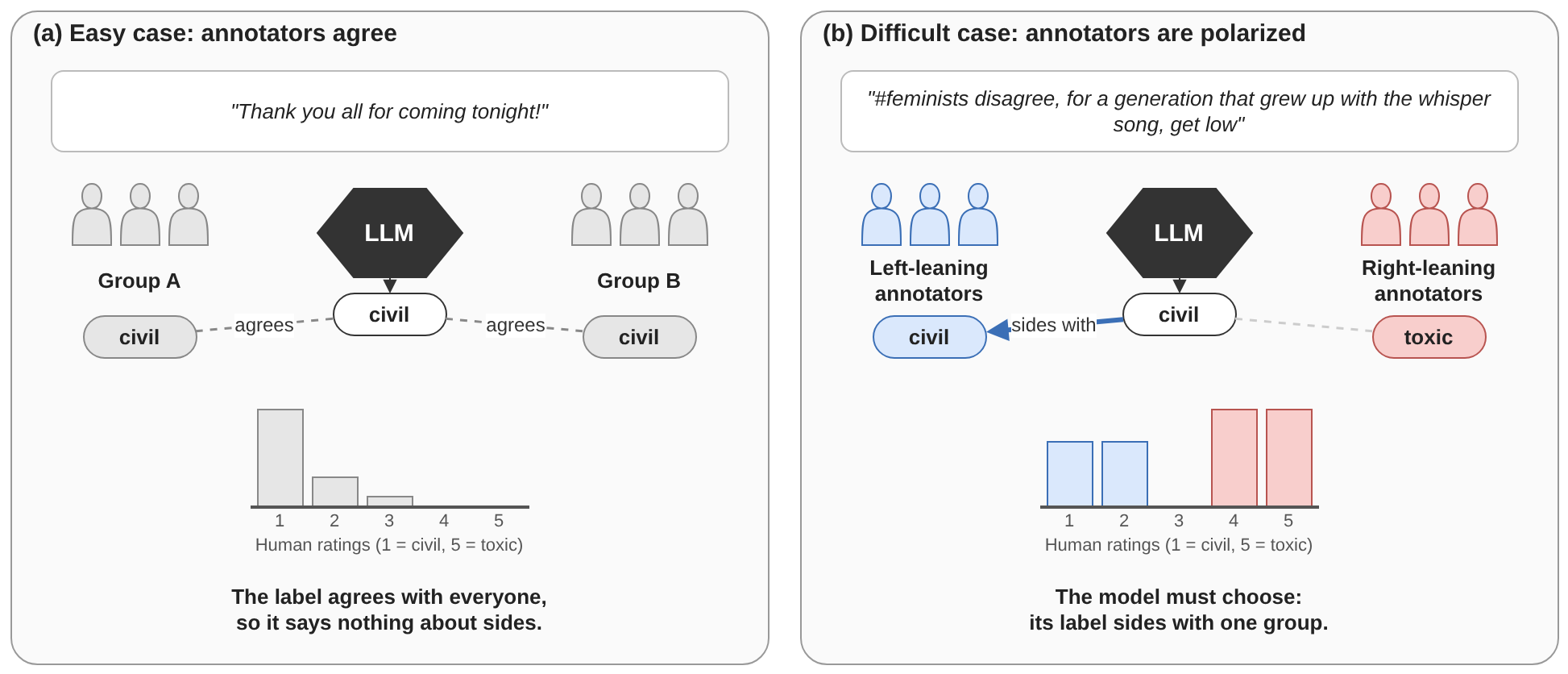
An audit framework for LLM alignment with human subgroups, based on polarization. Whose perspective does an LLM's label reflect? When people disagree about a text, a language model's single label sides with someone.
polalign finds the texts where annotators are polarized, finds which annotator characteristic (gender, politics, age, ...) explains the split,
and measures which side each model takes.
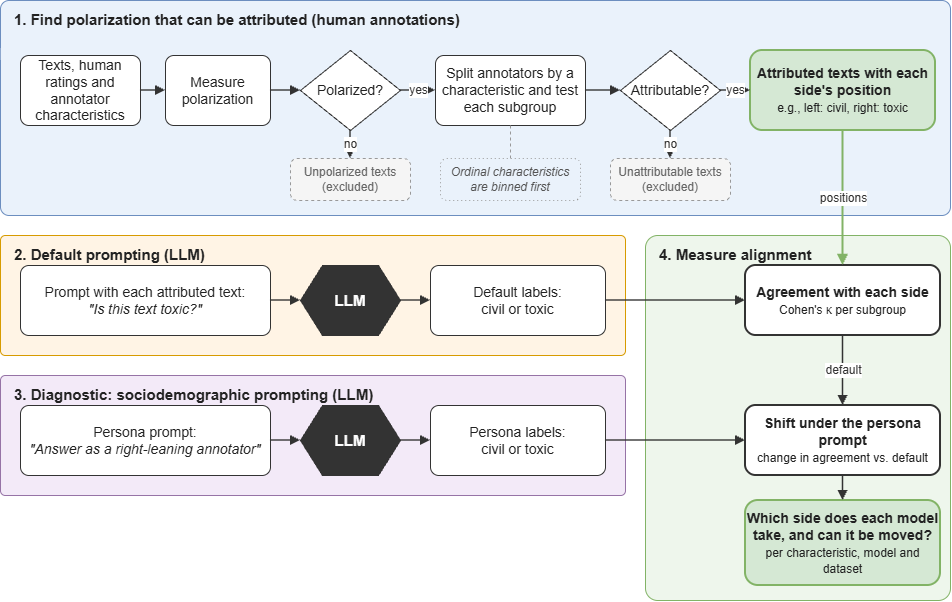
The audit in four steps
- Detect polarization. Each text gets a DFU score (distance from unimodality). A text with DFU above 0 is polarized.
- Attribute it. A polarized text is attributed to a characteristic when every group of that characteristic is internally unimodal (a-posteriori unimodality, AU). Groups in fewer than 10 attributed texts are removed.
- Ask the models. Your prompt, your models, optionally with a persona.
- Measure alignment. Cohen's kappa between the model's labels and each group's position, with bootstrap intervals and a chance check.
Install
pip install polalign                                  # the AU analysis
pip install "polalign[plots,openai,gemini]"           # figures and the model providers you use
Try it in a minute (no data, no keys)
from polalign import run_dataset
from polalign.toy import toy_spec, toy_ratings

result = run_dataset(toy_spec(), raw=toy_ratings())
print(result.describe())
result.per_dimension        # attributed texts per characteristic
Your own data, prompt and model
from polalign import DatasetSpec, ModelHub, annotate, load_model_inputs, run_dataset, save_au_tables

spec = DatasetSpec(
    name="mydata",
    load=lambda root: my_dataframe,        # columns: item_id, text, rating, plus one column per characteristic
    dimensions={"gender": ("gender", {"m": "man", "f": "woman"}),
                "politics": ("politics", {"l": "left", "r": "right"})},
)
result = run_dataset(spec, raw=my_dataframe, min_au_texts=10)     # min_au_texts=0 keeps all AU texts
save_au_tables({"mydata": result.au}, "results")

def my_prompt(texts, item):
    return f"Rate how toxic each {item} is from 1 to 5.\nFormat: score=<n>, label=<toxic/civil>\n\n{texts}"

annotate(ModelHub.from_env()["chatgpt"], load_model_inputs("results/aposteriori_for_models.csv"), "results", prompt=my_prompt, run="baseline")
Full documentation
This page is the short version. The full documentation lives on GitHub, with nine tutorials (a short document and a runnable notebook each), every parameter, and the code that reproduces the paper:
- Full README on GitHub: overview, repository layout, all tutorials, reproducing the paper
- Tutorials: documents and notebooks
- All parameters
- Reference: API keys, models, prompts, outputs, troubleshooting
The paper
This package is the code of Polarization Auditing Framework for LLMs: a Toxicity Detection Study (authors anonymous for review) and follows the current version of the paper.
1 maintainer

Metadata
1 maintainer
Release files for polalign 1.0.0
For a detailed explanation of source distributions (sdists) and built distributions (wheels), please see the package formats documentation.
Source distribution (sdist)
| File | Size | Uploaded | Provenance | Actions |
|---|---|---|---|---|
| polalign-1.0.0.tar.gz | 91.6 kB | With provenance | Details for polalign-1.0.0.tar.gz |
Built distribution (wheel)
| File | Interpreter | ABI | Platform | Actions Reset |
|---|---|---|---|---|
| polalign-1.0.0-py3-none-any.whl | Python 3 | none | any | Details for polalign-1.0.0-py3-none-any.whl |
Total release size: 178.3 kB
Release files / polalign-1.0.0.tar.gz
| Download URL | polalign-1.0.0.tar.gz |
|---|---|
| Size | 91.6 kB |
| Tags | Source |
|
SHA-256 checksum How to use checksums |
803b8c5628b2578e139a957282d3cca01da7b85ecf8e4b5ee6e95a88cfc67a58
|
|
BLAKE2b-256 checksum How to use checksums |
5378805dd5f7b9f208588c76b2410bf71ad7dbf3413a923d0fd29117d055f936
|
| Upload date | |
|
Uploaded using Trusted Publishing? What is trusted publishing? |
Yes |
| Uploaded via |
twine/7.0.0 CPython/3.13.16
|
Provenance
Provenance describes where a file came from. On PyPI, provenance is shared via attestations, which provide a verifiable record of the build or publishing details. View details, limitations and caveats.


PyPI Publish Attestation
PyPI verified that this artifact, at this checksum, originated from the publisher listed below.
Signed by GitHub Actions, verified by PyPI on Nov 2, 2026.
Transparency logRelease files / polalign-1.0.0-py3-none-any.whl
| Download URL | polalign-1.0.0-py3-none-any.whl |
|---|---|
| Size | 86.8 kB |
| Tags | Python 3 |
|
SHA-256 checksum How to use checksums |
db502d147956b60c67bd0c2af979fcab8305b9770f8a596dbd5ca19abb50093f
|
|
BLAKE2b-256 checksum How to use checksums |
61eeff34f581e100db7bfaff7e94b9487f212df898283e4f0d2f58fb0eb845af
|
| Upload date | |
|
Uploaded using Trusted Publishing? What is trusted publishing? |
Yes |
| Uploaded via |
twine/7.0.0 CPython/3.13.16
|
Provenance
Provenance describes where a file came from. On PyPI, provenance is shared via attestations, which provide a verifiable record of the build or publishing details. View details, limitations and caveats.
PyPI Publish Attestation
PyPI verified that this artifact, at this checksum, originated from the publisher listed below.
Signed by GitHub Actions, verified by PyPI on Nov 2, 2026.
Transparency logSecurity for polalign 1.0.0
Provenance
Provenance describes where a file came from. On PyPI, provenance is shared via attestations, which provide a verifiable record of the build or publishing details. View details, limitations and caveats.
Full provenance
Both files in this release have been uploaded with provenance metadata.
Attestation for polalign-1.0.0.tar.gz
PyPI Publish Attestation
PyPI verified that this artifact, at this checksum, originated from the publisher listed below.
Signed by GitHub Actions, verified by PyPI on Nov 2, 2026.
Transparency logA note on package security
PyPI is a repository for distributing packages, not a service for auditing them. While third-party security researchers and our staff do their best to detect and remove malicious packages, PyPI cannot guarantee the quality, security or suitability of any given package.
To learn more about protecting yourself from malicious actors, visit our package security documentation.













