
polanon


Reversible PII masking for LLM calls, Polish-first. Mask personal data before a prompt leaves your network, send only tokens to the model, and put the originals back into its answer — even while it streams. Pure Python: the standard library is the whole core.
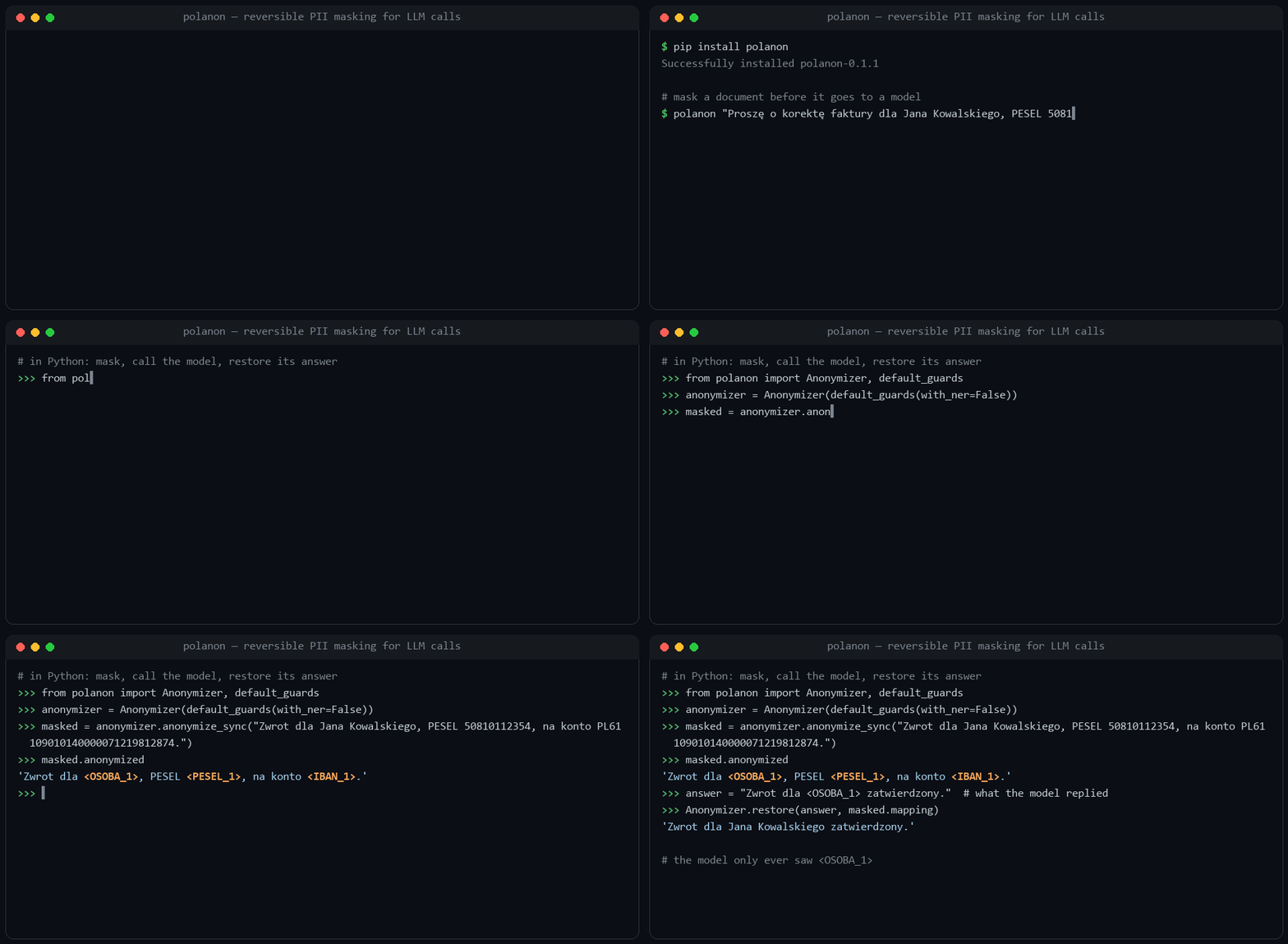
pip install polanon
from polanon import Anonymizer, default_guards

anonymizer = Anonymizer(default_guards(with_ner=False))

result = anonymizer.anonymize_sync(
    "Proszę o korektę faktury dla Jana Kowalskiego, PESEL 50810112354, "
    "konto PL61109010140000071219812874, mail jan.kowalski@example.com."
)
print(result.anonymized)
# Proszę o korektę faktury dla <OSOBA_1>, PESEL <PESEL_1>, konto <IBAN_1>, mail <EMAIL_1>.

answer = "Korekta dla <OSOBA_1> (PESEL <PESEL_1>) jest gotowa."  # what the model replied
print(Anonymizer.restore(answer, result.mapping))
# Korekta dla Jana Kowalskiego (PESEL 50810112354) jest gotowa.
The model only ever sees <OSOBA_1>. The mapping that turns it back into a name never leaves your
process. anonymize_sync works in scripts, Django and Flask views, Celery tasks and notebooks; in
async code, await anonymizer.anonymize(...) does the same work in a worker thread.
Why another PII library
General-purpose tools are built around English. Polish data needs three things they do not do out of the box:
- Checksums. A PESEL, NIP, REGON, ID card number, IBAN or payment card is validated, not just pattern-matched: the checksum rejects most random digit strings — for a PESEL, together with the birth date, about 98% of them — while a valid number always passes. KRS numbers, which have no public checksum, and passports are recognised next to their label as well.
- Seven grammatical cases. "Jan Kowalski", "Jana Kowalskiego" and "z Janem Kowalskim" are the same person. Polish first names are recognised in every case, in lowercase and typed without Polish letters, together with the surname that agrees with them, without any language model.
- Polish model labels. Polish spaCy models tag people as
persName, notPERSON. A pipeline configured for English labels finds no names at all, and says nothing about it.
It also reads foreign invoices: EU, UK and Swiss VAT numbers, company register numbers, Bankgiro, Plusgiro and sort codes, international phone numbers, street addresses and postcodes.
Install
| You want | Install |
|---|---|
| Identifiers, contacts, secrets, Polish names, companies by legal form | pip install polanon |
| Also places, and names and organisations no rule can see | pip install "polanon[ner]" then python -m spacy download pl_core_news_md |
| The stage-2 judges (a local Ollama model, or a remote one) | pip install "polanon[judge]" |
Then use default_guards() with the model, or default_guards(with_ner=False) without it.
Another spaCy model is one argument away: default_guards(spacy_model="pl_core_news_lg").
From the command line
Text comes from the arguments or, without any, from standard input. Masked text goes to stdout and the mapping to stderr, so a pipeline can keep the two apart:
polanon "Jan Kowalski, PESEL 50810112354"
cat umowa.txt | polanon --ner > masked.txt 2> mapping.json
A non-zero exit status means stderr holds an error rather than the mapping. In Windows
PowerShell 5.1, read the file with Get-Content -Encoding UTF8 umowa.txt | polanon: a plain
cat there re-encodes Polish letters before they reach the program, and a garbled name is not
recognised.
Streaming
A provider streams arbitrary fragments, so <OSOBA_1> can arrive as <OSO and BA_1>. The
restorer holds back anything that could still grow into a token:
restorer = Anonymizer.stream_restorer(result.mapping)
for chunk in stream:  # "Dzień dobry <OSO", "BA_1>, PESEL <PESEL", "_1> zweryfikowany."
    print(restorer.feed(chunk), end="")
print(restorer.flush())
# Dzień dobry Jana Kowalskiego, PESEL 50810112354 zweryfikowany.
With Claude, GPT or a local model
Mask before the call, restore while the answer streams. With the Anthropic SDK:
import anthropic
from polanon import Anonymizer, default_guards

anonymizer = Anonymizer(default_guards(with_ner=False))
masked = anonymizer.anonymize_sync(question)
restorer = Anonymizer.stream_restorer(masked.mapping)

with anthropic.Anthropic().messages.stream(
    model="claude-opus-5-5",
    max_tokens=64000,
    system="Personal data is replaced by tokens such as <OSOBA_1>. Copy a token exactly as written.",
    messages=[{"role": "user", "content": masked.anonymized}],
) as stream:
    for text in stream.text_stream:
        print(restorer.feed(text), end="")
print(restorer.flush())
Telling the model what the tokens are keeps it from rewriting them. The
examples go further:
openai_chat.py does the same for any OpenAI-compatible endpoint (OpenAI, OpenRouter, Azure, vLLM,
a local Ollama), and anthropic_chat.py holds a conversation whose history keeps masked text only,
so an answer restored for the reader is never sent back in the clear. Both are tested in CI against
the real SDKs, offline.
What it detects
Checksum-validated Polish identifiers (PESEL, NIP, REGON, ID card, IBAN, payment cards), KRS numbers
next to their label, e-mail addresses and phone numbers, street addresses and postcodes, IPv4 and
IPv6, MAC addresses, vehicle registrations after their label ("nr rej."), VINs, passport numbers,
birth dates, API keys, tokens and passwords, Polish first names with their surnames, and company
names anchored on a legal form ("Sp. z o.o.", "S.A.", "Ltd", "GmbH"). With the ner extra, a spaCy
model adds places and the names nothing else marks. An optional second stage lets a small local
model review the masked text for what still identifies someone by context. Other dates are
recognised too, but left readable unless you ask for them.
Text copied from PDFs, Word or macOS is read as a person would read it: letters written as a base letter plus an accent, no-break spaces and en dashes inside numbers, and invisible zero-width characters do not hide a value. The mapping keeps each value as it was first written.
On the annotated sample documents in the repository, the rules alone fully mask 85% of the
values and the rules with pl_core_news_md mask 98%, with nothing left half-masked. Ten short
documents are a regression check, not a research benchmark: see the
benchmark notes for what is
missed and why, and for Microsoft Presidio on the same documents with the same model: 65% fully
masked, 74% at its most lenient.
Worth knowing
Tokens are stable per conversation, not global. Pass the mapping from the latest result to the next call: the same value keeps the same token, and a token is never reused for another value. The mapping you pass in is read, not changed, so keep the one each result returns:
mapping = result.mapping
second = anonymizer.anonymize_sync("Ten sam PESEL 50810112354", mapping)
second.anonymized  # "Ten sam PESEL <PESEL_1>"
mapping = second.mapping  # everything so far, for the next turn
A token restores the form it replaced. Masking happens on the text as written, so a name masked in the genitive comes back in the genitive. Ask the model to keep tokens where the grammar allows it ("dla <OSOBA_1>"), or restore into a template you control. Spellings that differ only in letter case, in the kind of whitespace (a no-break space, a line break, a run of spaces) or in invisible characters are the same value, and so are an identifier's groups written apart or together: they share its token, and restore writes the spelling seen first. Passwords and custom types are the exception, since two passwords that differ in case are two passwords, and a password never shares a token with a name that reads alike. A one-word name found in all lowercase keeps a token of its own too, for the reason below.
Every occurrence of a masked value is masked, also where no detector would recognise it on its own: as written, in capitals, across a line break, with a zero-width character in it, with its groups spaced differently, and around whatever a detector found inside it. Two exceptions keep ordinary words readable. A capitalised one-word name is not matched in all lowercase, because Zima, Kot and Wilk are surnames and "zima" is winter; identifiers such as a VIN or an e-mail address are matched in any case. A number shorter than six digits, such as a PIN, is not matched inside a longer number, a date, a time or an amount: "15.04.2025", "2024–2025", "2025,50" and "20250" stay readable when the PIN is 2025, while "w 2025 roku" and "PIN/PUK 2025/36912874" do not.
A token you write stays yours. A placeholder such as <PESEL_1> in your own text is never handed
to real data. It joins the mapping as standing for itself, so the reservation holds in later turns
too.
The mapping is the sensitive half. result.anonymized holds a token for everything the
detectors found, and only what they missed in the clear; result.mapping is the key that undoes
it. Store the mapping the way you would store the original document.
Replaying a conversation? mask_known_values(text, mapping) masks every value a mapping already
holds in text that was masked earlier, such as history sent again after a new value got its token.
The same call checks a payload before it leaves: mask_known_values(payload, mapping) == payload
means no value the mapping holds is left where the library would mask it.
Words of your own. In-house names no rule can know, such as a project codename or a client, go on a denylist and are masked wherever they appear, in any case and across line breaks:
guards = default_guards(denylist=["Projekt Wichura", "Zakład Nowak"], with_ner=False)
Checking the answer. After restoring, anonymizer.sweep(restored, mapping) reports tokens the
model invented and personal data its answer added: report.is_clean, or report.unknown_tokens
and report.new_spans to look at.
Choosing what to mask
Anonymizer(guards) masks DEFAULT_ENABLED: every type in ENTITY_TYPES except DATE, because a
date rarely identifies anyone and masking every deadline leaves the model unable to answer. A birth
date does identify someone, so a date after "ur.", "data urodzenia", "DOB" or "geb." is its own
type, BIRTH_DATE, and stays masked. Pass enabled to choose for yourself:
from polanon import DEFAULT_ENABLED, ENTITY_TYPES, Anonymizer, default_guards

guards = default_guards(with_ner=False)
Anonymizer(guards, enabled=DEFAULT_ENABLED | {"DATE"})  # dates too
Anonymizer(guards, enabled={"PESEL", "NIP", "IBAN"})  # identifiers only
list(ENTITY_TYPES)  # every name you can use
A name that is neither built in nor declared in a guard's entity_types raises ValueError, so a
typo such as "PERSONS" cannot quietly switch masking off.
A second opinion: the judge
Rules and a language model miss what identifies someone only by context: "the finance director of the only steelworks in town". A judge is a small model that reads the masked text after stage 1 and flags such fragments. Run it locally with Ollama, so the review never leaves your network:
import asyncio

from polanon import Anonymizer, JudgeError, default_guards
from polanon.judge import OllamaJudge

anonymizer = Anonymizer(
    default_guards(),
    judge=OllamaJudge(model="qwen2.5:1.5b"),
    judge_fallback="block",  # refuse to go on if the judge is down
)


async def main(text: str) -> None:
    try:
        result = await anonymizer.anonymize(text)
    except JudgeError:
        ...  # the judge was down, and "block" means nothing goes out


asyncio.run(main("..."))
It needs pip install "polanon[ner,judge]", the spaCy model, a running Ollama and
ollama pull qwen2.5:1.5b. With judge_fallback="send_stage1" the call goes on when the judge
is down, and result.judge_failed says that stage 1 went out alone.
Judges are asynchronous, so anonymize_sync refuses an anonymizer that has one. RemoteJudge asks an
OpenAI-compatible endpoint instead; the masked text then leaves your network, which makes it a
testing aid rather than a privacy control.
Names that should stay readable
A language model flags "Facebook" or "Google Ads" as an organisation, which masks the very thing a question is about. Pass an allowlist and those detections are dropped before tokens are assigned:
from polanon import WELL_KNOWN_NAMES, Allowlist, Anonymizer, default_guards

anonymizer = Anonymizer(default_guards(), allowlist=Allowlist(WELL_KNOWN_NAMES))
A one-word name also matches its Polish case forms ("Facebooku", "Canvie"). Only detections of names are dropped, and only when every word in them is on the list; identifiers, the denylist and values a conversation has already masked stay masked.
The pieces
| Module | What it is for |
|---|---|
guards/ |
deterministic detectors. Each returns Spans in original-text coordinates |
pipeline.py |
runs the guards in a thread, resolves overlaps, assigns stable tokens |
policy.py |
the entity taxonomy and the token naming (<OSOBA_1>, <PESEL_1>) |
judge/ |
the optional second stage: a model reviews the masked text for what still identifies |
stream_restore.py |
puts originals back into a streamed reply without splitting a token |
output_sweep.py |
flags invented tokens and personal data the answer introduced |
Adding a detector
Subclass Guard, return spans in original-text coordinates and respect the enabled set. A type of
your own goes in entity_types, which turns it on by default; it becomes the label of its tokens,
so it is written in uppercase letters and underscores:
import re

from polanon import Anonymizer, Guard, Span, default_guards


class EmployeeIdGuard(Guard):
    name = "employee_id"
    entity_types = frozenset({"EMPLOYEE_ID"})

    def detect(self, text: str, enabled: set[str]) -> list[Span]:
        if "EMPLOYEE_ID" not in enabled:
            return []
        return [
            Span(m.start(), m.end(), "EMPLOYEE_ID", 1.0, self.name)
            for m in re.finditer(r"\bEMP-\d{5}\b", text)
        ]


anonymizer = Anonymizer([*default_guards(with_ner=False), EmployeeIdGuard()])
anonymizer.anonymize_sync("Wniosek EMP-11111").anonymized  # "Wniosek <EMPLOYEE_ID_1>"
The score decides who wins where detections overlap: 1.0 for a value a checksum, a label or an
official format vouches for, 0.85 for a statistical guess; the judge's findings score 0.5. A secret
is masked whole, with whatever was detected inside it. A span outside the text, a type spelled any
other way, or one spelled like a built-in token label (OSOBA, DATA) raises ValueError naming
your guard.
Before you rely on it
Masking is pseudonymisation, not anonymisation in the legal sense, and no detector catches everything. The threat model says what is covered, what is not, and what stays your application's job, starting with keeping the mapping safe.
polanon was built as the masking engine of piigate, a self-hosted hub that lets a team use Claude or GPT on real documents without sending personal data to the provider; the hub is not published yet. The library knows nothing about it — no HTTP, no database, no settings — and a test fails if it ever starts to.
Contributing
Bug reports, missed values and new detectors are welcome: see CONTRIBUTING.md. A way to get an original value past the masking is a security report, made privately as SECURITY.md describes.
MIT licensed.
1 maintainer

Metadata
1 maintainer
Release files for polanon 0.1.1
For a detailed explanation of source distributions (sdists) and built distributions (wheels), please see the package formats documentation.
Source distribution (sdist)
| File | Size | Uploaded | Provenance | Actions |
|---|---|---|---|---|
| polanon-0.1.1.tar.gz | 239.8 kB | With provenance | Details for polanon-0.1.1.tar.gz |
Built distribution (wheel)
| File | Interpreter | ABI | Platform | Actions Reset |
|---|---|---|---|---|
| polanon-0.1.1-py3-none-any.whl | Python 3 | none | any | Details for polanon-0.1.1-py3-none-any.whl |
Total release size: 342.8 kB
Release files / polanon-0.1.1.tar.gz
| Download URL | polanon-0.1.1.tar.gz |
|---|---|
| Size | 239.8 kB |
| Tags | Source |
|
SHA-256 checksum How to use checksums |
44dcc93e6a87e2eff65f163fbd48a868b4abd7fcfeee57a56d2ca774b582ee9a
|
|
BLAKE2b-256 checksum How to use checksums |
8f64aead44d2df5c0251918e27283b18859579a8d34a608fd7b40d2e934c7434
|
| Upload date | |
|
Uploaded using Trusted Publishing? What is trusted publishing? |
Yes |
| Uploaded via |
twine/7.0.0 CPython/3.13.16
|
Provenance
Provenance describes where a file came from. On PyPI, provenance is shared via attestations, which provide a verifiable record of the build or publishing details. View details, limitations and caveats.


PyPI Publish Attestation
PyPI verified that this artifact, at this checksum, originated from the publisher listed below.
Signed by GitHub Actions, verified by PyPI on Nov 3, 2026.
Transparency logRelease files / polanon-0.1.1-py3-none-any.whl
| Download URL | polanon-0.1.1-py3-none-any.whl |
|---|---|
| Size | 103.0 kB |
| Tags | Python 3 |
|
SHA-256 checksum How to use checksums |
5dab8b78c22687ff08f4c2fbe09ade5ae75f23d2c6d1e0b782254b643ea6aeea
|
|
BLAKE2b-256 checksum How to use checksums |
21c6c060273a9349ea7be7302e4ceefd33af3508bb3a2edeeebfbacda7fce460
|
| Upload date | |
|
Uploaded using Trusted Publishing? What is trusted publishing? |
Yes |
| Uploaded via |
twine/7.0.0 CPython/3.13.16
|
Provenance
Provenance describes where a file came from. On PyPI, provenance is shared via attestations, which provide a verifiable record of the build or publishing details. View details, limitations and caveats.
PyPI Publish Attestation
PyPI verified that this artifact, at this checksum, originated from the publisher listed below.
Signed by GitHub Actions, verified by PyPI on Nov 3, 2026.
Transparency logSecurity for polanon 0.1.1
Provenance
Provenance describes where a file came from. On PyPI, provenance is shared via attestations, which provide a verifiable record of the build or publishing details. View details, limitations and caveats.
Full provenance
All 2 files in this release have been uploaded with provenance metadata.
Attestation for polanon-0.1.1.tar.gz
PyPI Publish Attestation
PyPI verified that this artifact, at this checksum, originated from the publisher listed below.
Signed by GitHub Actions, verified by PyPI on Nov 3, 2026.
Transparency logA note on package security
PyPI is a repository for distributing packages, not a service for auditing them. While third-party security researchers and our staff do their best to detect and remove malicious packages, PyPI cannot guarantee the quality, security or suitability of any given package.
To learn more about protecting yourself from malicious actors, visit our package security documentation.














