
Polars List Utils (polist)
polist is a Python package that provides a set of utilities for working with List-type columns in Polars DataFrames, especially for signal processing and feature extraction.
So far these utilities comprise those that I found to be missing or lacking from the List namespace within the Polars library while I was working on a project at work that required extensive handling of signal data which I was storing in Polars DataFrames.
By providing these utilities as a Polars plugin, and thus not having to leave the Polars DataFrame for these operations, I was able to significantly speed up the processing of my data by benefiting from Polars query optimization and parallelization. So while the operations themselves are not necessarily faster than their Numpy counterparts (although they might be in some cases), the integration with Polars gave my larger processing pipeline a significant speed boost.
A disclaimer about authorship
This library started life as a hand-crafted solution to a problem at work. The time pressures of life and work eventually led me to succumb to taking shortcuts and let AI take the wheel. This repo is therefore no longer "artisanal": it is AI-generated, reviewed to the best of my time and abilities, and fully dog-fooded by me at work.
Features
-
polist.apply_interp- Interpolates a new List-type column from 3 specified List-type columns.
- Behaviour as expected from the
numpy.interpfunction, but for Polars DataFrames. - Supply the
x_column,y_column, andxp_columncolumns to obtain the interpolated y-values.
-
polist.apply_butterworth- Applies a Butterworth filter (low-pass, high-pass, band-pass) to a List-type column of signal data.
- The filter is applied bidirectionally (like
scipy.signal.filtfilt), so there is no phase lag, but the magnitude response is squared: the cutoff sits at -6dB instead of -3dB. - A band-pass doubles the design order, as in
scipy.signal.butter.
-
polist.apply_fft- Applies a (real) Fast Fourier Transform (FFT) to a List-type column of signal data,
producing the
N/2 + 1amplitudes from DC to Nyquist. - Can pre-process the signals with a windowing function (e.g. Hann, Blackman), applied
in periodic (sym=False) form as in
scipy.signal.periodogram. - Scales the amplitudes under scipy's names:
amplitudereads a tone's peak amplitude A,amplitude_squaredreads A² (the square ofamplitude, a convenience),spectrumits mean-square A²/2 (scipy.signal.periodogram(scaling="spectrum")), anddensityits power density (scaling="density", integrates to the signal's mean-square power). - The length of each signal must be a power of two of at least 2 — a violation raises —
and the corresponding frequency axis is
[i * sample_rate / N for i in range(N // 2 + 1)].
- Applies a (real) Fast Fourier Transform (FFT) to a List-type column of signal data,
producing the
-
polist.agg_slices- Computes an aggregation of a range of y-values defined by some x-values for List-type columns.
- This is useful for feature extraction from signals, e.g. to compute the mean of a signal in a certain time range or a spectrum in a certain frequency range.
- Ranges to include or exclude can be given as simple
(lo, hi)tuples or with explicit boundary modes like((lo, "closed"), (hi, "open")).
-
polist.agg_lists- Applies element-wise list-aggregations to a List-type column in a GroupBy context.
- Composed from Polars' own vertical aggregations, with a small pass-through plugin
that normalizes
ArraytoListand carries thestrict/list_lengthchecks; it lives here so that both aggregation functions offer the same aggregations with the same missing-data behaviour. One consequence: it aggregates in the column's own dtype, as Polars does, rather than inf64-- so near theFloat32range limit it can overflow where the round-once plugin kernels stay finite.
-
polist.zip_binary- Applies a binary operation element-wise between two List-type columns, per element
exactly as the corresponding scalar Polars operation: arithmetic (
add,sub,mul,div) with null propagation and IEEE float behaviour (output dtype follows Polars supertyping, so twoFloat32inputs stayFloat32),and/oron Boolean lists with Kleene logic, and comparisons (gt,ge,lt,le,eq,ne) following Polars' total order (NaN equals NaN and exceeds everything else), emitting Boolean lists.
- Applies a binary operation element-wise between two List-type columns, per element
exactly as the corresponding scalar Polars operation: arithmetic (
-
polist.cum_agg_runs- Cumulatively aggregates a List-type column within runs gated by a Boolean List-type
column: a run is a maximal region of constant gate value (null gates break runs), only
True-gated elements accumulate, and every other position emits null (or a plain zero withoutside="zero"). - Each emitted element equals the vertical aggregation over the run's elements so far,
so an all-
Truegate overFloat64trackscum_sum/cum_min/cum_max/cum_count; null values emit null but keep the running state, exceptcount, which emits the running count ascum_countdoes. - This function has always emitted the true prefix extreme -- NaN for an all-NaN
prefix, or a leading infinity -- where Polars up to 1.43 leaked its
cum_min/cum_maxfold seed (+f64::MAXforcum_min,-f64::MAXforcum_max; briefly±inf) at those positions. Polars >= 1.44 agrees with this function.Float32values accumulate inf64and round once at the boundary, so a Polars version that accumulates step-wise inFloat32can differ in the last bits and near the range limit. Float32values stayFloat32;countemitsUInt32(Polars' count dtype).
- Cumulatively aggregates a List-type column within runs gated by a Boolean List-type
column: a run is a maximal region of constant gate value (null gates break runs), only
Every function accepts a length-1 literal list column (e.g. pl.lit([...])) for any
input and broadcasts it across rows, provided at least one other input is a real column --
as in Polars generally, an expression built only from length-1 literals produces a single
row rather than broadcasting, so the claim is moot for the single-input transforms and for
agg_lists, which aggregates rows rather than mapping them. Anything structural raises instead of silently
returning nulls: invalid configuration (bad cutoffs, unknown window names), mismatched
paired lengths, integer inner dtypes, and per-row shapes a transform cannot process — a
non-power-of-two FFT length, a Butterworth signal shorter than its reflection padding, an
empty list. For mixed-length List data the escape hatch is pre-filtering with list.len()
before the transform — in a lazy query the optimizer pushes a later filter below the
transform, so offending rows are dropped before validation rather than raising.
Only genuinely missing data nulls: a null row, or a null element inside a transform's
signal.
Float32 columns stay Float32; the plugin kernels compute in f64 and round once at
the output boundary, while agg_lists aggregates in the column's own dtype as Polars
does. The one dtype exception: count emits UInt32, Polars' count dtype, everywhere it
appears.
Both aggregation functions support sum, mean, median, std, min, max, delta,
and count, and both handle missing data like the vertical aggregations of Polars itself.
(Semantically, that is: floating-point accumulation order differs from Polars', so results
agree to rounding rather than bit-for-bit.)
- Nulls are skipped: excluded from both the numerator and the denominator, so
countonly counts non-null values and an empty or all-null selection yields null,countreading 0 andsumfollowing theemptysetting below. - NaNs propagate: Polars treats NaN as a legitimate float value, so it flows into the
sum and poisons
sum,meanandstd. Two exceptions to be aware of areminandmax, which skip NaNs (unless all values are NaN), andmediansorts NaN as the largest value. stdis the sample standard deviation (ddof=1) and yields null for fewer than two values, as in Polars.
The three transforms instead follow a three-line rule: missing data nulls (a null row or
a null element yields a null row — a signal with missing samples cannot be meaningfully
transformed); invalid values propagate (NaN and ±inf flow through the arithmetic — one NaN
yields an all-NaN spectrum, staying visibly invalid rather than becoming missing); wrong
shape raises. For the aggregations an empty list is simply an empty selection, and
zip_binary and cum_agg_runs mirror the corresponding scalar and cumulative Polars
operations per element, treating empty lists as valid (empty in, empty out).
List and Array
Every function accepts both List and Array columns. A length-preserving function
returns the container it was given; apply_fft narrows an Array(w) to Array(w // 2 + 1),
and apply_interp follows its xp argument, since that decides the output's shape.
zip_binary returns an Array only when both operands are Arrays, since both are
operands; cum_agg_runs follows its value column alone, its gate being a mask rather than
an operand. Where two inputs must agree element-for-element, their widths are checked
before execution if both are Arrays, and per row otherwise. Two exceptions to container
propagation: agg_slices reduces to a scalar, and agg_lists always returns a List,
being an expression composition that never sees its input's schema (an Array input to it
must match list_length exactly, rather than being null-padded like a short List).
Zero-width Arrays are rejected at any nesting depth, because Polars panics when slicing
them; zero-length Lists are fine.
Two conventions, one switch
Polars answers "what is the sum of no values" with 0.0, the identity element of addition.
For feature extraction that is the dangerous answer: an empty selection usually means a
misconfigured range, and a real 0.0 disguises that as a measurement which then sails
through a threshold. So agg_slices and agg_lists take an empty argument:
empty="null"(default) — summing nothing is unknown, not zero.empty="zero"— Polars' convention, matchingexplode().group_by().agg(col.filter(...).sum()).
It reaches exactly one cell of the matrix: sum is the only aggregation with a non-null
identity, every other one yields null over nothing either way, and count yields 0 either
way.
The switch governs an empty selection — no index fell in range, or the lists were
themselves empty, the limiting case of the same condition. A null row stays null under both
settings for every aggregation, count included. So empty="zero" is not the same as
.fill_null(0.0): that cannot tell a missing row from an empty selection, and would turn a
missing measurement into a real zero, which is the error this flag exists to avoid.
The same philosophy sets the strict default. apply_interp verifies that x is
non-decreasing, agg_slices rejects inverted or NaN range bounds at expression
construction, and agg_lists raises on lists carrying non-null data past
list_length rather than silently truncating it (a null-padded tail is lossless and
never raises) — all on by default, since each covers a failure that is
otherwise silent. Pass strict=False for the lenient readings (numpy's unsorted-x
behaviour, empty selections from inverted ranges, list_length as a deliberate window).
NaN, which announces itself in the output, propagates rather than raising either way.
Errors raised from inside a row describe the offending row by its shape rather than its position: Polars hands a plugin one chunk at a time, so any row number counted there would be chunk-local and would point at a different, valid row of the frame.
Example
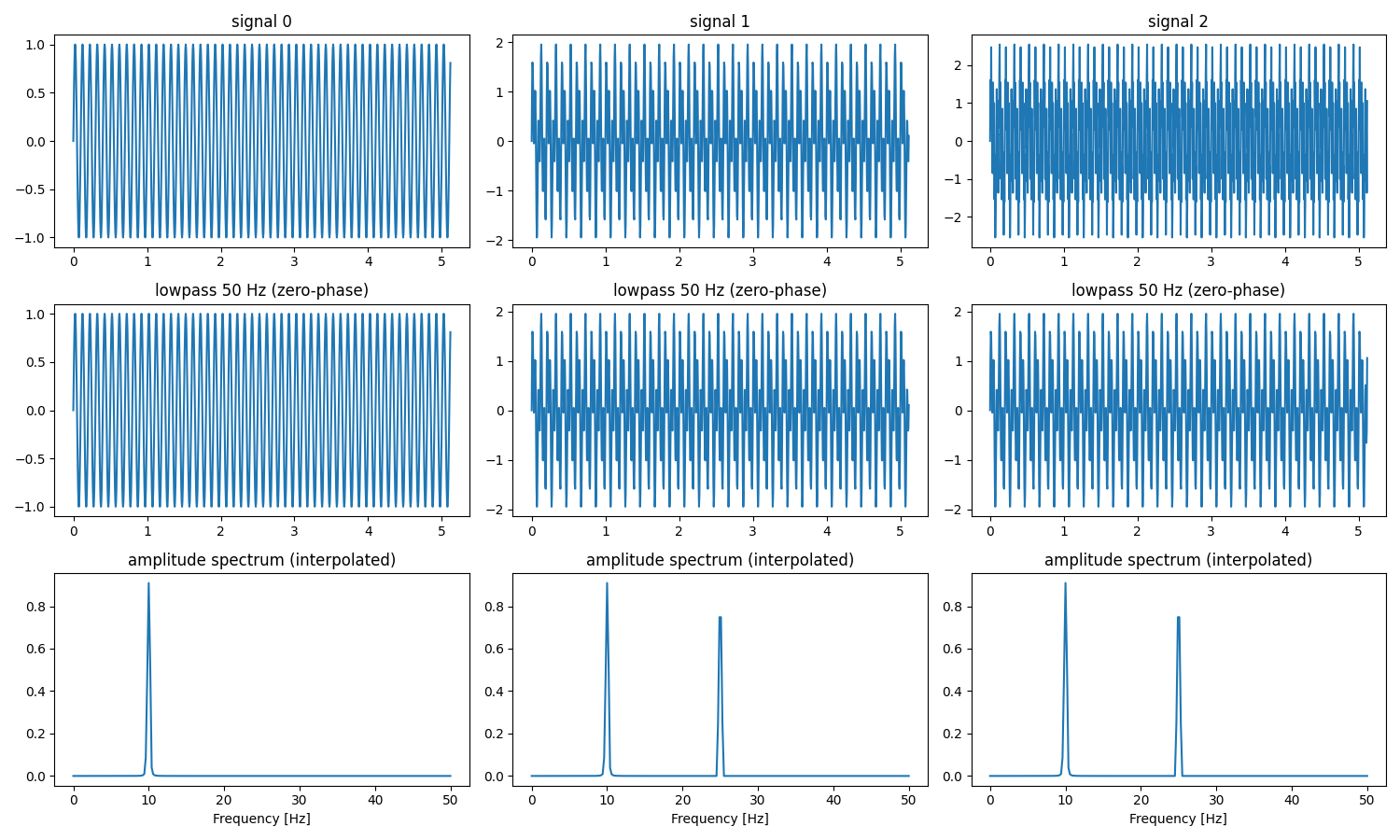
import polars as pl
import polars_list_utils as polist

Fs, N = 200.0, 1024
FREQS = [i * Fs / N for i in range(N // 2 + 1)]

df = (
    df
    .with_columns(
        polist.apply_butterworth(
            "signal",
            sample_rate=Fs,
            max_freq=50.0,
        )
        .alias("filtered")
    )
    .with_columns(
        polist.apply_fft(
            "filtered",
            sample_rate=Fs,
            window="hann",
            scaling="amplitude",
        )
        .alias("fft")
    )
    .with_columns(
        polist.agg_slices(
            "fft",
            pl.lit(FREQS),
            aggregation="mean",
            slices_include=[(20.0, 30.0)],
        )
        .alias("mean_20_30hz")
    )
)
See examples/showcase.py for the full pipeline:
Installation (user)
uv pip install polars-list-utils
Installation (developer)
- Setup Rust (i.e. install rustup)
- Setup Python (i.e. install uv)
- Setup environment and compile plugin:
uv sync --extra dev
uv run maturin develop --release --uv
- (Maybe) configure Cargo to find uv's Python installs. For example:
# .cargo/config.toml
[env]
PYO3_PYTHON = "C:\\Users\\travis.hammond\\AppData\\Roaming\\uv\\python\\cpython-3.12.0-windows-x86_64-none\\python.exe"
- Test and run the example:
uv run pytest
uv run ./examples/showcase.py
- Lint:
uvx ty check
uvx ruff check
cargo clippy --release -- -D warnings
cargo fmt
Changelog
2.0.0
One bundled breaking release. New: the sum aggregation everywhere; zip_binary
(element-wise arithmetic, Kleene and/or, and total-ordered comparisons between two
list columns); cum_agg_runs (cumulative aggregation within gate-delimited runs, matching
Polars' cum_* semantics); Array columns accepted by every function, with the container
preserved; and an empty switch on the aggregations choosing what the sum of nothing is
-- "null" (default) or Polars' "zero".
Breaking: strict checks are on by default (unsorted interpolation axes, invalid ranges,
and lossy agg_lists truncation now raise; pass strict=False for the old leniency).
Wrong shape raises instead of yielding null rows (non-power-of-two FFT lengths, too-short
Butterworth signals, empty lists into transforms -- pre-filter with list.len() upstream),
while NaN/±inf now propagate into visibly invalid output instead of becoming null: guard
thresholds with is_finite(). Float32 columns stay Float32, count returns UInt32,
and integer inner dtypes raise. FFT scalings use scipy's names -- power -> spectrum,
psd -> density, plus new amplitude_squared; window names are unchanged. The
even-count median now matches Polars exactly (last-ulp changes on stored features).
Fixed: Array inputs no longer abort the process; no input dtype can panic; aliased or
JSON-shaped range arguments no longer crash agg_slices.
1 maintainer

Metadata
1 maintainer
Release files for polars-list-utils 2.0.0
For a detailed explanation of source distributions (sdists) and built distributions (wheels), please see the package formats documentation.
Source distribution (sdist)
| File | Size | Uploaded | |
|---|---|---|---|
| polars_list_utils-2.0.0.tar.gz | 373.6 kB | Details |
Built distributions (wheels)
| File | Reset | |||
|---|---|---|---|---|
| polars_list_utils-2.0.0-cp310-abi3-win_amd64.whl | CPython 3.10 | abi3 | Windows x86-64 | Details |
| polars_list_utils-2.0.0-cp310-abi3-manylinux_2_17_x86_64.manylinux2014_x86_64.whl | CPython 3.10 | abi3 | Linux glibc 2.17+ x86-64 | Details |
| polars_list_utils-2.0.0-cp310-abi3-manylinux_2_17_aarch64.manylinux2014_aarch64.whl | CPython 3.10 | abi3 | Linux glibc 2.17+ ARM64 | Details |
| polars_list_utils-2.0.0-cp310-abi3-macosx_11_0_arm64.whl | CPython 3.10 | abi3 | macOS 11.0+ ARM64 | Details |
| polars_list_utils-2.0.0-cp310-abi3-macosx_10_12_x86_64.whl | CPython 3.10 | abi3 | macOS 10.12+ x86-64 | Details |
Total release size: 32.0 MB
Release files / polars_list_utils-2.0.0.tar.gz
| Download URL | polars_list_utils-2.0.0.tar.gz |
|---|---|
| Size | 373.6 kB |
| Tags | Source |
|
SHA-256 checksum How to use checksums |
0058c10d170704b9f80dae6aaa312721afcff45573533e21e9623fe0db55c993
|
|
BLAKE2b-256 checksum How to use checksums |
113cae1d712ad6bc92179ce157578c4b0fb50e896dbe4660b78b24d436bf4296
|
| Upload date | |
|
Uploaded using Trusted Publishing? What is trusted publishing? |
No |
| Uploaded via |
maturin/1.15.0
|
Release files / polars_list_utils-2.0.0-cp310-abi3-win_amd64.whl
| Download URL | polars_list_utils-2.0.0-cp310-abi3-win_amd64.whl |
|---|---|
| Size | 6.2 MB |
| Tags | CPython 3.10 Windows x86-64 abi3 |
|
SHA-256 checksum How to use checksums |
37ff66394154de9fa8b2295234bf4abf464986596a5118b16d49a4a02c3e50e9
|
|
BLAKE2b-256 checksum How to use checksums |
5f21f4c0663034c7857812c0918bcde6c96b7dea1216228c67a535acb174760f
|
| Upload date | |
|
Uploaded using Trusted Publishing? What is trusted publishing? |
No |
| Uploaded via |
maturin/1.15.0
|
Release files / polars_list_utils-2.0.0-cp310-abi3-manylinux_2_17_x86_64.manylinux2014_x86_64.whl
| Download URL | polars_list_utils-2.0.0-cp310-abi3-manylinux_2_17_x86_64.manylinux2014_x86_64.whl |
|---|---|
| Size | 6.9 MB |
| Tags | CPython 3.10 Linux glibc 2.17+ x86-64 abi3 |
|
SHA-256 checksum How to use checksums |
f1a03052032e7a8f02e3b5ced8fd370052bed02c9eba62ac611066dd912e00e7
|
|
BLAKE2b-256 checksum How to use checksums |
d470e06bdbe59b788e4c458f362ba6290f2f2f26de70324daf0e0660dc39ec61
|
| Upload date | |
|
Uploaded using Trusted Publishing? What is trusted publishing? |
No |
| Uploaded via |
maturin/1.15.0
|
Release files / polars_list_utils-2.0.0-cp310-abi3-manylinux_2_17_aarch64.manylinux2014_aarch64.whl
| Download URL | polars_list_utils-2.0.0-cp310-abi3-manylinux_2_17_aarch64.manylinux2014_aarch64.whl |
|---|---|
| Size | 6.8 MB |
| Tags | CPython 3.10 Linux glibc 2.17+ ARM64 abi3 |
|
SHA-256 checksum How to use checksums |
fd0ba248c5e1a51418fec4631d15e314b1792da6e3bb0900dfd8394024c99134
|
|
BLAKE2b-256 checksum How to use checksums |
b91f500220aeef55b143f4f1fe4c4e236d12afb8a81a0afb5a4ceff9651ccd44
|
| Upload date | |
|
Uploaded using Trusted Publishing? What is trusted publishing? |
No |
| Uploaded via |
maturin/1.15.0
|
Release files / polars_list_utils-2.0.0-cp310-abi3-macosx_11_0_arm64.whl
| Download URL | polars_list_utils-2.0.0-cp310-abi3-macosx_11_0_arm64.whl |
|---|---|
| Size | 5.6 MB |
| Tags | CPython 3.10 abi3 macOS 11.0+ ARM64 |
|
SHA-256 checksum How to use checksums |
b33759b132d9dd1bf2197a952db385a3f311a455c76184f7c36fde4f2596f2ab
|
|
BLAKE2b-256 checksum How to use checksums |
b6c74fb3662539b9e2387b515f2a4b79a5a6f362aa10302c624ac182b136bf50
|
| Upload date | |
|
Uploaded using Trusted Publishing? What is trusted publishing? |
No |
| Uploaded via |
maturin/1.15.0
|
Release files / polars_list_utils-2.0.0-cp310-abi3-macosx_10_12_x86_64.whl
| Download URL | polars_list_utils-2.0.0-cp310-abi3-macosx_10_12_x86_64.whl |
|---|---|
| Size | 6.0 MB |
| Tags | CPython 3.10 abi3 macOS 10.12+ x86-64 |
|
SHA-256 checksum How to use checksums |
c88b29aa7611a53a52e3fdf550a0e5b47a62a3000e990c3ba1b9954f4d8af9fd
|
|
BLAKE2b-256 checksum How to use checksums |
01a63e19e0978eb71f9a4674c8e0d225cc0158d495e59113bb126aa015042c3c
|
| Upload date | |
|
Uploaded using Trusted Publishing? What is trusted publishing? |
No |
| Uploaded via |
maturin/1.15.0
|














