
PolicyAware AI Gateway & Agent Control Plane
PyPI: policyaware | Downloads: Pepy stats | Python: 3.10+ | License: Apache-2.0 | Docs: GitHub Pages
PolicyAware adds deny-by-default policy, PII redaction, MCP tool governance, model routing, runtime evaluation, local code scanning, and audit traces to LLM, RAG, and AI agent applications in minutes.
PolicyAware is an open-source AI control plane and security gateway for governed LLM applications, RAG pipelines, MCP-style tools, and autonomous AI agents. Distributed as a lightweight Python package (pip install policyaware), it helps teams inspect prompts, request context, tool calls, model routing decisions, outputs, local code, and audit traces before AI workflows move into production.
Unlike basic content filters that only check text strings, PolicyAware provides policy-aware governance across requests, tools, models, evaluations, and local code scans.
Deployment model: PolicyAware is an adoption-ready open-source framework that teams embed and operate inside their own AI applications, platforms, and CI workflows. It keeps the base install lightweight with native rules-based governance, and uses optional integrations such as Presidio, ProtectAI/Transformers, NeMo Guardrails, Guardrails AI, Haystack, and provider adapters when teams need deeper detection or ecosystem-specific behavior.
Documentation site: https://ktirupati.github.io/policyaware/
Capability docs: docs/capabilities.md Ready-to-use YAML policies: docs/capabilities/ready-to-use-yaml.md Comparison guide: PolicyAware vs guardrails vs AI gateway vs model router Alternatives guide: PolicyAware alternatives for guardrails, AI gateways, model routers, and MCP governance Usage modes: Gateway vs callbacks vs tool governance vs scan Enterprise readiness: enterprise AI governance checklist Limitations: current scope and production validation notes Security model: deny-by-default and layered AI governance Examples matrix: choose the right runnable example Compatibility: Python, providers, extras, and integration status Integrations strategy: official vs compatible integrations Benchmarks: lightweight governance benchmarks Demo outputs: captured terminal output for runnable examples Changelog: release history
Enterprise Core Capabilities
1. Agent Control Plane And MCP Governance
- Action-level tool governance: Evaluates connector names, action names, arguments, user role, tenant, region, and approval requirements before agent tools execute.
- Deny-by-default tool shielding: Supports MCP-style tool policies that block unauthorized or destructive actions unless explicitly allowed.
2. Multi-Engine Security And Guardrail Orchestration
- Unified governance pipeline: Combines data protection, YAML policy enforcement, risk classification, model routing, guardrail adapters, evaluation, and audit logging in one modular Python framework.
- Optional security integrations: Supports optional integrations such as Microsoft Presidio for stronger PII detection, ProtectAI/Transformers-based classifiers for ML signals, NVIDIA NeMo Guardrails, and Guardrails AI adapters.
3. Cost-Aware Runtime Routing And FinOps Controls
- Policy-based model routing: Routes requests across local and external model providers based on task type, risk level, region, provider availability, cost, quality, and policy constraints.
- Token and budget controls: Supports token, budget, and risk-aware limits to help reduce runaway agent loops and uncontrolled model usage.
4. Observability, Audit, And Local Code Scanning
- Audit-ready traces: Records structured policy decisions, risk tiers, reason codes, model choices, evaluation scores, token estimates, and request/response snapshots.
- Observability exporters: Provides Prometheus-style and OpenTelemetry-shaped exports for integration with monitoring and compliance workflows.
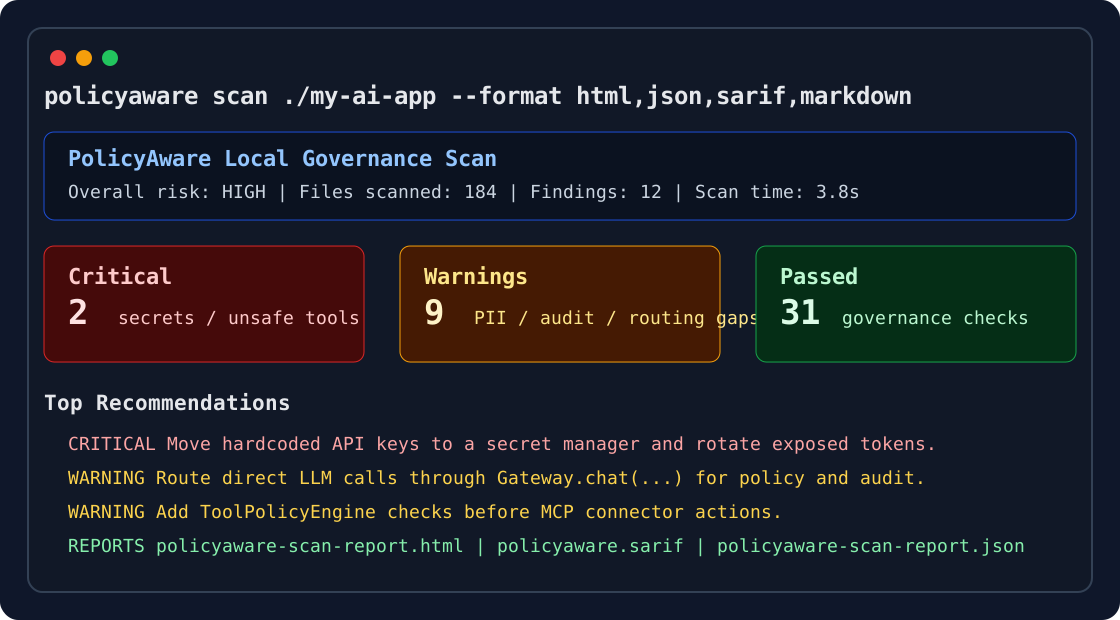
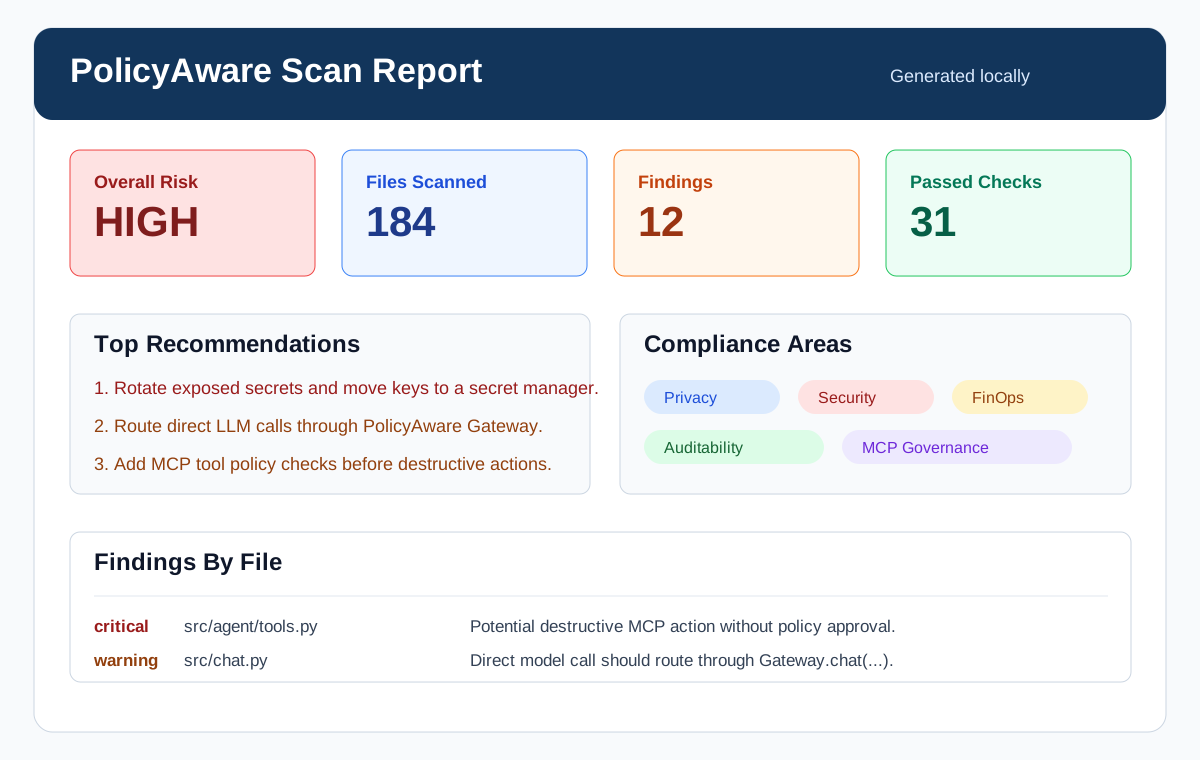
- PolicyAware Scan CLI: Scans local codebases for PII, PHI, secrets, direct LLM calls, missing tool governance, weak routing controls, audit gaps, and configuration risks, then generates developer-friendly HTML, JSON, SARIF, and Markdown reports.
- Framework callbacks: Includes lightweight LangChain and LlamaIndex callback handlers that aggregate streamed tokens and report policy, risk, leakage, eval, and token-accounting results.
- LangGraph node guard: Adds dependency-free node/state and tool-call governance for graph-based AI agents.
- Haystack governance components: Adds optional Haystack-style components for RAG query governance, output evaluation, and agent tool permission checks.
- Microsoft AGT-style evidence export: Converts PolicyAware policy, tool, gateway, and audit decisions into dependency-free evidence JSON for enterprise agent governance workflows.
- Smart integration recommender: Inspects project signals and user hints to recommend FastAPI, LangChain, LangGraph, Haystack, MCP/tool governance, privacy, guardrails, routing, audit, or scan entry points with reasons.
Runtime Flow Summary
flowchart LR
    A["AI App / RAG Pipeline / Agent"] --> B["PolicyAware SDK / CLI / Middleware / Callback"]
    B --> C["Data Protection"]
    C --> D["Risk Classification"]
    D --> E["Policy Decision"]
    E -->|deny| F["Stop"]
    E -->|approval| G["Human Approval"]
    E -->|allow| H["Model Routing"]
    E --> J["MCP Tool Governance"]
    H --> I["Model Provider"]
    J --> K["Tool / Connector"]
    I --> L["Runtime Evaluation"]
    K --> L
    L --> M["Audit Trace / Evidence"]
Read more: Architecture
Which Entry Point Should I Use?
| Need | Use |
|---|---|
| Full model request control, routing, eval, and audit | Gateway.chat(...) |
| Existing LangChain or LlamaIndex pipeline telemetry | PolicyAwareCallbackHandler |
| LangGraph node/state governance | PolicyAwareNodeGuard |
| MCP-style connector/action permissions | ToolPolicyEngine |
| Pre-deployment code governance scan | policyaware scan ./app |
| Microsoft AGT-style evidence export | to_agt_tool_evidence(...) |
| Find the best integration for a project | policyaware integrations recommend . |
| Simple PII/PHI/secrets string check | DataProtectionEngine.inspect(...) |
| YAML policy unit testing | PolicyEngine.decide(...) |
Read more: Usage Modes
Where PolicyAware Fits
Use Guardrails AI or NeMo Guardrails when your main goal is conversational safety, structured outputs, or model response validation.
Use an AI gateway or model router when your main goal is provider abstraction, API key handling, retries, rate limits, fallback, or cost/latency routing.
Use PolicyAware when AI requests and agent actions need governance: user/tenant/context policy, PII/PHI/secrets handling, MCP/tool permissions, approval decisions, model routing after policy approval, evaluations, and audit evidence.
Short version: use PolicyAware when AI actions need governance, not just generation.
Scan Report Preview
Author
Created and maintained by Krishna Kishor Tirupati.
Project links:
- PyPI: policyaware
- GitHub: ktirupati/policyaware
- Documentation: PolicyAware AI Gateway Docs
- LinkedIn: Krishna Tirupati
Feedback And Testimonials
Using PolicyAware in a project, prototype, enterprise AI workflow, security review, or governance evaluation?
Please share feedback, use cases, feature requests, and testimonials through the channels below:
- Private structured feedback form: PolicyAware User Feedback And Testimonials
- Public discussions: GitHub Discussions
- Testimonials and user stories: Show and Tell
- Issues and bugs: GitHub Issues
Helpful feedback includes what you built, which PolicyAware feature you used, what risk or governance gap it helped identify, and what should improve next.
Please do not share secrets, private prompts, PHI, PII, customer data, or confidential internal details.
Contributing And Roadmap
PolicyAware welcomes focused contributions from developers, AI platform engineers, security engineers, and governance practitioners.
- Contributing guide: CONTRIBUTING.md
- Roadmap: ROADMAP.md
- Good first issues: GOOD_FIRST_ISSUES.md
- Security policy: SECURITY.md
- Adoption and impact tracking: ADOPTION.md
- Curated testimonials: TESTIMONIALS.md
Quick Start
pip install policyaware
policyaware about
policyaware feedback
policyaware integrations list
policyaware integrations recommend .
policyaware integrations recommend . --use-case rag --framework haystack --needs "citations pii audit"
policyaware integrations recommend . --html integration-report.html
policyaware doctor
policyaware examples list
policyaware examples run langgraph-agent-governance
policyaware init
policyaware policy validate policyaware.yaml
policyaware policy migrate policyaware.yaml --to 0.3 --out policyaware.v0.3.yaml
policyaware dev simulate
policyaware risk classify "Email jane@example.com about a patient diagnosis" --domain healthcare
policyaware scan ./mylocalfolder
policyaware scan ./mylocalfolder --json policyaware-scan-report.json --fail-on high
policyaware scan ./mylocalfolder --sarif policyaware.sarif
policyaware scan ./mylocalfolder --markdown policyaware-scan-report.md
policyaware scan ./mylocalfolder --baseline policyaware-baseline.json
policyaware scan ./mylocalfolder --config examples/policyaware-scan.yaml
policyaware scan ./mylocalfolder --diff --diff-base origin/main
policyaware scan ./mylocalfolder --format html,json,sarif,markdown
policyaware guards list examples/full-stack-guardrails/policy.yaml
Installation Profiles
The default install is intentionally lightweight. It includes the core CLI, local scanner, policy engine, routing abstractions, cost/risk governance primitives, audit/eval contracts, and YAML policy support.
pip install policyaware
Install optional integrations only when you need them:
pip install "policyaware[privacy]"     # Presidio + spaCy privacy detection
pip install "policyaware[guardrails]"  # NeMo Guardrails + Guardrails AI
pip install "policyaware[haystack]"    # Haystack RAG/agent integration environment
pip install "policyaware[providers]"   # Provider extras such as Bedrock boto3
pip install "policyaware[ml]"          # Transformers/Torch classifiers
pip install "policyaware[onnx]"        # ONNX runtime path for supported classifiers
pip install "policyaware[all]"         # All optional integrations
Backward-compatible aliases are also available:
pip install "policyaware[presidio]"
pip install "policyaware[nemo]"
pip install "policyaware[guardrails-ai]"
pip install "policyaware[full]"
For local development from this repository:
pip install -e ".[dev]"
policyaware policy test examples/policies/basic.yaml
policyaware policy validate examples/policies/basic.yaml
policyaware risk classify "Summarize this patient diagnosis" --domain healthcare
policyaware tools check examples/policies/tool-governance.yaml --agent code_assistant --connector github --action create_pr
policyaware eval run examples/evals/support_rag.yaml
policyaware scan . --out policyaware-scan-report.html
policyaware scan . --include ".py,.yaml,.json" --exclude "tests,fixtures"
policyaware scan . --write-baseline policyaware-baseline.json
policyaware scan . --config examples/policyaware-scan.yaml --format html,json,sarif,markdown
For copy-pasteable end-to-end examples, see Working Examples.
Local code scan docs: policyaware scan
CLI usability docs: doctor, examples, migration, recommendation reports
Microsoft AGT-style interop example: examples/microsoft-agt-interop
LangGraph governance example: examples/langgraph-agent-governance
Enterprise control-plane demo: examples/enterprise-ai-control-plane
Generate A Starter Policy
Create a NIST-aligned baseline starter policy in the current directory:
policyaware init
policyaware policy validate policyaware.yaml
Use a custom path or overwrite intentionally:
policyaware init --out config/policyaware.yaml
policyaware init --out policyaware.yaml --force
The generated template is deny-by-default and includes baseline rules for PII/PHI/secrets handling, risky MCP/tool command blocking, approval for side-effecting tool actions, token budget caps, and high-iteration agent workflows.
LangChain And LlamaIndex Callbacks
Use callbacks when you already have an LLM framework pipeline and want PolicyAware governance results without changing the model call.
from policyaware.integrations.langchain import PolicyAwareCallbackHandler

policyaware_callback = PolicyAwareCallbackHandler(config="policyaware.yaml")

response = chain.invoke(
    {"question": "Summarize this customer ticket."},
    config={"callbacks": [policyaware_callback]},
)

result = policyaware_callback.last_result
print(result.policy_decision.decision)
print(result.risk.tier)
print(result.output_findings.contains_sensitive)
Streaming-friendly manual example:
from policyaware.integrations.langchain import PolicyAwareCallbackHandler

handler = PolicyAwareCallbackHandler(config="policyaware.yaml")
handler.on_llm_start(prompts=["Email jane@example.com with the ticket summary."])

for token in ["Safe ", "summary ", "without ", "private ", "data."]:
    handler.on_llm_new_token(token)

result = handler.on_llm_end()
print(result.to_dict())
LlamaIndex-style callbacks are also available:
from policyaware.integrations.llamaindex import PolicyAwareCallbackHandler

handler = PolicyAwareCallbackHandler(config="policyaware.yaml")
handler.on_event_start(payload={"query_str": "Answer with citations from policy documents."})
handler.on_llm_new_token("The policy requires citation review [doc-1].")
result = handler.on_event_end(payload={})
More details: LangChain and LlamaIndex callback integrations
Copy-Paste Examples
- FastAPI LLM policy middleware: protect a FastAPI
/chatendpoint with policy checks before model execution. - LangChain policy guardrails: wrap a chain-style LLM call with deny-by-default policy, PII redaction, and secret blocking.
- MCP tool permission gateway: govern connector-level and action-level tool permissions for agent workflows.
- Haystack RAG governance: add PolicyAware query, output, and tool governance around Haystack-style RAG and agent workflows.
- PII redaction policy: inspect and redact sensitive text before model execution.
- Regulated RAG assistant: require citations and stricter controls for healthcare-style RAG.
- Provider routing by risk: route public-safe requests to low-cost models and high-risk requests to approved models.
- Audit trace viewer: write audit traces and generate a local HTML trace viewer.
- Approval workflow hooks: send high-risk requests to approval instead of calling a model.
- Local code scan: scan local AI app code and generate an HTML governance report.
- Full-stack guardrails: orchestrate NeMo Guardrails, Guardrails AI, or custom validators as input/output guards.
Captured terminal output for the runnable examples is available in docs/demo-outputs.md.
Articles
- PolicyAware vs Guardrails vs AI Gateways vs Model Routers
- Build a Policy-Aware AI Gateway in Python
- Stop Shipping AI Features Without Guardrails
from policyaware import Gateway, GatewayRequest

gateway = Gateway.from_policy_file("examples/policies/basic.yaml")

response = gateway.chat(
    GatewayRequest(
        tenant="acme",
        app="claims-assistant",
        user={"id": "u_123", "role": "claims_adjuster"},
        context={"region": "us", "task_type": "summarization", "risk": "low"},
        messages=[{"role": "user", "content": "Summarize claim ACME-42."}],
    )
)

print(response.content)
print(response.policy.decision)
print(response.policy.reason_codes)
print(response.trace_id)
Architecture
Application / Agent / RAG App
        |
        v
PolicyAware SDK / Middleware
        |
        v
Identity + Context Resolver
        |
        v
Policy Decision Engine -> Data Protection Engine -> Model Router -> Provider/Tool
        |
        v
Runtime Evaluation -> Audit Trace -> Response
Repository Layout
src/policyaware/
  audit.py              Request traces and audit export records
  cli.py                policyaware CLI
  data_protection.py    PII/PHI/secret detection and redaction
  evals.py              Offline and runtime evaluation primitives
  gateway.py            Main SDK facade
  models.py             Core typed contracts
  policy.py             Deny-by-default policy engine
  providers.py          Provider abstraction and local simulated provider
  routing.py            Policy-aware model routing
  integrations/         FastAPI, Flask, LangChain, LlamaIndex shims
examples/
  policies/
  evals/
tests/
Policy Example
id: basic_enterprise_policy
default: deny

rules:
  - name: allow_low_risk_support
    effect: allow
    when:
      user.role_in: ["support_agent", "claims_adjuster"]
      request.risk_in: ["low", "medium"]
      data.contains_secrets: false

  - name: redact_pii_for_non_privileged_users
    effect: transform
    action: redact
    when:
      data.contains_pii: true
      user.role_not_in: ["privacy_admin", "compliance_officer"]

  - name: require_approval_for_high_risk
    effect: require_approval
    when:
      request.risk: "high"
Development Status
This is a production-oriented open-source framework: the core extension points and executable behavior are present, while teams can connect their preferred identity systems, workflow tools, storage backends, dashboards, and enterprise review processes around it.
v0.2 MVP Capabilities
- Deterministic risk classification: low, medium, high, critical.
- Explainable policy decisions with reason codes and remediation.
- Replayable audit trace snapshots.
- Audit bundle generation.
- Tool governance policies for MCP-style connectors and actions.
- Governance-aware eval report schema.
- Provider adapters for OpenAI-compatible APIs, Azure OpenAI, Anthropic, Bedrock, Vertex AI, Ollama, and vLLM.
- Optional ML signal integrations for Presidio PII detection, ProtectAI prompt-injection detection, and custom Transformers domain/risk classifiers.
- Optional NeMo Guardrails and Guardrails AI adapters for full-stack guardrail orchestration.
- Fast local code scanner and HTML recommendation report.
- SQLite audit storage and static trace viewer.
- Prometheus text and OpenTelemetry-shaped JSON exporters.
- File and webhook approval hooks.
- Executable golden dataset policy checks.
Third-Party ML Models
Optional ML integrations may download third-party models at runtime. PolicyAware does not bundle model weights. Review and accept the license or access terms for any model you configure, especially gated Hugging Face models.
Recommended GitHub Topics
For discovery, use repository topics such as llm, ai-gateway, llm-governance, guardrails, rag, mcp, ai-agents, pii-redaction, model-routing, audit, python, and open-source.
License
Apache-2.0
1 maintainer

Download files
Download the file for your platform. If you're not sure which to choose, learn more about installing packages.
Source Distribution
Built Distribution
Filter files by name, interpreter, ABI, and platform.
If you're not sure about the file name format, learn more about wheel file names.
Copy a direct link to the current filters
File details
Details for the file policyaware-0.3.1.tar.gz.
File metadata
- Download URL: policyaware-0.3.1.tar.gz
- Upload date:
- Size: 238.6 kB
- Tags: Source
- Uploaded using Trusted Publishing? Yes
- Uploaded via:
twine/7.0.0 CPython/3.13.14
File hashes
| Algorithm | Hash digest | |
|---|---|---|
| SHA256 |
7f4f0bf4d98dc003520cbc1b126e08c1ba1807825c47c462e862e35e8d60dbeb
|
|
| MD5 |
47efadc651e84933762feb19347fdffd
|
|
| BLAKE2b-256 |
8c34b93f412b1478db51193e076f793f64760579024245446df352860c504d55
|
Provenance
The following attestation bundles were made for policyaware-0.3.1.tar.gz:
Publisher:
publish.yml on ktirupati/policyaware
-
Statement:
-
Statement type:
https://in-toto.io/Statement/v1 -
Predicate type:
https://docs.pypi.org/attestations/publish/v1 -
Subject name:
policyaware-0.3.1.tar.gz -
Subject digest:
7f4f0bf4d98dc003520cbc1b126e08c1ba1807825c47c462e862e35e8d60dbeb - Sigstore transparency entry: 2335457634
- Sigstore integration time:
-
Permalink:
ktirupati/policyaware@9fa727f26af26a1e4454b840857ecb4bcd53cba6 -
Branch / Tag:
refs/tags/v0.3.1 - Owner: https://github.com/ktirupati
-
Access:
public
-
Token Issuer:
https://token.actions.githubusercontent.com -
Runner Environment:
github-hosted -
Publication workflow:
publish.yml@9fa727f26af26a1e4454b840857ecb4bcd53cba6 -
Trigger Event:
push
-
Statement type:
File details
Details for the file policyaware-0.3.1-py3-none-any.whl.
File metadata
- Download URL: policyaware-0.3.1-py3-none-any.whl
- Upload date:
- Size: 93.9 kB
- Tags: Python 3
- Uploaded using Trusted Publishing? Yes
- Uploaded via:
twine/7.0.0 CPython/3.13.14
File hashes
| Algorithm | Hash digest | |
|---|---|---|
| SHA256 |
8f515e6c6311581b34d2f25f511f5a21febbd71057d906a63c52ff6e7767e8e6
|
|
| MD5 |
1397d3c8a503ffba318632fae0ae4dd9
|
|
| BLAKE2b-256 |
66cc67ed0657f5350f004d516082ca3e500c149c4b5c51f1607e11980f7304d5
|
Provenance
The following attestation bundles were made for policyaware-0.3.1-py3-none-any.whl:
Publisher:
publish.yml on ktirupati/policyaware
-
Statement:
-
Statement type:
https://in-toto.io/Statement/v1 -
Predicate type:
https://docs.pypi.org/attestations/publish/v1 -
Subject name:
policyaware-0.3.1-py3-none-any.whl -
Subject digest:
8f515e6c6311581b34d2f25f511f5a21febbd71057d906a63c52ff6e7767e8e6 - Sigstore transparency entry: 2335457659
- Sigstore integration time:
-
Permalink:
ktirupati/policyaware@9fa727f26af26a1e4454b840857ecb4bcd53cba6 -
Branch / Tag:
refs/tags/v0.3.1 - Owner: https://github.com/ktirupati
-
Access:
public
-
Token Issuer:
https://token.actions.githubusercontent.com -
Runner Environment:
github-hosted -
Publication workflow:
publish.yml@9fa727f26af26a1e4454b840857ecb4bcd53cba6 -
Trigger Event:
push
-
Statement type:







