
polystep





Gradient-free neural network training via optimal transport.
Accepted at Transactions on Machine Learning Research (TMLR).
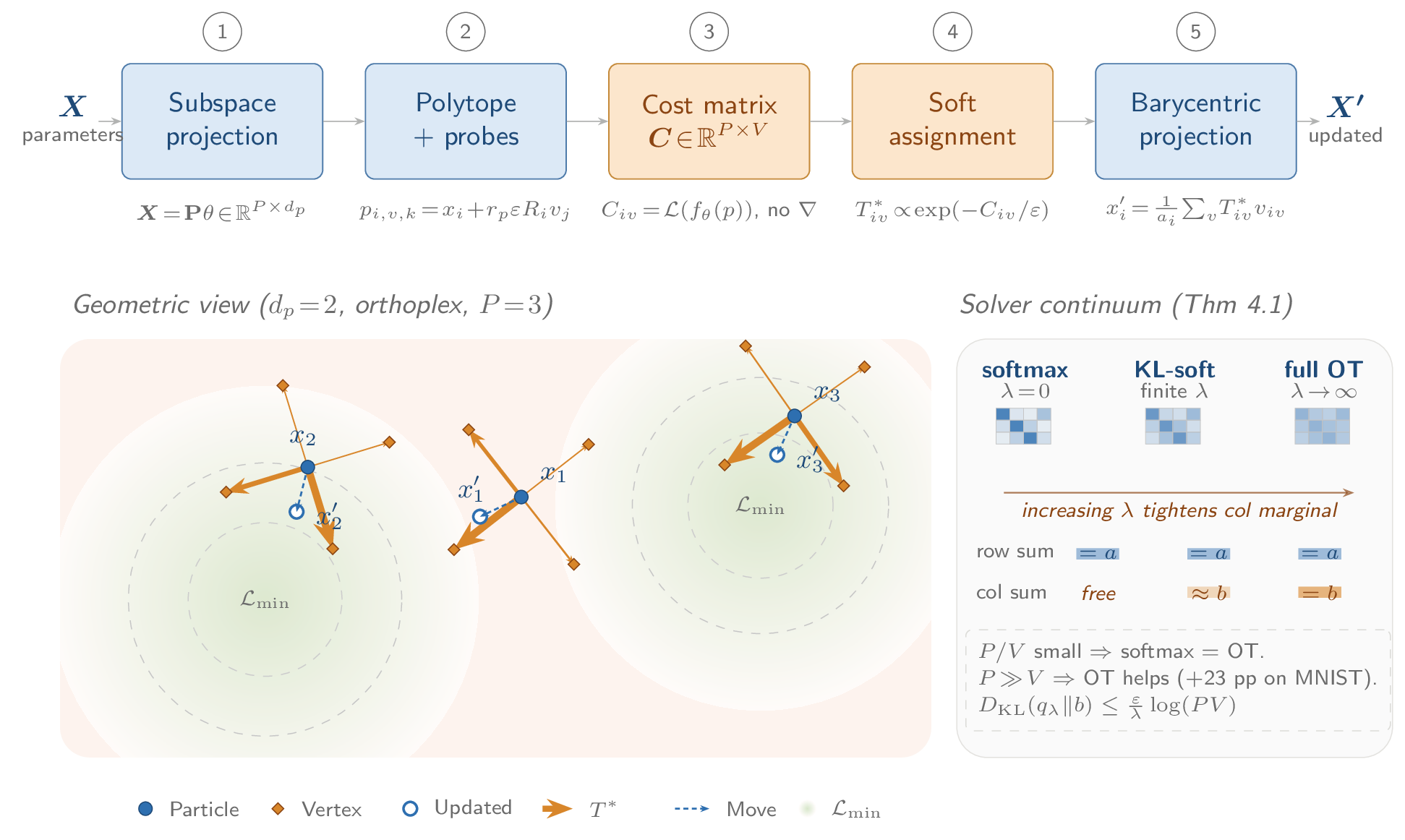
PolyStep evaluates finite-radius parameter perturbations and updates parameters through a weighted barycenter. It supports spiking networks, quantized layers, hard routing, and other models without useful gradients. For differentiable models, backpropagation is usually faster.
Paper · Interactive visualization · API reference · Julia package
Installation
pip install polystep
pip install "polystep[examples]"  # dependencies for the repository's examples
Python 3.11+ and PyTorch 2.8+ are required. Choose a CUDA build compatible with your
driver from the PyTorch installation guide.
For development, install pip install -e ".[dev]" from a checkout.
Quickstart
import torch
from torch import nn
from torch.utils.data import DataLoader, TensorDataset
from polystep import HybridSubspace, ParamLayout, PolyStepOptimizer, TrainConfig, train

model = nn.Sequential(nn.Linear(16, 32), nn.ReLU(), nn.Linear(32, 3))
loader = DataLoader(
    TensorDataset(torch.randn(256, 16), torch.randint(0, 3, (256,))),
    batch_size=32,
)
subspace = HybridSubspace.from_layout(
    ParamLayout.from_module(model), rank=4, max_subspace_dim=128,
)
optimizer = PolyStepOptimizer(model, subspace=subspace, solver="softmax")
train(model, loader, nn.CrossEntropyLoss(), optimizer, TrainConfig(epochs=5))
Replace the generated data with your dataset. max_subspace_dim=128 caps the search
at 128 coordinates, so each step scores 144 candidates. In manual loops, call
register_evaluator() before each batch; train() does this automatically. See
performance
for candidate paths, thread counts, compilation, and memory settings.
Ask/tell
from polystep import PolyStepES

es = PolyStepES(dim=20, epsilon=0.1, step_radius=0.3)
for _ in range(300):
    candidates = es.ask()
    es.tell(candidates.square().sum(dim=1))
print(es.best_fitness, es.best_solution)
Synthetic objectives
import torch
from polystep import Ackley
from polystep.solver import PolyStep

solver = PolyStep.create(Ackley(dim=10), epsilon=0.5, max_iterations=50)
state = solver.run(torch.randn(100, 10))
Method
Each step samples a rotated polytope, evaluates its vertices, computes transport weights, and moves to their barycenter. Subspaces reduce the number of coordinates searched. Softmax normalizes each particle's vertex weights; Sinkhorn also enforces the target marginal.
Finite-radius probes can cross flat regions of discontinuous losses. Performance depends on the radius, representation, and evaluation budget. PolyStep's optional quadratic models and radius controllers are implementation heuristics; they do not inherit classical direct-search or trust-region guarantees.
Baselines
polystep.baselines provides openai_es, spsa, mezo, random_search, eggroll,
and cma_es, which needs pip install cma. One evaluation means one candidate
scored, even when candidates are batched:
from polystep.baselines import Objective, openai_es

objective = Objective(lambda x: x.square().sum(1), dim=64, budget=10_000)
result = openai_es(objective, sigma=0.05, lr=0.1, popsize=32)
The paper runners match search spaces, budgets and tuning as the reproducibility guide describes.
Benchmarks
Five-seed mean ± sample standard deviation, with configurations and checkpoints selected on validation data; the probSAT and RC2 columns are single runs. In the architecture tables, OpenAI-ES, CMA-ES and EGGROLL get PolyStep's candidate-evaluation budget, and SPSA, MeZO and random search get its step count. On argmax attention, hard MoE and ETTh1, the population methods instead get 32 evaluations per PolyStep step, spent at their own population size, and Adam trains for PolyStep's 30 epochs, except 50 on ETTh1. On MAX-SAT, CMA-ES and OpenAI-ES get 50 evaluations per PolyStep step. OpenAI-ES scores 50 candidates at each of PolyStep's steps, while CMA-ES doubles its population at each restart and takes fewer generations. The tables were recorded before 1.0; the reproducibility guide lists the rows that 1.0 changes. The experiment index has the full tables.
Non-differentiable tasks
Test accuracy %. A dash means the method was not run on that task.
| Task | PolyStep | CMA-ES | OpenAI-ES | SPSA | Adam (surrogate) | Non-diff op |
|---|---|---|---|---|---|---|
| SNN/LIF (MNIST) | 93.0 ± 0.2 | 77.1 ± 13.3 | 79.6 ± 5.2 | 53.9 ± 3.0 | 86.3 ± 10.6 | threshold() |
| Int8 quantized | 97.0 ± 0.1 | 91.6 ± 0.4 | 94.4 ± 0.2 | 82.5 ± 0.5 | 97.8 ± 0.1 | round() |
| Argmax attention | 86.6 ± 0.4 | 79.5 ± 0.5 | 80.0 ± 0.4 | 67.4 ± 1.3 | 88.6 ± 0.1 | argmax() |
| Staircase activation | 94.3 ± 0.1 | 89.2 ± 0.4 | 88.9 ± 0.5 | 45.2 ± 4.2 | 97.5 ± 0.1 | floor() |
| Hard MoE routing | 90.6 ± 0.2 | 77.8 ± 1.5 | 82.5 ± 0.8 | 25.4 ± 3.5 | - | argmax() |
MAX-SAT (% clauses satisfied)
| Variables | PolyStep | CMA-ES | OpenAI-ES | probSAT | RC2 |
|---|---|---|---|---|---|
| 100 | 98.0 ± 0.7 | 99.0 ± 0.3 | 99.4 ± 0.1 | 99.8 | 99.8 |
| 5,000 | 98.1 ± 0.1 | 95.2 ± 0.2 | 92.9 ± 0.2 | 99.9 | timeout |
| 100,000 | 98.1 ± 0.0 | 90.7 ± 0.1 | 88.9 ± 0.0 | 99.6 | timeout |
Differentiable sanity checks
| Task | PolyStep | Adam |
|---|---|---|
| MNIST (2-layer MLP) | 96.8 ± 0.1 | 97.7 ± 0.1 |
| ETTh1 (LSTM, MSE; lower is better) | 0.253 ± 0.023 | 0.247 ± 0.023 |
The SNN surrogate-gradient baseline varies substantially across seeds. Adam leads on the differentiable tasks, and specialized solvers lead on MAX-SAT. See limitations for unsupported configurations and comparison limits.
Documentation
- API reference
- Performance
- Examples
- Experiments and reproduction
- Determinism
- Contributing and changelog
Citation
@article{le2026training,
  title={Training Non-Differentiable Networks via Optimal Transport},
  author={Le, An T},
  journal={Transactions on Machine Learning Research},
  year={2026},
  url={https://openreview.net/forum?id=8mlcqTTMuU}
}
Acknowledgments
Thanks to Viet T. Nguyen for the interactive visualization.
License
1 maintainer

Metadata
1 maintainer
Release files for polystep 1.0.0
For a detailed explanation of source distributions (sdists) and built distributions (wheels), please see the package formats documentation.
Source distribution (sdist)
| File | Size | Uploaded | |
|---|---|---|---|
| polystep-1.0.0.tar.gz | 359.4 kB | Details |
Built distribution (wheel)
| File | Interpreter | ABI | Platform | Reset |
|---|---|---|---|---|
| polystep-1.0.0-py3-none-any.whl | Python 3 | none | any | Details |
Total release size: 522.6 kB
Release files / polystep-1.0.0.tar.gz
| Download URL | polystep-1.0.0.tar.gz |
|---|---|
| Size | 359.4 kB |
| Tags | Source |
|
SHA-256 checksum How to use checksums |
9c5e5050f6e66bc718f1a72137ef82025e4b46f5ede310f371d5b56f11c1af3e
|
|
BLAKE2b-256 checksum How to use checksums |
c3b757b7bb23ac93228a351bb5cbbff1faefd17cecfc99b0f19b871854726525
|
| Upload date | |
|
Uploaded using Trusted Publishing? What is trusted publishing? |
Yes |
| Uploaded via |
twine/7.0.0 CPython/3.13.14
|
Provenance
Provenance describes where a file came from. On PyPI, provenance is shared via attestations, which provide a verifiable record of the build or publishing details. View details, limitations and caveats.


PyPI Publish Attestation
PyPI verified that this artifact, at this checksum, originated from the publisher listed below.
Signed by GitHub Actions, verified by PyPI on Oct 12, 2026.
Transparency logRelease files / polystep-1.0.0-py3-none-any.whl
| Download URL | polystep-1.0.0-py3-none-any.whl |
|---|---|
| Size | 163.2 kB |
| Tags | Python 3 |
|
SHA-256 checksum How to use checksums |
894715dbbb5f0a95dac0afdb600206e5b20d7b06d24fe25276497b6e1f6f9d97
|
|
BLAKE2b-256 checksum How to use checksums |
082aea95d2953e3e1d5b1e245178cba60907c143a570bf2cb6f91a8b9b22ac73
|
| Upload date | |
|
Uploaded using Trusted Publishing? What is trusted publishing? |
Yes |
| Uploaded via |
twine/7.0.0 CPython/3.13.14
|
Provenance
Provenance describes where a file came from. On PyPI, provenance is shared via attestations, which provide a verifiable record of the build or publishing details. View details, limitations and caveats.
PyPI Publish Attestation
PyPI verified that this artifact, at this checksum, originated from the publisher listed below.
Signed by GitHub Actions, verified by PyPI on Oct 12, 2026.
Transparency log













