
poorjev
The poor man's Jev. An open source, local-first "System One" decision layer for LLM apps: typed decisions with provably calibrated confidence. No API key. No waitlist.





Your model's 0.9 is a vibe. poorjev's 0.9 is a measurement.
Every LLM-in-JSON-mode hands you a confidence score and hopes you don't check it. poorjev checks it. On the shipped eval set it cuts calibration error (ECE) from 0.170 to 0.071 with zero loss of accuracy, and it runs on your laptop with no API key.
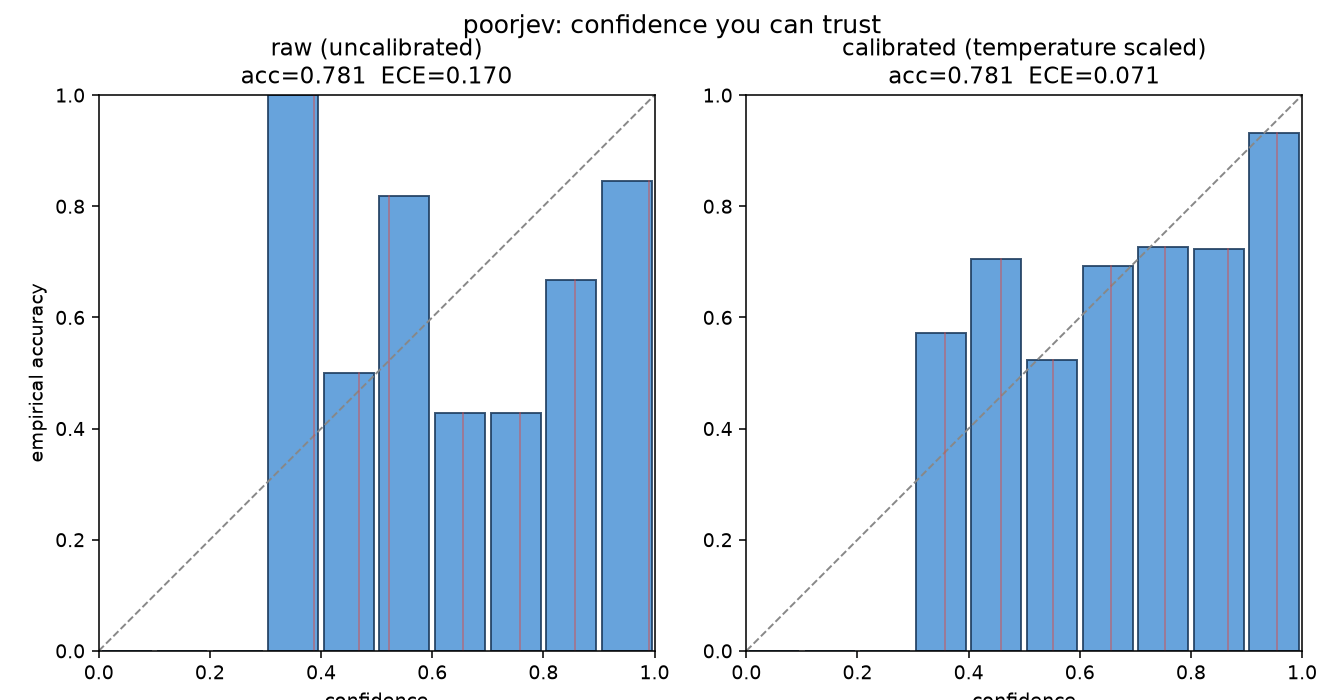
Left: raw confidences, overconfident. Right: calibrated, a stated 0.8 really is right about 80% of the time.
Quickstart
pip install "poorjev[local]"
PyPI publish is pending. Until then:
pip install "poorjev[local] @ git+https://github.com/rupeshpoojary9/poorjev"
from poorjev import Client, Choice, Score, Noul

client = Client()  # local model, no key, offline after one download

result = client.ask(
    state="I've emailed three times and I'm STILL being double-charged. Cancel my account today.",
    questions={
        "topic":        Choice(["billing", "technical", "account", "shipping", "other"]),
        "frustration":  Score(levels=["low", "medium", "high"]),
        "is_urgent":    Noul("The customer needs a response today."),
        "wants_cancel": Noul("The customer wants to cancel their account."),
    },
)

result["topic"].value          # "billing"      always one of your options, by construction
result["topic"].confidence     # 0.86           calibrated, not a vibe
result["frustration"].value    # "high"
result["is_urgent"].value      # True
result["wants_cancel"].value   # True
One call, one model pass, four typed answers. No prompt engineering, no JSON parsing, no "the model returned prose."
Use it in Claude Code (MCP server)
poorjev ships an MCP server, so a Claude Code (or Claude Desktop) agent can make fast, local, calibrated decisions as tools, with no API key and no token cost. The obvious use: gate a risky tool call before the agent runs it.
pip install "poorjev[local,mcp]"
claude mcp add poorjev -- poorjev serve
Or add it to .mcp.json by hand:
{
  "mcpServers": {
    "poorjev": { "command": "poorjev", "args": ["serve"] }
  }
}
The agent then has these local tools:
| Tool | What it does |
|---|---|
gate(action) |
guardrail: should this action be blocked (moves money, deletes data)? |
judge(text, statement) |
a yes/no question, with calibrated P(true) |
classify(text, options) |
pick one option, with calibrated confidence |
rate(text, levels) |
an ordinal score (low / medium / high) |
decide(text, questions) |
several typed questions at once, one pass |
Why this beats asking an LLM to judge: it is local (private), free (no tokens), fast, and the confidence is calibrated instead of made up.
Why poorjev exists
Most production AI work is not chat. It is fast structured decisions: route a ticket, classify an intent, score a sentiment, extract a field, gate a tool call. TypeSafe's Jev named this category ("System One" models) and nailed the thesis, but Jev is closed, hosted, and behind a waitlist.
poorjev gives you the same developer interface, locally and openly, and it wins on the one thing that actually matters for routing and gating: confidence you can trust. A model that is right 78% of the time but honest about which 78% is worth more in production than a smarter model that is silently overconfident.
poorjev vs Jev
| Jev (TypeSafe) | poorjev | |
|---|---|---|
| Interface (typed questions, one pass) | yes | yes |
| Calibrated confidence | yes (claimed) | yes (measured, reproducible) |
| Schema-valid output, 0 type errors | yes | yes, by construction |
| Runs locally, no API key | no | yes |
| Your data stays in your environment | no | yes |
| Waitlist / signup | yes | no |
| Open source | no | yes (MIT) |
| Speed | very fast (custom model) | slower, honest about it |
poorjev is not a Jev clone and makes no speed claims. It reproduces the interface and the calibrated-confidence guarantee on commodity models, and proves the calibration with numbers.
The three primitives
| Primitive | Use it for | Returns |
|---|---|---|
Choice(options) |
classification, routing | winning option, per-option probabilities, calibrated confidence |
Score(levels) |
ordinal rating, severity | winning level, a continuous score on the scale, confidence |
Noul(statement) |
yes/no gates, guardrails | P(true), thresholded to a bool |
The returned value is always drawn from the set you declared. An invalid category is structurally impossible, not "usually avoided." This is tested against adversarial inputs (NaN, infinity, negatives, all-zero score vectors).
How it works
state + typed questions
        |
        v
   one batched pass through a local zero-shot NLI model   (no API key)
        |
        v
   raw probabilities per option
        |
        v
   calibration: temperature scaling + conformal abstention
        |
        v
   typed, schema-valid answers + calibrated confidence
- Local backend (default): one small natural-language-inference model scores every option as an entailment hypothesis, in a single batched forward pass. Fully offline after a one-time ~400MB download. No key, no vendor, your text never leaves your machine.
- Calibration (the moat): temperature scaling fits one scalar so predicted confidence matches real accuracy; conformal thresholding turns a target risk budget into an "I don't know, escalate" signal.
- LLM backend (optional, roadmap): when you need more reasoning, point poorjev at an LLM and it makes that model's confidence honest too. That is the intelligence dial, not the default.
Benchmarks
Reproduce everything with two commands:
poorjev eval       --set evalset/tasks.jsonl          # accuracy, ECE, Brier, risk-coverage
poorjev calibrate  --set evalset/tasks.jsonl --plots  # before/after ECE + the diagrams
On the shipped eval set (55 hand-labelled items, 160 decisions), local NLI backend, keyless:
| Metric | Raw | Calibrated |
|---|---|---|
| Accuracy | 0.781 | 0.781 |
| ECE (calibration error) | 0.170 | 0.071 |
| Brier | 0.184 | lower |
| Temperature | 1.00 | 2.71 |
Temperature is fit by 5-fold cross-validation, so the "after" number is measured on held-out data, never on data it was fit on. Full tables and the honest limitations are in RESULTS.md.
Selective prediction: it knows when it doesn't know
Set a risk budget and poorjev abstains on its least confident decisions instead of guessing:
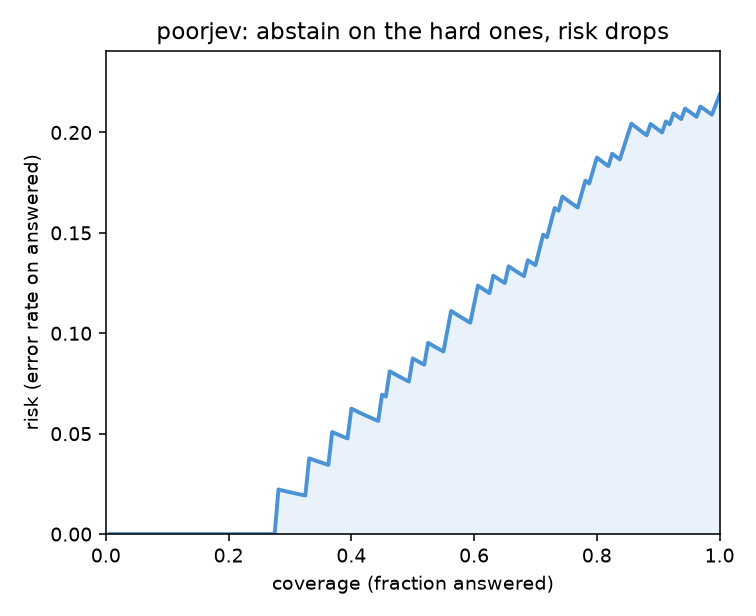
At a 10% error budget it confidently answers 55% of decisions and escalates the rest. That is the natural bridge from System One (fast automatic answer) to System Two (a human, or a bigger model).
Real examples
python examples/ticket_router.py   # full triage on a support ticket
python examples/tool_gate.py       # gate a risky tool call before it runs
python examples/demo.py            # raw vs calibrated, side by side
The tool-gate example encodes a practical lesson: the local model is strong at concrete questions ("this action moves money", "this deletes data") and weak at abstract ones ("this is dangerous"). Ask concrete questions and let a one-line rule apply the policy.
Honest limitations
No hype. Here is what this is not.
- Not as fast as Jev. Jev uses a custom model. poorjev uses commodity ones. We report latency, we do not market it.
- The eval set is small (tens of items, one labeller, English, support flavoured). Enough to show calibration direction and schema validity, not a leaderboard.
- After-ECE is 0.071, not below 0.05. That is the real cross-validated number, reported as measured. Per-question temperature would likely push it lower.
- The local model is moderately intelligent. It does real semantic entailment, not deep reasoning. Calibration and abstention are what make that safe.
FAQ
Is this a Jev clone? No. It reproduces Jev's developer interface and its calibrated-confidence guarantee on open, local models. It does not copy Jev's architecture or its speed.
Do I need an API key or GPU? No. The default backend runs on CPU, offline, after one model download.
How is this different from an LLM in JSON mode? Two ways. Output is schema-valid by construction, not by parsing. And the confidence is calibrated and proven, not a number the model made up.
What is a "System One" model? A model for fast, automatic, structured decisions (classify, route, score, gate), as opposed to slow, deliberative chat. The name is from Kahneman's System 1 / System 2.
What is ECE? Expected Calibration Error: the average gap between a model's confidence and its actual accuracy. Lower is better. poorjev's whole job is to shrink it.
Can I use my own model? Yes. Backends are pluggable; a backend only implements entail_probs(pairs).
Roadmap
- Typed primitives, schema-valid by construction
- Local NLI backend, single pass, keyless
- Eval set + metrics (accuracy, ECE, Brier, risk-coverage)
- Calibration: temperature scaling + conformal abstention
- MCP server: use poorjev as local tools in Claude Code
- Optional LLM backend (the intelligence dial)
-
system-one-bench: a standalone calibration benchmark for the category
Contributing
Issues and PRs welcome, especially new labelled decision tasks for the eval set. If you find a case where the confidence is not honest, that is a bug worth filing.
License
MIT. Use it, ship it, sell it.
poorjev: poor in price, rich in honesty. If your model's confidence is a vibe, come check it.
1 maintainer

Release files for poorjev 0.1.0
For a detailed explanation of source distributions (sdists) and built distributions (wheels), please see the package formats documentation.
Source distribution (sdist)
| File | Size | Uploaded | |
|---|---|---|---|
| poorjev-0.1.0.tar.gz | 171.1 kB | Details |
Built distribution (wheel)
| File | Interpreter | ABI | Platform | Reset |
|---|---|---|---|---|
| poorjev-0.1.0-py3-none-any.whl | Python 3 | none | any | Details |
Total release size: 198.5 kB
Release files / poorjev-0.1.0.tar.gz
| Download URL | poorjev-0.1.0.tar.gz |
|---|---|
| Size | 171.1 kB |
| Tags | Source |
|
SHA-256 checksum How to use checksums |
642e99bef4e9fb03e14ba3105329a74b84b35d02e52dd229252fdf1531cf9ff0
|
|
BLAKE2b-256 checksum How to use checksums |
8b322b113db1c589ba4f089ca34f7abba5239d071c3cd37e77ff9e78e7efaa45
|
| Upload date | |
|
Uploaded using Trusted Publishing? What is trusted publishing? |
No |
| Uploaded via |
twine/7.0.0 CPython/3.12.7
|
Release files / poorjev-0.1.0-py3-none-any.whl
| Download URL | poorjev-0.1.0-py3-none-any.whl |
|---|---|
| Size | 27.4 kB |
| Tags | Python 3 |
|
SHA-256 checksum How to use checksums |
c99421a4dcce6bcf5ed2671b41a6ae7243c7ccad86a292018d7b68584ef8a512
|
|
BLAKE2b-256 checksum How to use checksums |
7eb803aa83080983259b27db76bf7355e1439903727a11c82cbb5cadf30baf85
|
| Upload date | |
|
Uploaded using Trusted Publishing? What is trusted publishing? |
No |
| Uploaded via |
twine/7.0.0 CPython/3.12.7
|













