


Poros is a streaming LoRA fine-tuning engine for models larger than GPU or unified memory. It keeps frozen 4-bit base weights in host RAM or on SSD and streams one block of layers through the GPU at a time while training the adapters. On dense models that fit in VRAM, streamed training matches a standard resident run under torch.equal.
Supports SFT, DPO, IPO, KTO, ORPO, and SimPO on Linux (NVIDIA Ampere+) and Apple silicon (macOS 14+).
Quickstart
pip install poros-train
Installs Poros with torch, transformers, peft, and bitsandbytes (macOS skips bitsandbytes). Runs on Linux with NVIDIA (compute capability 8.0+, Ampere or newer) and Apple silicon (macOS 14+). Installation.
poros machine                                         # checks GPU, driver, RAM, disk and software; prints the next command
poros recipes                                         # the certified runs, and the machine each ran on
poros train qwen2.5-0.5b-instruct --data chats.jsonl  # start small
poros export last --format merged                     # export a merged model for vLLM or TGI
In Python, poros.Run gives you a plain training loop one step at a time:
import poros

run = poros.Run.create("Qwen/Qwen2.5-7B-Instruct", rank=16, length=512, dataset="chats.jsonl")
data = poros.data.chats("chats.jsonl", run.tokenizer, length=512)
for step in run.steps(200):
    run.forward_backward(data.batch(step))
    run.optim_step()
run.save()   # prints where: ./poros_output/checkpoint-199
Chats train with SFT and preference pairs train with DPO automatically; IPO, KTO, ORPO, and SimPO are built in too. See Quickstart and Training.
Results
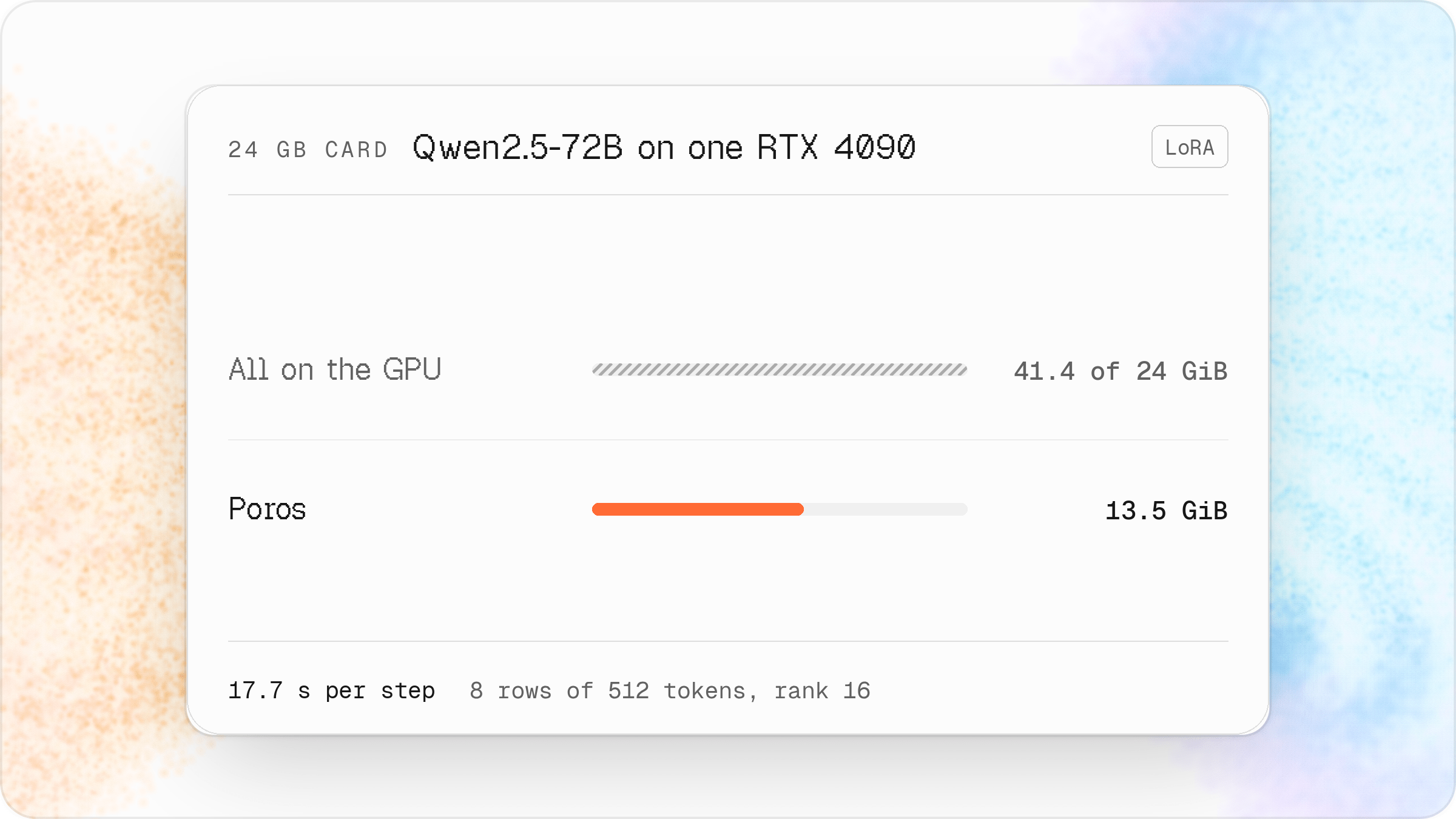
RTX 4090 (24 GB): Qwen2.5-72B (41.4 GiB in 4-bit) trains in 13.5 GiB VRAM reserved (9.9 GiB allocated) and 45.1 GiB host RAM at 17.7 s/step (512-token rows, rank 16, 8 rows/step; benchmark run on a 59.6 GiB host). |
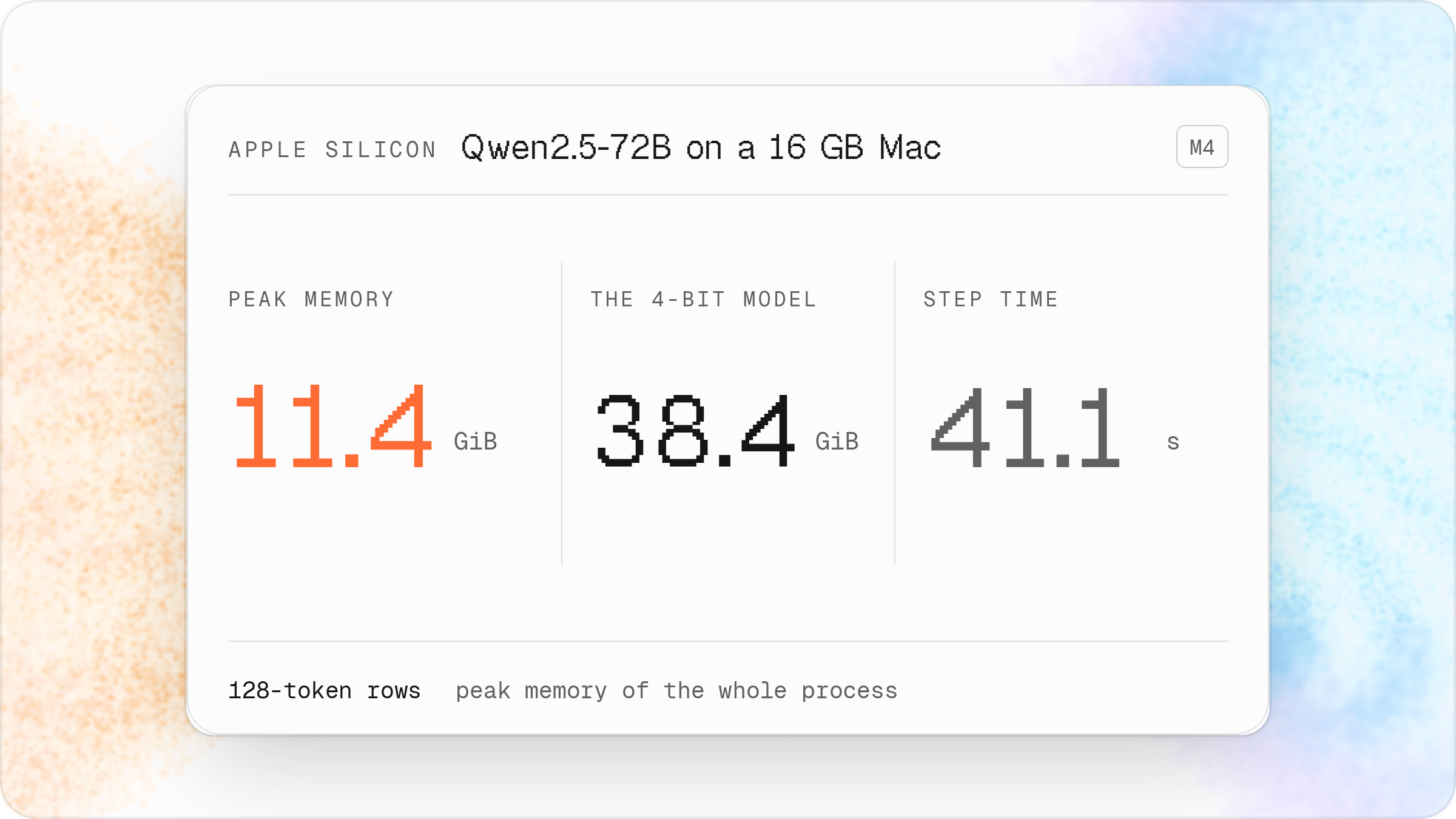
M4 Mac (16 GB): Qwen2.5-72B-Instruct (38.4 GiB in 4-bit) streams from an external USB4 SSD at 11.4 GiB peak unified memory and 41.1 s/step on 128-token rows (6-step run). A 144-step run from the internal SSD took loss on 4 held-out rows from 3.01 to 0.68 at 37.9 s/step. |
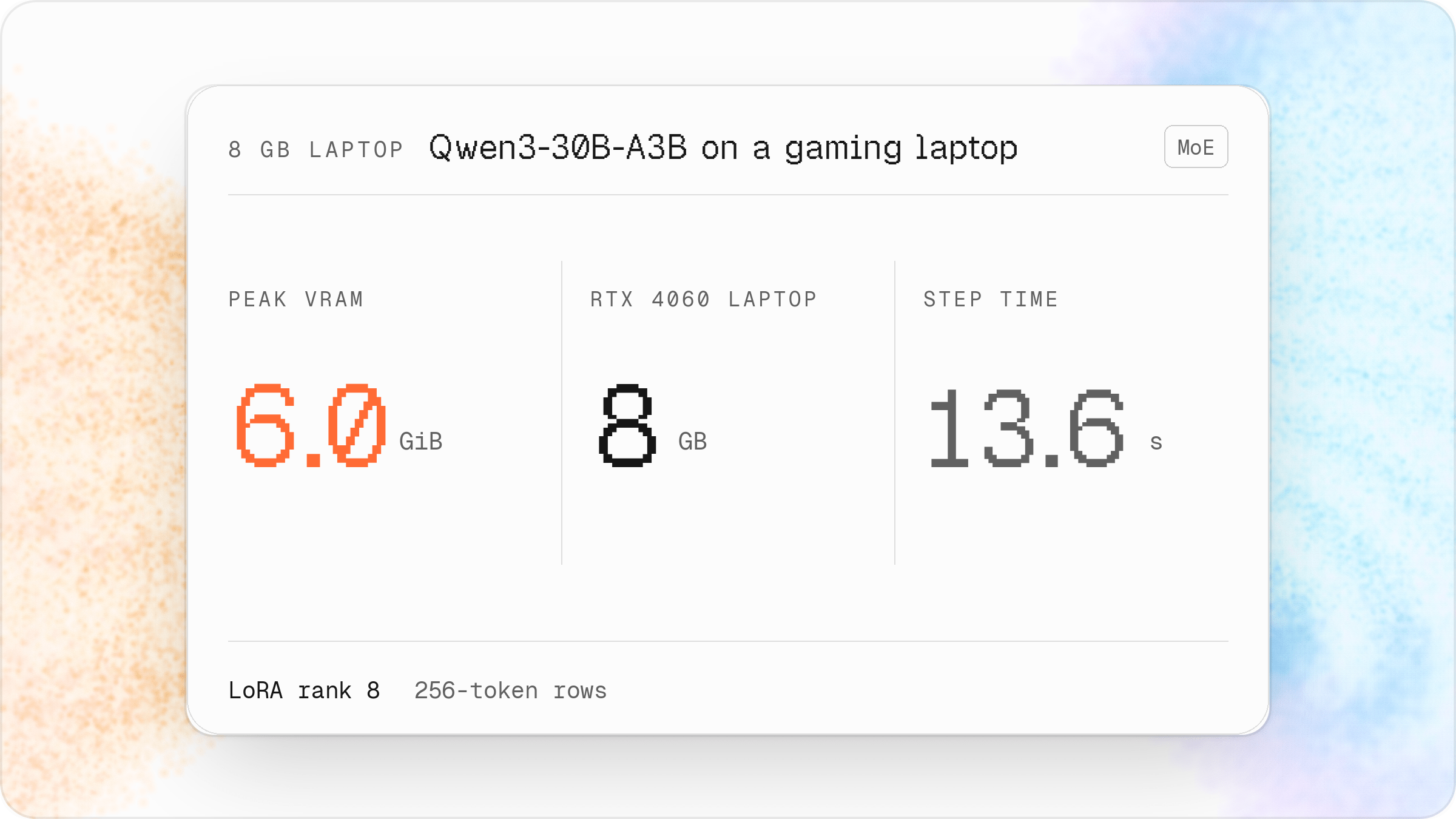
RTX 4060 Laptop (8 GB): Qwen3-30B-A3B trains in 6.0 GiB VRAM and 6.4 GiB host RAM at 13.6 s/step (LoRA rank 8, 256-token rows; expert store built on the laptop; measured run, the recipe is certified on the RTX 4090). |
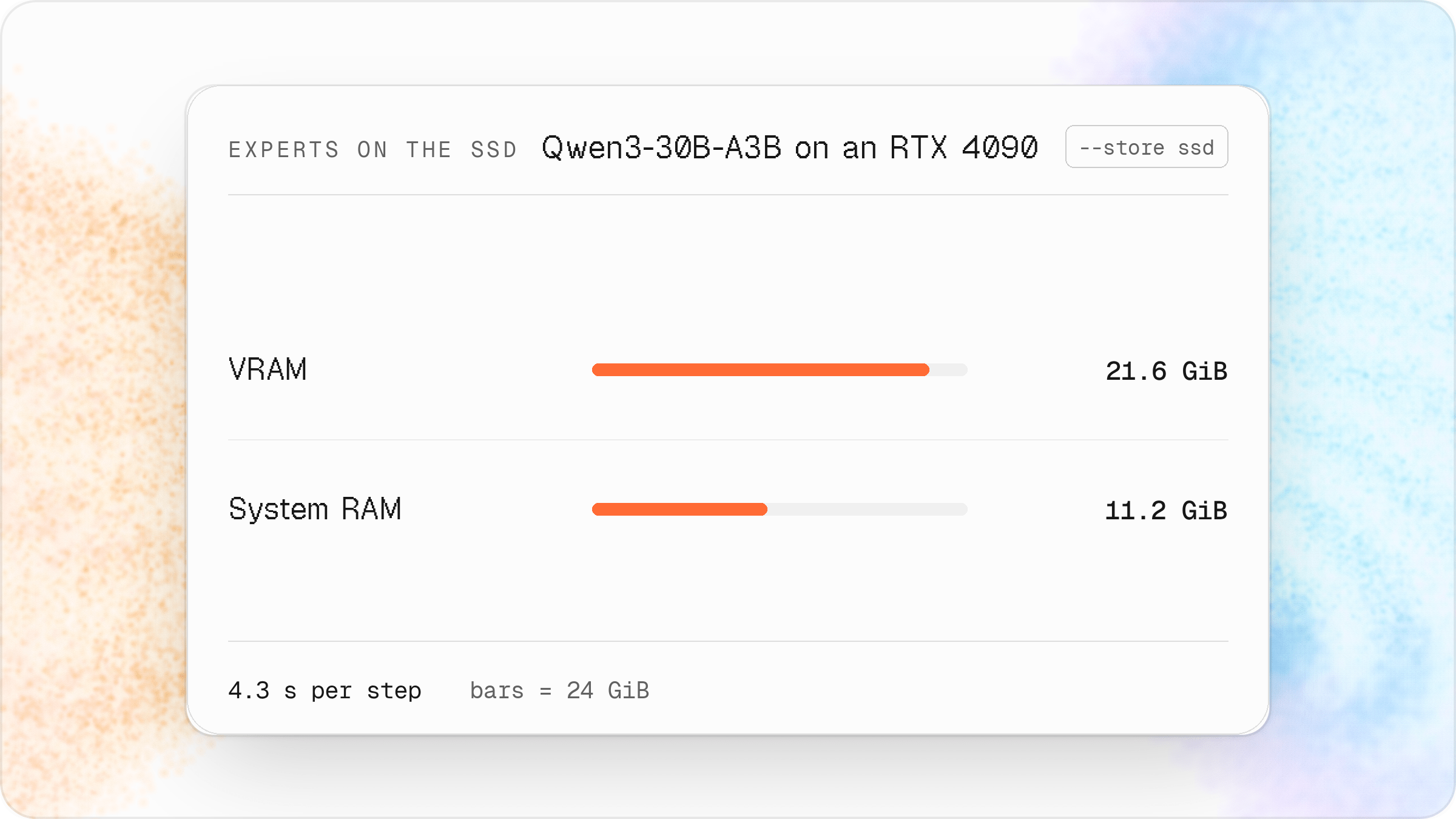
MoE experts on disk ( |
Host RAM is peak process memory excluding droppable checkpoint file pages. Every setting and run is in Benchmarks.
The raw benchmark logs behind these figures live in a companion repository,
Caistro-Labs/poros-benchmarks, at the same
docs/validation/ paths the docs, the package and the paper cite.
Performance
Measured on an RTX 4090 (24 GB VRAM, 59.6 GiB RAM) with batch 1, gradient accumulation 8, 512-token rows, and LoRA rank 16. The efficient setting is the default and uses less GPU memory; fast uses more GPU memory and takes less time per step.
| Model | Setting | Time / step | VRAM reserved | Host RAM (peak) |
|---|---|---|---|---|
| Qwen2.5-72B | efficient (default) | 17.7 s | 13.5 GiB | 45.1 GiB |
| Qwen3-30B-A3B | efficient (default) | 4.6 s | 9.1 GiB | 19.9 GiB |
Each figure is the median of three interleaved runs in one session. VRAM is peak reserved across load and training; host RAM excludes droppable checkpoint file pages. Full protocol and runs: Benchmarks and Reproducibility.
How it works
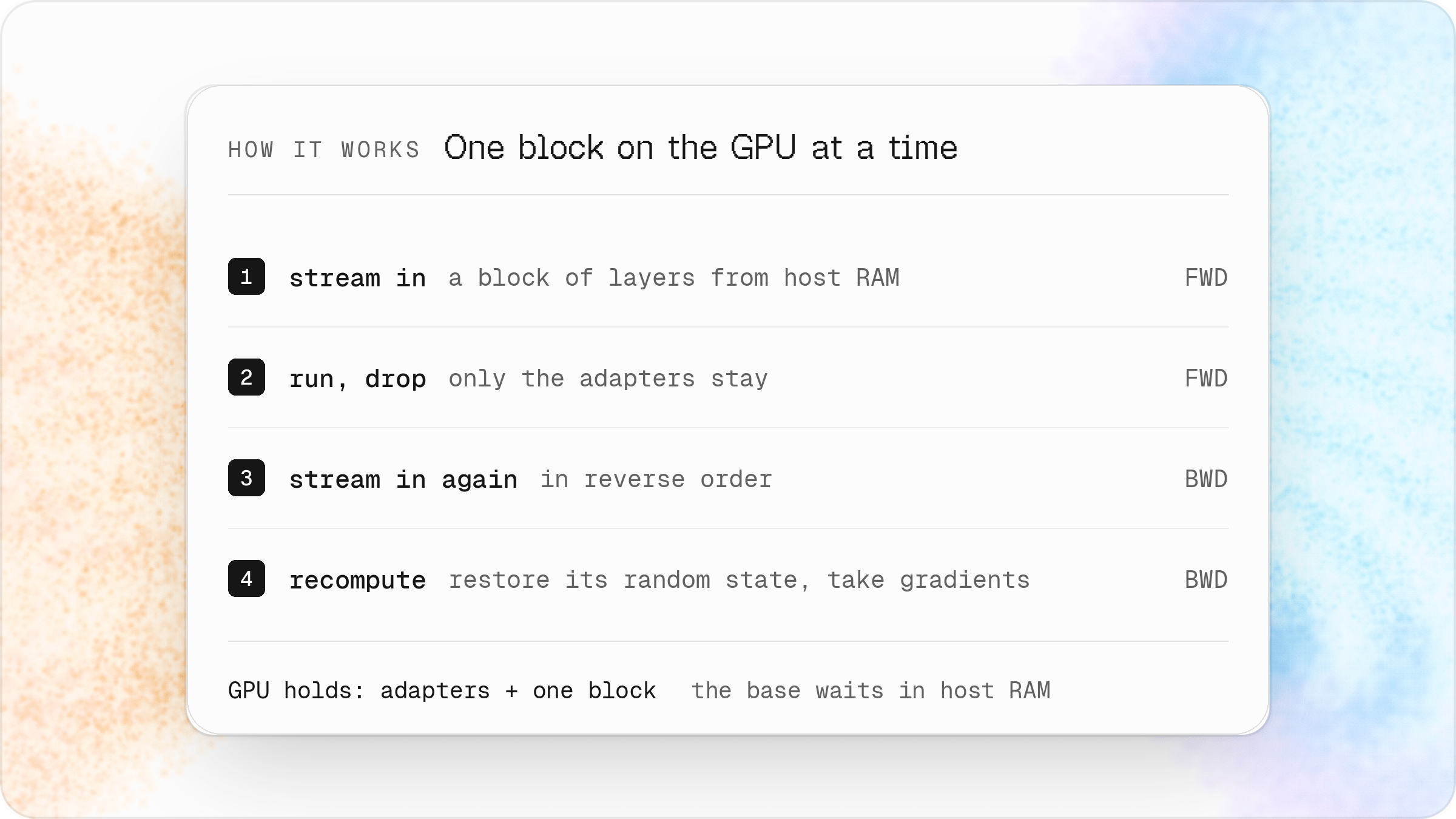
In QLoRA, the base weights are frozen and never receive gradients, so keeping all 80 layers pinned in VRAM only crowds out everything else. Poros leaves the 4-bit base in host RAM (or on an SSD for MoE experts and Apple silicon), streams one block onto the GPU for the forward pass, keeps activations only at block boundaries, drops the weights, then reloads blocks in reverse to recompute during backward.
Before each block's forward pass, Poros snapshots CPU and CUDA RNG state and restores it during backward recomputation so dropout masks stay identical. On dense models that fit on the card, the adapter matches a fully on-GPU run under torch.equal (checked over 200 steps with dropout off), and you can verify it on your own machine with poros prove. For MoE models like Qwen3-30B-A3B (128 experts per layer, 8 active per token), --store ssd streams only the routed experts into VRAM. See Streaming and memory.
Supported models and limits
The models below are examples: any model of a listed architecture trains at any size with no extra flags; see Architectures.
| Dense | |
| Qwen2.5 | Qwen2.5-0.5B, 7B, 32B and 72B and their Instruct versions; DeepSeek-R1-Distill-Qwen-1.5B |
| Qwen3 | Qwen3-0.6B, Qwen3-32B |
| Qwen3.5 / 3.6 / 3.8 | Qwen3.5-4B, Qwen3.8-27B |
| Gemma 3 | gemma-3-1b, gemma-3-27b |
| Gemma 4 | gemma-4-31B (not E2B or E4B) |
| MoE | |
| Qwen3 MoE | Qwen3-30B-A3B, Qwen3-Coder-30B-A3B |
| Qwen3.5 / 3.6 MoE | Qwen3.6-35B-A3B |
| Gemma 4 MoE | gemma-4-26B-A4B |
| OLMoE | OLMoE-1B-7B |
| Qwen2 MoE | Qwen1.5-MoE-A2.7B |
| DeepSeek-V2 | DeepSeek-V2-Lite |
| Machines | |
| NVIDIA | Linux, compute capability 8.0 or newer (Ampere, Ada, Hopper, Blackwell) |
| Mac | Apple silicon, macOS 14 or later |
Run poros check <model> to check any model's config.json before downloading. Other architectures still train, with no check behind them; see Models.
Limits to know upfront:
- Single GPU, LoRA only: multi-GPU and full fine-tuning are not supported yet.
- Slower when a model already fits: streaming adds transfer overhead on every step, so train resident whenever a model fits comfortably on your card.
- Host RAM and disk space: dense models live in host RAM (the 72B's peak is in Results);
--store ssdbuilds the SSD expert store from the full download, so disk needs room for both. - Platform: Windows is not supported and WSL2 is untested. Full list in Limits.
The docs are also at caistrolabs.com/docs, and poros docs serves them offline. Coding agents read AGENTS.md and poros agents. To cite Poros, use CITATION.cff.
License
Poros is Apache-2.0, built by Caistro Labs. Report a bug in issues or share an idea in Discussions; CONTRIBUTING.md explains how.
Qwen2.5-72B and its Instruct model use the Qwen license; Poros itself is Apache-2.0.
1 maintainer

Metadata
1 maintainer
Release files for poros-train 1.0.0
For a detailed explanation of source distributions (sdists) and built distributions (wheels), please see the package formats documentation.
Source distribution (sdist)
| File | Size | Uploaded | Provenance | Actions |
|---|---|---|---|---|
| poros_train-1.0.0.tar.gz | 1.3 MB | With provenance | Details for poros_train-1.0.0.tar.gz |
Built distribution (wheel)
| File | Interpreter | ABI | Platform | Actions Reset |
|---|---|---|---|---|
| poros_train-1.0.0-py3-none-any.whl | Python 3 | none | any | Details for poros_train-1.0.0-py3-none-any.whl |
Total release size: 2.7 MB
Release files / poros_train-1.0.0.tar.gz
| Download URL | poros_train-1.0.0.tar.gz |
|---|---|
| Size | 1.3 MB |
| Tags | Source |
|
SHA-256 checksum How to use checksums |
24158616f86ea31906725d571b5f395eb8ab99be0fd1b0217672121b78c9613b
|
|
BLAKE2b-256 checksum How to use checksums |
90423ebdc69529cc4cd0afd456e3d72c148f87091838ef5281f8ff6307ada720
|
| Upload date | |
|
Uploaded using Trusted Publishing? What is trusted publishing? |
Yes |
| Uploaded via |
twine/7.0.0 CPython/3.13.16
|
Provenance
Provenance describes where a file came from. On PyPI, provenance is shared via attestations, which provide a verifiable record of the build or publishing details. View details, limitations and caveats.


PyPI Publish Attestation
PyPI verified that this artifact, at this checksum, originated from the publisher listed below.
Signed by GitHub Actions, verified by PyPI on Nov 24, 2026.
Transparency logRelease files / poros_train-1.0.0-py3-none-any.whl
| Download URL | poros_train-1.0.0-py3-none-any.whl |
|---|---|
| Size | 1.5 MB |
| Tags | Python 3 |
|
SHA-256 checksum How to use checksums |
80810a92c5c0310f8415b9f33f65f0ba32f1e03822f976de4cb0ce21ddf9e98a
|
|
BLAKE2b-256 checksum How to use checksums |
79de2de92764a7b893963649eb29b6154b60665ab66801cd4bded559c070619a
|
| Upload date | |
|
Uploaded using Trusted Publishing? What is trusted publishing? |
Yes |
| Uploaded via |
twine/7.0.0 CPython/3.13.16
|
Provenance
Provenance describes where a file came from. On PyPI, provenance is shared via attestations, which provide a verifiable record of the build or publishing details. View details, limitations and caveats.
PyPI Publish Attestation
PyPI verified that this artifact, at this checksum, originated from the publisher listed below.
Signed by GitHub Actions, verified by PyPI on Nov 24, 2026.
Transparency logSecurity for poros-train 1.0.0
Provenance
Provenance describes where a file came from. On PyPI, provenance is shared via attestations, which provide a verifiable record of the build or publishing details. View details, limitations and caveats.
Full provenance
Both files in this release have been uploaded with provenance metadata.
Attestation for poros_train-1.0.0.tar.gz
PyPI Publish Attestation
PyPI verified that this artifact, at this checksum, originated from the publisher listed below.
Signed by GitHub Actions, verified by PyPI on Nov 24, 2026.
Transparency logA note on package security
PyPI is a repository for distributing packages, not a service for auditing them. While third-party security researchers and our staff do their best to detect and remove malicious packages, PyPI cannot guarantee the quality, security or suitability of any given package.
To learn more about protecting yourself from malicious actors, visit our package security documentation.













