
PosturaNet
Fixes cloud security issues without breaking prod.
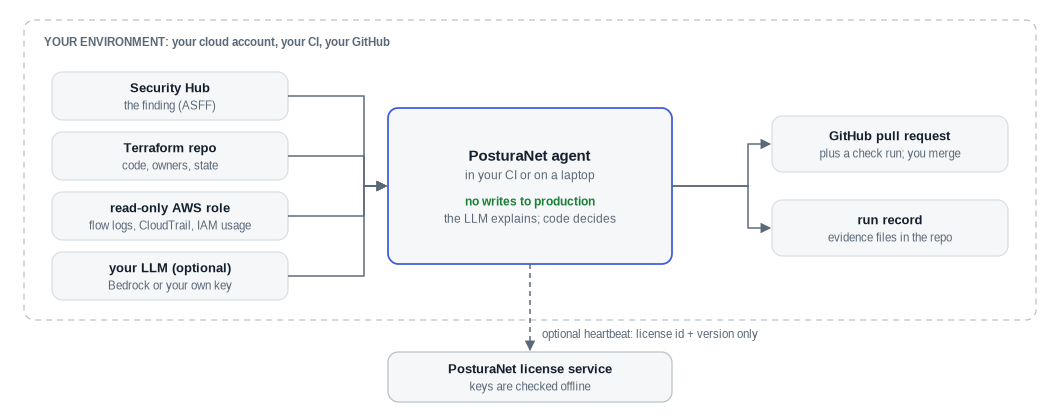
PosturaNet is a source-available remediation agent for AWS + Terraform. It takes a security finding, locates the owning Terraform and team, learns what actually uses the resource from flow logs and CloudTrail, records that as a behavior contract, and opens a pull request with the smallest fix that keeps every observed behavior working. It runs in your CI with a read-only role and never changes production.
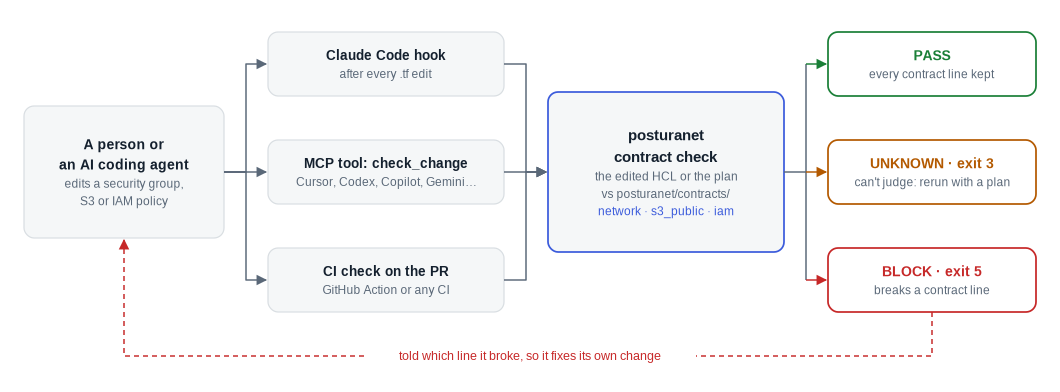
It also checks every security group, S3 and IAM policy change, written by a person or an AI agent, against those contracts before it merges: a PosturaNet contract check on PRs, a step in any CI, a Claude Code plugin, and MCP setups for Cursor, Codex, Copilot, Gemini, Windsurf, Cline, Kiro, Continue, Zed and Goose.
Status: early access. 0.3.0 is on PyPI:
connect, outcomes, exceptions, runbooks and approval at the terminal are new.88 controls: security groups, S3 public access and IAM least privilege from usage evidence, plus 74 settings controls. Findings from Security Hub, Prowler, Checkov or Trivy.
Get started
Each step has a command you can copy as written. Every command also prints its own examples: posturanet <command> --help.
1. Install
pip install posturanet            # add the MCP server for coding agents: pip install "posturanet[mcp]"
posturanet                        # every command, with an example
Python 3.11+. If your shell can't find posturanet (common with the Microsoft Store Python on Windows), run python -m posturanet instead.
2. Give it a read-only role
posturanet init > policy.json # the read-only IAM policy PosturaNet needs; attach it to a role
PosturaNet only reads: flow logs, CloudTrail, IAM last-accessed data, S3 settings and access logs, and Terraform state. It never calls a mutating AWS API, and a person merges every PR.
3. Connect your scanner, coding agent and CI
posturanet connect                # everything PosturaNet works with
posturanet connect prowler        # the exact commands for one of them
posturanet connect cursor --write --repo .    # add the MCP server and rule to this repo
posturanet connect github --write --repo .    # add the PR check workflow
--write never overwrites a file you already have, and adds to an existing AGENTS.md instead of replacing it.
4. See what your findings end in
prowler aws --output-formats json-ocsf --output-directory prowler-out/
posturanet findings list prowler-out/<file>.ocsf.json --all
Every failed finding gets an outcome: fix (PosturaNet opens a PR), runbook (steps for a person, such as root MFA), exception (a risk your team accepted) or none yet. The top line shows your coverage.
Accepted a risk? Put it in .posturanet/exceptions.yaml with an owner and an expiry date. When it expires, the finding comes back.
exceptions:
  - control: S3.8
    resource: acme-assets          # leave out to cover every resource for this control
    owner: web-team
    reason: public website bucket behind CloudFront
    expires: 2027-03-31
For a runbook: posturanet fixes show IAM.6 prints the steps.
5. Fix one
posturanet findings split prowler-out/<file>.ocsf.json --out findings/   # one file per finding
posturanet fix findings/EC2.13-sg-0a91f3c2.json --dry-run --repo infra/  # see the fix; no AWS, writes nothing
posturanet fix findings/EC2.13-sg-0a91f3c2.json --repo infra/            # read evidence, run terraform plan
posturanet fix findings/EC2.13-sg-0a91f3c2.json --repo infra/ --open-pr  # open the PR when every check passes
If anything is missing (no evidence, an unclear owner, a check that fails), PosturaNet stops, says why and what to do next, and opens no PR.
A security group with SSH open to the internet. PosturaNet reads 89 days of flow logs, keeps the four sources that really connect, drops a one-off scanner, flags the outside partner for review, and proposes the smallest change:
An IAM policy with ec2:*. Shrunk to the three actions IAM's last-accessed data shows in use, with every unknown spelled out:
6. Approve what the evidence can't show
Some things only a person can confirm. For example, IAM doesn't record S3 object reads, so PosturaNet can't tell whether s3:GetObject is used. When you run fix at a terminal, it asks you about each item and shows the before and after. Only then does it ask Approve this change?. Your answers go into the contract and the PR says who approved it. Nothing is ever asked in CI, pipes, JSON output or agent hooks.
7. Keep it fixed
posturanet contract check --source --repo infra/                 # check an edit against the contracts (exit 5 = BLOCK)
terraform show -json plan.out > plan.json && posturanet contract check --plan plan.json   # the same in CI, from a plan
posturanet verify owner/repo#123 --repo infra/                   # after merge: did the fix hold?
A person or an AI agent puts the wildcard back. The contract check blocks the edit and says which contract line it breaks:
Inside a coding agent. With the Claude Code plugin, this is what Claude is told right after its edit, so it fixes its own change before going on. Other agents get the same result from the MCP tool check_change:
In Claude Code, add the plugin (skill, MCP server and a hook that checks every .tf edit):
/plugin marketplace add Mihirajmera/posturanet
/plugin install posturanet@posturanet
Try it offline (no AWS)
From a clone of this repo:
pip install -e ".[dev]"
posturanet fix tests/fixtures/findings/sg_ssh_open.json --dry-run \
  --repo tests/fixtures/tf/basic --evidence-file tests/fixtures/flows/bastion_90d.json
This reads a synthetic finding, finds the Terraform block and its owner, builds a behavior contract from 89 days of synthetic flow logs, computes the smallest rule set with Z3, and prints the diff. Nothing is written. The recordings above come from the same fixtures (python docs/media/make.py).
From your scanner
PosturaNet doesn't detect; it fixes what your scanner already found. It reads findings from:
| Scanner | Output to pass | Controls PosturaNet can fix from it |
|---|---|---|
| AWS Security Hub | ASFF JSON, or OCSF from aws securityhub get-findings-v2 / EventBridge |
all 88 |
| Security Hub remediation plans | posturanet findings pull-plans (read-only) |
the plan's linked controls PosturaNet fixes, as one PR per plan |
| Prowler | prowler aws --output-formats json-ocsf (or its ASFF output) |
72, from Prowler's own mapping to Security Hub controls |
| Checkov | checkov -d . -o json |
52, from 56 Checkov checks |
| Trivy | trivy config -f json . |
31, from 36 Trivy checks |
Wiz, Orca, Prisma Cloud and other platforms can send findings to Security Hub, but with their own rule names. PosturaNet doesn't map those to controls yet, so they show as none.
A Security Hub remediation plan targets one resource and groups the exposures one fix would close. PosturaNet reads the controls those exposures link, fixes the ones it supports on that resource as one change (for example RDS.2+RDS.8: no public access and deletion protection), and opens one PR for the plan. AWS's own guidance text is shown to you but never used to write the change.
Checkov and Trivy read your code, so their findings name a Terraform address. PosturaNet finds the deployed resource for that address in the Terraform state; a resource that isn't applied yet stops with a clear reason. Each Checkov and Trivy check was mapped by hand after reading the check's source, and a check that isn't mapped is listed as unsupported, never guessed (src/posturanet/ingest/iac_checks.json).
What it fixes
- Security group ingress (EC2.13, 14, 18, 19, 53, 54): replaces open rules with the sources seen in VPC flow logs, checked with Z3 against a behavior contract.
- S3 public access and IAM least privilege (IAM.1, IAM.21): from S3 access logs and IAM last-accessed data, with the same contracts.
- 74 settings controls: settings like RDS deletion protection and backups, DynamoDB point-in-time recovery, KMS key rotation, CloudTrail log validation, OpenSearch encryption and the IAM password policy. No evidence needed; same plan-scope checks, so a setting that would replace the resource stops instead. The ones that can affect a client (public access on RDS, Redshift and EKS, public IPs on launch templates and ECS services, IMDSv2, ECR tag immutability, S3 ACLs, KMS on S3 and SNS) are marked
risk: mediumand say what to check before merging. - Runbooks for 8 controls that aren't a Terraform change (root MFA, root access keys, key rotation, unused credentials, MFA for users, the security contact).
posturanet fixes list               # every control and what it changes
posturanet fixes show RDS.8         # one control in detail
posturanet fix tests/fixtures/findings/rds_deletion_protection.json --dry-run --repo tests/fixtures/tf/config
How it works
From finding to pull request. Nine stages, each a plain function. Any stage that lacks what it needs stops with the reason and the next step, and no PR is opened:
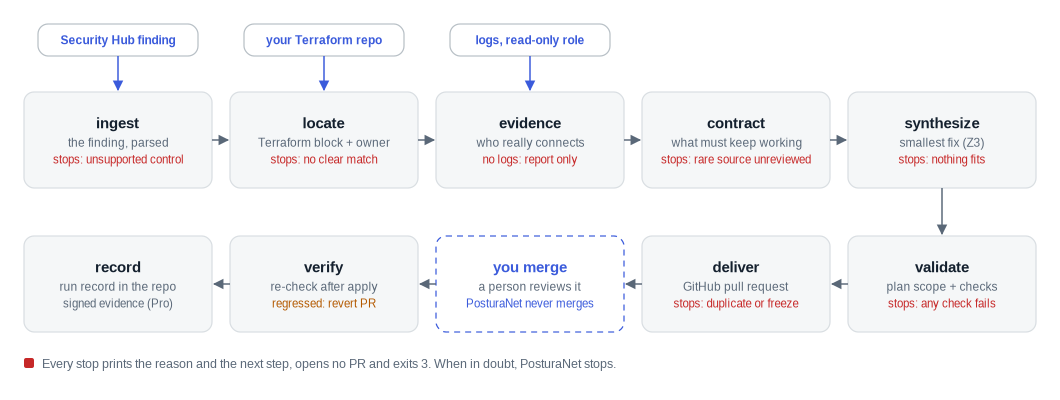
Every later change is checked. The contract records what must keep working. A change by a person or an AI coding agent is checked against it in the agent, over MCP, or in CI:
It runs where your code runs. A read-only role, your own LLM if you use one, and no customer data sent anywhere:
Diagrams are drawn by python docs/media/diagrams.py; the full design is in docs/02_ARCHITECTURE_AND_DATA.md. What's next: reports/coverage-roadmap.md.
Project docs
| Doc | Purpose |
|---|---|
| docs/01_PRD.md | Product requirements: what we build, with FR/NFR IDs |
| docs/02_ARCHITECTURE_AND_DATA.md | Architecture, data models, schemas, queries |
| AGENTS.md | Rules for AI coding agents, and for PosturaNet's own runtime agent |
| docs/04_DESIGN_SYSTEM.md | CLI, PR, check-run and brand design system |
| integrations/ | GitHub Action, CI and per-agent setup |
License
Functional Source License 1.1, Apache 2.0 future license (FSL-1.1-ALv2).
- You can use PosturaNet for free in your own company, read the code, change it and run it in your CI, including for clients if you provide services.
- You can't offer it, or a product built from it, as a competing commercial product or service.
- After two years each release becomes Apache 2.0, with no restrictions.
"PosturaNet" is a trademark: forks must use another name. Paid features ship separately in posturanet-pro.
1 maintainer

Metadata
1 maintainer
Release files for posturanet 0.3.0
For a detailed explanation of source distributions (sdists) and built distributions (wheels), please see the package formats documentation.
Source distribution (sdist)
| File | Size | Uploaded | Provenance | Actions |
|---|---|---|---|---|
| posturanet-0.3.0.tar.gz | 253.6 kB | With provenance | Details for posturanet-0.3.0.tar.gz |
Built distribution (wheel)
| File | Interpreter | ABI | Platform | Actions Reset |
|---|---|---|---|---|
| posturanet-0.3.0-py3-none-any.whl | Python 3 | none | any | Details for posturanet-0.3.0-py3-none-any.whl |
Total release size: 478.3 kB
Release files / posturanet-0.3.0.tar.gz
| Download URL | posturanet-0.3.0.tar.gz |
|---|---|
| Size | 253.6 kB |
| Tags | Source |
|
SHA-256 checksum How to use checksums |
08c069461f72469a8e4df849ca0f63ac11deb7a079faa127e03e714fc3e1dfd4
|
|
BLAKE2b-256 checksum How to use checksums |
c25e7db498ed5e6e58f977c6753ff4eadad86713df096df6a4dfd6606e9e72cd
|
| Upload date | |
|
Uploaded using Trusted Publishing? What is trusted publishing? |
Yes |
| Uploaded via |
twine/7.0.0 CPython/3.13.16
|
Provenance
Provenance describes where a file came from. On PyPI, provenance is shared via attestations, which provide a verifiable record of the build or publishing details. View details, limitations and caveats.


PyPI Publish Attestation
PyPI verified that this artifact, at this checksum, originated from the publisher listed below.
Signed by GitHub Actions, verified by PyPI on Nov 12, 2026.
Transparency logRelease files / posturanet-0.3.0-py3-none-any.whl
| Download URL | posturanet-0.3.0-py3-none-any.whl |
|---|---|
| Size | 224.8 kB |
| Tags | Python 3 |
|
SHA-256 checksum How to use checksums |
f564a562e25ceaf11e50d8a9bf32df402dc9a565b2614bb2d0007015bc5e593d
|
|
BLAKE2b-256 checksum How to use checksums |
41d747933eccb2fb6a03f72fc3384fd03488dca9b55ec2cc518e40b301e01665
|
| Upload date | |
|
Uploaded using Trusted Publishing? What is trusted publishing? |
Yes |
| Uploaded via |
twine/7.0.0 CPython/3.13.16
|
Provenance
Provenance describes where a file came from. On PyPI, provenance is shared via attestations, which provide a verifiable record of the build or publishing details. View details, limitations and caveats.
PyPI Publish Attestation
PyPI verified that this artifact, at this checksum, originated from the publisher listed below.
Signed by GitHub Actions, verified by PyPI on Nov 12, 2026.
Transparency logSecurity for posturanet 0.3.0
Provenance
Provenance describes where a file came from. On PyPI, provenance is shared via attestations, which provide a verifiable record of the build or publishing details. View details, limitations and caveats.
Full provenance
Both files in this release have been uploaded with provenance metadata.
Attestation for posturanet-0.3.0.tar.gz
PyPI Publish Attestation
PyPI verified that this artifact, at this checksum, originated from the publisher listed below.
Signed by GitHub Actions, verified by PyPI on Nov 12, 2026.
Transparency logA note on package security
PyPI is a repository for distributing packages, not a service for auditing them. While third-party security researchers and our staff do their best to detect and remove malicious packages, PyPI cannot guarantee the quality, security or suitability of any given package.
To learn more about protecting yourself from malicious actors, visit our package security documentation.














