
PaddleMaterials




🚀 Introduction
PaddleMaterials is an end-to-end AI4Materials toolkit built on the PaddlePaddle deep learning framework. Designed as a data-mechanism dual-driven platform for developing and deploying foundation models in materials science, PPMat enables researchers to efficiently build AI models and accelerate material discovery using pretrained models.
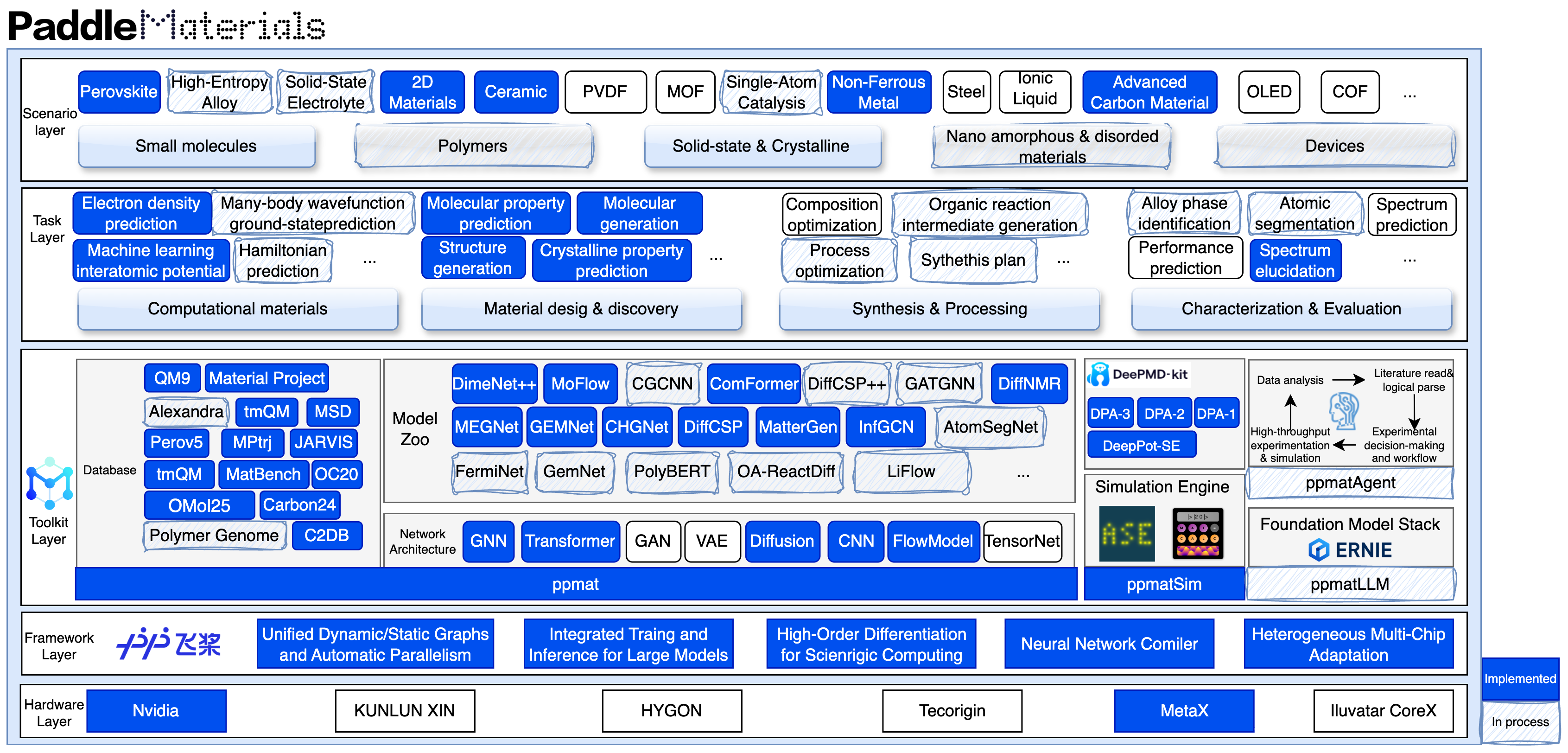
🧩 Core Capabilities
| Task | Description | Typical Applications |
|---|---|---|
| Property Prediction (PP) | Predict material properties from structure | Forward design or predict formation energy, band gap, elastic moduli etc. |
| Structure Generation (SG) | Generate novel crystal structures | Inverse design or structure generation |
| Machine Learning Interatomic Potential (MLIP) | Surrogate Model for DFT as ML potentials | Molecular dynamics simulations |
| Electronic Structure (ES) | Surrogate Model for DFT to predict physical field | Predict electronic density |
| Spectrum Elucidation (SE) | Reconstruct structures from spectra | NMR structure elucidation |
| Spectrum Enhancement (SPEN) | Enhance microscopy and spectrum signals | STEM image enhancement, denoising |
🧱 Supported Materials
- Inorganic Crystals - Well-supported with multiple datasets and pretrained models
- Organic Molecules - Support for multiple datasets and pretrained models including small molecules and partial polymers
✨ Why PaddleMaterials?
- ✅ Rich Pretrained Models & AI-ready Datasets - 50+ pretrained models ready for inference and Multiple curated datasets for training
- ✅ Multi-Task Integration - Unified framework across tasks of PP, SG, MLIP, ES, SE, SPEN etc.
- ✅ Multi-Hardware Support - Full support for NVIDIA GPUs and MetaX GPUs and Intel CPUs
- ✅ Production-Ready - Easy to use with standandlize design & distributed training, mixed precision, checkpoint recovery
📑 Support Tasks
| Task | Description | Link |
|---|---|---|
| Property Prediction (PP) | Predict formation energy, band gap, elastic properties | README |
| Structure Generation (SG) | Generate new crystal structures with diffusion models | README |
| Machine Learning Interatomic Potential (MLIP) | DFT-accurate potentials for molecular dynamics | README |
| Electronic Structure (ES) | Predict electronic structure properties | README |
| Spectrum Elucidation (SE) | Reconstruct molecular structures from NMR spectra | README |
| Spectrum Enhancement (SPEN) | Enhance microscopy and spectral signals | README |
🤖 Available Pretrained Models
| Task | Models | Dataset |
|---|---|---|
| Property Prediction | MEGNet, iComformer, DimeNet++, SphereNet | MP2018, MP2024, JARVIS, QM9, etc. |
| Structure Generation | MatterGen, DiffCSP | MP20, ALEX, etc. |
| Machine Learning Interatomic Potential | CHGNet, MatterSim, SphereNet | MPTRJ, MD17, etc. |
| Electronic Structure | InfGCN | QM9_ES, MP_ES, OMol25_MC_ES, etc. |
| Spectrum Elucidation | DiffNMR | MSD_NMR, etc. |
| Spectrum Enhancement | SFIN | SFIN-HAADF/BF, etc. |
Full model list: See MODEL_REGISTRY
🚀 Get Started
🔧 Installation
Please refer to the installation document for your hardware environment. See SupportedHardwareList for more multi-hardware adaptation information.
⚡ Easy Inference
Property Prediction
Predict material formation energy using a pretrained MEGNet model:
python property_prediction/predict.py \
    --model_name='megnet_mp2018_train_60k_e_form' \
    --weights_name='best.pdparams' \
    --input_format=cif --input_path='./property_prediction/example_data/cifs/' \
    --output_path='results/'
Structure Generation
Generate novel crystal structures using a pretrained MatterGen model:
python structure_generation/sample.py \
    --model_name='mattergen_mp20' \
    --weights_name='latest.pdparams' \
    --output_path='result_mattergen_mp20/' \
    --mode='by_num_atoms' \
    --num_atoms=4
Interatomic Potentials
Predict energy and forces using a pretrained MatterSim model:
python interatomic_potentials/predict.py \
    --model_name='mattersim_1M' \
    --weights_name='mattersim-v1.0.0-1M_model.pdparams' \
    --input_format=cif --input_path='./interatomic_potentials/example_data/cifs/' \
    --output_path='results/'
Electronic Structure
Predict electron density from the bundled methane example using a pretrained InfGCN model:
python electronic_structure/predict.py \
    --model_name='infgcn_qm9' \
    --weights_name='best.pdparams' \
    --input_format=mol --input_path='electronic_structure/example_data/methane.mol' \
    --grid_shape=8 \
    --grid_batch_size=4096 \
    --output_path='output/infgcn_qm9/methane'
See the InfGCN prediction guide for dataset-based and local-checkpoint inference.
Spectrum Elucidation
Run NMR spectrum elucidation using the bundled example and a pretrained DiffNMR model:
python spectrum_elucidation/sample.py \
    --model_name='diffnmr_msdnmr_nless15' \
    --weights_name='best.pdparams' \
    --output_path='result_diffnmr_nless15/'
Spectrum Enhancement
Enhance STEM images using a pretrained SFIN model:
python spectrum_enhancement/predict.py \
    --model_name='sfin_haadf_enhance' \
    --weights_name='best.pdparams' \
    --input_path='path/to/noisy_image.png' \
    --output_path='result_sfin/'
🏋️ Start Training
For training and fine-tuning, refer to the documentation.
🤝 Contributors & Cooperation & Community
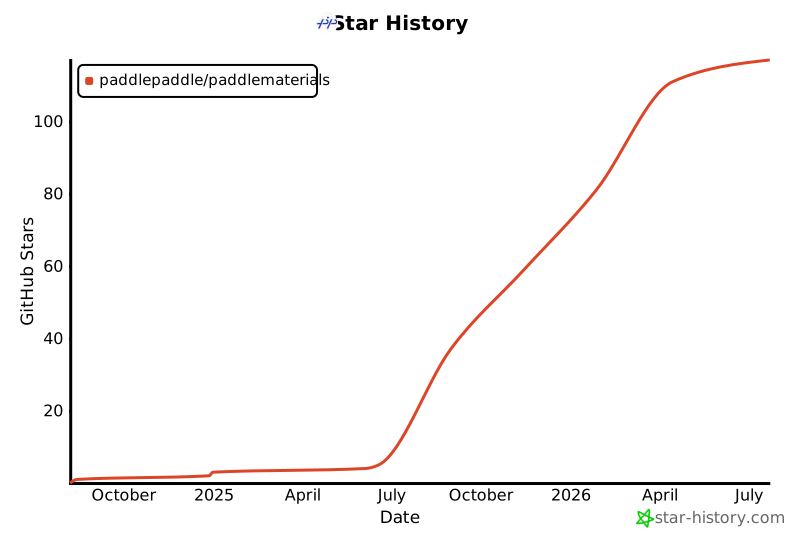
Thanks to all contributors who have helped build PaddleMaterials!

Thanks for the following organiziton for cooprative support!


Join the PaddleMaterials WeChat group to discuss with us!

🛠️ Contribute to PaddleMaterials
For developer, please refer to architecture.
📜 License
PaddleMaterials is licensed under the Apache License 2.0.
🎓 Citation
@misc{paddlematerials2025,
  title={PaddleMaterials, a deep learning toolkit based on PaddlePaddle for material science.},
  author={PaddleMaterials Contributors},
  howpublished = {\url{https://github.com/PaddlePaddle/PaddleMaterials}},
  year={2025}
}
🙏 Acknowledgements
This repository references code from the following projects:
PaddleScience | Matgl | CDVAE | DiffCSP | MatterGen | MatterSim | CHGNet | AIRS
1 maintainer

Metadata
1 maintainer
Release files for ppmat 0.3.0
For a detailed explanation of source distributions (sdists) and built distributions (wheels), please see the package formats documentation.
Source distribution (sdist)
| File | Size | Uploaded | Provenance | Actions |
|---|---|---|---|---|
| ppmat-0.3.0.tar.gz | 646.3 kB | With provenance | Details for ppmat-0.3.0.tar.gz |
Built distribution (wheel)
| File | Interpreter | ABI | Platform | Actions Reset |
|---|---|---|---|---|
| ppmat-0.3.0-cp310-cp310-manylinux2014_x86_64.manylinux_2_17_x86_64.whl | CPython 3.10 | CPython 3.10 | Linux glibc 2.17+ x86-64 | Details for ppmat-0.3.0-cp310-cp310-manylinux2014_x86_64.manylinux_2_17_x86_64.whl |
Total release size: 1.7 MB
Release files / ppmat-0.3.0.tar.gz
| Download URL | ppmat-0.3.0.tar.gz |
|---|---|
| Size | 646.3 kB |
| Tags | Source |
|
SHA-256 checksum How to use checksums |
9ec965c4b487dbd81c9b0a0d7b9c7796c9b2a3925c4e42e13172a2bcfc83002d
|
|
BLAKE2b-256 checksum How to use checksums |
c49d852154beae7c251a5dca4945a8216b1228280165d01f2705873e79789b94
|
| Upload date | |
|
Uploaded using Trusted Publishing? What is trusted publishing? |
Yes |
| Uploaded via |
twine/7.0.0 CPython/3.13.14
|
Provenance
Provenance describes where a file came from. On PyPI, provenance is shared via attestations, which provide a verifiable record of the build or publishing details. View details, limitations and caveats.


PyPI Publish Attestation
PyPI verified that this artifact, at this checksum, originated from the publisher listed below.
Signed by GitHub Actions, verified by PyPI on Aug 19, 2026.
Transparency logRelease files / ppmat-0.3.0-cp310-cp310-manylinux2014_x86_64.manylinux_2_17_x86_64.whl
| Download URL | ppmat-0.3.0-cp310-cp310-manylinux2014_x86_64.manylinux_2_17_x86_64.whl |
|---|---|
| Size | 1.1 MB |
| Tags | CPython 3.10 Linux glibc 2.17+ x86-64 |
|
SHA-256 checksum How to use checksums |
1f1e4a8f21cade2331136e9c33b1da2c4b45c7710956c7694adc6272711c152a
|
|
BLAKE2b-256 checksum How to use checksums |
859ba347ff1c89b9b2994945cba350a3b079c8cce083a0d4113eaba90d9dd749
|
| Upload date | |
|
Uploaded using Trusted Publishing? What is trusted publishing? |
Yes |
| Uploaded via |
twine/7.0.0 CPython/3.13.14
|
Provenance
Provenance describes where a file came from. On PyPI, provenance is shared via attestations, which provide a verifiable record of the build or publishing details. View details, limitations and caveats.
PyPI Publish Attestation
PyPI verified that this artifact, at this checksum, originated from the publisher listed below.
Signed by GitHub Actions, verified by PyPI on Aug 19, 2026.
Transparency logSecurity for ppmat 0.3.0
Provenance
Provenance describes where a file came from. On PyPI, provenance is shared via attestations, which provide a verifiable record of the build or publishing details. View details, limitations and caveats.
Full provenance
All 2 files in this release have been uploaded with provenance metadata.
Attestation for ppmat-0.3.0.tar.gz
PyPI Publish Attestation
PyPI verified that this artifact, at this checksum, originated from the publisher listed below.
Signed by GitHub Actions, verified by PyPI on Aug 19, 2026.
Transparency logA note on package security
PyPI is a repository for distributing packages, not a service for auditing them. While third-party security researchers and our staff do their best to detect and remove malicious packages, PyPI cannot guarantee the quality, security or suitability of any given package.
To learn more about protecting yourself from malicious actors, visit our package security documentation.














