
This release is a pre-release and may not be stable for production use.
ppsds: probabilistic prediction for stochastic dynamical systems
How probabilistically predictable is a system you only partly know? ppsds answers from both sides: the ceiling any probabilistic prediction could reach on a system you know exactly, and a probabilistic predictor that comes with a floor over every system you are willing to admit.
If that sounds abstract, that is expected. The paragraph above is written for readers who already know what a stochastic dynamical system is and what probabilistic prediction means. Many people have never met either term, and some may already be working with such a system without knowing it. You cannot miss a capability you have never had a name for. The one-minute game below replaces the vocabulary with something you can play: place a few bets, watch the system move, and see what a probabilistic prediction is before reading a definition of it.
|
|
|
||||||||
|
A puck moves around a table. You bet on where it will land next by placing stacks. Then the dealer drops a ball: every stack within |
|||||||||
Install
pip install ppsds
0.0.3-alpha is a pre-release: pin it with pip install ppsds==0.0.3a0, or pass --pre. Plain
pip install ppsds selects it while no stable version exists; once 0.1.0 is out, plain install
selects the stable release.
Core dependencies are numpy, scipy, cvxpy and gymnasium; Python 3.10 or newer. Only the experiment and plotting periphery needs more:
pip install "ppsds[experiments]" # adds matplotlib, pandas, seaborn, tqdm
Each example and experiment directory also carries its own environment.yml if you would rather create a conda environment for exactly one page.
The game rules, and why they are the package
Bet by placing stacks; one stack is one atom of a pmf and its height is the weight. The dealer drops a ball, every stack within epsilon of the landing pays its share, and your round is scored by the epsilon-logarithm score — the log of the probability you gave the landing's neighbourhood.
Cover the table builds the safe layout: it tiles the noise support, so it pays the same share every round and cannot lose — at the price of never winning big. A run ends when a round pays nothing, or when you ask it to.
Playing it is free, needs no install, and keeps nothing: the page has no server behind it. When you want the same thing done rigorously, the bets you place export to a file that the betting experiment reads back and recomputes round by round.
Get started
Rows are how far you want to go. Columns are what you start from, ordered from nothing to data without a model.
| From → | A · Just curious Nothing yet. |
B · Build it yourself No environment. |
C · Your system You can step it. |
D · Data only No model or env. |
|---|---|---|---|---|
| L0 · See | 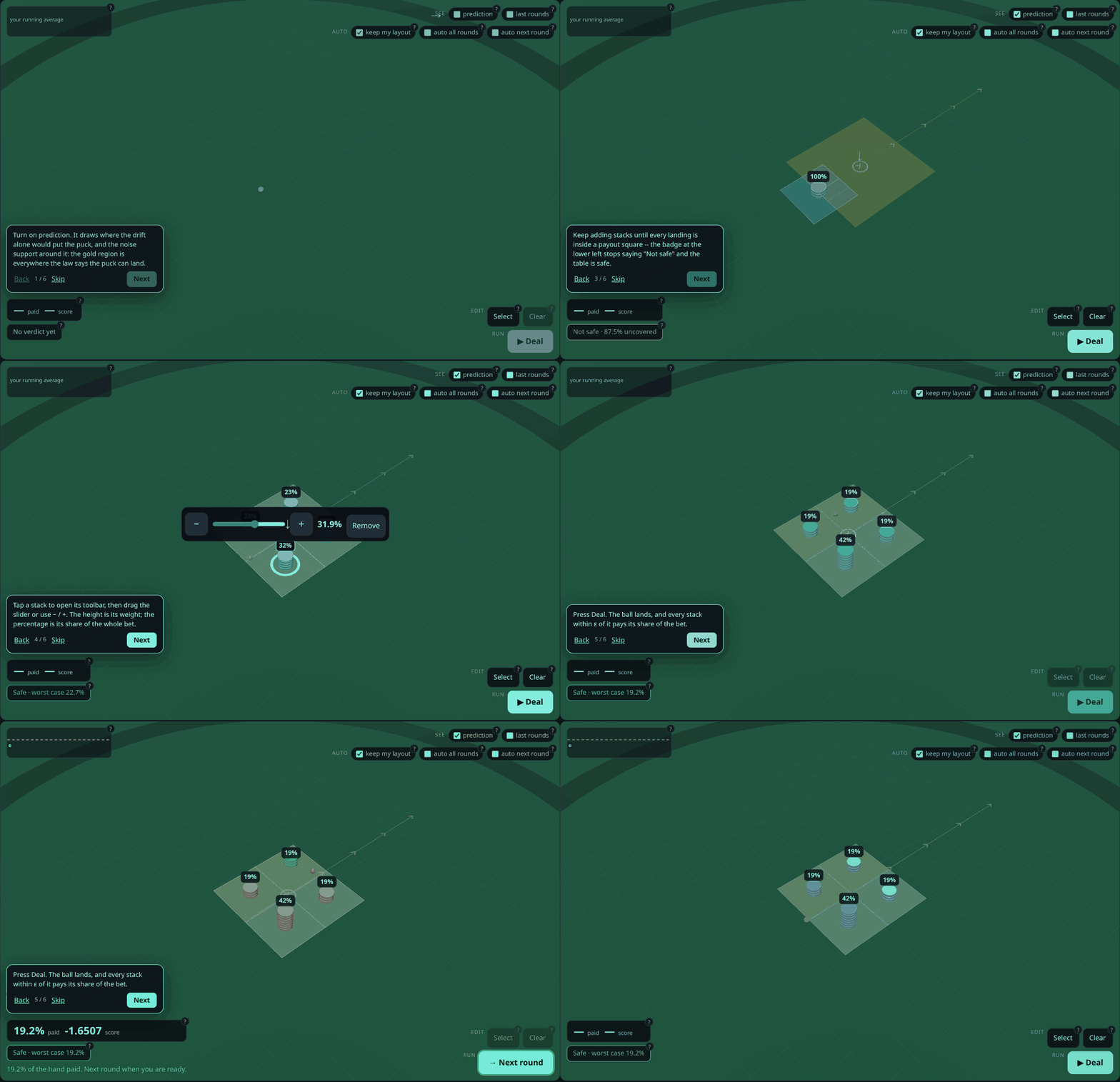 Just curious: see what a probabilistic prediction is in one minute. |
— | — | — |
| L1 · Use | — | 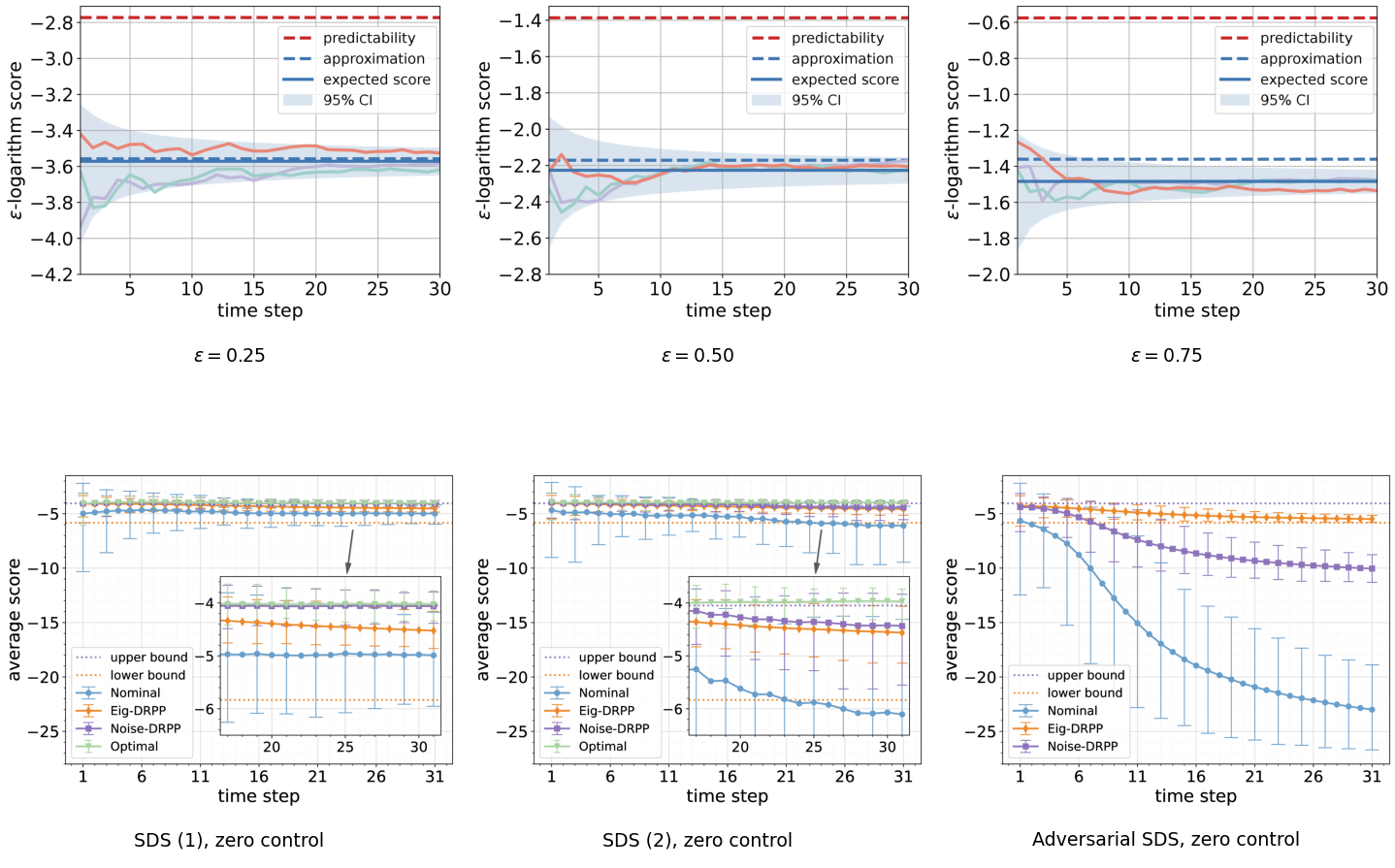 Reproduce a paper: build the system from the paper and check its figures. |
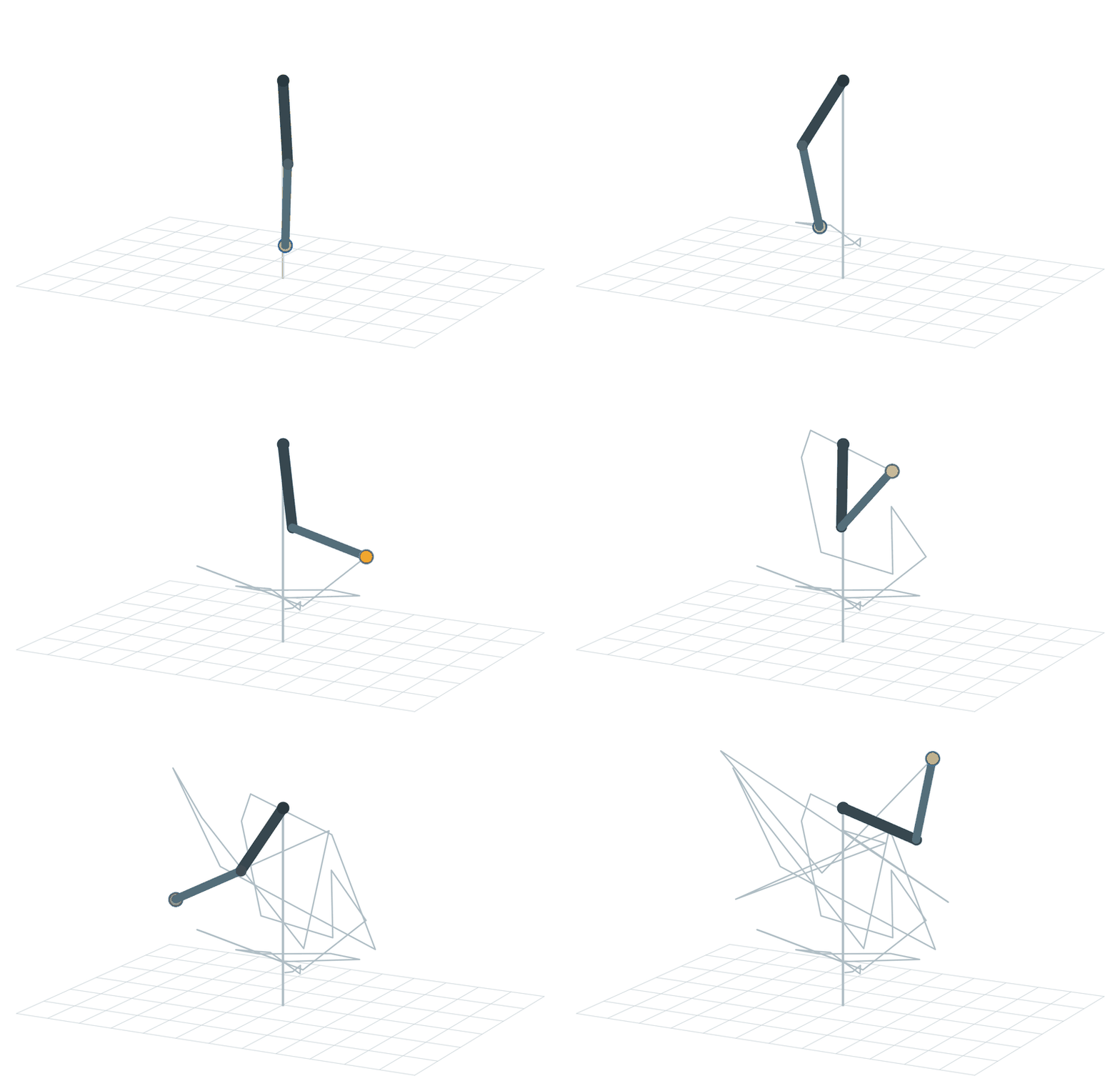 Use it on your system: put a predictor on a Gymnasium environment you already have. |
Only data: you need a system you can step; read the limits first. |
| L2 · Extend | — | Add a predictor kind: try a different prediction law in a simulation you build. | 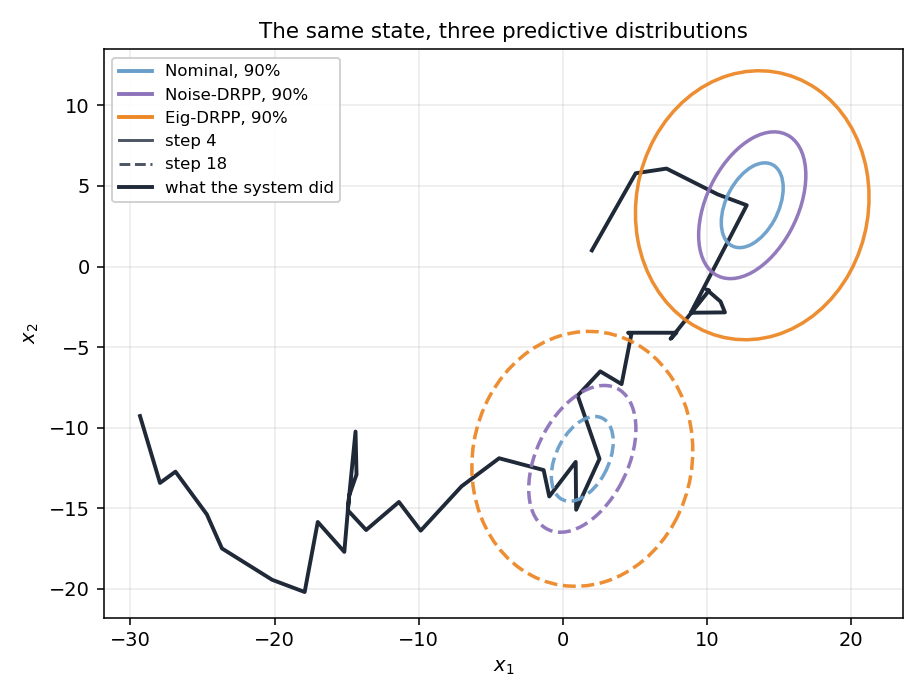 Add a family: teach the library the uncertainty language your system needs. |
— |
| L3 · Research | — | Work on the ceiling: scoring rules, predictability, and what no predictor can beat. | Do research on the floor: change the assumptions, not just the implementation. | — |
| L4 · Contribute | Found a problem while playing: open an issue; the game is a real user of the library. | Contribute what you built: file an L1 issue, or send an L2/L3 result (including a benchmark) as a pull request. | Contribute what you built: file an L1 issue, or send your L2/L3 results as a pull request. | Discuss a research collaboration: this column is future research; L0–L3 are blank here. |
Recommended routes
The table above sells one story at a time. These are the routes — paths that cross the site's four sections, for a reader who knows what they are trying to get done.
Need the panorama? The map below shows every route at a glance; the map page explains what each one means and how the sections connect.
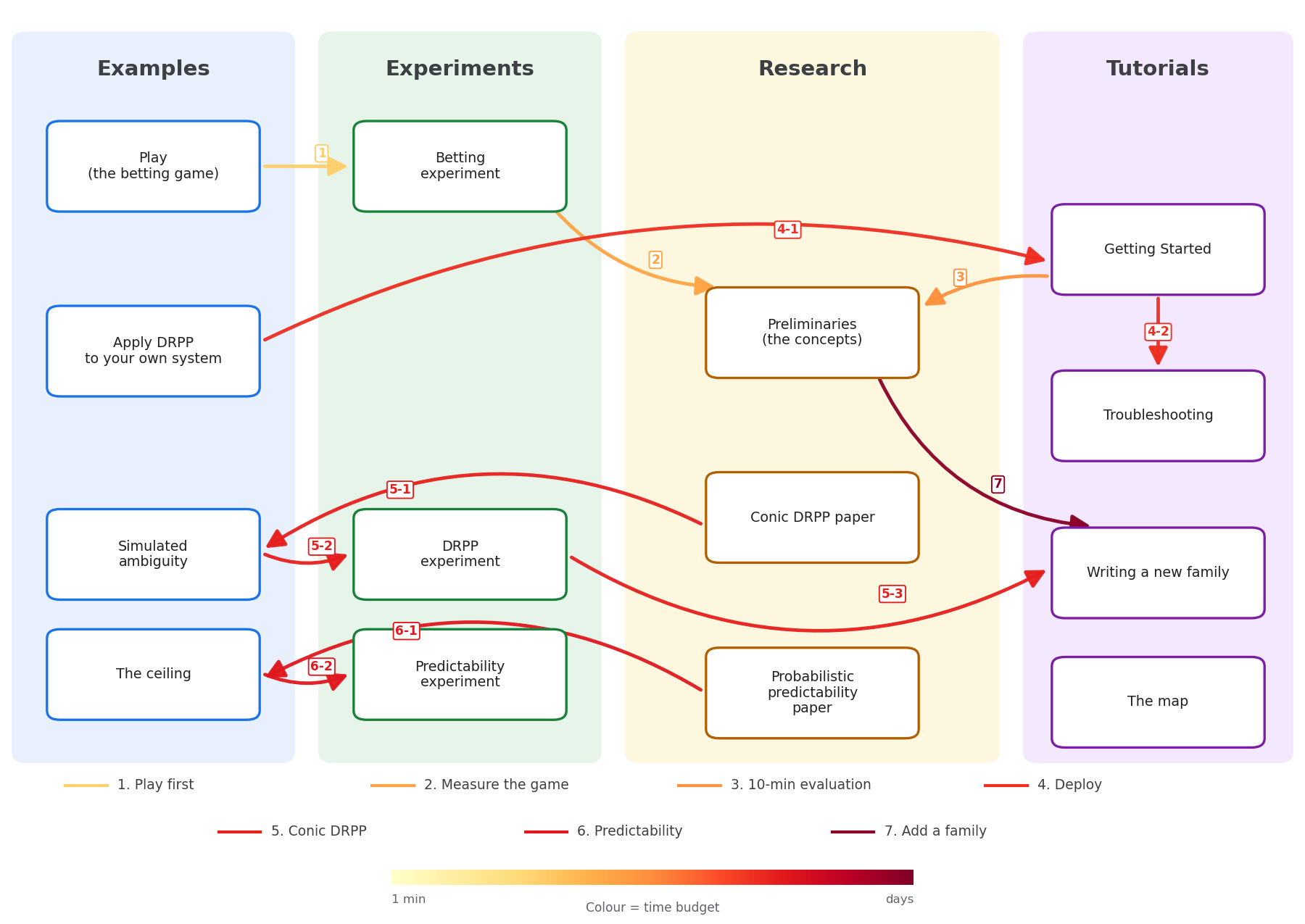
1 · Play first. The game needs nothing installed. Thirty seconds on the table, and you know what a probabilistic prediction is.
2 · Measure the game properly. The game → the betting experiment → Preliminaries. The same move over thousands of trajectories, against the ceiling.
3 · The 10-minute evaluation. The apply quickstart → the honest limits. Run one script, read what the guarantee does not cover, and decide whether to try it.
4 · Deploy on your own system. Apply DRPP → Getting Started → Troubleshooting. The four-step declaration, the pitfalls, and the two ways it surprises you.
5 · Check or reproduce the conic DRPP paper. The paper → the simulated-ambiguity example → the DRPP experiment → A new family and its DRPP.
6 · Check or reproduce the probabilistic predictability paper. The paper → the ceiling example → the predictability experiment.
7 · Do research, or add a family. Preliminaries → either paper → A new family and its DRPP → CONTRIBUTING.
Sections on this site
| Section | What it is |
|---|---|
| Examples | Four stories you can run. Each prints every number it talks about; no batch infrastructure required |
| Experiments | The same questions at paper scale: cached, parallel, reproducible, with the figures the papers report |
| Research | The common preliminaries, and one page per paper with its result, its figure, its experiment links, and its citation |
| Tutorials | Topics treated on their own terms — Getting Started, A new family and its DRPP, Troubleshooting, and the map |
| API | Generated from the docstrings, so it cannot drift from the code |
A little more about what is inside
ppsds predicts the next state of a stochastic dynamical system as a distribution rather than a point. It is for systems you can step (a simulator, or a Gymnasium environment) and can model, but not exactly: an underactuated robot, a vehicle or drone held near its operating point, a plant inside a process simulator.
An ordinary predictor trusts that model. That works until the real system drifts away from it, and then the prediction is quietly too narrow: overconfident exactly when you needed it to be honest.
ppsds ships one remedy today: DRPP, distributionally robust probabilistic prediction. You declare an ambiguity set — the systems you are willing to admit — and DRPP returns the predictive distribution whose worst-case expected score over that set is as high as it can be: a floor that holds for every system in the set, for the price of a little average performance.
That DRPP is the one for conic-moment ambiguity sets, on an additive-drift system. It is the first of a template rather than a single method: each family of ambiguity sets yields its own DRPP, and the drpp subpackage is built to hold more. Zoom out one level and DRPP is one kind of probabilistic predictor; probabilistic predictability answers the same question from the other side, for a system you do know exactly.
Citation and licence
If you use ppsds, cite the software:
@software{ppsds,
  title   = {ppsds: probabilistic prediction for stochastic dynamical systems},
  author  = {Xu, Tao and He, Jianping},
  license = {MIT},
  url     = {https://github.com/Xuzerken/ppsds}
}
GitHub's Cite this repository button reads
CITATION.cff and produces the same entry; an archived release with a DOI will be added once the first stable release is archived. Each paper's citation is at the end of its page: conic DRPP paper and probabilistic predictability paper.
ppsds is MIT licensed: use it freely, keep the copyright and licence notice. If you want to contribute, CONTRIBUTING has the setup, the tests, and the rule that a change must not move a number.
Next
- Thirty seconds, no install: play the betting game
- You have an environment: Getting Started puts a predictor on it
- You want the theory: Research, then the two papers
- You want the graph: the map
1 maintainer

Metadata
1 maintainer
Release files for ppsds 0.0.3a0
For a detailed explanation of source distributions (sdists) and built distributions (wheels), please see the package formats documentation.
Source distribution (sdist)
| File | Size | Uploaded | Provenance | |
|---|---|---|---|---|
| ppsds-0.0.3a0.tar.gz | 240.0 kB | With provenance | Details |
Built distribution (wheel)
| File | Interpreter | ABI | Platform | Reset |
|---|---|---|---|---|
| ppsds-0.0.3a0-py3-none-any.whl | Python 3 | none | any | Details |
Total release size: 334.4 kB
Release files / ppsds-0.0.3a0.tar.gz
| Download URL | ppsds-0.0.3a0.tar.gz |
|---|---|
| Size | 240.0 kB |
| Tags | Source |
|
SHA-256 checksum How to use checksums |
f13bc51f591d7744ad7a773c1fc0fe32e8cc04e2e882d09311b46747ff21ce28
|
|
BLAKE2b-256 checksum How to use checksums |
2fb5f8557ae8f21d5eca8249ddd3a311098e5fdaf8f9df32fdf143aae982a499
|
| Upload date | |
|
Uploaded using Trusted Publishing? What is trusted publishing? |
Yes |
| Uploaded via |
twine/7.0.0 CPython/3.13.14
|
Provenance
Provenance describes where a file came from. On PyPI, provenance is shared via attestations, which provide a verifiable record of the build or publishing details. View details, limitations and caveats.


PyPI Publish Attestation
PyPI verified that this artifact, at this checksum, originated from the publisher listed below.
Signed by GitHub Actions, verified by PyPI on Oct 19, 2026.
Transparency logRelease files / ppsds-0.0.3a0-py3-none-any.whl
| Download URL | ppsds-0.0.3a0-py3-none-any.whl |
|---|---|
| Size | 94.3 kB |
| Tags | Python 3 |
|
SHA-256 checksum How to use checksums |
88d0bf88484208519ec327856ad1282a4493035205b6f9c92d8f91bed46b5787
|
|
BLAKE2b-256 checksum How to use checksums |
318b3ce0d519147b51d33620a846e785585bf34f8cf03b7d16010e85bca83aa8
|
| Upload date | |
|
Uploaded using Trusted Publishing? What is trusted publishing? |
Yes |
| Uploaded via |
twine/7.0.0 CPython/3.13.14
|
Provenance
Provenance describes where a file came from. On PyPI, provenance is shared via attestations, which provide a verifiable record of the build or publishing details. View details, limitations and caveats.
PyPI Publish Attestation
PyPI verified that this artifact, at this checksum, originated from the publisher listed below.
Signed by GitHub Actions, verified by PyPI on Oct 19, 2026.
Transparency logSecurity for ppsds 0.0.3a0
Provenance
Provenance describes where a file came from. On PyPI, provenance is shared via attestations, which provide a verifiable record of the build or publishing details. View details, limitations and caveats.
Full provenance
All 2 files in this release have been uploaded with provenance metadata.
Attestation for ppsds-0.0.3a0.tar.gz
PyPI Publish Attestation
PyPI verified that this artifact, at this checksum, originated from the publisher listed below.
Signed by GitHub Actions, verified by PyPI on Oct 19, 2026.
Transparency logA note on package security
PyPI is a repository for distributing packages, not a service for auditing them. While third-party security researchers and our staff do their best to detect and remove malicious packages, PyPI cannot guarantee the quality, security or suitability of any given package.













