
PQID-Bench
A validation-aware benchmark suite for quantum-program generation






- Benchmark release:
v1.0.0 - Python package:
v1.1.2 - Scientific freeze:
2026-07-23 - Distribution status: frozen evidence release with a compatible software update
- Evaluator:
pqid-bench-evaluator-1.1.0-safe-builtins - Structural predicate:
pqid-bench-reference-signature-1.0.0-count-map - Prospective contract (Overview object O6): PQID-Bench 2 preregistration,
OSF DOI
10.17605/OSF.IO/WDERQ
PQID-Bench is a frozen research artifact derived from the archived PQID v1.0.2 dataset. It tests whether generated Qiskit programs merely execute or recover an explicitly limited reference structure. The benchmark does not treat execution as structural or semantic correctness.
Ecosystem Workflow

The evidence path keeps governed source data, deterministic splits, provider collection, isolated replay, numerical reporting, and interactive presentation as separate stages. The hosted explorer reads the final frozen artifacts; it is not part of scoring.
Frozen Design
| object | frozen value |
|---|---|
| clean generation population | 734 prompts |
| train / validation / test | 514 / 66 / 154 |
| test-set reference signatures | 144 |
| completed model routes | 21 |
| primary model-prompt cells | 3,234 |
| retrieval-copy baselines | 3 |
| stochastic-repeatability panel | 72 unique signatures x 21 models x 3 runs |
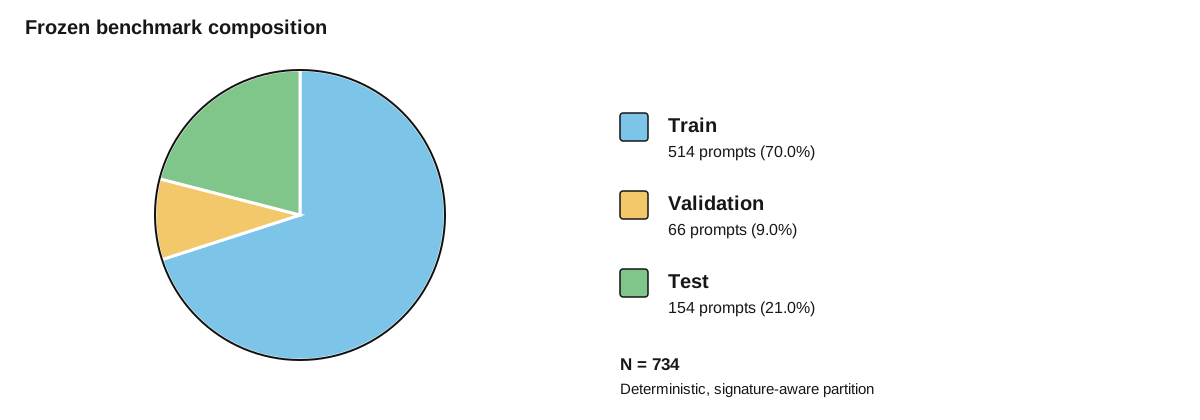
The clean generation population is partitioned deterministically into 514
training, 66 validation, and 154 held-out test prompts. The primary external
model comparison uses only the frozen test split.
60-Second Reproduction
Clone the evidence repository, install the published toolkit, and reproduce the headline matrix without contacting a provider or executing generated code:
git clone https://github.com/Elias-Abebe-Gasparini/PQID-Bench.git
cd PQID-Bench
python -m pip install "pqid-bench==1.1.2"
pqid-bench verify . --full
pqid-bench reproduce --release-dir . --format text
Expected anchors are 21 models, 154 prompts, 3,234 cells, 91.22%
execution, 91.03% assembly admissibility, and 52.66% signature recovery.
See the worked examples for the importable API, dashboard,
and outcome-blind live-run planning.
The primary reference-signature predicate compares qubit count, classical-bit count, and the complete evaluator-visible operation-type count map. Equality of that map implies scalar counted-operation equality under the frozen convention, so scalar operation count remains a separately reported diagnostic rather than a fourth conjunct. Ordered operation-and-operand tape equality and parameter-aware equality are stricter replay layers. None of these exact reference-reconstruction predicates proves semantic equivalence.
Visual Evidence Map

The interactive evidence explorer provides hoverable model profiles, a component-recovery heatmap, the complete operational-to-structural ladder, three-run repeatability estimates, and provider-route summaries. It is generated from the frozen artifacts on GitHub Pages and does not contact model providers or execute generated code.
Headline Results
| endpoint | count | rate |
|---|---|---|
| execution | 2,950 / 3,234 | 91.22% |
| quantum-assembly admissibility | 2,944 / 3,234 | 91.03% |
| reference-signature recovery | 1,703 / 3,234 | 52.66% |
| pooled Assembly-Structure Gap | 1,241 / 3,234 | 38.37 pp |
| pooled Execution-Structure Gap | 1,247 / 3,234 | 38.56 pp |
| executable signature disagreement | 1,247 / 2,950 | 42.27% |
| identifiable-subset structural-hallucination rate | 1,187 / 2,890 | 41.07% |
| ordered operation-and-operand recovery | 1,576 / 3,234 | 48.73% |
| parameter-aware recovery | 1,545 / 3,234 | 47.77% |
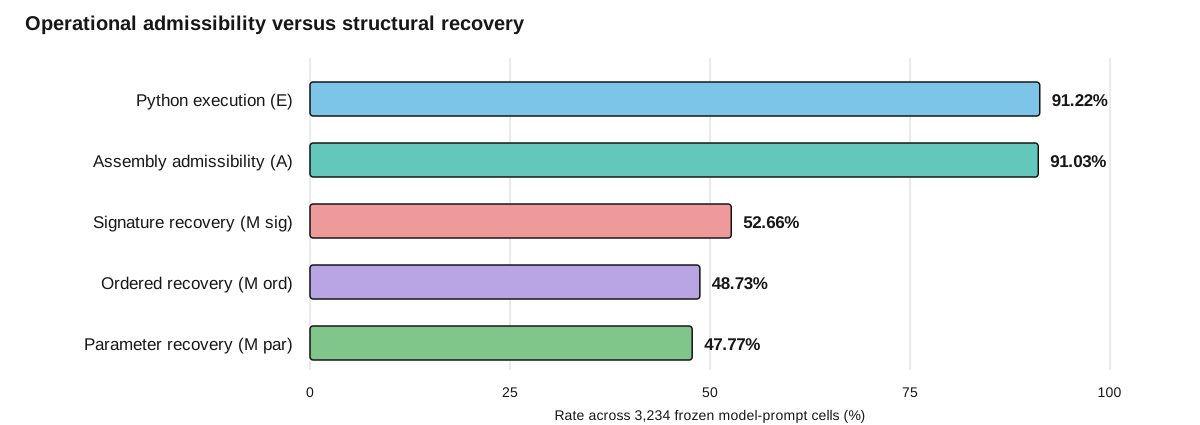
The bar chart makes the study object visible at a glance: operational
admissibility remains above 91%, whereas every frozen structural-recovery
endpoint remains below 53%.
Only six cells are lost from execution to assembly admissibility. On the frozen panel, the AS-Gap is the assembly-admissible subset of the ES-Gap and accounts for 99.52% of it. Assembly admissibility means successful OpenQASM 3 serialization under the evaluator, not backend execution.
The complete 154-prompt matrix remains primary. Four prompts whose wording
does not uniquely specify every frozen signature component are removed only in
the prespecified 150-prompt identifiability sensitivity analysis.
Repository Layout
| path | purpose |
|---|---|
data/ |
repository-cleared 734-row clean generation population |
artifacts/test_split_154/ |
deterministic split, prompts, templates, and retrieval-copy results |
artifacts/external_model_batches_154/ |
canonical requests, responses, evaluator reports, and trace manifests |
artifacts/analysis_154/ |
final matrix, inference, robustness, identifiability, and replay audits |
artifacts/stochastic_repeatability_21x72/ |
preregistered sequential repeatability design and consolidated three-run audit |
docs/ |
complete user manual, reviewer guide, contracts, and release documentation |
examples/ |
runnable offline reproduction, dashboard, and request-planning examples |
scripts/ |
evaluator, analysis, validation, and figure/table builders |
ARTIFACT_MANIFEST.tsv records the byte size and SHA-256 digest of every
public file. The response logs are frozen trace artifacts. Re-running live APIs
may produce different text and is not required to reproduce the reported
tables from the archived outputs.
Rendered publication figures, captions, editable figure sources, copy-ready
manuscript tables, the manuscript walkthrough notebook, and the undeployed
gateway bundle are intentionally excluded. Their numerical inputs and
generation scripts remain available; see
docs/REGENERATING_PUBLICATION_OUTPUTS.md.
Python Package
The repository is also the source distribution for pqid-bench 1.1.2. The
package separates eight operations that must not be conflated:
doctorreports the local runtime and optional dependencies;verifychecks release bytes againstARTIFACT_MANIFEST.tsv;reproducerecomputes published metrics from archived evaluation records without executing generated code;evaluatesummarizes a supplied canonical evaluation JSONL file;comparealigns a compatible candidate with the same frozen prompt denominator;dashboardbuilds a standalone interactive Plotly report from frozen evidence;run-modelcollects a new, traceable response panel from an OpenAI-compatible endpoint without executing generated code; andreplayexecutes archived or newly collected generated programs only inside the credential-free, network-disabled Docker evaluator.
The dependency-free package core and archived-analysis workflows are tested on Python 3.11--3.14. The optional replay container retains the frozen Python 3.13, Qiskit 2.1.1, Qiskit Aer 0.17.0, and python-dateutil 2.9.0.post0 environment used by the evaluator audit.
GitHub evaluator package
GitHub Packages hosts the pinned evaluator runtime as an OCI image:
docker pull ghcr.io/elias-abebe-gasparini/pqid-bench-evaluator:1.0.0
Immutable OCI manifest:
sha256:39825f5635cd6273e9e23c2848f2c88a2ff9d461e16a263fd89f22c6e664ac8f.
The GHCR image is the isolated execution environment used by
pqid-bench replay; it is not another Python distribution and does not change
the frozen benchmark version. The importable Python toolkit remains
authoritative on PyPI.
Install the toolkit from a checkout or wheel:
python -m pip install .
pqid-bench doctor
pqid-bench verify . --full
pqid-bench reproduce --release-dir . --format text
Install the optional visualization layer and create an offline HTML report:
python -m pip install "pqid-bench[visualization]"
pqid-bench dashboard --release-dir . --output pqid-bench-dashboard.html
The importable interface uses pqid_bench. Version dimensions are independent:
package 1.1.2 implements benchmark release 1.0.0, evaluator
pqid-bench-evaluator-1.1.0-safe-builtins, and structural predicate
pqid-bench-reference-signature-1.0.0-count-map. The optional replay
container is a separate distribution artifact at version 1.0.0; its image
identity does not replace the evaluator identifier.
Candidate comparison is denominator-safe by default: it requires a compatible
run manifest and one complete 154-prompt set per candidate model. Partial
results require --allow-partial and are compared only with the same frozen
prompt subset.
Numerical commands retain JSON as the default for automation and additionally
support --format text, --format markdown, and --format csv. The Python
BenchmarkSummary object likewise supports direct printing, copy-ready
Markdown, and tidy rows without adding a dataframe dependency. See the
reporting guide.
Fresh API generation always produces a new timestamped live_replication
rather than reproducing the archived model texts. The live runner exports only
the frozen model-facing messages, requires explicit third-party export
acknowledgement, never persists credential values, and supports bounded
retries and atomic resume. The separate Docker replay automatically emits
canonical evaluation cells and JSON, text, Markdown, and tidy CSV summaries.
See Live Model Testing.
Reproduction Entry Points
Start with:
- documentation home;
- interactive explorer;
- complete user manual;
- reviewer quickstart;
- data dictionary;
- worked examples;
- software-paper blueprint;
- software changelog;
- contribution guide;
- reproducibility artifact map.
The public evidence release deliberately excludes unpublished manuscript, supplement, and bibliography source files.
The Markdown manual works directly from the repository or installed source distribution. When MkDocs is available, serve the navigable local site from the release root:
mkdocs serve
Key checks:
pqid-bench verify . --full
pqid-bench reproduce --release-dir .
python scripts/test_pqid_bench_stochastic_repeatability.py
python scripts/analyze_pqid_bench_prompt_identifiability.py
python scripts/analyze_pqid_bench_ordered_operand_validation.py
python scripts/analyze_pqid_bench_evaluator_builtin_correction.py
Rebuild the synchronized public package and its archive from the parent PQID repository:
python scripts/build_pqid_bench_public_release.py --archive
Public Endpoints
- GitHub: https://github.com/Elias-Abebe-Gasparini/PQID-Bench
- Documentation: https://elias-abebe-gasparini.github.io/PQID-Bench/
- Interactive explorer: https://elias-abebe-gasparini.github.io/PQID-Bench/interactive/overview.html
- Python package: https://pypi.org/project/pqid-bench/
- Evaluator container: https://github.com/Elias-Abebe-Gasparini/PQID-Bench/pkgs/container/pqid-bench-evaluator
- PQID-Bench v1.0.0 archive: https://doi.org/10.5281/zenodo.21649753
- Hugging Face Dataset: https://huggingface.co/datasets/Elias-Abebe-Gasparini/PQID-Bench
- Source PQID dataset v1.0.2: https://doi.org/10.5281/zenodo.20674853
- Stable PQID dataset concept DOI: https://doi.org/10.5281/zenodo.20019482
The benchmark archive and its source PQID dataset are separate versioned research objects and require separate citations.
Licensing And Citation
Benchmark-authored documentation, metadata, and aggregate analysis artifacts
are released under CC BY 4.0. Code under src/, scripts/, and platforms/
is released under the MIT License. Source-derived rows retain their row-level
provenance and upstream license obligations; the package-level licenses do not
override those terms. See LICENSE.md.
Please cite the benchmark release:
Elias Abebe Gasparini. 2026. PQID-Bench: A Validation-Aware Benchmark Suite for Quantum-Program Generation (v1.0.0) [Software]. Zenodo. https://doi.org/10.5281/zenodo.21649753
The underlying dataset must be cited separately:
Elias Abebe Gasparini. 2026. PQID: Parallel Quantum Instruction Dataset (v1.0.2) [Data set]. Zenodo. https://doi.org/10.5281/zenodo.20674853
1 maintainer

Download files
Download the file for your platform. If you're not sure which to choose, learn more about installing packages.
Source Distributions
Built Distribution
Filter files by name, interpreter, ABI, and platform.
If you're not sure about the file name format, learn more about wheel file names.
Copy a direct link to the current filters
File details
Details for the file pqid_bench-1.1.2-py3-none-any.whl.
File metadata
- Download URL: pqid_bench-1.1.2-py3-none-any.whl
- Upload date:
- Size: 54.1 kB
- Tags: Python 3
- Uploaded using Trusted Publishing? No
- Uploaded via: twine/6.2.0 CPython/3.13.5
File hashes
| Algorithm | Hash digest | |
|---|---|---|
| SHA256 |
76d9722bb5c48ac1b0d75a4309d754708e0aaa261e1fdc7dddfac0be6a3ecb4f
|
|
| MD5 |
e5f29130b2eecf67897f9059ff2c26a4
|
|
| BLAKE2b-256 |
232b84cb6ca5281721f7af32586882d95d5727564eb9754765b4e86ff83378d0
|







