
pr-automation-agent
EU AI Act-compliant scaffold and shared library for automating ingest PRs with GitHub Copilot.
Works with plain Python, Prefect, Airflow, Dagster, or any pipeline framework. Zero pipeline framework required for the core package.


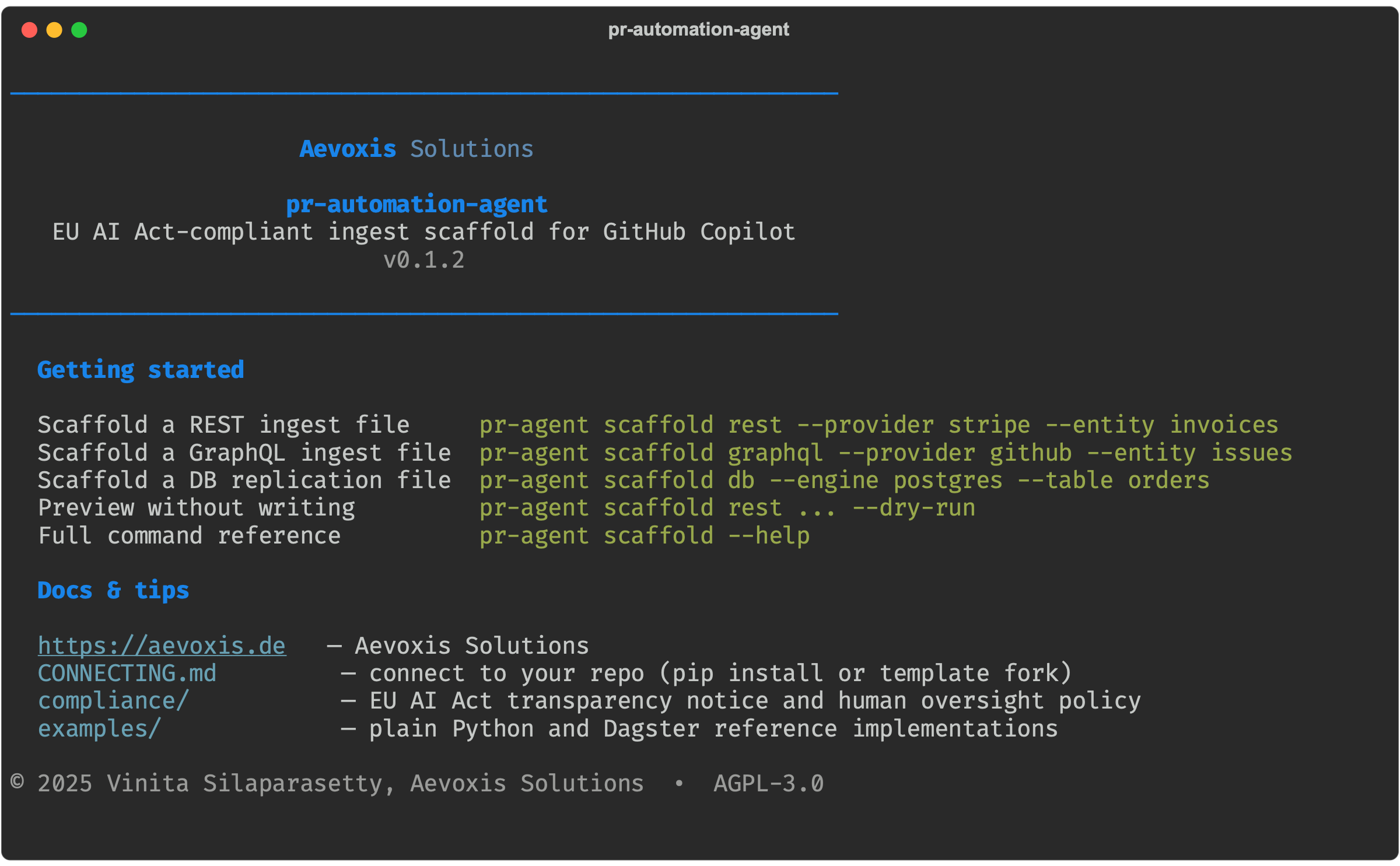
Table of contents
- What you get
- Requirements
- Install
- Quickstart — plain Python
- Quickstart — Dagster
- All scaffold options
- Secrets & configuration
- EU AI Act compliance
- Data & privacy (GDPR)
- Run the tests
- Connect your own repo
- License
What you get
| Component | Description |
|---|---|
pr-agent scaffold CLI |
Generate a correctly structured ingest file in seconds |
BaseRestFetcher |
Subclass and implement fetch_all() — REST ingest done |
BaseGraphQLFetcher |
Single-request GraphQL fetcher with cursor pagination variant |
BaseDbReplicator |
Incremental DB replication to Parquet with watermark support |
DevEnvSecretResolver |
Reads PR_AGENT__<GROUP>__<KEY> env vars — swap for AWS SSM etc. in prod |
| Dagster integration | Optional BaseRestAsset, BaseGraphQLAsset, BaseDbReplicationAsset |
log_ai_contribution() |
Append EU AI Act Art. 52 audit records locally after AI PRs merge |
.github/ workflows |
CI that tests, materializes examples, enforces EU AI Act disclosure |
compliance/ |
AI transparency notice (Art. 52/53) and human oversight policy (Art. 14) |
Requirements
- Python 3.10 or higher
- pip or uv
No other dependencies for the core package. Dagster, pandas, sqlalchemy, and requests are only needed if you use the Dagster integration or DB replication.
Install
# Core only — plain Python / any framework (no pipeline deps)
pip install pr-automation-agent

# With Dagster integration + DB replication support
pip install "pr-automation-agent[dagster]"

# With uv
uv add pr-automation-agent
uv add "pr-automation-agent[dagster]"
Startup time: ~50 ms import, ~380 ms total CLI start. Dagster, pandas, and sqlalchemy are lazy imports — they are never loaded unless you explicitly call them. The CLI stays fast regardless of which extras are installed.
Once installed, run pr-agent with no arguments to open the welcome screen.
Quickstart — plain Python
No pipeline framework required. The generated file is a plain callable you can import from any script, Prefect flow, Airflow task, cron job, or Django management command.
Step 1 — scaffold
pr-agent scaffold rest --provider stripe --entity invoices
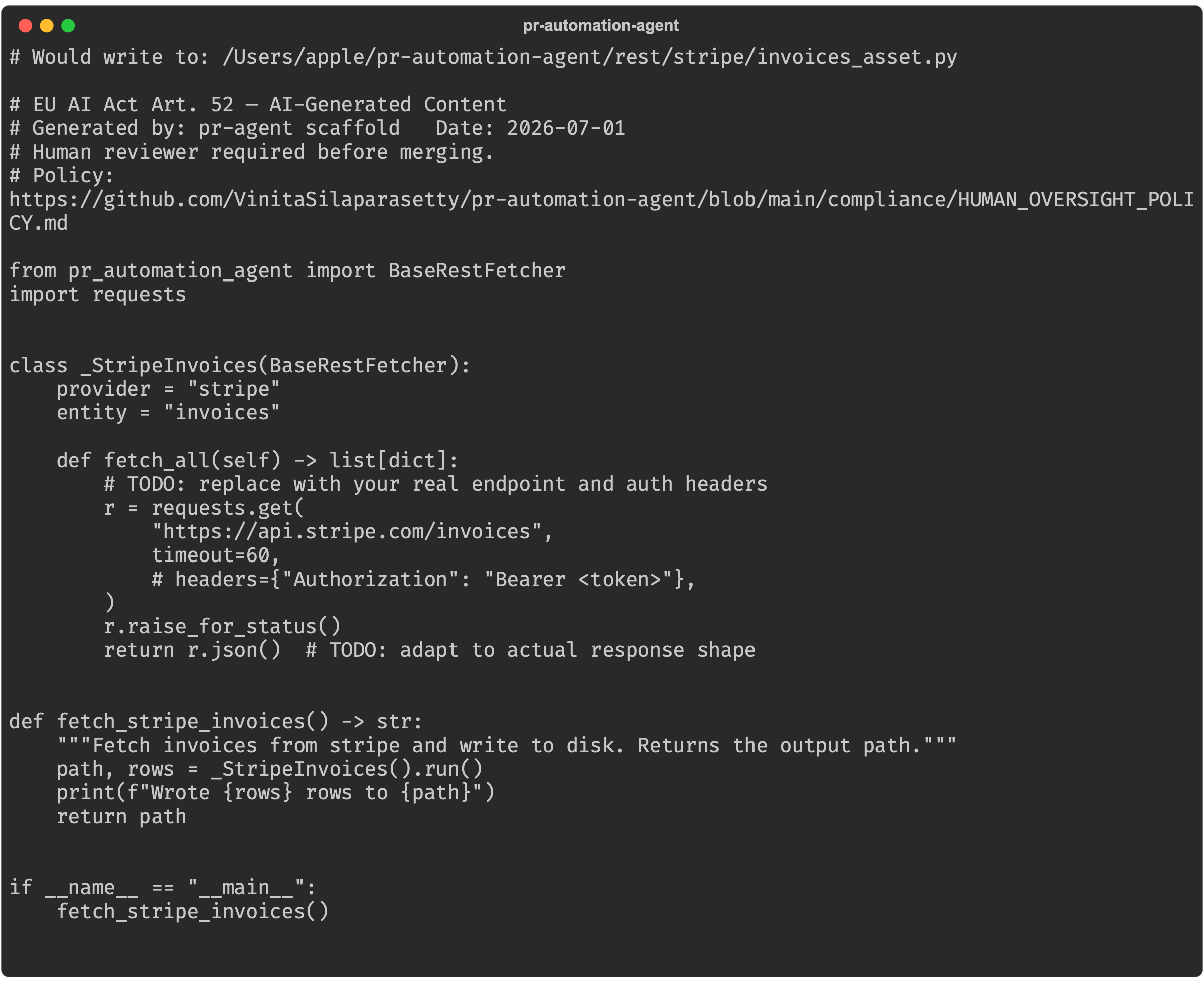
This writes rest/stripe/invoices_asset.py (relative to your working directory)
and creates __init__.py in every new subdirectory automatically.
Step 2 — fill in the TODOs
Open the generated file and replace the placeholder URL and auth headers with your real API call. Everything else — output path, date-stamped JSON, row count — is handled by the base class.
Step 3 — run it
python rest/stripe/invoices_asset.py
# Wrote 120 rows to tmp/stripe/invoices/2026-07-01.json
Or import the function from your pipeline:
from rest.stripe.invoices_asset import fetch_stripe_invoices

fetch_stripe_invoices()   # returns the output path
Quickstart — Dagster
Only do this if your repo already uses Dagster. Add --framework dagster
to the scaffold command:
pr-agent scaffold rest --provider stripe --entity invoices --framework dagster
The generated file uses BaseRestAsset and the @asset decorator
instead of a plain callable. Register it in your Definitions:
# defs.py
from dagster import Definitions, load_assets_from_modules
from pr_automation_agent.integrations.dagster import dev_env_secret_resolver_resource

import myrepo.ingest.rest.stripe.invoices_asset as stripe_invoices

defs = Definitions(
    assets=load_assets_from_modules([stripe_invoices]),
    resources={"secret_resolver": dev_env_secret_resolver_resource},
)
Verify it appears:
dagster asset list -m defs
All scaffold options
pr-agent scaffold TYPE [OPTIONS]

TYPE:
  rest      REST API ingest
  graphql   GraphQL API ingest (single-request or cursor-paginated)
  db        Incremental DB replication to Parquet

OPTIONS (rest / graphql):
  --provider NAME    Provider name, e.g. stripe, github   [required]
  --entity NAME      Entity/resource name, e.g. invoices  [required]
  --framework NAME   dagster  (omit for plain Python)

OPTIONS (db):
  --engine NAME      DB engine, e.g. postgres, mysql       [required]
  --table NAME       Table to replicate                    [required]
  --framework NAME   dagster  (omit for plain Python)

SHARED:
  --output-dir PATH  Write into this directory (default: current dir)
  --dry-run          Print the file without writing it

EXAMPLES:
  pr-agent scaffold rest    --provider stripe  --entity invoices
  pr-agent scaffold graphql --provider github  --entity issues
  pr-agent scaffold db      --engine postgres  --table orders
  pr-agent scaffold db      --engine postgres  --table orders --dry-run
  pr-agent scaffold rest    --provider stripe  --entity invoices --framework dagster
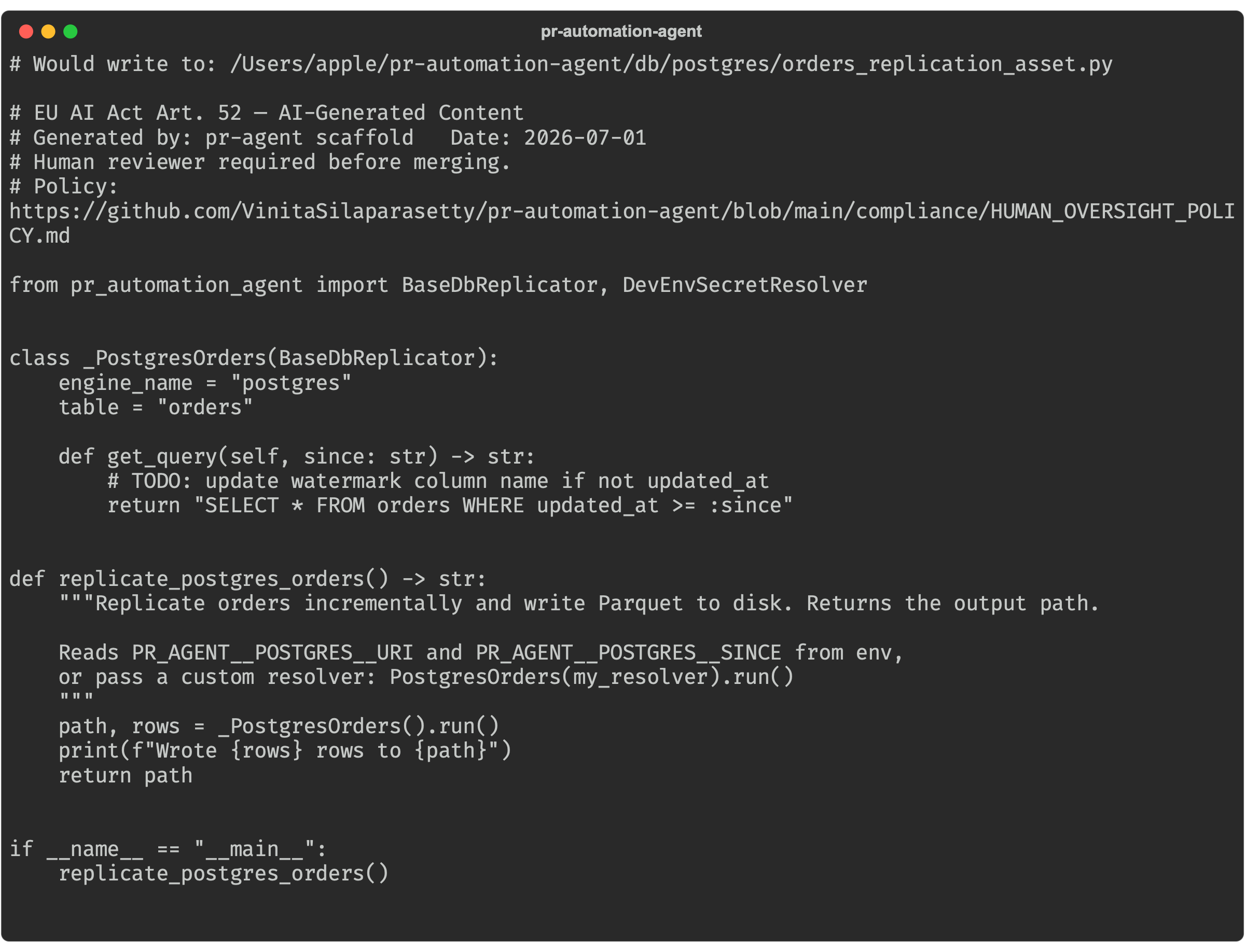
Every generated file includes:
- An EU AI Act Art. 52 header (date-stamped, names the tool)
- The correct base class import and subclass stub
- A single abstract method to implement (all I/O is handled for you)
- A
if __name__ == "__main__":entry point (plain Python) or@assetdecorator (Dagster)
Secrets & configuration
The tool never touches your credentials directly. Set environment variables before running:
# DB replication — postgres example
export PR_AGENT__POSTGRES__URI="postgresql://user:pass@localhost/mydb"
export PR_AGENT__POSTGRES__SINCE="2024-01-01"

# Any other secret group follows the same pattern:
# PR_AGENT__<GROUP>__<KEY>=<value>
DevEnvSecretResolver (the default) reads these at runtime. To use a
production secret backend, implement AbstractSecretResolver:
from pr_automation_agent import AbstractSecretResolver, SecretReference

class AwsSsmSecretResolver(AbstractSecretResolver):
    def resolve_as_str(self, ref: SecretReference) -> str:
        import boto3
        return boto3.client("ssm").get_parameter(
            Name=f"/pr-agent/{ref.group_name}/{ref.key}",
            WithDecryption=True,
        )["Parameter"]["Value"]

# Pass at construction time (plain Python)
path, rows = PostgresOrders(AwsSsmSecretResolver()).run()
For Dagster, register it as a resource instead of dev_env_secret_resolver_resource.
EU AI Act compliance
Risk classification: Limited Risk (not Annex III high-risk).
| Article | Obligation | What this package does |
|---|---|---|
| Art. 50 | Disclose AI interaction | PR template checkbox + ai-generated GitHub label |
| Art. 52 | Label AI-generated content | Header in every scaffolded file, auto-inserted |
| Art. 53/56 | GPAI deployer transparency | compliance/AI_TRANSPARENCY_NOTICE.md |
| Art. 14 (practice) | Human oversight | compliance/HUMAN_OVERSIGHT_POLICY.md + required PR review |
Audit trail — after a Copilot-generated PR is merged, record it:
from pr_automation_agent import log_ai_contribution

log_ai_contribution(
    file_path="ingest/rest/stripe/invoices_asset.py",
    ai_model="GitHub Copilot",
    human_reviewer="@yourhandle",
    pr_number="123",
)
Records are appended to compliance/audit_log/contributions.jsonl —
a local file, never transmitted anywhere. See compliance/
for the full policy documents.
Data & privacy (GDPR)
The tool does not collect, transmit, or store any personal data.
| Question | Answer |
|---|---|
| Does it require an account or authentication? | No |
| Does it send data to Aevoxis or any third party? | No |
| Does it have telemetry or analytics? | No |
| Does it make network requests at startup or during scaffold? | No |
| Where are output files written? | Locally, to tmp/ in your working directory |
| What does the audit log contain? | File path, AI model name, reviewer handle, PR number, timestamp — written locally only |
| Who controls the audit log? | You. It is a plain JSONL file in compliance/audit_log/. |
The requests library (used by BaseRestFetcher and BaseGraphQLFetcher) makes
HTTP calls only to URLs you configure in your own subclass — never
to Aevoxis or any default endpoint.
If your ingest files process personal data (e.g. user records from an API), you are the data controller / processor under GDPR — the tool is infrastructure, not a data processor itself.
For full GDPR and regulatory documentation see PRIVACY.md.
Run the tests
pip install -e ".[dev]"
pytest tests/ -v
31 tests covering resolvers, base classes, Dagster integration, and the
scaffold CLI (plain Python and Dagster variants, error cases, --dry-run,
__init__.py creation, provider sanitisation).
Connect your own repo
See CONNECTING.md for:
- Path A — GitHub template: click "Use this template", copy examples, done
- Path B — pip install: add to an existing repo in minutes
- Production secret backend examples (AWS SSM, GCP Secret Manager)
Feedback & contributing



All bug reports, feature requests, and ingest asset requests are tracked in GitHub Issues. Questions and general discussion go in GitHub Discussions.
License
GNU Affero General Public License v3 (AGPL-3.0).
Copyright (C) 2025 Vinita Silaparasetty, Aevoxis Solutions.
For commercial use, enterprise deployment, or licensing enquiries: info@aevoxis.de — aevoxis.de
1 maintainer

Metadata
1 maintainer
Release files for pr-automation-agent 0.1.2
For a detailed explanation of source distributions (sdists) and built distributions (wheels), please see the package formats documentation.
Source distribution (sdist)
| File | Size | Uploaded | Provenance | |
|---|---|---|---|---|
| pr_automation_agent-0.1.2.tar.gz | 34.6 kB | Without provenance | Details |
Built distribution (wheel)
| File | Interpreter | ABI | Platform | Reset |
|---|---|---|---|---|
| pr_automation_agent-0.1.2-py3-none-any.whl | Python 3 | none | any | Details |
Total release size: 64.2 kB
Release files / pr_automation_agent-0.1.2.tar.gz
| Download URL | pr_automation_agent-0.1.2.tar.gz |
|---|---|
| Size | 34.6 kB |
| Tags | Source |
|
SHA-256 checksum How to use checksums |
1a8a0943f5b760f0d1beb3564dcea67ec94492648a7fecc8e36f1cb19b298396
|
|
BLAKE2b-256 checksum How to use checksums |
3c13c7081aacee2a445ca769b5aded6730322ee70e67c2f85ceabebc02a924e1
|
| Upload date | |
|
Uploaded using Trusted Publishing? What is trusted publishing? |
Yes |
| Uploaded via |
uv/0.11.26 {"installer":{"name":"uv","version":"0.11.26","subcommand":["publish"]},"python":null,"implementation":{"name":null,"version":null},"distro":{"name":"Ubuntu","version":"24.04","id":"noble","libc":null},"system":{"name":null,"release":null},"cpu":null,"openssl_version":null,"setuptools_version":null,"rustc_version":null,"ci":true}
|
Release files / pr_automation_agent-0.1.2-py3-none-any.whl
| Download URL | pr_automation_agent-0.1.2-py3-none-any.whl |
|---|---|
| Size | 29.5 kB |
| Tags | Python 3 |
|
SHA-256 checksum How to use checksums |
6d24e754b6802e6c8f64759a5e11f3f28c9fe7b22d34961eedf957bd8860f572
|
|
BLAKE2b-256 checksum How to use checksums |
4c21a1662dff352e3b6641f4f0ad8417f21bfc6d3b2be175eb45b21d260142e3
|
| Upload date | |
|
Uploaded using Trusted Publishing? What is trusted publishing? |
Yes |
| Uploaded via |
uv/0.11.26 {"installer":{"name":"uv","version":"0.11.26","subcommand":["publish"]},"python":null,"implementation":{"name":null,"version":null},"distro":{"name":"Ubuntu","version":"24.04","id":"noble","libc":null},"system":{"name":null,"release":null},"cpu":null,"openssl_version":null,"setuptools_version":null,"rustc_version":null,"ci":true}
|
Security for pr-automation-agent 0.1.2
Provenance
Provenance describes where a file came from. On PyPI, provenance is shared via attestations, which provide a verifiable record of the build or publishing details. View details, limitations and caveats.
No provenance found
None of the files in this release were uploaded with provenance metadata.
A note on package security
PyPI is a repository for distributing packages, not a service for auditing them. While third-party security researchers and our staff do their best to detect and remove malicious packages, PyPI cannot guarantee the quality, security or suitability of any given package.














