
Alpha agent trust middleware: audit trails, safety guardrails, HITL, and tool validation

Project description
Pramagent




Trust middleware for LLM agents: deterministic tool policy, HITL approvals, and tamper-evident audit traces. Alpha - read the implementation status before customer-facing pilots.
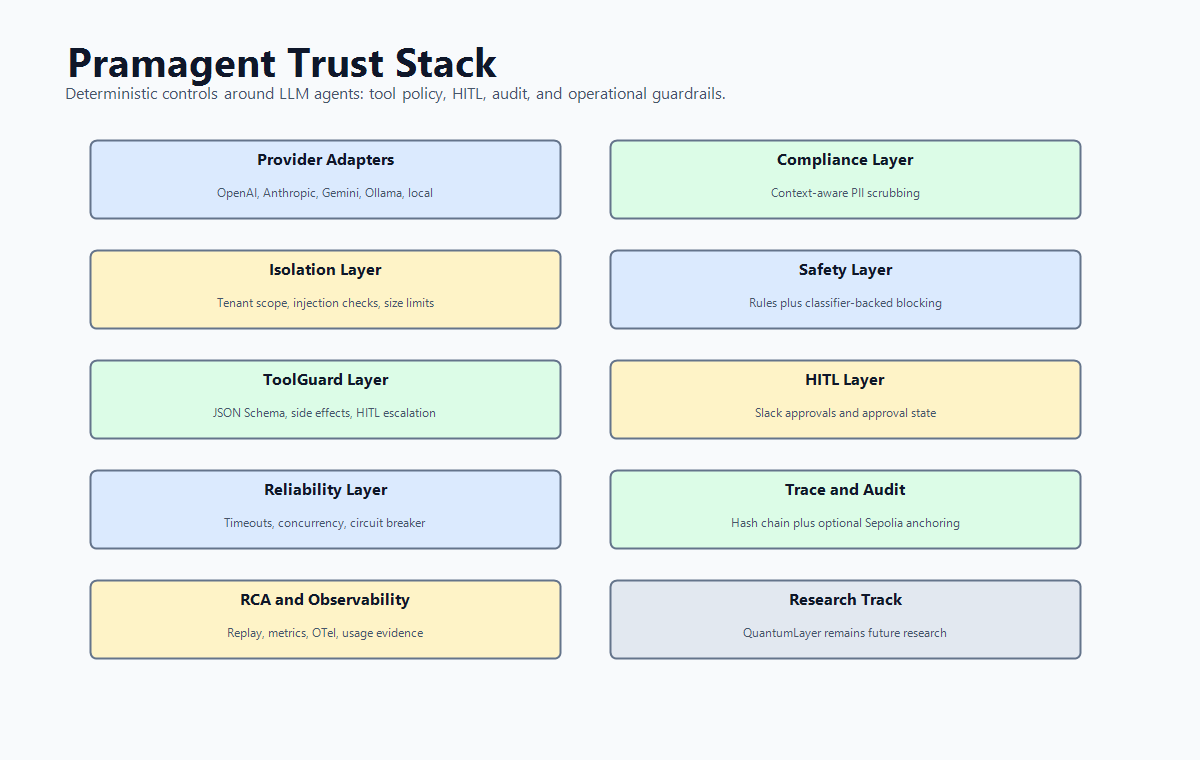
Pramagent wraps OpenAI, Anthropic, Gemini, Ollama, local, and OpenAI-compatible providers with guardrails that run outside the model. The most differentiated layer is ToolGuard: deterministic tool validation with JSON Schema, tenant/action allow-lists, side-effect taxonomy, dangerous-chain detection, output scanning, and HITL escalation.
Alpha Maturity Notice
Pramagent is published as Alpha software. It has live smoke-test evidence for Sepolia anchoring, S3 cold archive, local load testing, real OpenAI/Ollama provider calls, and bundled red-team runs, but it has not passed an external penetration test, SOC 2 audit, HIPAA assessment, or regulated-production certification.
Do not treat Pramagent as bank-grade or healthcare-grade security infrastructure. Do not claim prompt-injection immunity, production compliance, or third-party-validated safety from the bundled benchmarks alone. Read Implementation status, Live test results, and Hardening guide before using it in a customer-facing pilot.
Bare Install Quickstart
This works with the base package only. No Docker, API server, or provider key is required.
pip install pramagent
import asyncio
from pramagent import Pramagent

async def main():
    resp = await Pramagent().run("Summarize this request", tenant_id="demo", session_id="s1")
    print(resp.output)
    print(resp.trace.this_hash)

asyncio.run(main())
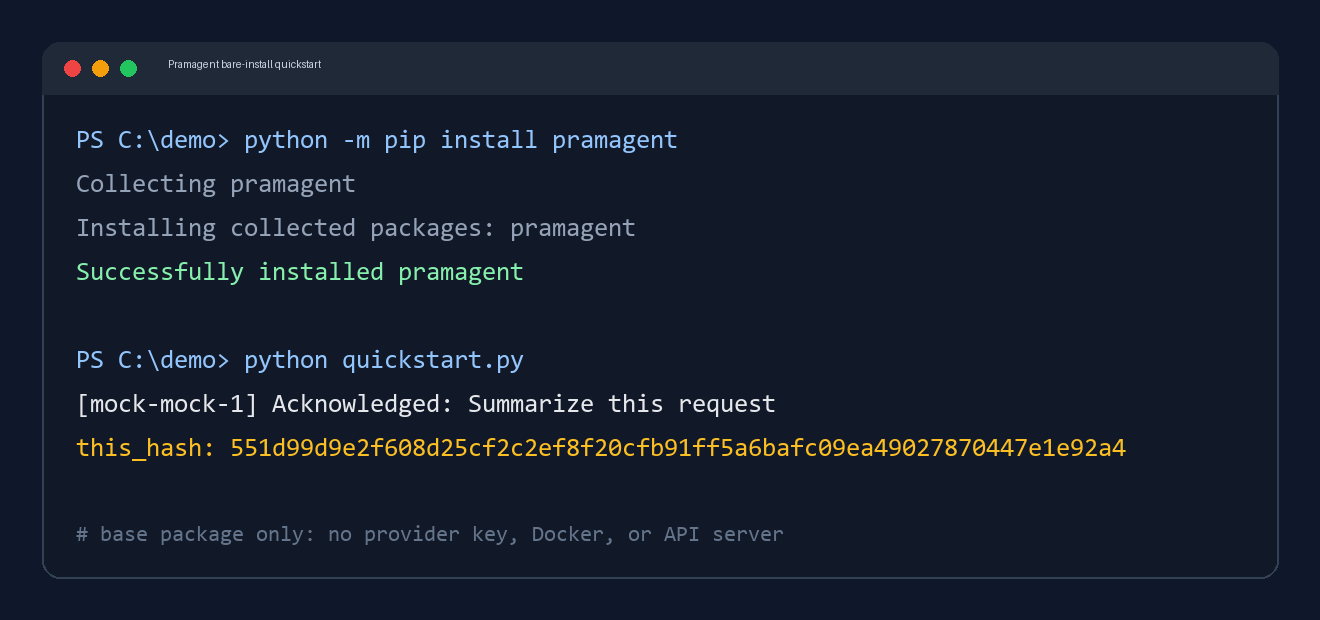
That creates a tamper-evident trace using the deterministic mock provider.
Swap to a real OpenAI model by setting OPENAI_API_KEY:
from pramagent import Pramagent
from pramagent.providers import OpenAIProvider

armor = Pramagent(provider=OpenAIProvider(model="gpt-4o-mini"))
API And Dashboard Install
pip install "pramagent[api,dashboard,redis,postgres]"
From source:
git clone git@github.com:sriram7737/pramagent.git
cd Pramagent
pip install -e ".[dev,api,redis,postgres,dashboard]"
CLI And Docker Quickstart
pramagent init
pramagent validate
Run the local stack:
cp .env.example .env
docker compose up -d
Open:
- API docs:
http://localhost:8080/docs - Dashboard:
http://localhost:8501
Run the release sanity checks:
python -m pytest -q --tb=no
pramagent redteam --json --attacks 100
pramagent redteam --json --dynamic --attacks 200 --seed 999
Current local result: 420 passed.
ToolGuard Example
import asyncio

from pramagent import Pramagent, Verdict
from pramagent.layers import ToolGuardLayer, ToolPolicy
from pramagent.layers.tool_guard import SideEffect

guard = ToolGuardLayer(policies=[
    ToolPolicy(
        name="send_payment",
        side_effect=SideEffect.PAYMENT,
        action=Verdict.ESCALATE,
        allowed_tenants={"finance_team"},
        schema={
            "type": "object",
            "required": ["amount_usd", "destination"],
            "properties": {
                "amount_usd": {"type": "number", "minimum": 0.01, "maximum": 5000},
                "destination": {"type": "string", "pattern": r"acct-\d{6,}"},
            },
            "additionalProperties": False,
        },
    )
])

armor = Pramagent(tool_guard=guard)

async def main():
    decision = armor.validate_tool(
        "send_payment",
        {"amount_usd": 250.00, "destination": "acct-123456"},
        tenant_id="finance_team",
        session_id="demo",
    )
    print(decision.verdict)  # ESCALATE

    too_large = armor.validate_tool(
        "send_payment",
        {"amount_usd": 9000.00, "destination": "acct-123456"},
        tenant_id="finance_team",
        session_id="demo",
    )
    print(too_large.verdict, too_large.reason)  # BLOCK: schema violation

    wrong_tenant = armor.validate_tool(
        "send_payment",
        {"amount_usd": 250.00, "destination": "acct-123456"},
        tenant_id="marketing_team",
        session_id="demo",
    )
    print(wrong_tenant.verdict, wrong_tenant.reason)  # BLOCK: tenant mismatch

    response = await armor.run(
        "Summarize this payment request",
        tenant_id="finance_team",
        session_id="demo",
        action="send_payment",
    )
    print(response.hitl)
    print(response.trace.this_hash)

asyncio.run(main())
When To Use Pramagent
- You are wrapping LLM calls or agent workflows and need audit trails, policy checks, HITL approvals, PII scrubbing, and provider fallback in one place.
- You want deterministic tool policy outside the model, especially for actions like payments, data export, account changes, or admin operations.
- You are building an internal tool or pilot where honest safety evidence matters more than marketing claims.
- You need tamper-evident traces with optional Sepolia anchoring and encrypted S3 cold archive support.
When Not To Use Pramagent Yet
- You need certified bank-grade, healthcare-grade, or SOC2-audited production infrastructure today.
- You need proven jailbreak resistance against a serious red team; the bundled benchmark is only a deterministic smoke test, not third-party assurance.
- You need mature enterprise dashboard auth such as SSO/OIDC/RBAC. Optional SQL users/password reset exist, but this is not an enterprise IAM plane yet.
- You need production-grade scale evidence, chaos engineering, or SLA-backed capacity numbers beyond the published local Docker Compose load run.
- You need billing-grade Stripe/Chargebee metering rather than the local usage ledger and event hooks.
What Works Today
| Capability | Status | Notes |
|---|---|---|
| Provider adapters | Implemented | Mock, OpenAI, Anthropic, Gemini, Ollama, OpenAI-compatible/local |
| ToolGuard | Strong MVP | JSON Schema, allow-lists, side-effect taxonomy, output scanning |
| HITL | Beta | Slack callbacks, approval queues, quorum/escalation primitives, ServiceNow/PagerDuty/email/webhook notifiers |
| Audit trail | Strong MVP | SHA-256 hash chain; optional real Sepolia anchoring |
| PII redaction | Strong MVP | Context-aware patterns for common regulated data |
| Auth/rate limits/quotas | Beta | JWT/API keys, token buckets, per-tenant quotas |
| Dashboard | Prototype | Shared-key fallback, optional SQL users/password reset, tenant scoping, traces, approvals, metrics, usage page |
| Redis/Postgres backends | Beta | Wired and tested locally; needs scale/load testing |
| OpenTelemetry | Partial | Per-layer spans exist; dashboards and alerting need hardening |
| Red-team benchmark | MVP | Static and dynamic mutation modes with bypass/false-positive rates |
| Billing hooks | MVP | In-memory hash-chain usage ledger plus fail-open webhook; no Stripe/Chargebee provider yet |
| S3 cold archive | MVP | Gzip + encrypted trace archive wrapper; metadata sink hook |
Honest Limits
- Prompt-injection defense is not complete. The bundled static corpus and seeded dynamic mutation smoke tests now pass, but the embedding classifier is optional and the project still needs larger third-party red-team sets.
- ToolGuard is a hard policy gate outside the model, but it is not a sandbox.
- Slack is the main decision-collecting HITL adapter today. ServiceNow, PagerDuty, email, and generic webhooks are useful notification/escalation adapters, but broader enterprise approval workflows are still in development.
- Dashboard auth has tenant-scoped shared-key fallback plus optional SQL-backed users and password reset. It is still not SSO/OIDC/RBAC-grade.
- Ethereum anchoring is Sepolia/testnet-oriented; no mainnet runbook, verifier contract, HSM/KMS key-management story, or enterprise anchoring operating model is included yet.
- The usage ledger is local audit evidence for pilots, not an invoice-grade billing system.
- Redis/Postgres support exists, but the stack has not been chaos-tested or load-tested for high-stakes deployments.
- No external penetration test or formal compliance certification has been run.
- QuantumLayer is future research only. It is not implemented, advertised as a feature, or exposed as a production API.
Optional Anchoring And Archive
pip install "pramagent[ethereum,s3]"
Ethereum/Sepolia anchoring submits the audit head as transaction calldata and stores the tx hash plus block number on the trace when configured. S3 cold archive wraps a primary store and archives pruned/erased traces as encrypted gzip JSON while keeping metadata available for compliance reporting.
Demo Flow
pramagent init
docker compose up -d
python -m pytest -q --tb=no
pramagent redteam --json --dynamic --attacks 200 --seed 999
Then use the dashboard to inspect traces, pending HITL approvals, audit status, metrics, and per-tenant usage.
Docs
Author
License
Apache-2.0.
Release history Release notifications | RSS feed


Download files
Download the file for your platform. If you're not sure which to choose, learn more about installing packages.
Source Distribution
Built Distribution
Filter files by name, interpreter, ABI, and platform.
If you're not sure about the file name format, learn more about wheel file names.
Copy a direct link to the current filters
File details
Details for the file pramagent-0.5.13.tar.gz.
File metadata
- Download URL: pramagent-0.5.13.tar.gz
- Upload date:
- Size: 367.0 kB
- Tags: Source
- Uploaded using Trusted Publishing? No
- Uploaded via: twine/6.2.0 CPython/3.13.13
File hashes
| Algorithm | Hash digest | |
|---|---|---|
| SHA256 |
ebc766779fe01fc3bda4a30567d0f03380686000adbeb7ed9f649726b02794f6
|
|
| MD5 |
c5f749a621ce71356632d012754e6e6c
|
|
| BLAKE2b-256 |
b7f31efa92d735e1a9de42ab8b79cf47c099986c2a0750b8b2d1315e7688b9a9
|
File details
Details for the file pramagent-0.5.13-py3-none-any.whl.
File metadata
- Download URL: pramagent-0.5.13-py3-none-any.whl
- Upload date:
- Size: 229.1 kB
- Tags: Python 3
- Uploaded using Trusted Publishing? No
- Uploaded via: twine/6.2.0 CPython/3.13.13
File hashes
| Algorithm | Hash digest | |
|---|---|---|
| SHA256 |
b79eb78a380529892f74bb040b39ebcd9cfbdef4c3e253d960c32b627d2eeb61
|
|
| MD5 |
cbc66cd57a668230945bf091404a28ae
|
|
| BLAKE2b-256 |
d99f101278976f92aa06fc6d05c406227e6f9e03533bae601d9a8e8998ba7bb0
|






