
pre-commit-update
One hook to manage them all...












pre-commit-update is a simple CLI tool and a pre-commit hook to check and update pre-commit hooks.
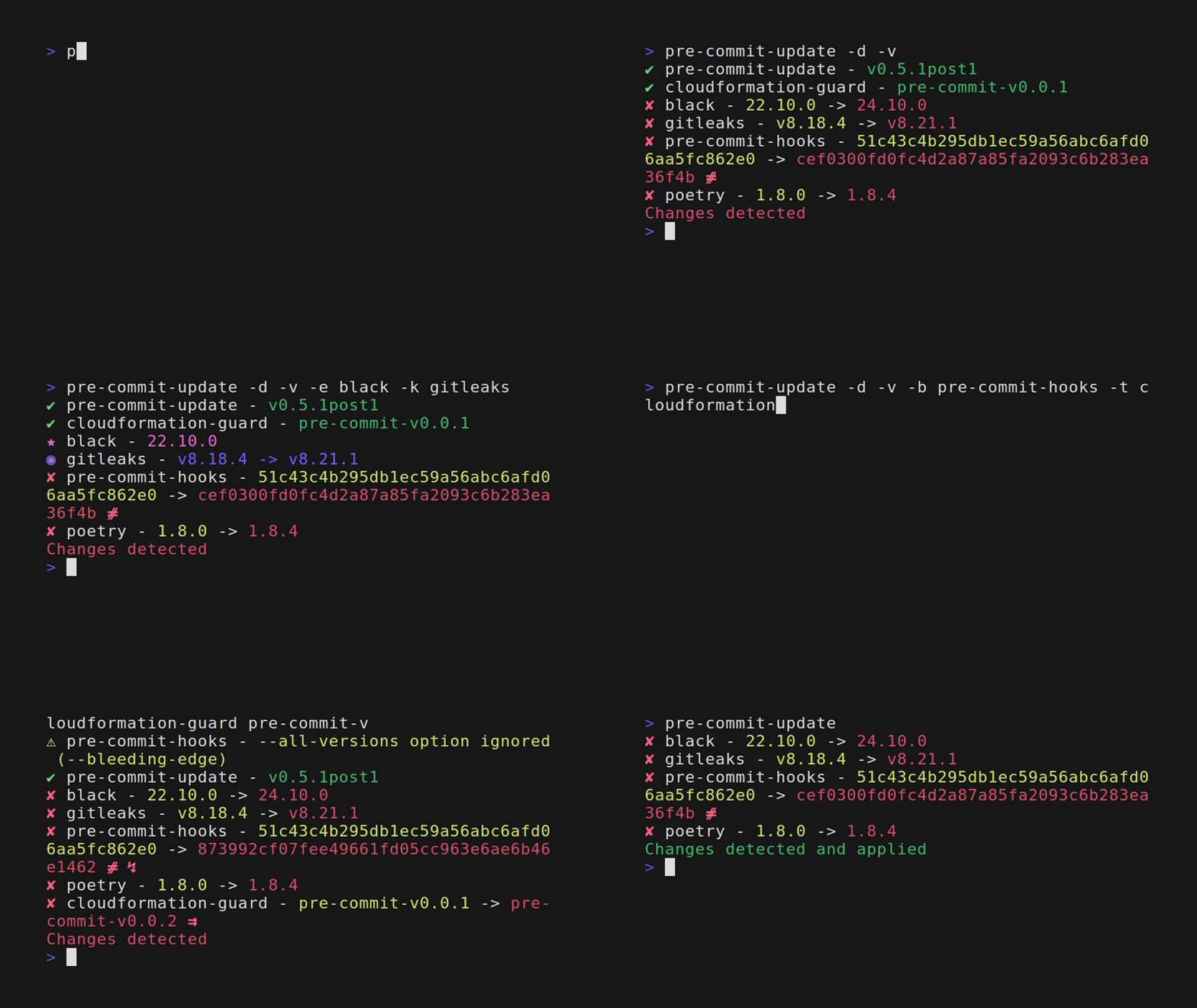
Table of contents
1. Reasoning
pre-commit is a nice little tool that helps you polish your code before releasing it into the wild.
It is fairly easy to use. A single pre-commit-config.yaml file can hold multiple hooks (checks) that will go through
your code or repository and do certain checks. The problem is that the file is static and once you pin your hook versions
after a while they get outdated.
pre-commit-update was created because there is no easy way to update your hooks by using
pre-commit autoupdate as it is not versatile enough.
2. Features
| Feature | pre-commit-update | pre-commit autoupdate |
|---|---|---|
| Has dry run (checks for updates, does not update) | Yes | No |
| Can use stable versions only | Yes | No |
| Can exclude repo(s) from update check | Yes | Workaround (updates only specified repo(s)) |
| Can keep repo(s) (checks for updates, does not update) | Yes | No |
| Can update by hash instead of tag | Yes | Yes |
| Can define custom tag prefix schema | Yes | No |
| Can be used as a pre-commit hook | Yes | No |
Can be configured in pyproject.toml |
Yes | No |
3. Installation
pre-commit-update is available on PyPI:
$ python -m pip install pre-commit-update
4. Usage
pre-commit-update can be used as below:
$ pre-commit-update [OPTIONS]
  Option:                                       Short description:

  -c, --config-file FILE                        Path to the configuration pyproject.toml
                                                file  [default: None]

  -d, --dry-run / -nd, --no-dry-run             Checks for the new versions without updating
                                                if enabled  [default: nd]

  -dm, --dry-run-mode [strict|warn]             Dry run mode: 'strict' prints the changes
                                                and exits, 'warn' only prints the changes
                                                [default: strict]

  -a, --all-versions / -na, --no-all-versions   Includes the alpha/beta versions when
                                                updating if enabled  [default: na]

  -v, --verbose / -nv, --no-verbose             Displays the complete update output if
                                                enabled  [default: nv]

  -w, --warnings / -nw, --no-warnings           Displays warning messages if enabled  [default: w]

  -p, --preview / -np, --no-preview             Previews the cli option values by the
                                                overwriting order if enabled (disables the
                                                actual cli work!)  [default: np]

  -j, --jobs INTEGER                            Maximum number of worker threads to be used
                                                for processing

  -e, --exclude REPO_URL_TRIM                   Exclude specific repo(s) by the
                                                REPO_URL_TRIM - use '*' as a wildcard

  -k, --keep REPO_URL_TRIM                      Keep the version of specific repo(s) by the
                                                REPO_URL_TRIM (still checks for the new
                                                versions) - use '*' as a wildcard

  -b, --bleeding-edge REPO_URL_TRIM             Get the latest version or commit of specific
                                                repo(s) by the REPO_URL_TRIM - use '*' as a
                                                wildcard

  -t, --tag-prefix <REPO_URL_TRIM TEXT>...      Set the custom tag prefix for the specific
                                                repo(s) by combining REPO_URL_TRIM with tag
                                                prefix value

  -V, --version                                 Show the version and exit.

  -h, --help                                    Show this message and exit.
Below you can find more detailed explanations of how each option works.
Some of the options (--exclude, --keep and --bleeding-edge) use REPO_URL_TRIM as an argument.
Example of the REPO_URL_TRIM: https://github.com/ambv/black -> black (you will only pass black as a parameter to the
--exclude, --keep or --bleeding-edge option)
-
-c, --config-file FILE- Path to the configuration pyproject.toml file. This can be an absolute or relative path. Make sure that the path ends withpyproject.toml. -
-d, --dry-run / -nd, --no-dry-run- If enabled, updates will be fetched, but they won't be applied. Useful if you are only curious about potential changes that would occur. -
-dm, --dry-run-mode [strict|warn]- If set tostrict, the changes will be printed and the process will exit. If set towarn, the changes will be printed but the process will not exit. This option is ignored if the--dry-runoption is not enabled! -
-a, --all-versions / -na, --no-all-versions- If enabled, all version tags will be checked. This may include alpha, beta or release candidate versions. Keep in mind that this option is not the same as-b, --bleeding-edge! -
-v, --verbose / -nv, --no-verbose- If enabled, every detail will be printed out once the process completes. This does not display warnings if they are disabled (-nw, --no-warnings)! -
-w, --warnings / -nw, --no-warnings- If enabled, various validation warnings will be displayed (mostly configuration issues) -
-p, --preview / -np, --no-preview- This option excludes all other options if enabled! It is used in order to display the configuration priorities/overwrites between default configuration,pyproject.tomlconfiguration and options passed directly to the cli. It also displays the final configuration and what was changed. -
-j, --jobs- This option sets the maximum number of worker jobs (threads). If left blank, value used will equal to yourcpu_count + 4 -
-e, --exclude- This option, if used, excludes the complete repo (along with all the hooks) from update check. That means that the given repo url (for the givenREPO_URL_TRIM) will be completely skipped. You can exclude multiple repos by repeating the option multiple times (example:--exclude black --exclude isort). You can also use a wildcard*(example:--exclude '*') in order to exclude every single repo from the update process. This is useful when, for example, your python version is not up-to-date, and you need time to upgrade your code before updating your hooks to their latest versions. -
-k, --keep- This option, if used, keeps the current repo version/hash (along with all the hooks). That means that the given repo url (for the givenREPO_URL_TRIM) will fetch available updates and display them, but no update will take place. You can keep multiple repos by repeating the option multiple times (example:--keep black --keep isort). You can also use a wildcard*(example:--keep '*') in order to keep every single repo pinned to the current version while also checking for updates. -
-b, --bleeding-edge- This option, if used, gets the latest repo version/hash (whatever is more recent). That means that the given repo url (for the givenREPO_URL_TRIM) will be updated to the latest tagged version OR latest commit, depending on which one is more recent. This also means that--bleeding-edgeoption ignores the--all-versionsoption - it will always fetch the latest update - stable or not. You can set multiple repos as--bleeding-edgeby repeating the option multiple times (example:--bleeding-edge black --bleeding-edge isort). You can also use a wildcard*(example:--bleeding-edge '*') in order to update every single repo to the latest version/hash. -
-t, --tag-prefix- This option, if used, sets custom tag prefix schema for the specified repos. This is useful if your repo has custom tags for pre-commit. For example, ifREPO_URL_TRIMblackhas tags aspre-commit-tag-v0.1.1, you can use--tag-prefixas--tag-prefix black pre-commit-tag-v. You can set multiple custom tag schemas for multiple repos with--tag-prefixoption by repeating the option multiple times (example:--tag-prefix black custom-version-v --tag-prefix isort another-schema-v). -
-V, --version- Displays the current version ofpre-commit-update. -
-h, --help- Displays all the available options along with the short description of each.
1) Pipeline usage example
a) GitLab job:
pre-commit-hooks-update:
  stage: update
  script:
    # install git if not present in the image
    - pip install pre-commit-update
    - pre-commit-update --dry-run
  except:
    - main
  when: manual
  allow_failure: true
2) pre-commit hook usage example
You can also use pre-commit-update as a hook in your pre-commit hooks:
- repo: https://gitlab.com/vojko.pribudic.foss/pre-commit-update
  rev: v0.9.0  # Insert the latest tag here
  hooks:
    - id: pre-commit-update
      # Example args (use your own configuration)
      args: [--dry-run, --exclude, black, --keep, isort, --tag-prefix, black, custom-version-v]
5. Configuration
You can configure pre-commit-update in your pyproject.toml as below (do your own configuration):
Example:
[tool.pre-commit-update]
dry_run = true
dry_run_mode = "strict"
all_versions = false
verbose = true
warnings = true
preview = false
jobs = 10
exclude = ["isort"]
keep = ["black"]
bleeding_edge = ["pylint"]
tag_prefix = [["black", "custom-tag-schema-v"]]
You can always check the configuration overrides (priorities) by running pre-commit-update -p / pre-commit-update --preview
1) YAML output configuration
You can configure the output of pre-commit-update resulting YAML in your pyproject.toml as below (do your own configuration):
Example:
[tool.pre-commit-update.yaml]
mapping = 4
sequence = 4
offset = 2
6. F.A.Q
1) New version of pre-commit-update has a bug, what should I do?
These things do happen, unfortunately. Please report your issue(s) here.
If you are using pre-commit-update as a pre-commit hook and the previous version
of pre-commit-update worked for you, you can pin that specific version in your .pre-commit-config.yaml file.
To do so, just add the following in your .pre-commit-config.yaml file:
- repo: https://gitlab.com/vojko.pribudic.foss/pre-commit-update
  rev: v0.8.0  # Version that works for you
  hooks:
    - id: pre-commit-update
      args: [--keep, pre-commit-update]
If you are using pre-commit-update as a CLI, you can downgrade to the previous version by running:
$ python -m pip install pre-commit-update==vX.X.X
Replace the X.X.X with the previous version that worked for you.
2) There are certain icons in the output messages, what do they mean?
pre-commit-update uses the following icons/text in the output messages:
⚠,▲,[warning]- Indicates that a message is a warning✔,√,[no-update]- Indicates that there is no need to update the hook✘,×,[update]- Indicates that hook needs to be updated⧣,≠,[hash]- Indicates that the hook is using a hash instead of a tag★,*,[exclude]- Indicates that the hook is excluded from the update process◉,●,[keep]- Indicates that the hook will check for updates but will not be updated↯,±,[bleeding-edge]- Indicates that the hook is using bleeding edge version/hash⇉,»,[tag-prefix]- Indicates that the hook is using custom tag prefix schema
Some terminals support the Unicode icons (first set), some support universal icons (second set) and some do not support either (third set).
pre-commit-update will fallback to whatever is supported by the terminal you use.
1 maintainer

Metadata
1 maintainer
Release files for pre-commit-update 0.10.0
For a detailed explanation of source distributions (sdists) and built distributions (wheels), please see the package formats documentation.
Source distribution (sdist)
| File | Size | Uploaded | Provenance | Actions |
|---|---|---|---|---|
| pre_commit_update-0.10.0.tar.gz | 20.7 kB | Without provenance | Details for pre_commit_update-0.10.0.tar.gz |
Built distribution (wheel)
| File | Interpreter | ABI | Platform | Actions Reset |
|---|---|---|---|---|
| pre_commit_update-0.10.0-py3-none-any.whl | Python 3 | none | any | Details for pre_commit_update-0.10.0-py3-none-any.whl |
Total release size: 40.1 kB
Release files / pre_commit_update-0.10.0.tar.gz
| Download URL | pre_commit_update-0.10.0.tar.gz |
|---|---|
| Size | 20.7 kB |
| Tags | Source |
|
SHA-256 checksum How to use checksums |
6b95b37e8b82682193f90189ce3c9e73386d5389125c8b803f96cf2ce12f4a67
|
|
BLAKE2b-256 checksum How to use checksums |
98ca27b60885c4b1c923b7b4a30721747e2553d1acde303c46117acc9e732d1e
|
| Upload date | |
|
Uploaded using Trusted Publishing? What is trusted publishing? |
No |
| Uploaded via |
poetry/2.2.1 CPython/3.12.15 Linux/7.2.3-2-MANJARO
|
Release files / pre_commit_update-0.10.0-py3-none-any.whl
| Download URL | pre_commit_update-0.10.0-py3-none-any.whl |
|---|---|
| Size | 19.4 kB |
| Tags | Python 3 |
|
SHA-256 checksum How to use checksums |
c1f91309c245678a99d1a09fffe02358a09d3d02f9fa72b1b04bfec7bc826dca
|
|
BLAKE2b-256 checksum How to use checksums |
4986a984fc1f0fcb6df943f30006cad0cf5a42a24caae28130c8da2bb7ed79b2
|
| Upload date | |
|
Uploaded using Trusted Publishing? What is trusted publishing? |
No |
| Uploaded via |
poetry/2.2.1 CPython/3.12.15 Linux/7.2.3-2-MANJARO
|
Security for pre-commit-update 0.10.0
Provenance
Provenance describes where a file came from. On PyPI, provenance is shared via attestations, which provide a verifiable record of the build or publishing details. View details, limitations and caveats.
No provenance found
None of the files in this release were uploaded with provenance metadata.
A note on package security
PyPI is a repository for distributing packages, not a service for auditing them. While third-party security researchers and our staff do their best to detect and remove malicious packages, PyPI cannot guarantee the quality, security or suitability of any given package.
To learn more about protecting yourself from malicious actors, visit our package security documentation.














