
Prerequisite Circuits

Track what an intervention removes—and whether it stays removed as a model learns.
Code and evidence accompanying When Data Can Teach: Prerequisite Circuits Gate Learning, by Kunwar Kalra and Thanush Patlolla. Submitted to ICLR 2027; an arXiv link will be added when available.
Paper · Reproduction · Package guide · Evidence
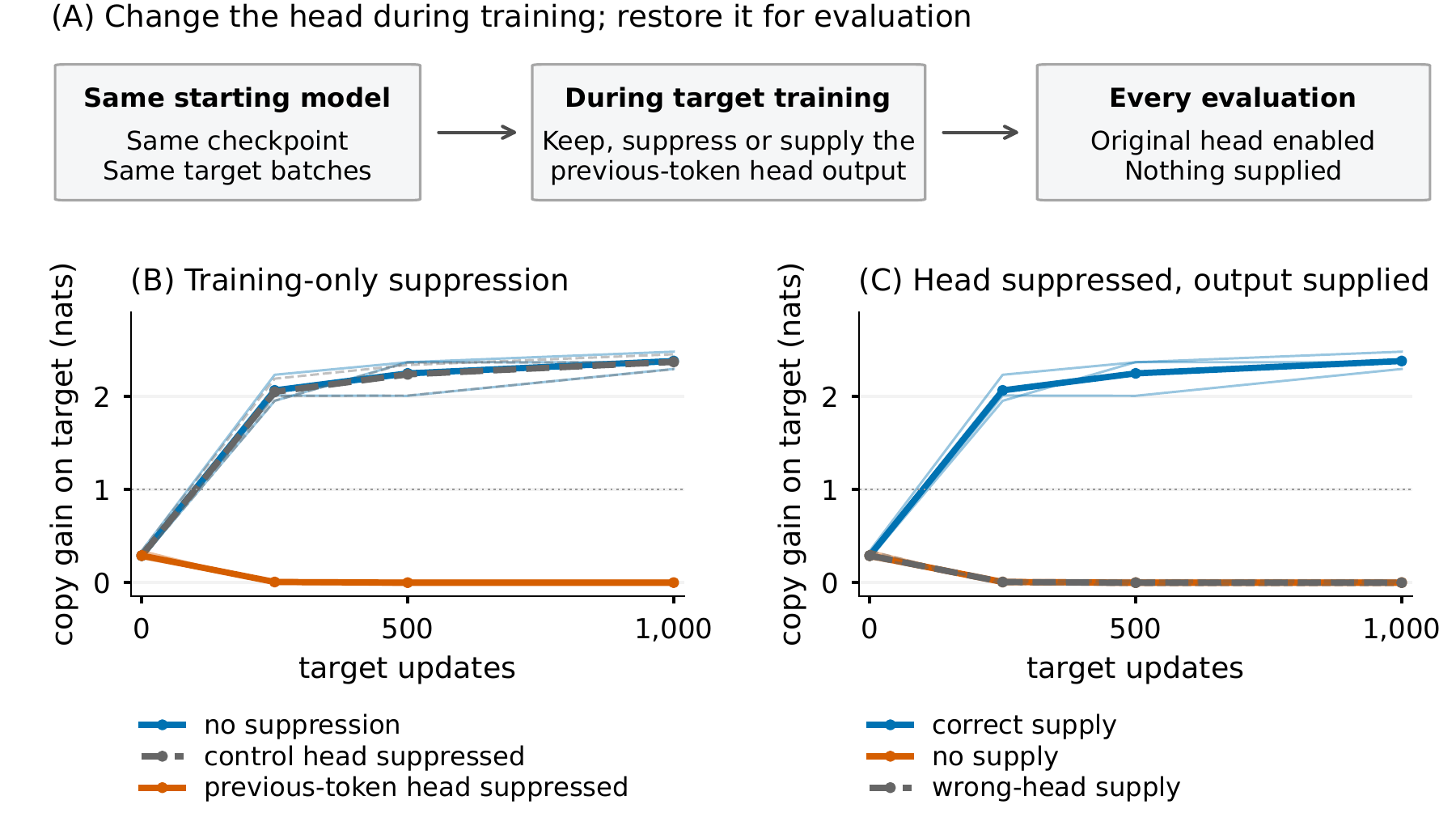
The research studies how an existing computation changes what fixed future data can teach. Controlled removal/rescue experiments isolate this effect. Pretrained Pythia experiments test training-only head suppression and examine compensation over longer training. The demonstrated task family is induction and copying.
Start with the evidence
The package's reporting API uses only the Python standard library. From a clone:
python -m pip install .
prereq report results/reference/410m_*.json --html outputs/report.html --open
The interactive report works offline: compare runs, inspect exact observations, and export the embedded records. It reads saved evidence and does not train a model. For the paper's figures, raw-record verification, and experiment recipes, see Reproduction.
Run a small experiment
python -m pip install '.[train,plot]'
OMP_NUM_THREADS=1 prereq demo --output outputs/demo
prereq report outputs/demo/*.json --plot outputs/demo/learning.pdf
The CPU example compares available, suppressed, matched-control, correct-supply, and wrong-supply conditions under common evaluation. It is an illustrative fixed-feature model, not a replication or additional result from the paper. The paper's controlled-transformer replication is available separately.
Use the monitor in your experiment
from prerequisite_circuits import Criterion, Observation, Trajectory

trajectory = Trajectory(
    "head-suppression",
    criterion=Criterion(maximum_suppressed=0.20, minimum_drop=0.30, acquisition=0.50),
    metadata={"evaluation": "training intervention removed"},
)
trajectory.append(Observation(
    step=0,
    target_available=0.01,
    prerequisite_available=0.66,
    prerequisite_suppressed=0.06,
))
trajectory.save("outputs/trajectory.json")
These are illustrative values. Supply measurements from your own independent probe and choose the criterion before evaluating outcomes. The guide shows how to attach the monitor to a PyTorch loop without replacing its optimizer or trainer.
The optional PyTorch API provides scoped channel/head interventions, detached activation supply, exact batch replay checks, and a small matched-branch runner. Hooks are removed on exit, including exceptions. Evaluation preserves random states, module modes, and buffers. The runner initializes a fresh optimizer in each branch; it does not silently inherit optimizer history.
What version 0.1 establishes
The package reports intervention effectiveness on a declared probe at observed updates. It also measures target acquisition under the specified evaluation condition. It does not infer continuous suppression, discover a complete circuit, or turn temporal ordering into a causal mechanism.
A candidate can be evaluated with removal, controls, and rescue. Automatic candidate discovery and validated mechanisms beyond induction are future research directions. New task/mechanism adapters can be added without changing the record format. See Methods and scope.
Repository
| Path | Contents |
|---|---|
src/prerequisite_circuits/ |
Reusable monitoring, interventions, replay, and reports |
experiments/ |
Versioned paper recipes and recorded environments |
analysis/ |
Figure/table reproduction and evidence checks |
results/ |
Compact reference trajectories and artifact manifests |
examples/ |
Small working examples |
tests/ |
Software and intervention-semantics tests |
paper/ |
Preprint PDF, complete LaTeX source, figures, and generated tables |
docs/ |
Reproduction, package usage, methods, and evidence index |
Original execution sources and larger records are separate, checksum-verified release assets. They retain their historical identities. Refactored package code is a new implementation with explicit parity tests, not a relabeled historical execution. No training or multi-GB download occurs on import or installation.
Development
See Development and releases for the public/private research workflow and publication steps.
python -m pip install -e '.[dev,pythia]'
python -m pytest
ruff check src tests examples analysis experiments
python -m build
The scientific checks include channel/gradient scope, restoration cleanup, data-replay mismatches, observation neutrality, and independent reconstruction of GPT-NeoX head outputs. GPU experiments are opt-in. Original code is MIT licensed; third-party assets retain their own licenses. See CITATION.cff.
2 maintainers


Metadata
2 maintainers
Release files for prerequisite-circuits 0.1.0
For a detailed explanation of source distributions (sdists) and built distributions (wheels), please see the package formats documentation.
Source distribution (sdist)
| File | Size | Uploaded | |
|---|---|---|---|
| prerequisite_circuits-0.1.0.tar.gz | 29.5 kB | Details |
Built distribution (wheel)
| File | Interpreter | ABI | Platform | Reset |
|---|---|---|---|---|
| prerequisite_circuits-0.1.0-py3-none-any.whl | Python 3 | none | any | Details |
Total release size: 54.7 kB
Release files / prerequisite_circuits-0.1.0.tar.gz
| Download URL | prerequisite_circuits-0.1.0.tar.gz |
|---|---|
| Size | 29.5 kB |
| Tags | Source |
|
SHA-256 checksum How to use checksums |
1482b074214fee56b7d16a11c5a8be7ec9750599877f201786b0b2baea45e023
|
|
BLAKE2b-256 checksum How to use checksums |
c3be04dad1a7a06f67469619402b84c129ca4ae975bd17c6b7276ec1c0a6c393
|
| Upload date | |
|
Uploaded using Trusted Publishing? What is trusted publishing? |
Yes |
| Uploaded via |
twine/7.0.0 CPython/3.13.14
|
Provenance
Provenance describes where a file came from. On PyPI, provenance is shared via attestations, which provide a verifiable record of the build or publishing details. View details, limitations and caveats.


PyPI Publish Attestation
PyPI verified that this artifact, at this checksum, originated from the publisher listed below.
Signed by GitHub Actions, verified by PyPI on Oct 6, 2026.
Transparency logRelease files / prerequisite_circuits-0.1.0-py3-none-any.whl
| Download URL | prerequisite_circuits-0.1.0-py3-none-any.whl |
|---|---|
| Size | 25.1 kB |
| Tags | Python 3 |
|
SHA-256 checksum How to use checksums |
5c86515a273fa241e62e742b6de906b3470f75ecd0ce82e794f2d45402e615a8
|
|
BLAKE2b-256 checksum How to use checksums |
3f1f59d4d12f32e510f4d5c98d264b5a145e0da1e12d9f117b55dee1e26c4ab8
|
| Upload date | |
|
Uploaded using Trusted Publishing? What is trusted publishing? |
Yes |
| Uploaded via |
twine/7.0.0 CPython/3.13.14
|
Provenance
Provenance describes where a file came from. On PyPI, provenance is shared via attestations, which provide a verifiable record of the build or publishing details. View details, limitations and caveats.
PyPI Publish Attestation
PyPI verified that this artifact, at this checksum, originated from the publisher listed below.
Signed by GitHub Actions, verified by PyPI on Oct 6, 2026.
Transparency log












