
PrevhClassifier
This package implements the Prevh classification algorithm.
The algorithm is based in the follow research Pages 71-76.

User Guide
This package can be installed with the following command: pip install prevhlib
Python example:
import numpy as np
import pandas as pd
from __init__.PrevhClassifier import PrevhClassifier
from sklearn.preprocessing import StandardScaler, LabelEncoder

if __name__ == '__main__':
    iris = pd.read_csv('Datasets/iris.csv')

    X = iris.iloc[:, 0:4].values
    y = iris.iloc[:, 4].values
    header = (iris.columns[:-1], iris.columns[-1])

    prevh = PrevhClassifier(distance_algorithm="euclidean")
    prevh.fit(X, y, header=header, encoder=LabelEncoder(), scaler=StandardScaler())

    print(prevh)
    # Outputs:
    # {
    #    "dataset": {
    #       "header": {
    #          "features": "Index(['sepal length', 'sepal width', 'petal length', 'petal width'], dtype='object')",
    #          "classes": "class"
    #       },
    #       "encoder": "LabelEncoder()",
    #       "scaler": "StandardScaler()"
    #    },
    #    "distance": "euclidean"
    # }

    print(prevh.classify(np.array([5.1, 3.5, 1.4, 0.2]), K=3))
    # Outputs: (array(['Iris-setosa'], dtype=object), np.float64(0.2653212465045153))

    kfold_split_arguments = {
        "n_splits": 5,
        "random_state": 42,
        "shuffle": True
    }

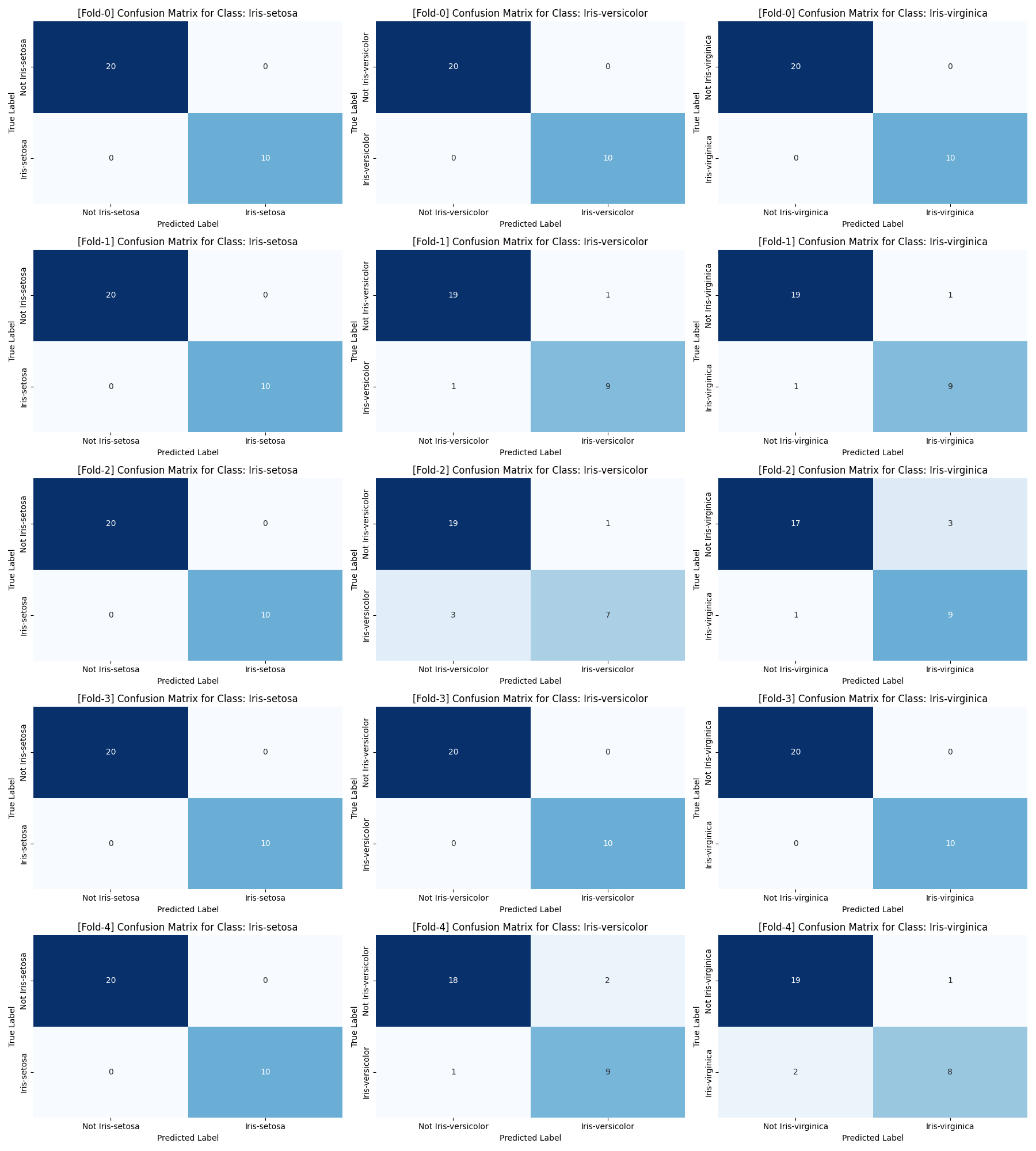
    Evaluation_Results = prevh.evaluate(1, "kfold_cross_validation", kfold_split_arguments)

    print(Evaluation_Results.get_metrics())
    # Outputs:
    #       accuracy  precision    recall  f1-score
    # 0     0.966667   0.972222  0.962963  0.965899
    # 1     0.966667   0.969697  0.952381  0.958486
    # 2     0.966667   0.962963  0.966667  0.962848
    # 3     0.900000   0.911681  0.905556  0.907368
    # 4     0.966667   0.972222  0.972222  0.971014
    # Mean  0.953333   0.957757  0.951958  0.953123

    Evaluation_Results.plot_confusion_matrices()
Next Steps
- In the next steps I will add support to other split, evaluation, encoder, and decoder methods.
- I expect to in new versions to comparisons between other machine learn method and the prevh classifier.
Change Log
0.2.0 (27/09/2024)
MAJOR CHANGES
- Update in the README.md
- Added new R2, MSE, MAE metrics
- Change in the confusion matrix plot function
1 maintainer

Metadata
1 maintainer
Release files for prevhlib 0.2.0
For a detailed explanation of source distributions (sdists) and built distributions (wheels), please see the package formats documentation.
Source distribution (sdist)
| File | Size | Uploaded | Provenance | Actions |
|---|---|---|---|---|
| prevhlib-0.2.0.tar.gz | 22.1 kB | Without provenance | Details for prevhlib-0.2.0.tar.gz |
Built distribution (wheel)
| File | Interpreter | ABI | Platform | Actions Reset |
|---|---|---|---|---|
| prevhlib-0.2.0-py3-none-any.whl | Python 3 | none | any | Details for prevhlib-0.2.0-py3-none-any.whl |
Total release size: 45.0 kB
Release files / prevhlib-0.2.0.tar.gz
| Download URL | prevhlib-0.2.0.tar.gz |
|---|---|
| Size | 22.1 kB |
| Tags | Source |
|
SHA-256 checksum How to use checksums |
506fbc1b4f9016cc0dbfa89fd8ed308a8391b9b3abd2618be09ffb6a8acfda39
|
|
BLAKE2b-256 checksum How to use checksums |
64ad747b2e96a5d310a669094ba4f710588bf920758763f907024f21c05ac8b6
|
| Upload date | |
|
Uploaded using Trusted Publishing? What is trusted publishing? |
No |
| Uploaded via |
twine/5.1.1 CPython/3.9.20
|
Release files / prevhlib-0.2.0-py3-none-any.whl
| Download URL | prevhlib-0.2.0-py3-none-any.whl |
|---|---|
| Size | 22.9 kB |
| Tags | Python 3 |
|
SHA-256 checksum How to use checksums |
2d42bddac5c45e2b5de32edd8f59cdddcf967d4aac2c93080f690170a71e3ea4
|
|
BLAKE2b-256 checksum How to use checksums |
1d452627ff86964b5c0c630b9e56702751ba883df3e883c67e3643e28a3389ff
|
| Upload date | |
|
Uploaded using Trusted Publishing? What is trusted publishing? |
No |
| Uploaded via |
twine/5.1.1 CPython/3.9.20
|
Security for prevhlib 0.2.0
Provenance
Provenance describes where a file came from. On PyPI, provenance is shared via attestations, which provide a verifiable record of the build or publishing details. View details, limitations and caveats.
No provenance found
None of the files in this release were uploaded with provenance metadata.
A note on package security
PyPI is a repository for distributing packages, not a service for auditing them. While third-party security researchers and our staff do their best to detect and remove malicious packages, PyPI cannot guarantee the quality, security or suitability of any given package.
To learn more about protecting yourself from malicious actors, visit our package security documentation.














