
A previous release had provenance metadata, but this release does not. View details.
PrivateCloud



Terraform + K3s + Python = your own private cloud.
PrivateCloud is a Python CLI installer that provisions a Kubernetes-based private cloud stack.
It focuses on fast deployment, repeatable infrastructure, and production-ready defaults.
Demo
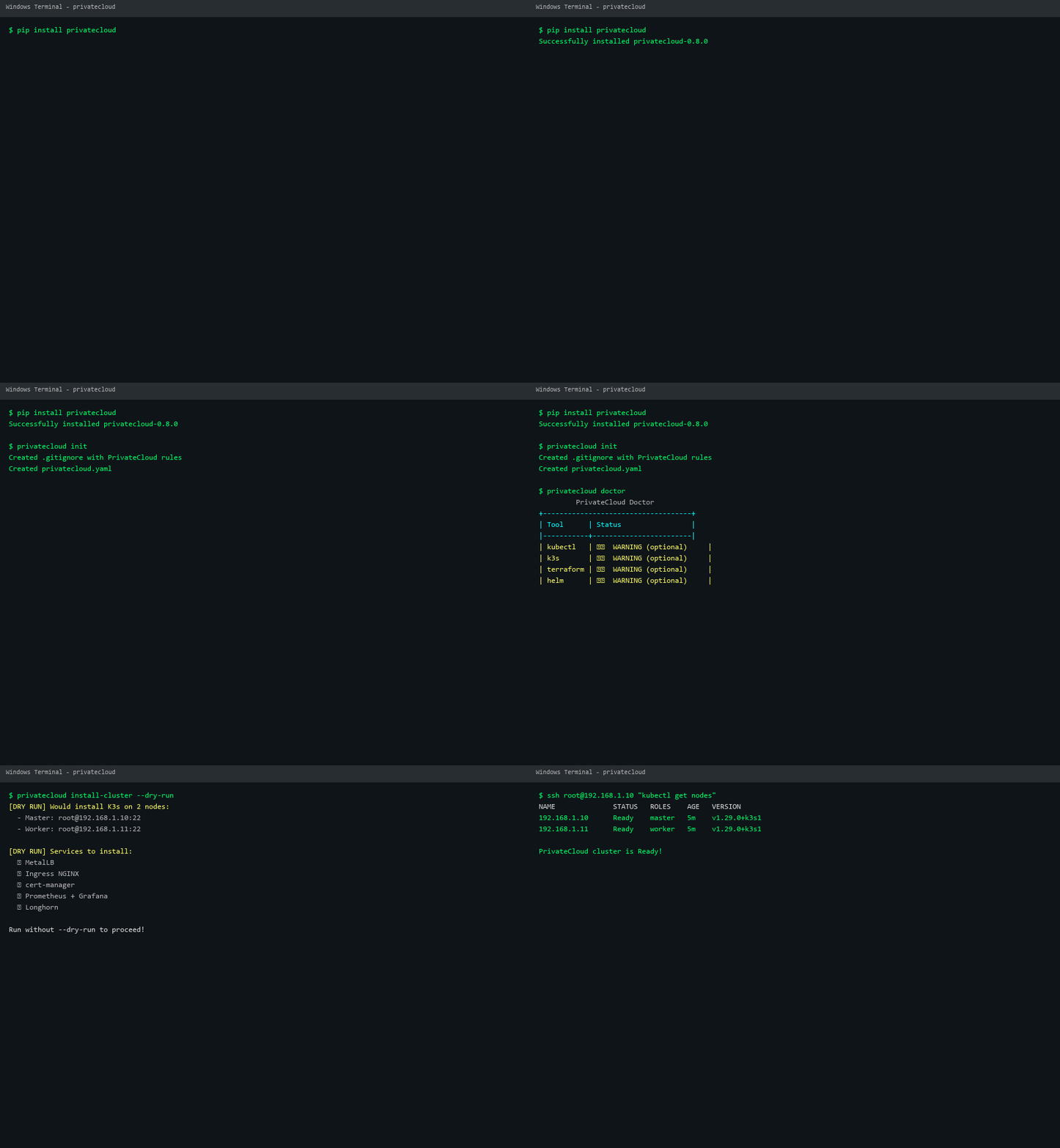
Features Overview (v0.8.0)
Deployment
- Provider abstraction — bare-metal SSH, Proxmox VE, or HPE Morpheus VM Essentials via Terraform
- Terraform runner — generates, applies, and destroys infrastructure automatically
- Config auto-write — Terraform outputs (node IPs) written back to
privatecloud.yaml - Helm-based service installation — all services deployed via Helm charts
Cluster Management
- Cluster upgrade —
privatecloud upgrade v1.30.0+k3s1 - Multi-cluster — manage multiple clusters with
cluster list/add/switch/remove - HA setup — high availability with multiple masters
- Add-on marketplace — one-command install of common tools
Backup & Restore
- Local backups — full cluster state to
backups/directory - Encrypted backups — age encryption with
--encrypt - Cloud storage — S3, GCS, Azure Blob integration
- Scheduled backups — cron/systemd timers with
backup schedule - etcd snapshots —
backup create --etcd-snapshot - Longhorn PITR — snapshots and point-in-time restore
Security
- GUI authentication —
--authflag with env var credentials - Secret masking — tokens/passwords masked in logs
- Environment variables —
${VAR}syntax for secrets - Auto .gitignore — prevents accidental secret commits
GUI Dashboard
- Web UI —
privatecloud gui --port 8080 - Cluster metrics — nodes, pods, health status
- One-click actions — backup, restore, destroy
Operations
- Diagnostics —
privatecloud doctor --diagnostics - Configuration linting —
privatecloud lint - Release notes —
privatecloud release-notes
Requirements
| Tool | Required |
|---|---|
| Python 3.9+ | ✅ |
| ssh / scp | ✅ |
| curl | ✅ |
| terraform | ✅ |
| helm | ✅ |
| kubectl | optional |
| flask | for GUI |
| age | for backup encryption |
Install
pip install privatecloud
Quickstart
# Initialize
privatecloud init                      # generate privatecloud.yaml
privatecloud doctor --diagnostics      # check dependencies and cluster health
privatecloud lint                      # validate config

# Deploy
privatecloud plan                      # preview the install plan
privatecloud install-cluster           # deploy everything
privatecloud install-cluster --dry-run # preview without changes

# Manage
privatecloud gui --port 8080           # start web dashboard
privatecloud upgrade v1.30.0+k3s1     # upgrade cluster
privatecloud cluster list              # list managed clusters

# Backup & Restore
privatecloud backup create                         # create backup
privatecloud backup create --encrypt              # encrypted backup
privatecloud backup create --s3 my-bucket        # upload to S3
privatecloud backup create --etcd-snapshot       # include etcd
privatecloud backup schedule daily --keep 7       # schedule backups
privatecloud backup list                          # list backups
privatecloud backup restore <name>               # restore backup
privatecloud backup restore <name> --force       # force restore

# Snapshots & PITR
privatecloud snapshot my-volume                   # create snapshot
privatecloud snapshots-list                      # list all snapshots
privatecloud restore my-volume snap-123          # restore from snapshot

# Add-ons
privatecloud addon list                           # list available add-ons
privatecloud addon install monitoring-stack       # install add-on
privatecloud addon search logging                 # search add-ons

# Destroy
privatecloud destroy                             # with backup prompt
privatecloud destroy --yes                        # skip confirmation
Configuration
cluster_name: my-private-cloud
provider: bare-metal          # or "proxmox" or "morpheus"
k3s_version: v1.29.0+k3s1

nodes:
  - host: 192.168.1.10
    user: root
    role: master
  - host: 192.168.1.11
    user: root
    role: worker

proxmox:
  url: https://192.168.1.100:8006/api2/json
  token_id: root@pam!mytoken
  token_secret: "${PROXMOX_TOKEN}"  # Use env var for secrets
  node: pve
  template: ubuntu-2204-template
  master_count: 1
  worker_count: 2

# morpheus:
#   url: https://morpheus.example.com
#   username: admin
#   password: ${MORPHEUS_PASSWORD}
#   group_name: My Group
#   cloud_name: My Cloud
#   instance_type_name: Ubuntu
#   layout_name: VMware VM
#   plan_name: 1 CPU, 2GB Memory
#   master_count: 1
#   worker_count: 2
#   cloud_type: vmware

services:
  metallb: true
  ingress_nginx: true
  cert_manager: true
  monitoring: true
  longhorn: true
Provider Modules Roadmap
| Provider | Status | Description |
|---|---|---|
| Bare-metal | ✅ Stable | Direct SSH installation |
| Proxmox | ✅ v0.2.0 | Proxmox VE via Terraform |
| HPE Morpheus | ✅ v0.8.0 | HPE Morpheus VM Essentials via Terraform |
| Hetzner | 🔜 v0.7.0 | Hetzner Cloud API |
| LibVirt | 🔜 v0.7.0 | Local KVM/libvirt VMs |
| vSphere | 📋 Backlog | VMware vSphere integration |
| OpenStack | 📋 Backlog | OpenStack integration |
Roadmap
v0.7.0
- Hetzner Cloud provider
- LibVirt/KVM provider
- Cluster backup verification
- Rollback from failed upgrade
v1.0 (Production Ready)
- High-availability k3s with external DB
- Rolling cluster upgrades
- Multi-cluster management UI
- Add-on marketplace with 20+ tools
- Cloud storage backup with lifecycle policies
Contributing
See CONTRIBUTING.md for development guidelines.
License
MIT
1 maintainer

Metadata
1 maintainer
Release files for privatecloud 0.8.1
For a detailed explanation of source distributions (sdists) and built distributions (wheels), please see the package formats documentation.
Loss of provenance
These files do not have provenance metadata, despite files in a prior release including this data.
We recommend further investigation before installing these files. View details.
Source distribution (sdist)
| File | Size | Uploaded | Provenance | Actions |
|---|---|---|---|---|
| privatecloud-0.8.1.tar.gz | 53.3 kB | Without provenance | Details for privatecloud-0.8.1.tar.gz |
Built distribution (wheel)
| File | Interpreter | ABI | Platform | Actions Reset |
|---|---|---|---|---|
| privatecloud-0.8.1-py3-none-any.whl | Python 3 | none | any | Details for privatecloud-0.8.1-py3-none-any.whl |
Total release size: 109.1 kB
Release files / privatecloud-0.8.1.tar.gz
Loss of provenance
This file belongs to a release without provenance metadata, despite a prior release including this data.
We recommend further investigation before installing this file. View details.
| Download URL | privatecloud-0.8.1.tar.gz |
|---|---|
| Size | 53.3 kB |
| Tags | Source |
|
SHA-256 checksum How to use checksums |
378fefa2d1e0b87ea66a1fe71cd79110a08fb1a71090d11172f1c06ef242b1b9
|
|
BLAKE2b-256 checksum How to use checksums |
e0726e305ff9a1c5047a259c336598bb14e4224586e03831631f646b44732373
|
| Upload date | |
|
Uploaded using Trusted Publishing? What is trusted publishing? |
No |
| Uploaded via |
twine/6.2.0 CPython/3.12.10
|
Release files / privatecloud-0.8.1-py3-none-any.whl
Loss of provenance
This file belongs to a release without provenance metadata, despite a prior release including this data.
We recommend further investigation before installing this file. View details.
| Download URL | privatecloud-0.8.1-py3-none-any.whl |
|---|---|
| Size | 55.7 kB |
| Tags | Python 3 |
|
SHA-256 checksum How to use checksums |
fc05afc2ed325331d6c3e08984885c2f416442835b165da65e4f3246afac4937
|
|
BLAKE2b-256 checksum How to use checksums |
4cf5b80ef3428adeb8e338513af2172eb3c1a40e59b654d07ffc0b5657bb653f
|
| Upload date | |
|
Uploaded using Trusted Publishing? What is trusted publishing? |
No |
| Uploaded via |
twine/6.2.0 CPython/3.12.10
|
Security for privatecloud 0.8.1
Provenance
Provenance describes where a file came from. On PyPI, provenance is shared via attestations, which provide a verifiable record of the build or publishing details. View details, limitations and caveats.
Loss of provenance
A previous release of these files had provenance metadata, but this release does not.
While this could reflect a routine change by the project maintainers, it may also indicate that the release files have been compromised.
Release comparison
- Removed 0.7.0 2 files With provenance
- Added 0.8.1 2 files Without provenance
A note on package security
PyPI is a repository for distributing packages, not a service for auditing them. While third-party security researchers and our staff do their best to detect and remove malicious packages, PyPI cannot guarantee the quality, security or suitability of any given package.
To learn more about protecting yourself from malicious actors, visit our package security documentation.














