





Clip fraction 0.000. Sampler drift 10,000×. Your logs called it a calm run.
Quick start · Four layers · Python API · Checklist · Reference results · Citation
A new method beat its importance-corrected baseline in every setting we ran. Then we probed the harness, the code that delays the sampler, builds each arm's configuration, picks the data for each update and computes each loss. Four details had shaped the result, and every one of them hid behind a log that looked fine.
- The Idle Clip. The PPO ratio pointed at the learner's own recomputed policy, so the clip never fired.
- The Lost Seed. The data seed never reached one arm, so its three runs replayed one data order.
- The Stuck Batch. A replay queue served its first batch for 33 updates in a row.
- The Rogue Normaliser. A loss divided by a different normaliser than its equation.
With the harness checked, the clean sweep on verl became a tie. PTH turns those four lessons into checks you can run on your own comparison. Two of them read the verl logs you already have. The other two take one line of logging or one short test.
A log that looked right
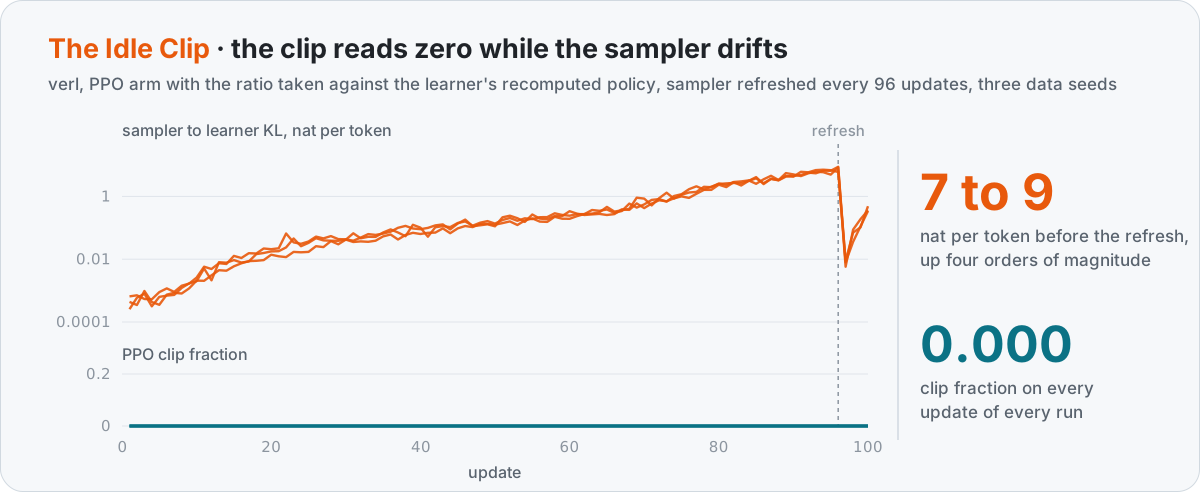
Here is the Idle Clip in a real verl run. The PPO arm logged a clip fraction of 0.000 on every update, which reads like a calm, healthy run. Over the same updates the sampler drifted four orders of magnitude away from the learner. The ratio was taken against the learner's own recomputed probabilities, so the clip had nothing to act on and the arm trained with no off-policy correction at all. PTH check 1 spots this from a single verl console log.
Quick start
Check your last run in one command.
pip install probe-the-harness
pth verl path/to/run.log
To compare arms, tell pth which run belongs to which arm:
pth verl --arm "grpo=logs/grpo-*.txt" --arm "tis=logs/tis-*.txt" \
         --vary algorithm.rollout_correction.rollout_is -q
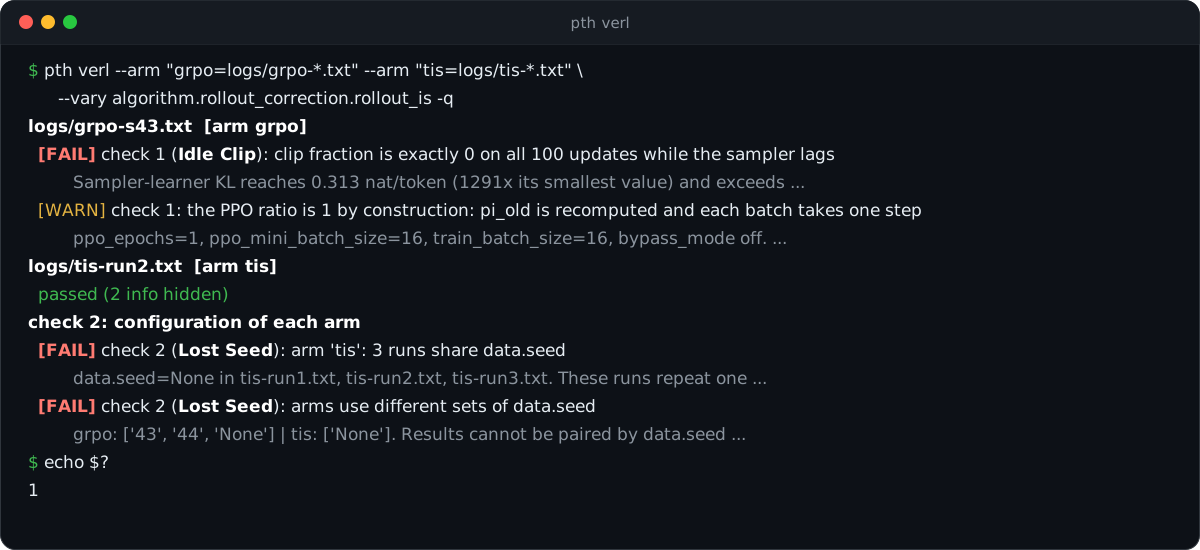
Six console logs from the report, one command, two of the four caught in plain sight: the Idle Clip in every GRPO run and the Lost Seed in the TIS arm. pth exits with status 1 whenever a check fails, so it can stand guard over a results table in CI.
The core needs only numpy and Python 3.9 or newer. For check 4 (PyTorch) and YAML configs:
pip install "probe-the-harness[all]"
The verl reader needs trainer.logger to include console and actor_rollout_ref.rollout.calculate_log_probs=True. docs/verl.md shows how to run check 1 inside the update and how to save configurations and data orders for check 2.
Four layers, four checks
Every layer of a harness has a quantity that everyone logs and a quantity that actually decides the comparison. PTH measures the second one and calls out what it finds by name.
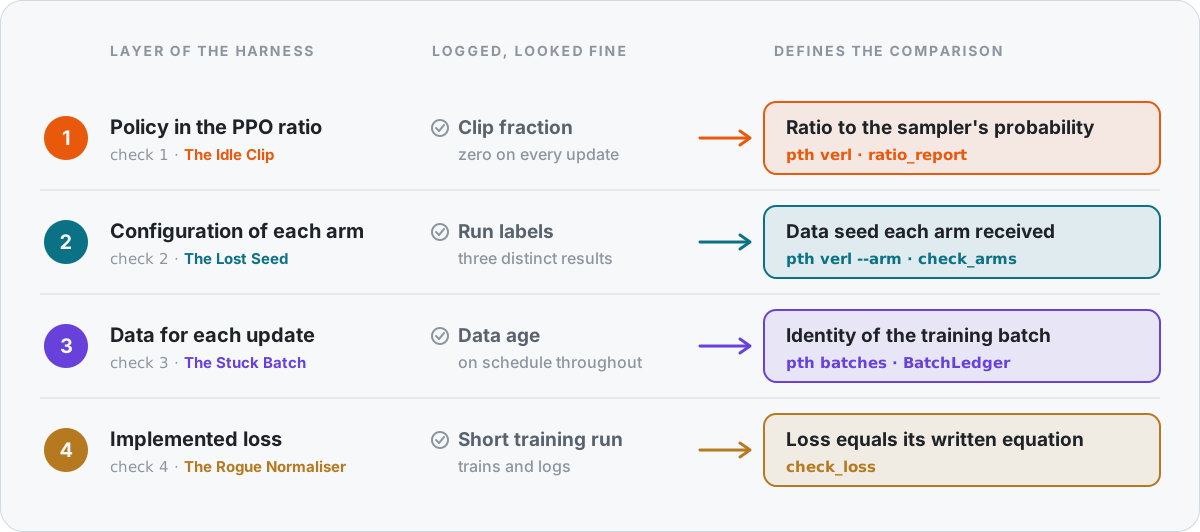
Checks 5 to 7 carry the same principle to the comparison as a whole: map each baseline's stable range, report paired differences per seed, and review code and logs against each claim. CHECKLIST.md lists all seven with the signal each one looks for.
Python API
Every check returns a Report: findings at three levels (fail, warn, info) plus the statistics behind them. report.ok is false when any finding fails, and report.raise_on_fail() turns that into an exception. A finding that matches one of the four carries its name in finding.tag: pth.IDLE_CLIP, pth.LOST_SEED, pth.STUCK_BATCH or pth.ROGUE_NORMALISER.
Check 1 policy in the PPO ratio
import pth

# Inside the update, per micro-batch. In verl: verl/workers/actor/dp_actor.py
rep = pth.ratio_report(log_prob, rollout_log_probs, response_mask, logp_old=old_log_prob)
rep.stats["kl_sampler_to_old"]          # KL(sampler || pi_old), nat per token
rep.stats["ratio_to_sampler"]["p99"]    # 99th percentile of pi_theta / q

# From logged series, any framework
rep = pth.scan_clip_vs_kl(clip_fraction_by_update, kl_by_update)
Check 2 configuration of each arm
configs = {run: pth.load_config(f"{run}/resolved_config.yaml") for run in runs}
rep = pth.check_arms(configs, arm_of=lambda run: run.split("-")[0],
                     vary=["algorithm.rollout_correction.rollout_is"],
                     replicate=["data.seed"])

# Runs launched with different seeds should see different data orders
rep = pth.check_data_orders({run: pth.data_order_fingerprint(first_prompt_ids[run]) for run in runs},
                            seeds=launch_seeds)
Check 3 data for each update
ledger = pth.BatchLedger()
for update in range(num_updates):
    batch, age = queue.next()
    ledger.record(update, pth.batch_fingerprint(batch["input_ids"]), age=age)
print(ledger.report(expected_age=lambda u: min(u, k)))
check 3: data for each update
  [FAIL] check 3 (Stuck Batch): 32 of 100 updates reuse an earlier batch
         100 updates trained on 68 distinct batches. Updates 0 to 32 all trained on one batch ...
  [INFO] check 3: data age follows the design on every update
Check 4 implemented loss
rep = pth.check_loss(my_loss, written_equation, pth.random_batch(), wrt=["logp"])
  [FAIL] check 4 (Rogue Normaliser): loss: gradient with respect to logp differs from the equation
         max abs difference 0.017. Within every sequence the gradients point the same way, with a
         per-sequence factor between 0.6897 and 1.379. The two differ in a normaliser.
Check 6 paired differences per seed
rep = pth.paired_differences({"tis": {43: .785, 44: .808}, "grpo": {43: .778, 44: .777}},
                             "tis", "grpo", scale=100)
# mean +1.9 over 2 seeds, range +0.7 to +3.1
Runnable versions of checks 3 and 4:
python examples/replay_queue.py       # a warm-up queue reuses batch 0 for 33 updates at the designed data age
python examples/loss_vs_equation.py   # a batch token mean against a per-response mean, found as a normaliser
Reference results on verl
Correctly configured TIS and uncorrected GRPO under sampler lag, from the report: Qwen2.5-Math-1.5B on GSM8K, verl with vLLM 0.11, 16 prompts and 8 responses per update, 512 response tokens, AdamW at 2e-6, KL penalty 1e-3 to the initial model, one optimiser step per batch, 100 updates. The learner's weights reach the sampler on every N-th update only. Final greedy accuracy on the 1319 test problems, by data seed.
| N = 64, default | 43 | 44 | N = 96, default | 43 | 44 | |
|---|---|---|---|---|---|---|
| Uncorrected GRPO | .743 | .778 | .777 | .114 | .280 | .099 |
| TIS | .763 | .785 | .808 | .764 | .781 | .785 |
TIS uses algorithm.rollout_correction.rollout_is=token with rollout_is_threshold=2.0, which multiplies the loss by the detached weight min(pi_old / q, 2) with q the sampler's recorded probability. It stays stable over all 100 updates at both intervals. The uncorrected arm is verl's PPO loss with ppo_epochs=1 and one mini-batch per batch, where the ratio is 1 and the clip cannot act. Use these numbers as a yardstick: if your own TIS baseline falls apart in this setting, run checks 1 to 4 before you blame the method.
Probe your harness before a reviewer does
Run pth verl on the logs behind your next results table. If it stays quiet, ship the table. If it names an Idle Clip or a Lost Seed, you just saved yourself a rebuttal.
Development
git clone https://github.com/pth2002/probe-the-harness && cd probe-the-harness
pip install -e ".[all,test]" && pytest
Citation
@misc{pan2026probe,
  title         = {Probe the Harness: Setup Checks for Stale-Data {RL} Comparisons in Language Models},
  author        = {Pan, Taiheng},
  year          = {2026},
  eprint        = {2610.02911},
  archivePrefix = {arXiv},
  primaryClass  = {cs.LG},
  doi           = {10.48550/arXiv.2610.02911}
}
License
MIT
1 maintainer

Metadata
1 maintainer
Release files for probe-the-harness 0.1.0
For a detailed explanation of source distributions (sdists) and built distributions (wheels), please see the package formats documentation.
Source distribution (sdist)
| File | Size | Uploaded | |
|---|---|---|---|
| probe_the_harness-0.1.0.tar.gz | 32.6 kB | Details |
Built distribution (wheel)
| File | Interpreter | ABI | Platform | Reset |
|---|---|---|---|---|
| probe_the_harness-0.1.0-py3-none-any.whl | Python 3 | none | any | Details |
Total release size: 60.8 kB
Release files / probe_the_harness-0.1.0.tar.gz
| Download URL | probe_the_harness-0.1.0.tar.gz |
|---|---|
| Size | 32.6 kB |
| Tags | Source |
|
SHA-256 checksum How to use checksums |
c2b945ad97f64df2786b978f5d33e5cfdce17187edd18110a308b96a2ee92393
|
|
BLAKE2b-256 checksum How to use checksums |
1d90fae00b35074a2efe194c04a87eceef871e076a0cabd0b19751a190ae1edc
|
| Upload date | |
|
Uploaded using Trusted Publishing? What is trusted publishing? |
Yes |
| Uploaded via |
twine/7.0.0 CPython/3.13.14
|
Provenance
Provenance describes where a file came from. On PyPI, provenance is shared via attestations, which provide a verifiable record of the build or publishing details. View details, limitations and caveats.


PyPI Publish Attestation
PyPI verified that this artifact, at this checksum, originated from the publisher listed below.
Signed by GitHub Actions, verified by PyPI on Oct 6, 2026.
Transparency logRelease files / probe_the_harness-0.1.0-py3-none-any.whl
| Download URL | probe_the_harness-0.1.0-py3-none-any.whl |
|---|---|
| Size | 28.1 kB |
| Tags | Python 3 |
|
SHA-256 checksum How to use checksums |
0c193870070fa3ab0345a751232f09be65b9a012daacb78a364b010e875e2adb
|
|
BLAKE2b-256 checksum How to use checksums |
e93c4a3d8c4a36d7e9cee46993b2cf06bdfbebfd93fda9c7316ea534a89d984a
|
| Upload date | |
|
Uploaded using Trusted Publishing? What is trusted publishing? |
Yes |
| Uploaded via |
twine/7.0.0 CPython/3.13.14
|
Provenance
Provenance describes where a file came from. On PyPI, provenance is shared via attestations, which provide a verifiable record of the build or publishing details. View details, limitations and caveats.
PyPI Publish Attestation
PyPI verified that this artifact, at this checksum, originated from the publisher listed below.
Signed by GitHub Actions, verified by PyPI on Oct 6, 2026.
Transparency log












