
Probability Distribution Visualizer
An interactive probability distribution visualizer with a Streamlit web interface, a typed Python API, and toolkits for fitting, Monte Carlo simulation, and statistical testing.







- Docs (GitHub Pages): https://sanskarpan.github.io/probviz/
- 16 univariate distributions (10 continuous + 6 discrete) with PDF/PMF, CDF, quantiles, sampling, and full statistics — in the web app and the API.
- Advanced modules (Python API): multivariate distributions, copulas, mixtures/GMM, distribution fitting, Monte Carlo, and statistical tests.
- Production-ready: 695-test suite, typed packaging (
pyproject.toml),probvizCLI, Docker/Compose, CI with coverage gate, docs + PyPI + Docker release pipelines. SeeCHANGELOG.md.
Gallery
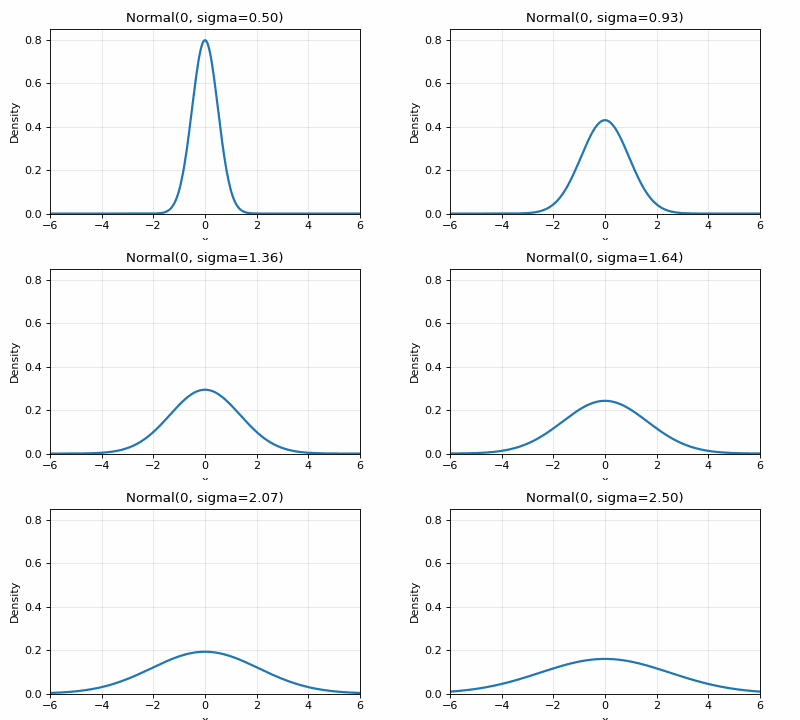
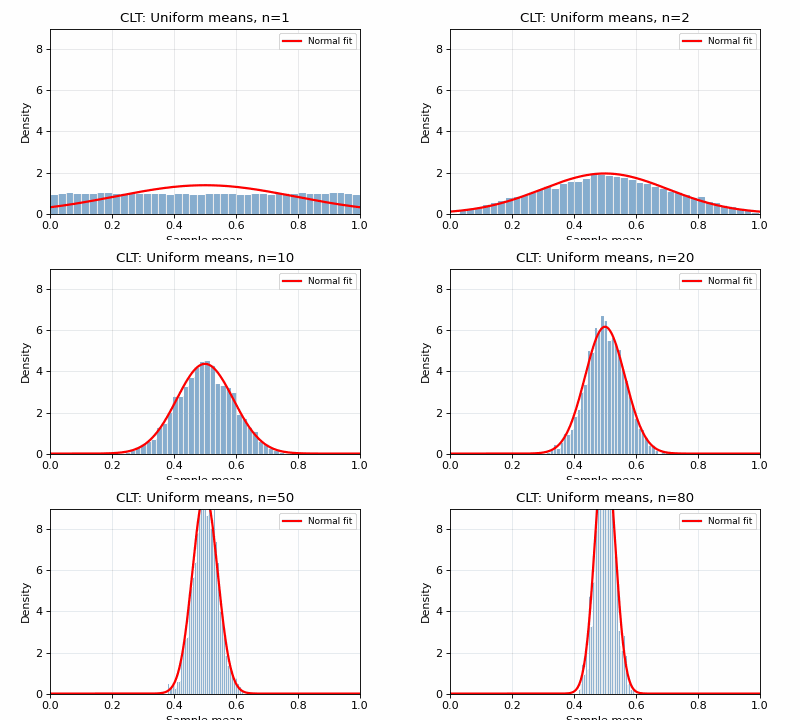
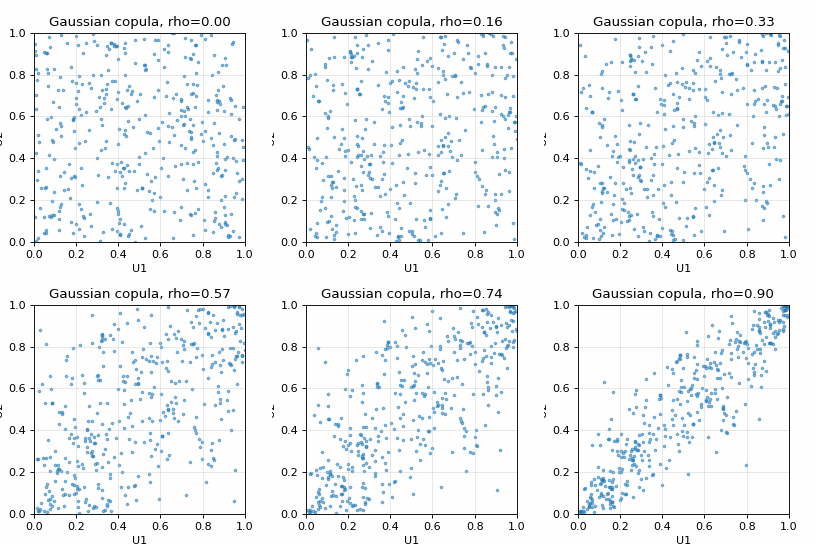
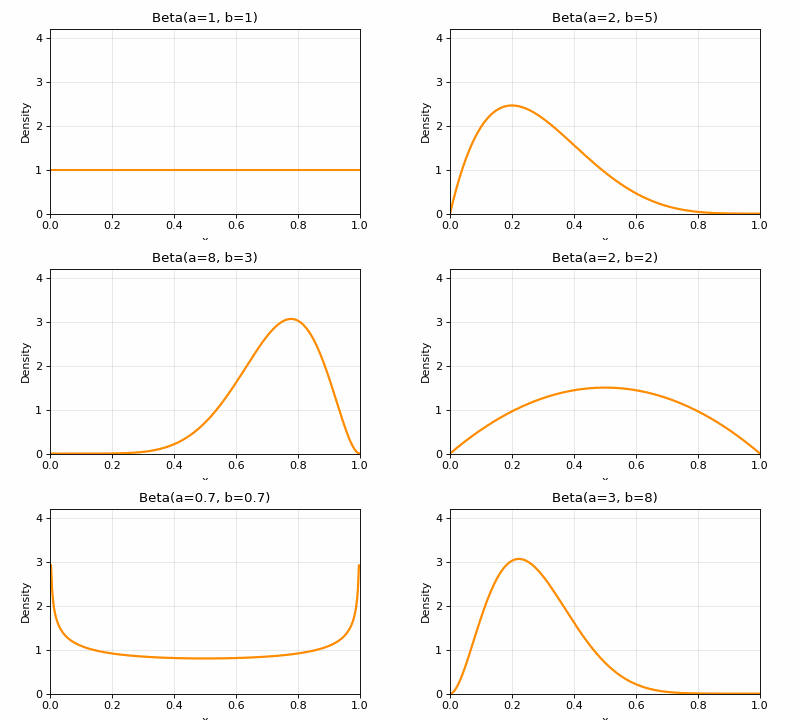
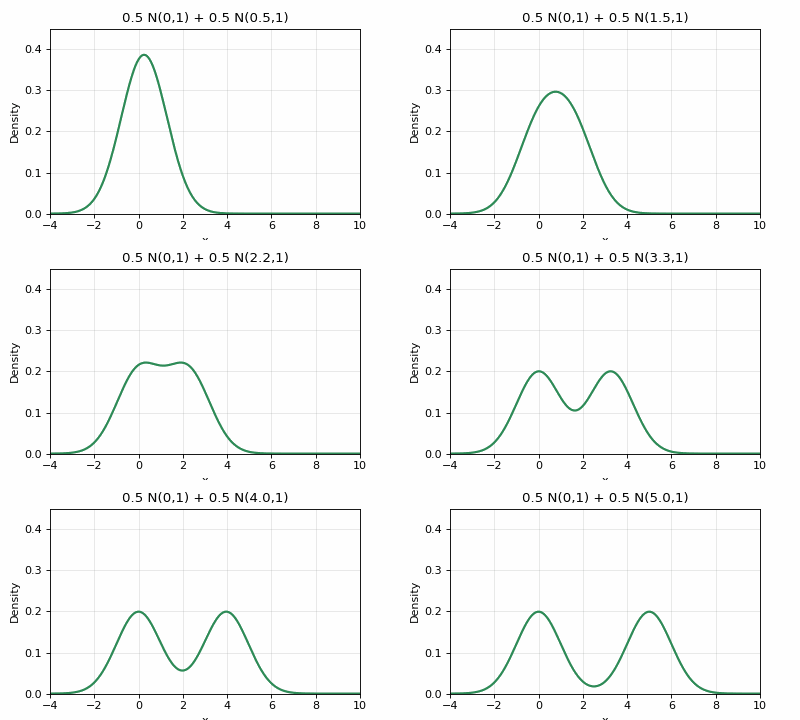
Top: Normal σ sweep · CLT convergence · Gaussian-copula ρ sweep. Bottom: Beta shape sweep · mixture separation. Regenerate with python examples/generate_media.py.
Quick start
pip install probviz
probviz app
Or from source:
git clone https://github.com/sanskarpan/probviz.git
cd probviz
pip install -r requirements.txt
streamlit run web/app.py
Open http://localhost:8501. Full guide: QUICKSTART.md ·
docs quickstart.
Install as a package
pip install -e ".[test]"
probviz app        # launch the UI
probviz test       # run tests
probviz version    # print version
Docker
docker build -t probviz .
docker run -p 8501:8501 probviz
# or
docker compose up --build
What's inside
| Area | Contents |
|---|---|
| Univariate | Normal, Exponential, Uniform, Beta, Gamma, Chi-Square, Student-t, Weibull, Lognormal, Cauchy · Binomial, Poisson, Geometric, Negative Binomial, Hypergeometric, Discrete Uniform |
| Multivariate | Multivariate Normal, Dirichlet, Multivariate Student-t, Wishart |
| Copulas | Gaussian, Clayton, Gumbel, Student-t + fit_copula_to_data |
| Mixtures | MixtureDistribution (1-D EM), GaussianMixtureModel, BayesianGMM, BIC selection |
| Fitting | DistributionFitter, BayesianEstimator, GoodnessOfFit |
| Monte Carlo | MonteCarloSimulator, VarianceReduction, QuasiMonteCarloSimulator |
| Tests | hypothesis / nonparametric / descriptive dict-returning helpers |
| Utils | validation, preprocessing, plotting, structured logging; probviz.visualizers facade |
Project layout and conventions: docs/architecture.md.
API reference: docs/api.md (rendered on the docs site).
Python API
import numpy as np
from probviz.distributions import NormalDistribution, BinomialDistribution

normal = NormalDistribution(mu=0, sigma=1)
x = np.linspace(-4, 4, 200)
pdf, cdf = normal.pdf(x), normal.cdf(x)
samples = normal.rvs(size=1000, random_state=42)
print(normal.get_statistics())
print(normal.interval(0.95), normal.ppf(0.975))

binomial = BinomialDistribution(n=10, p=0.3)
print(binomial.pdf(np.arange(0, 11)))
from probviz.fitting import DistributionFitter
from probviz.monte_carlo import MonteCarloSimulator

fitter = DistributionFitter(samples)
print(fitter.fit_all())

rng = np.random.default_rng(42)
sim = MonteCarloSimulator(random_seed=42)
res = sim.estimate_probability(lambda: rng.normal(0, 1) > 1.0, num_samples=100_000)
print(res["probability"], res["confidence_interval"])
Known limitations (by design)
- The Streamlit app covers the 16 univariate distributions only; advanced modules are Python-API only.
Clayton/Gumbelcopulapdf/rvsare bivariate-only (explicit error otherwise).StudentTCopulahas no closed-formcdf/pdf; use Monte Carlo viarvs.MixtureDistributionEM assumes 1-D components; use the sklearn GMM wrappers for multivariate mixtures.- Cauchy moments are undefined — the API surfaces
naninstead of masking it.
Testing
pip install -r requirements-dev.txt
pytest tests/ -q                                  # 695 tests
pytest tests/ -q --cov=src --cov-report=term      # with coverage (gate: 80%)
flake8 src/ tests/ --count --select=E9,F63,F7,F82 --statistics
mypy --config-file=pyproject.toml src/
Contributing
See CONTRIBUTING.md (setup, style, tests, PR checklist),
CODE_OF_CONDUCT.md, and SECURITY.md.
License
MIT — see LICENSE. If you use this in research or teaching:
@software{probability_distribution_visualizer,
  title  = {Probability Distribution Visualizer},
  author = {sanskarpan},
  year   = {2026},
  url    = {https://github.com/sanskarpan/probviz}
}
Also see CITATION.cff.
1 maintainer

Metadata
1 maintainer
Release files for probviz 1.0.8
For a detailed explanation of source distributions (sdists) and built distributions (wheels), please see the package formats documentation.
Source distribution (sdist)
| File | Size | Uploaded | Provenance | Actions |
|---|---|---|---|---|
| probviz-1.0.8.tar.gz | 327.2 kB | Without provenance | Details for probviz-1.0.8.tar.gz |
Built distribution (wheel)
| File | Interpreter | ABI | Platform | Actions Reset |
|---|---|---|---|---|
| probviz-1.0.8-py3-none-any.whl | Python 3 | none | any | Details for probviz-1.0.8-py3-none-any.whl |
Total release size: 419.1 kB
Release files / probviz-1.0.8.tar.gz
| Download URL | probviz-1.0.8.tar.gz |
|---|---|
| Size | 327.2 kB |
| Tags | Source |
|
SHA-256 checksum How to use checksums |
736c2e28d0c254c9076b68fa682c3614abf5e8efec8a50434ea2c1d8e6ba7ad3
|
|
BLAKE2b-256 checksum How to use checksums |
13e9e7718990d696fcd82086289331360c9a14bd4b6b904d71e6efac47fe7ac8
|
| Upload date | |
|
Uploaded using Trusted Publishing? What is trusted publishing? |
No |
| Uploaded via |
twine/7.0.0 CPython/3.13.14
|
Release files / probviz-1.0.8-py3-none-any.whl
| Download URL | probviz-1.0.8-py3-none-any.whl |
|---|---|
| Size | 91.9 kB |
| Tags | Python 3 |
|
SHA-256 checksum How to use checksums |
9752beb767f1e0e1fee9a28e869203a100bf582b0c3deec1e45584224590856e
|
|
BLAKE2b-256 checksum How to use checksums |
2bf074650b688762329564bf1eea4db46ab005781d4854ce44fc10bd3c462e34
|
| Upload date | |
|
Uploaded using Trusted Publishing? What is trusted publishing? |
No |
| Uploaded via |
twine/7.0.0 CPython/3.13.14
|
Security for probviz 1.0.8
Provenance
Provenance describes where a file came from. On PyPI, provenance is shared via attestations, which provide a verifiable record of the build or publishing details. View details, limitations and caveats.
No provenance found
None of the files in this release were uploaded with provenance metadata.
A note on package security
PyPI is a repository for distributing packages, not a service for auditing them. While third-party security researchers and our staff do their best to detect and remove malicious packages, PyPI cannot guarantee the quality, security or suitability of any given package.
To learn more about protecting yourself from malicious actors, visit our package security documentation.














