
Prompt-level analytics for Claude Code
Unofficial — not affiliated with Anthropic. This is a community tool that reads Claude Code's local log files. "Claude" and "Claude Code" are trademarks of Anthropic.





Other tools tell you what you spent per day or per session. This one goes down to the prompt: every prompt you have ever sent becomes one row, priced from the raw token counts in your local ~/.claude/projects/**/*.jsonl logs — no account, no API key, nothing leaves your machine.
- Tokens and cost per prompt and per project. A real dataset, not a daily total: which prompts and which projects actually cost you money, with a Pareto view of where it concentrates.
- Meta-analyses across long sessions. How the marginal cost of a prompt changes with its depth in the session, how the cache read/write mix shifts — the questions you can only ask once you have per-prompt rows.
- Automatic categorization of your prompts. A local, zero-dependency heuristic labels every prompt across thirteen categories (plan / implementation / debug / refactor / review / test / docs / ops / question / followup / feedback / notification / other) and scores its observed complexity 1–5. An offline semantic classifier (multilingual embeddings, still no API key) and an optional LLM pass can refine it (opt-in — see Categorization).
It validates its token totals against ccusage (see How the numbers stay accurate). Think of it as the per-prompt dataset layer that sits alongside the report-style tools.
📖 Full documentation is in the project wiki — Architecture, a Codebase Guide, the complete CLI reference, the Dashboard pages, and how the numbers stay accurate. This README is the quick tour.
See it without installing anything
Two surfaces on the same data — a Streamlit dashboard and a terminal CLI.
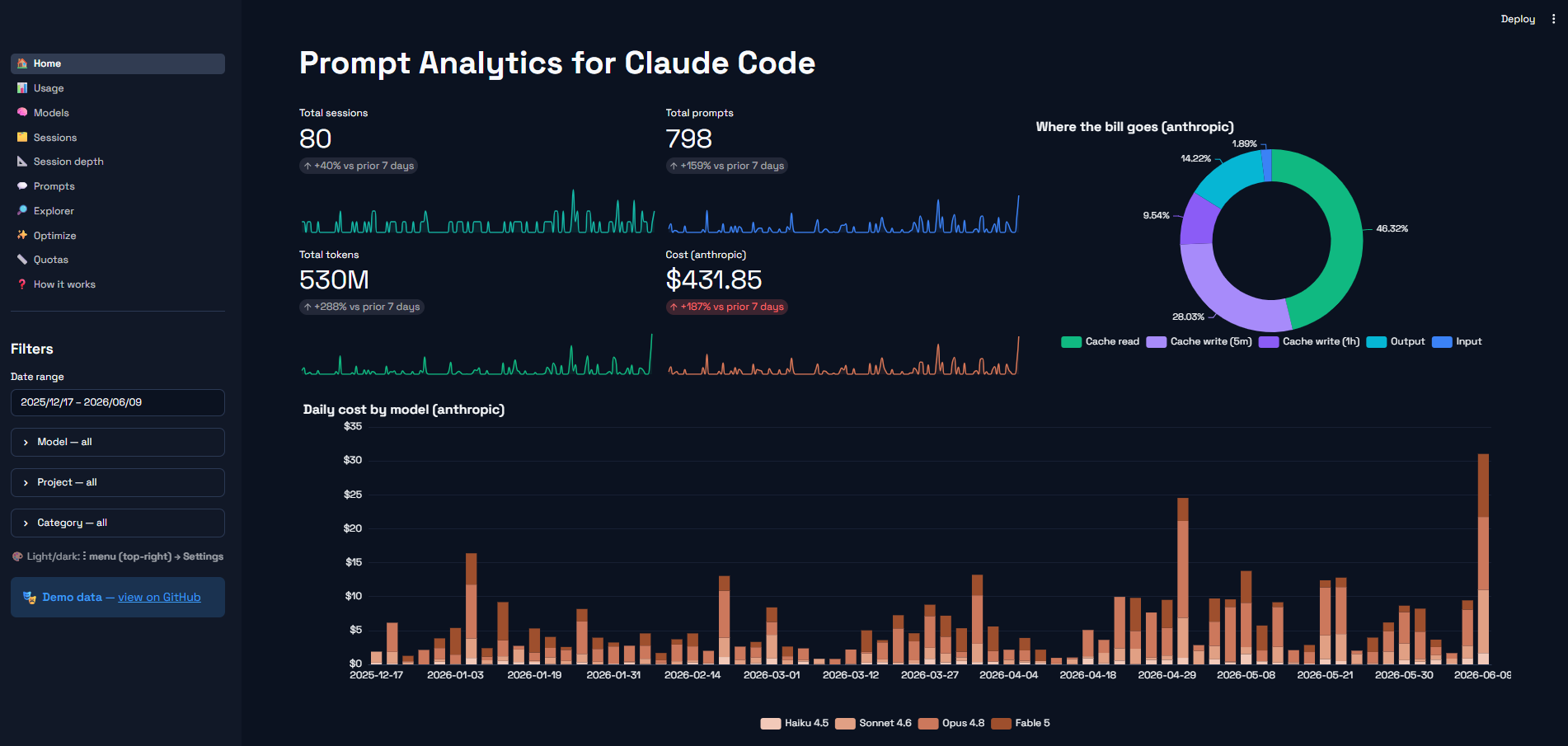
The richest way in is the dashboard, and a live demo runs it on a synthetic dataset (no real prompts), so you can explore every page before installing — the image below links to the live demo:
▶ Live demo: prompt-analytics-demo.streamlit.app
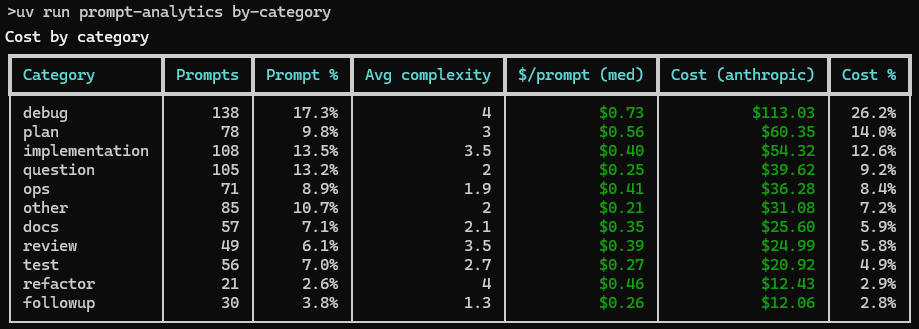
The same numbers are one line away in the terminal. For example, by-category auto-labels each prompt and scores its observed complexity 1–5 — a local heuristic, no LLM required:
Quick start
The richest way in is the dashboard — install with the dashboard extra and point it at your own data:
uv tool install "prompt-analytics-for-claude-code[dashboard]"
prompt-analytics dashboard          # refresh your data, then launch Streamlit on http://localhost:8501
dashboard refreshes the data first (extract + snapshot + local categorize, no API key) and then opens the board — so a fresh launch never shows stale numbers. Pass --no-refresh to skip that and open on the existing CSVs. (Plain pip: pip install "prompt-analytics-for-claude-code[dashboard]".)
No data yet, or just curious? The live demo runs the same dashboard on synthetic data — a tour of every page is in the wiki (Dashboard).
Prefer the terminal? The same data as a CLI
Every analysis is also a single line over your local logs — zero install with uv:
uvx --from prompt-analytics-for-claude-code prompt-analytics summary
Use it often? uv tool install prompt-analytics-for-claude-code (or pip install prompt-analytics-for-claude-code), then prompt-analytics summary.
The summary is a live parse of your logs — no extract step required (that one is just an export, see below). Running on the bundled demo dataset, the output looks like this; on your machine the source line reads live parse of ~/.claude/projects:
Usage summary
+------------------------------------------------------------------+
| Metric                     | Value                               |
|----------------------------+-------------------------------------|
| Sessions                   | 80                                  |
| Prompts                    | 798                                 |
| Projects                   | 5                                   |
| Period                     | 2025-12-17 .. 2026-06-09 (175 days) |
| Input tokens               | 1,729,726                           |
| Output tokens              | 2,961,653                           |
| Cache read tokens          | 497,973,616                         |
| Cache write (5m) tokens    | 22,683,667                          |
| Cache write (1h) tokens    | 4,680,558                           |
| Server tool use (requests) | 264                                 |
| Total tokens               | 530,029,220                         |
| Cost (anthropic)           | $431.85                             |
| Cost (copilot)             | $413.84                             |
| Subagents                  | $6.19 (1.4% of anthropic cost)      |
+------------------------------------------------------------------+
  Source: demo_data CSVs.
Prerequisites: Python 3.10+ and Claude Code with at least one recorded session under ~/.claude/projects/. No organization or Admin API key required (unlike the official Claude Code Analytics API, which needs both).
What it can tell you
Per-prompt rows answer questions a daily total can't. Every block below is real output from the bundled demo dataset (--from-csv demo_data); on your machine the source line reads live parse of ~/.claude/projects.
What one prompt actually costs, by session depth
The view report-style tools don't give: cost per prompt, bucketed by its position in the session. The mechanism is context rent — at depth 21–50 the median request re-reads ×2.71 the depth-1 context (≈344k tokens), paid on every turn until /compact resets it (context). sessions --depth and the dashboard box plot then show how that translates into the per-prompt cost distribution.
Where the bill goes: context rent
Almost none of your spend is the text you type or the model writes — 83% of the bill is "context rent", the cache reads and writes that re-send the conversation every turn (by-token-type: cache reads alone are 94% of tokens but 46% of cost). The same numbers are now also available per prompt.
The hidden cache costs: TTL expiry, compaction, overhead
Cache entries expire (5m / 1h TTL); pause longer and the next turn pays to re-write the whole context. ttl blames those re-writes on the pause that caused them (≈$36 here). compactions does the mirror for /compact (context before/after + the rebuild cost), and overhead isolates the fixed per-session cost (system prompt + CLAUDE.md + MCP tools).
Subagents, billed back to the prompt that spawned them
Sub-agent (isSidechain) work is parsed and rolled into the parent prompt, so nothing is under-counted — summary calls it out (Subagents: $6.19) and by-model adds a per-model column.
Is a Pro/Max plan worth it vs the API?
break-even prices your whole history on the per-token grid, projects it to a month, and compares each flat-rate plan:
Plan break-even: API-equivalent vs subscription (anthropic)
+--------------------------------------------------------------------+
| Plan           | Plan $/mo | Your API $/mo | vs plan | Saving $/mo |
|----------------+-----------+---------------+---------+-------------|
| Claude Pro     |    $20.00 |        $74.03 |   x3.70 |      $54.03 |
| Claude Max 5x  |   $100.00 |        $74.03 |   x0.74 |     $-25.97 |
| Claude Max 20x |   $200.00 |        $74.03 |   x0.37 |    $-125.97 |
+--------------------------------------------------------------------+
  Source: demo_data CSVs.
  Over the 175-day window your usage is worth $431.85 of anthropic API
  ($74.03/month projected at this rate).
  At this rate the Claude Pro plan ($20.00/mo) pays for itself: your
  API-equivalent is $74.03/month (x3.7 the price), an estimated $54.03/month
  cheaper than paying per token.
  Quota windows (peak utilization seen via `snapshot`): five_hour 100%,
  seven_day 84%, seven_day_sonnet 39%. High utilization means you are
  extracting most of the plan's allowance; low utilization means headroom
  (or a smaller plan would do).
Commands
Every analysis command works on the fly — it parses your JSONL in memory (~0.5 s) when there is no fresh extract to read, so you never have to run extract first. All of them accept --output-dir DIR, --format table|csv|json, --pricing PATH, --no-cache, --from-csv DIR (analyze the CSVs in DIR as-is, with no live parse and no freshness check — the CLI counterpart of what the dashboard does, e.g. summary --from-csv demo_data), and --since YYYY-MM-DD / --until YYYY-MM-DD to restrict the analysis to a date range (inclusive, e.g. summary --since 2026-06-01).
Commands that price tokens take --provider NAME to choose the rate card for the cost column (NAME is a provider key from the pricing grid — anthropic (default) or copilot ship by default; see Pricing providers).
Totals and breakdowns
| Command | Key flags | What it shows |
|---|---|---|
summary |
Sessions, prompts, tokens by type, cost per provider, period, subagent share. | |
by-project |
--provider NAME |
Cost / tokens / prompts per project, sorted by cost, with each project's share and the running cumulative %. |
by-model |
--compact --provider NAME |
Token and cost split per model (cache writes split by TTL, subagent column); --compact fits 80 columns. |
by-token-type |
--provider NAME |
Cost split per token type — the context-rent share of the bill (cache vs generation vs input). |
by-category |
--provider NAME |
Cost and observed complexity per category (needs categorize). |
timeline |
--by day|week|month --provider NAME |
Cost / prompts / tokens grouped by calendar period (chronological), each with its share of the total. |
prompts |
--top N --provider NAME |
The N most expensive prompts, with a preview. |
sessions |
--depth | --top N, --project NAME |
Sessions ranked by cost, or --depth for the marginal-cost-by-depth meta-analysis; --project restricts to one. |
Cost by content — the same reconciled bill, attributed across four levels of content (input → output → context → task), each metrics-only (no source code is ever stored):
| Command | Shows |
|---|---|
by-output |
Output composition: language mix (by extension), code vs tests, lines +/−, and the prose-vs-code split of generation cost. |
by-context |
Context composition: what fills the re-read cache by source, splitting one-off loading (cache_write) from rent (cache_read paid every turn it lingers). |
by-file |
Per-file footprint: edits + line diff (output) crossed with reads + context cost — the actionable "what to keep out of context". |
by-task |
Cost by task (the unit of work, not the prompt): total cost with context share, prompts, span, dominant category. Built from the TodoWrite spine with an inference fallback. |
impact |
Before/after a --pivot YYYY-MM-DD date: workload-normalized ratios (cost/prompt, output share, context rent share) with the workload confounders alongside — an observational split, not a controlled experiment. |
These power the dashboard's Composition page ("where your cost goes, by content") and its dedicated before/after Compare tab.
Beyond these, there are power-user analyses on the request grain (context, ttl, compactions, overhead, model-category, recommend, burn-rate, break-even) and the pricing / export / pipeline commands (compare, export, extract, snapshot, categorize, run, dashboard, config init). The full reference, grouped by purpose with every flag, is in the wiki:
Run prompt-analytics <command> --help for the full flag list. extract and run always regenerate the whole output atomically — there is no incremental mode to misuse, and changing the pricing never requires a re-extract (costs are computed at read time from raw counts).
Exporting data
extract writes the canonical, inspectable, zero-dependency format: relational CSVs keyed by prompt_id / session_id (sessions, prompts, prompts_text, tokens, requests, token_types, plus quota_log from snapshot) into ./output (gitignored). tokens.csv holds raw counts only — prices are computed at read time, so a pricing change never needs a re-extract. The exact column layout is the single source of truth in prompt_analytics/schema.py; the full data flow and CSV contract are in the wiki (Architecture → the data model).
For spreadsheets and BI tools that want one flat table, export --flat writes a single denormalized CSV — one row per prompt, token columns pivoted (input_tokens, output_tokens, cache_read_tokens, …), a cost_<provider>_usd column per provider, and the session fields duplicated in:
prompt-analytics export --flat --out my_usage.csv
Every command also takes --format json (a {title, rows, notes} object with raw numeric values) and --format csv (raw rows on stdout, notes on stderr) for piping into jq, pandas, or a notebook.
Pricing providers
Costs are computed at read time from a generic multi-provider grid (prompt_analytics/data/pricing.yml). Two ship by default — anthropic (published API rates) and copilot (the GitHub Copilot equivalent) — so compare answers "what would this usage cost billed through Copilot instead of the API?". Add any rate card under providers: (an internal plan, a Bedrock tier, a negotiated rate) or pass --pricing ./my.yml; the bundled grid is kept honest by a weekly CI drift job (LiteLLM + the live Copilot page). See CONTRIBUTING.md for the schema, or the wiki for how pricing works (lookup rules, drift job).
Example: compare across providers
Provider cost comparison
+---------------------------------------------------------------------+
| Model             |      Tokens | Cost (anthropic) | Cost (copilot) |
|-------------------+-------------+------------------+----------------|
| claude-opus-4-8   | 205,870,608 |          $211.45 |        $202.49 |
| claude-fable-5    |  53,609,993 |          $113.85 |        $109.50 |
| claude-sonnet-4-6 | 144,545,831 |           $82.41 |         $79.14 |
| claude-haiku-4-5  | 126,002,788 |           $24.13 |         $22.71 |
| TOTAL             | 530,029,220 |          $431.85 |        $413.84 |
+---------------------------------------------------------------------+
  Total on copilot: x0.96 the anthropic total.
Categorization
By default, categorization is 100% local and runs for everyone — no API key, no network:
prompt-analytics categorize        # heuristic, writes categories.csv
prompt-analytics by-category
A weighted FR+EN regex classifier labels each prompt across thirteen categories (plan / implementation / debug / refactor / review / test / docs / ops / question / followup / feedback / notification / other), and an observed complexity 1–5 is derived from the effort it actually triggered (turns, tool calls, length, cost) — a measurement, not a guess. Read $/prompt (med) alongside the total: a category can top the bill on volume alone, but a high median per prompt flags work that is intrinsically expensive (here debug is costly both ways at $0.73/prompt, while followup stays cheap at $0.26).
Example: by-category output
Cost by category
+---------------------------------------------------------------------------------------------------+
| Category       | Prompts | Prompt % | Avg complexity | $/prompt (med) | Cost (anthropic) | Cost % |
|----------------+---------+----------+----------------+----------------+------------------+--------|
| debug          |     138 |    17.3% |              4 |          $0.73 |          $113.03 |  26.2% |
| plan           |      78 |     9.8% |              3 |          $0.56 |           $60.35 |  14.0% |
| implementation |     108 |    13.5% |            3.5 |          $0.40 |           $54.32 |  12.6% |
| question       |     105 |    13.2% |              2 |          $0.25 |           $39.62 |   9.2% |
| ops            |      71 |     8.9% |            1.9 |          $0.41 |           $36.28 |   8.4% |
| other          |      85 |    10.7% |              2 |          $0.21 |           $31.08 |   7.2% |
| docs           |      57 |     7.1% |            2.1 |          $0.35 |           $25.60 |   5.9% |
| review         |      49 |     6.1% |            3.5 |          $0.39 |           $24.99 |   5.8% |
| test           |      56 |     7.0% |            2.7 |          $0.27 |           $20.92 |   4.9% |
| refactor       |      21 |     2.6% |              4 |          $0.46 |           $12.43 |   2.9% |
| followup       |      30 |     3.8% |            1.3 |          $0.26 |           $12.06 |   2.8% |
+---------------------------------------------------------------------------------------------------+
  Source: demo_data CSVs.
Prompt % and Cost % sit next to their own columns, so volume and spend are never conflated.
Offline semantic refinement (no API key)
categorize --semantic adds a third, fully offline classifier between the heuristic and the LLM: it reads meaning via multilingual embeddings, so it places FR+EN prompts the regex can't and trims the other long tail — with no API key and nothing leaving your machine.
prompt-analytics categorize --semantic # offline embeddings, writes categories.csv
The embeddings ship in the core package — there is no heavy extra to install. It uses a static, torch-free model2vec model (a few tens of MB, pure-numpy at inference, fetched once then cached for offline use). It is mono-label: each prompt scores the cosine similarity to per-category prototype examples (FR+EN), fused with a light lexical prime for ops/feedback; the top score wins, or falls back to other below a threshold τ.
It is opt-in on purpose — the heuristic stays the default. A litmus + LLM-judge evaluation on the demo corpus (scripts/eval_semantic.py) had the heuristic edge it out (80% vs 72% litmus), partly because synthetic, keyword-rich prompts favor the regex and human agreement on prompt intent tops out around ~0.7. The semantic mode is most useful on real, multilingual, open-ended prompts. Like the LLM, it only supersedes heuristic rows, never LLM-classified ones.
Power users can tune the calibrated defaults (τ, lexical prime weight, prototype top-k) via --tau / --prime-weight / --top-k, or a semantic: section in config.yml (CLI flag > config > calibrated default).
categorize --audit-categories is a related diagnostic: it clusters the whole corpus (HDBSCAN) and compares the natural clusters to the thirteen categories — flagging candidate merges/splits and the other bucket. It only writes a report + CSV; it never changes categories.csv.
Optional LLM refinement
categorize --llm re-labels prompts with an LLM; it only overwrites heuristic rows, never the reverse. Providers:
--provider anthropic(default whenANTHROPIC_API_KEYis set;--batchuses the Message Batches API, −50% cost).--provider openrouter— a third party. Up to ~2000 characters of each prompt are sent to OpenRouter; the command warns you at runtime before sending.--provider ollama— a local model via the OpenAI-compatible API atlocalhost:11434/v1. Free, no key, nothing leaves your machine.--provider azure— a third party (Azure OpenAI); like OpenRouter, prompt excerpts are sent to it.
Set keys in a .env file (see .env.example). Most Claude Code Pro/Max subscribers have no Console API key — that is exactly why the heuristic is the default.
How the numbers stay accurate
Claude Code writes a single assistant message as several JSONL lines carrying progressive snapshots of the same response — output_tokens grows line by line, and the model can even change mid-message. Naively summing every line double-counts and inflates token totals by roughly 2.5×.
The parser counts each response exactly once: for a given message.id + requestId it keeps the largest usage snapshot (ties broken by the first line, so a message straddling midnight belongs to its start day). Deduplication is global across all files, not per session — that is what corrects resumed / --resume sessions, where the same records are replayed into a new file.
On top of dedup, the extractor filters fake prompts (isMeta, <command-*> blocks, interruptions, the post-compaction notice — kept out of prompts.csv but still counted against the session), rolls sub-agent (isSidechain) cost into the parent prompt, and splits cache writes by TTL (cache_write_5m 1.25× vs cache_write_1h 2×).
These totals reconcile bucket-for-bucket with bunx ccusage --json (day × model) on real history — the reconciliation is scripted in scripts/reconcile_ccusage.py. Each command prints its data source, and extract ends with a loud report so a silent format break surfaces immediately.
- 📖 Full detail: Accuracy and Pricing — why the counts are right, ccusage reconciliation, and the V7 invariant.
Privacy
This tool reads your entire Claude Code prompt history, so it is explicit about what it touches.
Reads (locally): ~/.claude/projects/**/*.jsonl (read-only); ~/.claude/.credentials.json (only snapshot, to reuse your existing token); the pricing grid bundled in the package. A relocated Claude directory is honored via CLAUDE_CONFIG_DIR, like Claude Code itself. On Windows, ~ means C:\Users\<you> (%USERPROFILE%).
Writes (locally, never inside the installed package): the CSVs in your output directory (default ./output, gitignored). prompts_text.csv contains the full text of every prompt in clear, and prompts.csv keeps a short prompt_preview — treat an export as sensitive before sharing or committing it. A parse cache lives under %LOCALAPPDATA%\prompt-analytics\ on Windows, $XDG_CACHE_HOME/prompt-analytics/ (default ~/.cache/prompt-analytics/) elsewhere — safe to delete; entries for deleted logs are garbage-collected on each run.
--no-textis honest: it skipsprompts_text.csvand blanks theprompt_previewcolumn.- Free-text cells starting with
=,+,-, or@are prefixed with'so a crafted prompt can't execute as a spreadsheet formula.
Network: nothing by default. extract and every analysis command are fully local. snapshot reuses the token Claude Code stored in ~/.claude/.credentials.json to call an undocumented Anthropic OAuth usage endpoint (sent to Anthropic only; it fails gracefully if the endpoint changes). categorize --llm sends prompt excerpts to the provider you choose — and OpenRouter is a third party.
Related tools
- ccusage — fast terminal usage reports (daily/session/blocks) and JSON output, 14+ CLIs supported. Complementary: it does aggregated reports, this does the per-prompt dataset. Token totals here are validated against it.
- usage-monitor-for-claude — real-time quota tray app for Windows; it discovered the undocumented quota endpoint this tool's
snapshotreuses. - Claude-Code-Usage-Monitor — real-time 5-hour-block burn-rate monitor with P90 predictions.
- Claude Code Analytics API — official, org-level analytics; requires an organization and an Admin API key.
Contributing
See CONTRIBUTING.md for dev setup, how to add a pricing provider, and how to capture a versioned test fixture. In short: uv sync --all-extras, then ruff check ., ruff format --check ., mypy prompt_analytics tests, and pytest.
License
1 maintainer

Download files
Download the file for your platform. If you're not sure which to choose, learn more about installing packages.
Source Distribution
Built Distribution
Filter files by name, interpreter, ABI, and platform.
If you're not sure about the file name format, learn more about wheel file names.
Copy a direct link to the current filters
File details
Details for the file prompt_analytics_for_claude_code-0.5.0.tar.gz.
File metadata
- Download URL: prompt_analytics_for_claude_code-0.5.0.tar.gz
- Upload date:
- Size: 765.4 kB
- Tags: Source
- Uploaded using Trusted Publishing? Yes
- Uploaded via: twine/6.1.0 CPython/3.13.12
File hashes
| Algorithm | Hash digest | |
|---|---|---|
| SHA256 |
cd579677ddf3c1ab5618e7d1fbf417d66330e527dd975565408d7cab4862dd7b
|
|
| MD5 |
f91ec1f81e1e0d31645f6d3bae6e760f
|
|
| BLAKE2b-256 |
45fcbbe02cb6975454580c86926f09e89ea0fe5430d9195b860ad89f73610cd1
|
Provenance
The following attestation bundles were made for prompt_analytics_for_claude_code-0.5.0.tar.gz:
Publisher:
release.yml on romainfjgaspard/prompt-analytics-for-claude-code
-
Statement:
-
Statement type:
https://in-toto.io/Statement/v1 -
Predicate type:
https://docs.pypi.org/attestations/publish/v1 -
Subject name:
prompt_analytics_for_claude_code-0.5.0.tar.gz -
Subject digest:
cd579677ddf3c1ab5618e7d1fbf417d66330e527dd975565408d7cab4862dd7b - Sigstore transparency entry: 1998597420
- Sigstore integration time:
-
Permalink:
romainfjgaspard/prompt-analytics-for-claude-code@e29c823f392daa729feb3e2c881edab303f4153a -
Branch / Tag:
refs/tags/v0.5.0 - Owner: https://github.com/romainfjgaspard
-
Access:
public
-
Token Issuer:
https://token.actions.githubusercontent.com -
Runner Environment:
github-hosted -
Publication workflow:
release.yml@e29c823f392daa729feb3e2c881edab303f4153a -
Trigger Event:
push
-
Statement type:
File details
Details for the file prompt_analytics_for_claude_code-0.5.0-py3-none-any.whl.
File metadata
- Download URL: prompt_analytics_for_claude_code-0.5.0-py3-none-any.whl
- Upload date:
- Size: 267.5 kB
- Tags: Python 3
- Uploaded using Trusted Publishing? Yes
- Uploaded via: twine/6.1.0 CPython/3.13.12
File hashes
| Algorithm | Hash digest | |
|---|---|---|
| SHA256 |
57799c5072c3b83f5e5780a8b8dc6f0967530b502342738ec43cc38497eb49ac
|
|
| MD5 |
c068c1dfc16d42a0919f283d59a5dcba
|
|
| BLAKE2b-256 |
ff560de75534ba6ab6fd5926bf00dad3fc916c77e7bd3c52048295c8bad4ebe4
|
Provenance
The following attestation bundles were made for prompt_analytics_for_claude_code-0.5.0-py3-none-any.whl:
Publisher:
release.yml on romainfjgaspard/prompt-analytics-for-claude-code
-
Statement:
-
Statement type:
https://in-toto.io/Statement/v1 -
Predicate type:
https://docs.pypi.org/attestations/publish/v1 -
Subject name:
prompt_analytics_for_claude_code-0.5.0-py3-none-any.whl -
Subject digest:
57799c5072c3b83f5e5780a8b8dc6f0967530b502342738ec43cc38497eb49ac - Sigstore transparency entry: 1998597530
- Sigstore integration time:
-
Permalink:
romainfjgaspard/prompt-analytics-for-claude-code@e29c823f392daa729feb3e2c881edab303f4153a -
Branch / Tag:
refs/tags/v0.5.0 - Owner: https://github.com/romainfjgaspard
-
Access:
public
-
Token Issuer:
https://token.actions.githubusercontent.com -
Runner Environment:
github-hosted -
Publication workflow:
release.yml@e29c823f392daa729feb3e2c881edab303f4153a -
Trigger Event:
push
-
Statement type:







