
ProofFrame








Relational Arrow contracts, exact dataset rules, and verifiable evidence.
ProofFrame is a Rust-native data quality engine for PyArrow, Pandas, Polars, CSV, Parquet, and Arrow streams. It compiles strict contracts against the physical schema, scans record batches without turning rows into Python objects, and produces evidence that can be stored, compared, and signed.
Why ProofFrame
Most data checks answer one question: did the table pass? Production systems usually need three:
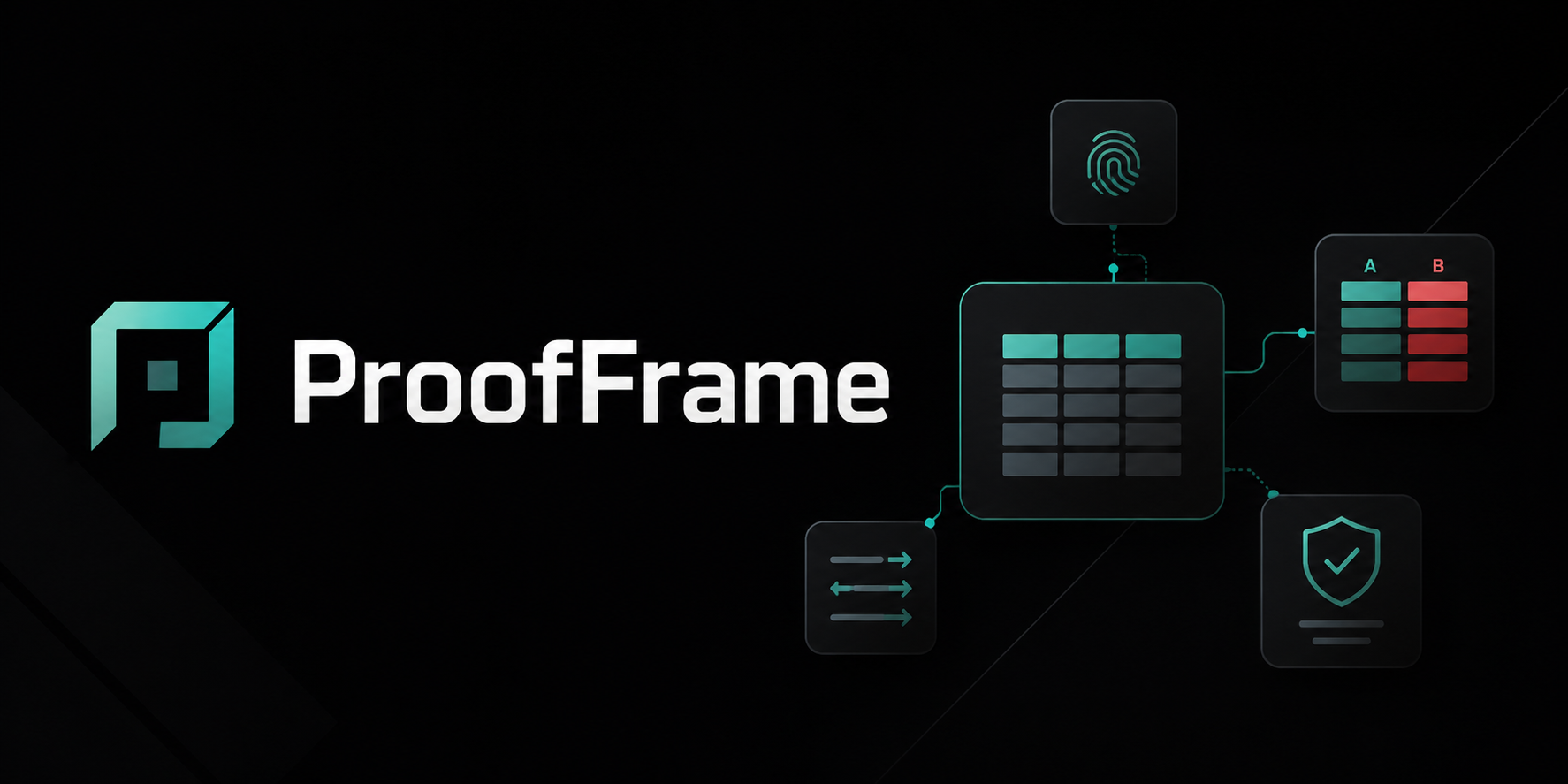
- What exactly was checked? Versioned BLAKE3 fingerprints identify the ordered dataset.
- Why did it fail? Exact violation counts and bounded row-level findings explain the verdict.
- What changed? Keyed diffs report added, removed, and changed records without loading both datasets into memory.
ProofFrame keeps these answers deterministic and resource-bounded. Exact uniqueness, diff, and leakage operations have explicit memory, temporary-storage, sample, and output limits. Corrupt temporary data, incompatible schemas, ambiguous contracts, and exceeded limits fail closed.
0.7.1 — Nine more rules, and a review every surface can write
Ordering, step, exclusivity, totals, mean, standard deviation, conditional uniqueness, ledger balance, category dominance, row-count drift, text length, and dates written as dates. Each one joins the plan digest only when a contract uses it, so existing receipts keep verifying.
Uniqueness no longer needs a writable directory, so it runs on a read-only filesystem and in a browser, failing closed on the memory budget instead of on a missing folder. With nowhere to spill, state grows until the budget stops it, and the columns compete for that budget rather than being rationed a slice each.
A profile now drops the one count it cannot finish instead of the whole scan, and says which:
ColumnProfile.distinct_limitedmarks a column whose distinct values outran the budget, so an absent count is absent for a stated reason. Rules that return a verdict are unchanged —uniquestill fails closed.The review is rendered by the engine.
review_htmlandreview_markdownare part of the crate, so a Rust caller gets the same offline report the CLI writes, and Python calls the same code instead of its own copy. Fixtures pin the output byte for byte against the renderer this replaced.0.7.0 — Review and acceptance
Turn a validation run into an offline HTML report, CI Markdown summary, validation JSON, and signable Evidence V2. One scan, exact counts, bounded samples.
Then decide with it:
accept_fileanswers accepted, rejected or unknown, and a file that could not be read is never quietly accepted. The bundle binds the contract, the acceptance policy, the CSV reader settings and the evidence, and verifies offline.Contract errors now identify the offending column and explain the expected type or version.
Try it without installing anything
Drop a CSV into the browser linter →
The engine is compiled to WebAssembly and runs in the tab: it reads the file with Arrow, infers a
draft contract, refuses to execute that draft until you have reviewed it, and renders the same HTML
review proofframe review writes. Nothing is uploaded, and the page reports the engine time it
measured on your machine.
Uniqueness and the dataset-level exact rules run there too, in memory, failing closed on the
budget rather than on a missing folder. Only references is refused, because it resolves against a
second dataset the page cannot bind; a contract that uses it is still checked for everything else,
and that result is reported as incomplete and carries no evidence.
Review a dataset
proofframe review orders.parquet --contract contract.json --out review-run
# Open review-run/index.html. To include finding details, use a NEW folder:
proofframe review orders.parquet --contract contract.json --out review-details --max-samples 20
CI: review exits 1 on contract violations; existing evidence still exits 0
when evidence generation succeeds. Samples default to zero. Contracts and column names
are not redacted. Nothing is uploaded. Read the review guide for limits,
privacy, signing, output publication and the runnable demo.
Accept or reject a delivery
A review tells you what the data looks like. Acceptance turns that into a decision an application can act on.
proofframe accept orders.csv --contract contract.json --policy policy.json   --csv-options reader.json --output acceptance.json
proofframe verify-acceptance acceptance.json
bundle = pf.accept_file("orders.csv", contract, policy=policy, csv_options=options)
bundle["payload"]["decision"]["status"]   # "accepted", "rejected" or "unknown"
Three answers, and the third is a real one: a missing file, a parse failure or an exhausted resource limit produces unknown, never a quiet accepted.
Zero violations is not the same as a result. A policy can require that named columns actually had values evaluated, so a file cannot be accepted because nothing was asked of it. The limit is stated plainly: those counters are per column, not proof that every rule ran.
CSV delimiter, encoding, decimal separator, column types and null tokens are chosen by you and
recorded in the bundle under their own identity, so two systems reading the same file either
agree or disagree visibly. 1.234 is not silently guessed.
verify_acceptance checks the bundle offline without rescanning, and checks its shape before
it trusts any digest — a hash proves that what is present was not edited and says nothing about
what is absent. Optional Ed25519 signing (proofframe[signing]) covers the whole payload.
Read the acceptance guide for the decision contract and its limits, and the runnable example for an accepted delivery, a rejected one, one that could not be read, and a tampered bundle that fails verification.
Install
Python 3.10–3.13:
pip install proofframe==0.7.1
Rust 1.85 or newer:
cargo add proofframe@0.7.1
The 30-second demo
import pyarrow as pa
import proofframe as pf

orders = pa.table({
    "order_id": [101, 102, 103],
    "subtotal": [12.50, 8.00, 10.00],
    "total": [12.50, 7.50, 10.00],
})

contract = {
    "version": "proofframe.contract.v2",
    "columns": {},
    "row_rules": [{
        "name": "total_covers_subtotal",
        "compare": {
            "left": {"column": "total"},
            "op": "gte",
            "right": {"column": "subtotal"},
        },
    }],
    "dataset_rules": {
        "row_count": {"min": 1},
        "distinct_ratio": {"order_id": {"min": 1.0}},
    },
}

report = pf.check(
    orders,
    contract,
    max_memory=64 << 20,
    max_temp=512 << 20,
    max_samples=20,
)

assert report["valid"] is False
assert report["violation_count"] == 1
The contract is compiled before scanning. Unknown fields, missing required columns, invalid bounds,
and rules that do not match the Arrow type are rejected before the first row is processed.
violation_count remains exact even when the retained findings sample is truncated.
Start from a reviewable draft
Use the native suggestion scanner to create a V2 draft, then inspect it before activation:
proofframe suggest data.parquet > contract.json
# Review contract.json and set "status" to "active" before checking it.
proofframe check data.parquet --contract contract.json
suggest performs its own Arrow scan so it can preserve exact integer bounds. It infers
types and non-null columns by default; uniqueness, required columns, and category allowlists
are explicit opt-ins. Timestamp and monotonically increasing numeric ranges are deliberately
omitted and recorded in suggested_from.review. A draft is rejected with
PF_DRAFT_CONTRACT until a reviewer changes its status to active. See the
five-minute guide and contract reference.
Cross-column and conditional rules
V2 compares Arrow values in their physical type. It does not cast through Python objects or parse an expression language at runtime.
shipments = pa.table({
    "ordered_at": [1, 3],
    "delivered_at": [2, 2],
    "status": ["delivered", "pending"],
    "tracking_id": ["TR-1", None],
})

contract = {
    "version": "proofframe.contract.v2",
    "columns": {},
    "row_rules": [
        {
            "name": "delivery_window",
            "compare": {
                "left": {"column": "ordered_at"},
                "op": "lte",
                "right": {"column": "delivered_at"},
            },
        },
        {
            "name": "delivered_has_tracking",
            "when": {
                "left": {"column": "status"},
                "op": "eq",
                "right": {"literal": "delivered"},
            },
            "assert": {"column": "tracking_id", "not_null": True},
        },
    ],
}

report = pf.check(shipments, contract)
Comparisons support signed and unsigned integers, floats, booleans, UTF-8, dates, timestamps, and decimal128 where the Arrow types are compatible. Null behavior is explicit. Conditional assertions cover nullability, numeric bounds, allowlists, patterns, and NaN policy without building a row mask.
Dataset-level rules and partitions
{
  "dataset_rules": {
    "monotonicity": [{ "name": "clock", "column": "ts", "direction": "strictly_increasing" }],
    "gap_detection": [{ "name": "bars", "column": "ts", "expected_step": 60 }],
    "mutually_exclusive": [{ "name": "tax_id", "columns": ["tckn", "vkn"] }],
    "sum": [{ "name": "turnover", "column": "amount", "max": 50000000 }],
    "mean": [{ "name": "latency", "column": "latency_ms", "max": 45 }],
    "std_dev": [{ "name": "spread", "column": "latency_ms", "max": 15 }],
    "balance_equal": [{ "name": "books", "left_column": "debit", "right_column": "credit" }],
    "max_dominant_value_ratio": [{ "name": "skew", "column": "country", "max": 0.7 }],
    "conditional_unique": [
      {
        "name": "live_ids",
        "columns": ["id"],
        "when": { "left": { "column": "is_deleted" }, "op": "eq", "right": { "literal": false } }
      }
    ]
  }
}
A step is measured in the column's own units and findings name them. A total is counted in 128-bit integers, or with compensated addition for floats, so it does not change with the reader's batch size. A statistic over no values is reported as such rather than as zero.
Dataset rules keep exact state across record-batch and partition boundaries. Distinct and composite keys use canonical values, not hash-only identity. When the memory budget is reached, sorted, checksummed runs spill under the configured temporary-storage limit.
partitions = [
    pa.table({"order_id": [101, 101], "line_id": [1, 2]}),
    pa.table({"order_id": [102], "line_id": [1]}),
]

contract = {
    "version": "proofframe.contract.v2",
    "columns": {},
    "dataset_rules": {
        "row_count": {"min": 3},
        "distinct_ratio": {"order_id": {"min": 0.5}},
        "composite_unique": [{
            "name": "line_key",
            "columns": ["order_id", "line_id"],
        }],
    },
}

report = pf.check_partitions(partitions, contract, threads=2)
assert report["valid"] is True
pf.check_partitions_with_evidence additionally returns an ordered manifest binding every
partition's V2 fingerprint, row count, schema, contract, compiled plan, result contribution, global
result, and resource settings. Reordering, omission, duplication, or mixed identities fails
verification.
Check a foreign key across datasets
orders = pa.table({"customer_id": [1, 99, 2]})
customers = pa.table({"id": [1, 2]})

contract = {
    "version": "proofframe.contract.v2",
    "dataset_rules": {
        "references": [{
            "name": "orders_customer_fk",
            "columns": ["customer_id"],
            "reference": "customers",
            "reference_columns": ["id"],
        }],
    },
}

report = pf.check(orders, contract, references={"customers": customers})
assert report["valid"] is False
assert report["findings"][0]["row"] == 1
assert report["references"][0]["reference_fingerprint"].startswith("pf-fp-v2:")
The contract names the reference; the caller supplies it. A declared reference with no bound dataset, and a bound dataset no rule uses, are both errors: a foreign key that is never evaluated would otherwise report as one that held. The report records the fingerprint of the dataset the keys resolved against, because "the key held" is not verifiable without saying against what.
One engine, several proof operations
Fingerprint a dataset
legacy = pf.fingerprint(orders, version="v1")
current = pf.fingerprint(orders, version="v2")
Fingerprints bind schema, row and column order, nulls, type tags, and canonical values. They do not depend on Arrow display formatting and remain stable across record-batch boundaries. V1 is frozen for existing proofs; V2 is a separate protocol for new evidence.
Diff by business key
changes = pf.diff(
    before,
    after,
    keys="order_id",
    max_memory=256 << 20,
    max_temp=2 << 30,
    max_samples=100,
    output="changes.jsonl",
    spill="auto",
)
Counts are exact. Samples stay bounded, while full change records can be written atomically as JSON Lines or Arrow IPC. Duplicate keys and schema mismatches fail loudly.
Create verifiable evidence
checked = pf.check_with_evidence(orders, contract, max_samples=20)
report = checked["report"]
evidence = checked["evidence"]

assert report["valid"] is False
assert evidence["schema"] == "proofframe.evidence.v2"
Evidence V2 binds the dataset fingerprint, canonical contract source, compiled plan, Arrow schema, engine version, resource limits, and result. Signed receipts use Ed25519 and separate cryptographic validity from signer trust. Keep signing material in a secret manager and verify against a public key obtained independently from the receipt.
Find PII and train/test leakage
pii = pf.scan_pii(customers)
overlap = pf.detect_leakage(train, test, keys="user_id")
PII findings contain the class, column, row, confidence, and a keyed fingerprint—not the matched value. Leakage reports support business keys or full-row identity and expose only bounded hashed samples.
Arrow-native by design
Pandas / Polars / PyArrow / Arrow C Stream / CSV / Parquet
                           |
                           v
                  Arrow record batches
                           |
          +----------------+----------------+
          |                |                |
       contracts       fingerprints      keyed diff
          |                |                |
          +----------------+----------------+
                           |
                           v
              deterministic JSON evidence
Known DataFrame containers provide exact row and logical-byte hints. Stream-only inputs remain
streaming. The Rust scan releases the Python GIL, and the ProofFrame crate itself uses
#![forbid(unsafe_code)].
Where ProofFrame fits
ProofFrame is strongest when you need Arrow-native, exact checks with bounded resources and evidence that records both the contract source and executable plan. It is deliberately smaller than established data-quality platforms.
| Tool | Prefer it when | ProofFrame trade-off |
|---|---|---|
| Pandera | You want Python-first dataframe schemas, typing, and familiar pandas workflows. | ProofFrame prioritizes Arrow streams, exact global rules, and evidence over dataframe typing ergonomics. |
| Great Expectations | You need a large expectation library, data docs, and broad orchestration connectors. | ProofFrame has a narrower rule surface and fewer integrations, but keeps validation and proof artifacts compact. |
| Soda | You want monitors, alerting, and a mature data-observability workflow. | ProofFrame is a library/CLI for deterministic checks; it does not replace an observability platform. |
| Deequ | Your data platform is Spark/Scala and you value its constraint-suggestion ecosystem. | ProofFrame avoids a Spark dependency and works directly with Arrow, but does not provide Deequ's Spark ecosystem. |
These tools can coexist: use ProofFrame at an Arrow boundary when repeatable checks, resource limits, and independently verifiable evidence matter.
CLI
proofframe check data.parquet --contract contract.json --max-memory 256MiB --max-temp 2GiB
proofframe fingerprint data.csv --fingerprint-version v2
proofframe diff old.parquet new.parquet --key order_id --output changes.jsonl
proofframe evidence data.parquet --contract contract.json --output evidence.json
proofframe verify receipt.json --expected-public-key "$PROOFFRAME_PUBLIC_KEY"
| Exit code | Meaning |
|---|---|
| 0 | Operation succeeded; check or receipt is valid |
| 1 | Contract violation or invalid receipt |
| 2 | Invalid input, contract, or command configuration |
| 3 | Engine, I/O, schema, or corrupt-data failure |
| 4 | Resource limit exceeded |
JSON is emitted only after a successful operation. File outputs use same-directory temporary files,
fsync, and atomic replacement.
Rust core
The default crate has no Python dependency. Rust users get the same compiled contracts, typed Arrow kernels, fingerprints, evidence, receipt verification, resource accounting, and spill engine used by the Python wheels.
Since 0.7.1 that includes the review itself. review_html and review_markdown render the report
and the CI summary from a report, its evidence and the contract, so the document a Rust caller
produces is the document proofframe review writes.
let html = proofframe::review_html(&report, &evidence, &contract, "orders.parquet", &columns)?;
See the crate guide and API documentation.
Compatibility and performance evidence
Version 0.7.1 preserves V1 fingerprints and the established compatibility entry points. New work
should use check, explicit fingerprint versions, Evidence V2, and Receipt V2.
Performance claims are tied to raw samples, dataset hashes, compiler and package versions, and machine metadata. The committed smoke harness is deterministic; the pinned 7,645,034-row Bitcoin comparison remains a dedicated-runner gate rather than a published benchmark claim. See testing and benchmark methodology.
Release integrity
The release workflow packages the exact wheel, sdist, and crate subjects before publication. It emits deterministic SHA-256 checksums, SPDX JSON SBOMs, GitHub build-provenance attestations, and SBOM attestations. PyPI uses trusted publishing; crates.io publication is gated by the same tagged commit and CI evidence. These controls support provenance verification, but they are not a claim of formal SLSA certification.
Development
cargo test --locked --all-targets --all-features
cargo clippy --locked --all-targets --all-features -- -D warnings
maturin develop --release --locked
python -m pytest -q
CI covers Rust 1.85, Python 3.10–3.13 on Linux, macOS, and Windows, portable wheels, release-mode allocation contracts, Miri-compatible state machines, fuzz targets, source-package hygiene, coverage, DeepSource, and SonarCloud.
License and security
ProofFrame is licensed under Apache-2.0. Report vulnerabilities through the process in SECURITY.md. Sponsorship is available through GitHub Sponsors.
1 maintainer

Release files for proofframe 0.7.1
For a detailed explanation of source distributions (sdists) and built distributions (wheels), please see the package formats documentation.
Source distribution (sdist)
| File | Size | Uploaded | |
|---|---|---|---|
| proofframe-0.7.1.tar.gz | 233.7 kB | Details |
Built distributions (wheels)
| File | Reset | |||
|---|---|---|---|---|
| proofframe-0.7.1-cp310-abi3-win_amd64.whl | CPython 3.10 | abi3 | Windows x86-64 | Details |
| proofframe-0.7.1-cp310-abi3-manylinux_2_17_x86_64.manylinux2014_x86_64.whl | CPython 3.10 | abi3 | Linux glibc 2.17+ x86-64 | Details |
| proofframe-0.7.1-cp310-abi3-manylinux_2_17_aarch64.manylinux2014_aarch64.whl | CPython 3.10 | abi3 | Linux glibc 2.17+ ARM64 | Details |
| proofframe-0.7.1-cp310-abi3-macosx_10_12_x86_64.macosx_11_0_arm64.macosx_10_12_universal2.whl | CPython 3.10 | abi3 | macOS 11.0+ ARM64, macOS 10.12+ universal2 (ARM64, x86-64), macOS 10.12+ x86-64 | Details |
Total release size: 10.6 MB
Release files / proofframe-0.7.1.tar.gz
| Download URL | proofframe-0.7.1.tar.gz |
|---|---|
| Size | 233.7 kB |
| Tags | Source |
|
SHA-256 checksum How to use checksums |
e4f3c0030e2393b9d13cc10859d0df1b0fc066ff3b8d53087ecde75566f1d0d7
|
|
BLAKE2b-256 checksum How to use checksums |
270eb5810874ce38a43f200f8458c2598079906c1fa05f76f2741756ebb763f6
|
| Upload date | |
|
Uploaded using Trusted Publishing? What is trusted publishing? |
Yes |
| Uploaded via |
twine/7.0.0 CPython/3.13.14
|
Provenance
Provenance describes where a file came from. On PyPI, provenance is shared via attestations, which provide a verifiable record of the build or publishing details. View details, limitations and caveats.


PyPI Publish Attestation
PyPI verified that this artifact, at this checksum, originated from the publisher listed below.
Signed by GitHub Actions, verified by PyPI on Sep 9, 2026.
Transparency logRelease files / proofframe-0.7.1-cp310-abi3-win_amd64.whl
| Download URL | proofframe-0.7.1-cp310-abi3-win_amd64.whl |
|---|---|
| Size | 2.2 MB |
| Tags | CPython 3.10 Windows x86-64 abi3 |
|
SHA-256 checksum How to use checksums |
299ae0aa76885437ec835ec8d4e89f56423905b744d158e4ab2bc896e61000c3
|
|
BLAKE2b-256 checksum How to use checksums |
8dc7c3e11fdb0c8ff6ede708aa68803cc62bee6d5780b9ae6f3a59c6be157003
|
| Upload date | |
|
Uploaded using Trusted Publishing? What is trusted publishing? |
Yes |
| Uploaded via |
twine/7.0.0 CPython/3.13.14
|
Provenance
Provenance describes where a file came from. On PyPI, provenance is shared via attestations, which provide a verifiable record of the build or publishing details. View details, limitations and caveats.
PyPI Publish Attestation
PyPI verified that this artifact, at this checksum, originated from the publisher listed below.
Signed by GitHub Actions, verified by PyPI on Sep 9, 2026.
Transparency logRelease files / proofframe-0.7.1-cp310-abi3-manylinux_2_17_x86_64.manylinux2014_x86_64.whl
| Download URL | proofframe-0.7.1-cp310-abi3-manylinux_2_17_x86_64.manylinux2014_x86_64.whl |
|---|---|
| Size | 2.2 MB |
| Tags | CPython 3.10 Linux glibc 2.17+ x86-64 abi3 |
|
SHA-256 checksum How to use checksums |
dda45cc71d97fb67cefb5306f442768e6d6532b8701eb8fc59e9be9a09228de8
|
|
BLAKE2b-256 checksum How to use checksums |
43ed2a9b853de82e9ae919270c6deec17e84b5ad08684b5dad3988a3918a1f36
|
| Upload date | |
|
Uploaded using Trusted Publishing? What is trusted publishing? |
Yes |
| Uploaded via |
twine/7.0.0 CPython/3.13.14
|
Provenance
Provenance describes where a file came from. On PyPI, provenance is shared via attestations, which provide a verifiable record of the build or publishing details. View details, limitations and caveats.
PyPI Publish Attestation
PyPI verified that this artifact, at this checksum, originated from the publisher listed below.
Signed by GitHub Actions, verified by PyPI on Sep 9, 2026.
Transparency logRelease files / proofframe-0.7.1-cp310-abi3-manylinux_2_17_aarch64.manylinux2014_aarch64.whl
| Download URL | proofframe-0.7.1-cp310-abi3-manylinux_2_17_aarch64.manylinux2014_aarch64.whl |
|---|---|
| Size | 2.0 MB |
| Tags | CPython 3.10 Linux glibc 2.17+ ARM64 abi3 |
|
SHA-256 checksum How to use checksums |
0a8df5c99fec5ed63ea7ab0133e991c3944cec7f8a964cfb877142a054673823
|
|
BLAKE2b-256 checksum How to use checksums |
bf2cf62d63c19b6125566f3a05e8b0f3cb63d1f99dc1898b5a4dff805973e35e
|
| Upload date | |
|
Uploaded using Trusted Publishing? What is trusted publishing? |
Yes |
| Uploaded via |
twine/7.0.0 CPython/3.13.14
|
Provenance
Provenance describes where a file came from. On PyPI, provenance is shared via attestations, which provide a verifiable record of the build or publishing details. View details, limitations and caveats.
PyPI Publish Attestation
PyPI verified that this artifact, at this checksum, originated from the publisher listed below.
Signed by GitHub Actions, verified by PyPI on Sep 9, 2026.
Transparency logRelease files / proofframe-0.7.1-cp310-abi3-macosx_10_12_x86_64.macosx_11_0_arm64.macosx_10_12_universal2.whl
| Download URL | proofframe-0.7.1-cp310-abi3-macosx_10_12_x86_64.macosx_11_0_arm64.macosx_10_12_universal2.whl |
|---|---|
| Size | 4.0 MB |
| Tags | CPython 3.10 abi3 macOS 10.12+ universal2 (ARM64, x86-64) macOS 10.12+ x86-64 macOS 11.0+ ARM64 |
|
SHA-256 checksum How to use checksums |
9782bdb3425a75e274a6d07da850f15d45a5e14186c78aa3b0cfa8ac1712e072
|
|
BLAKE2b-256 checksum How to use checksums |
ccc4bad49860a4f1fcd694984ec344378280598c2b22c7d57b4d7412f1f02327
|
| Upload date | |
|
Uploaded using Trusted Publishing? What is trusted publishing? |
Yes |
| Uploaded via |
twine/7.0.0 CPython/3.13.14
|
Provenance
Provenance describes where a file came from. On PyPI, provenance is shared via attestations, which provide a verifiable record of the build or publishing details. View details, limitations and caveats.
PyPI Publish Attestation
PyPI verified that this artifact, at this checksum, originated from the publisher listed below.
Signed by GitHub Actions, verified by PyPI on Sep 9, 2026.
Transparency log













