
PRoot-Distro is a lightweight rootless Linux container management utility built around proot.
Verified details
These details have been verified by PyPIProject links
GitHub Statistics
Maintainers

Project description
PRoot-Distro
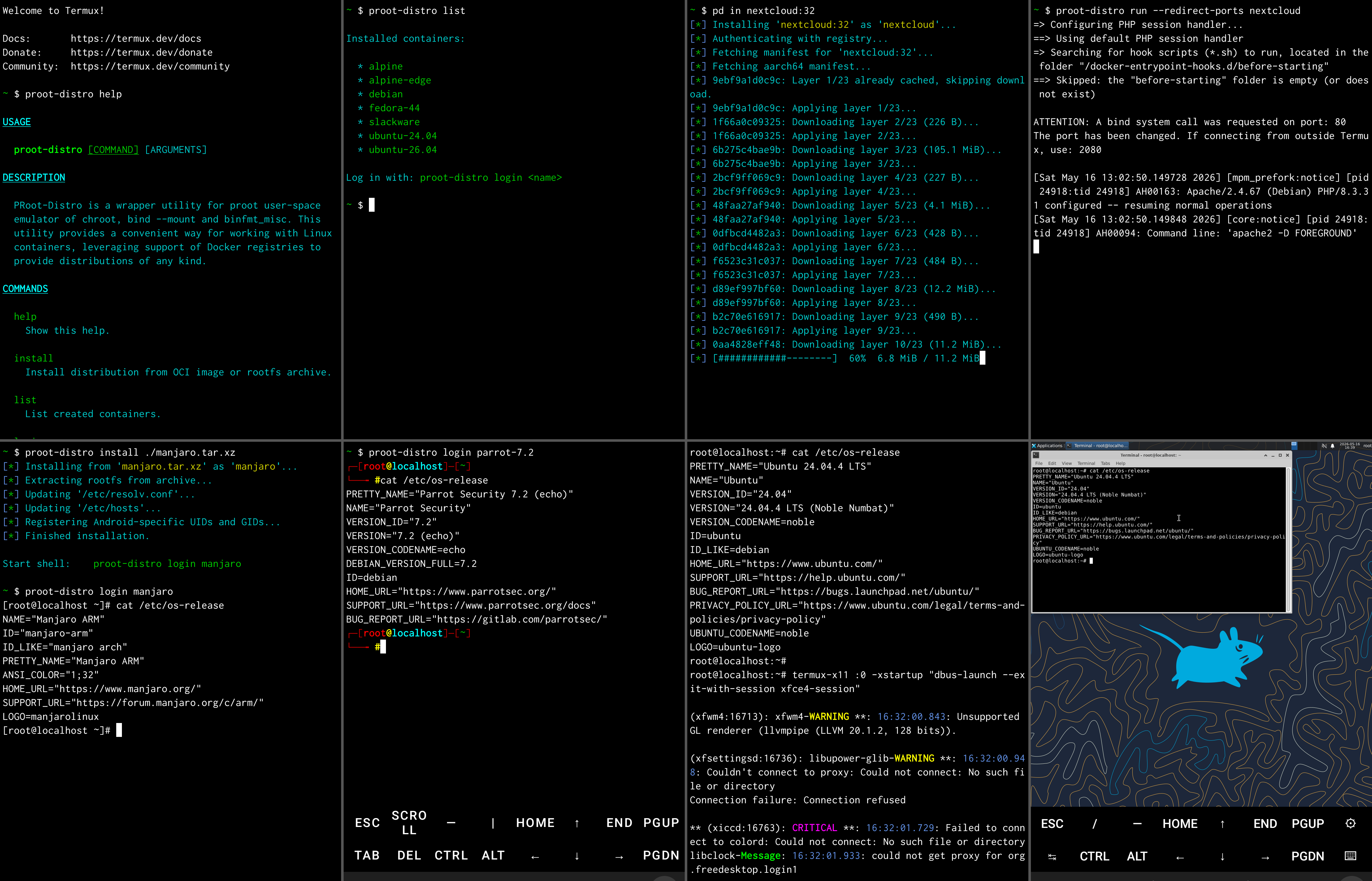
PRoot-Distro is a utility for managing rootless Linux containers in Termux and on regular Linux hosts. It uses proot to provide a chroot-like environment without requiring root access on the device.
Containers are created by pulling Docker/OCI images directly from Docker Hub or any compatible public registry — or by extracting a local tarball / OCI image archive. The container filesystem is assembled from the image layers and stored locally, ready to be entered at any time.
Table of contents
- Introduction
- Installation
- Quick start
- Commands
- How PRoot-Distro works
- Storage layout
- Environment variables
- Shell completions
- Limitations
- Donate
Introduction
PRoot-Distro lets you run a full Linux userland — Ubuntu, Debian, Alpine, Arch, openSUSE, distroless server images, anything available as a Docker/OCI image — on top of Termux on an Android device, or on top of a regular Linux distribution, without root, without a kernel module, and without a Docker daemon.
Typical use cases:
- Running a desktop-class Linux distribution on a phone or tablet.
- Cross-compiling for a different CPU architecture using QEMU user-mode.
- Spinning up server software (Nginx, Nextcloud, PostgreSQL, etc.) on Android by reusing the same OCI images you'd run on a server.
- Trying a distribution non-destructively: install, mess around,
proot-distro removewhen done.
The CLI is exposed both as proot-distro and the shorter alias pd.
Installation
PRoot-Distro is primarily distributed via Termux's pkg package
manager and via PyPI. Python 3.9 or newer is required. The only runtime
dependency is proot (and, optionally, a qemu-user-* package for
cross-architecture containers).
On Termux (Android)
Install Termux from F-Droid or the Termux GitHub Releases. Then, inside Termux:
pkg install proot-distro
This pulls in proot automatically as a dependency.
To install the latest published version from PyPI instead:
pkg install python proot
pip install proot-distro
On a regular Linux host
# Install proot via your distro's package manager, e.g. on Debian/Ubuntu:
sudo apt install proot python3-pip

pip install proot-distro          # from PyPI
# or
git clone https://github.com/termux/proot-distro
cd proot-distro
pip install .                     # from a local checkout
pip install -e .                  # editable install for development
First-run check
On startup the tool verifies that proot is available. If it isn't:
- On Termux, with an interactive terminal, you are prompted to
install it via
pkg install -y -q proot. - Otherwise, an install hint is printed and the program exits.
PRoot-Distro also refuses to run inside another proot (nested proot
is not supported by proot itself) and prints a yellow warning if
launched as the root user.
Quick start
# Install Ubuntu 24.04 from Docker Hub
proot-distro install ubuntu:24.04

# Start a shell inside the container
proot-distro login ubuntu

# Same thing, but using the short command alias
pd sh ubuntu

# Run a single command and exit
proot-distro login ubuntu -- /bin/uname -a

# List all installed containers
proot-distro list

# Rebuild from scratch (loses all in-container data)
proot-distro reset ubuntu

# Permanently remove a container
proot-distro remove ubuntu
Commands reference
The pd short alias works everywhere proot-distro does.
Every command supports --help (also -h, --usage), which prints
help text laid out for the current terminal width.
install — Install a container
proot-distro install [OPTIONS] (IMAGE or PATH)
Aliases: add, i, in, ins
Pull a Docker/OCI image and create a container from it, or extract one from a local archive file.
Options:
| Option | Description |
|---|---|
--name NAME |
Set a custom local name for the container. Defaults to the image name without tag/registry, or the archive filename without extension. Must start with a letter or digit; may contain only letters, digits, _, ., -. Empty name is rejected. |
--architecture ARCH |
Override the target CPU architecture. Accepts native names (aarch64, arm, i686, riscv64, x86_64) or Docker platform strings (linux/arm64, linux/amd64, linux/arm/v7, linux/386, linux/riscv64). Defaults to the host CPU. |
From a Docker/OCI registry
IMAGE is a standard Docker image reference:
| Form | Example |
|---|---|
| Official image | ubuntu:24.04 |
Official, no tag (uses latest) |
alpine |
| User image | myuser/myimage:tag |
| Custom registry | ghcr.io/foo/bar:latest |
Custom registries are detected by the first path component containing
. or : (i.e. a hostname). Public images on ghcr.io,
quay.io, registry.gitlab.com, etc. are pulled with an anonymous
Bearer token discovered from each registry's /v2/ challenge.
Layers are cached in $DOWNLOAD_CACHE_DIR/layers/ and reused on
subsequent installs. If both the resolved manifest and all of its
layers are already in the cache, installation runs fully offline.
Examples:
proot-distro install ubuntu:24.04
proot-distro install alpine:3.21 --name my-alpine
proot-distro install debian:bookworm --architecture aarch64
proot-distro install ghcr.io/myorg/myimage:latest
proot-distro install nextcloud:32
From a local archive
IMAGE can also be a path to a local archive file. A path is
recognised only when it starts with /, ./, ../, or ~ — a bare
token like ubuntu is always treated as a Docker image, even if a file
by that name happens to exist in the current directory.
Two archive formats are supported, auto-detected by reading the first 500 entries of the archive:
- Plain rootfs tarball — a tar archive whose top-level entries form
a standard Linux filesystem (
bin/,etc/,usr/, …). The tool scores strip levels 0–4 and picks the one that lands the most recognised rootfs directories at the root. Supported compression: gzip, bzip2, xz, lzma, or uncompressed. Nomanifest.jsonis written for this format (soresetandrunare not available). - OCI image layout — a tar archive that contains an
oci-layoutfile at its root (as produced bydocker save,skopeo copy oci-archive:, or similar tools). Layers are applied in order with full whiteout semantics, layer blobs are cached, andmanifest.jsonis written soresetandrunwork like with a registry-pulled image.
The container name is derived from the archive filename by stripping
known extensions (.tar, .tar.gz, .tgz, .tar.bz2, .tbz2,
.tar.xz, .txz, .tar.lzma, .tlzma, .oci.tar, .oci.tar.gz,
.oci.tar.xz) and sanitising the result. Use --name to set an
explicit name.
Examples:
# Plain rootfs tarball
proot-distro install ./alpine-rootfs.tar.gz

# OCI image layout saved with docker
docker save myimage:latest -o myimage.oci.tar
proot-distro install ./myimage.oci.tar --name myimage

# Explicit name and architecture override
proot-distro install /tmp/debian-arm.tar.xz --name debian --architecture arm
After installation the resolved image tag is shown (e.g.
Installing 'ubuntu:24.04'). If the image defines an Entrypoint, a
Run entrypoint: proot-distro run <name> hint is printed alongside
Start shell: proot-distro login <name>.
login — Start a shell inside a container
proot-distro login [OPTIONS] CONTAINER [-- COMMAND ...]
Aliases: sh
Spawn an interactive shell (or a custom command) inside an installed
container. The -- separator passes a command to run inside the
container's login shell (the shell still wraps it, so quoting and
redirection inside COMMAND work as expected).
Examples:
# Interactive shell as root
proot-distro login ubuntu

# Interactive shell as a non-root user
proot-distro login ubuntu --user myuser

# Run a single command
proot-distro login ubuntu -- /bin/ls /etc

# Run a shell command string
proot-distro login ubuntu -- bash -c "echo hello"

# Use the short alias
pd login ubuntu

# Inspect the full proot command line without running it
proot-distro login ubuntu --get-proot-cmd
Options always available:
| Option | Description |
|---|---|
--user USER |
Log in as USER (default: root). For containers without /etc/passwd, only a numeric UID or the literal root is accepted. |
--redirect-ports |
Redirect privileged ports 1–1023 to higher numbers (22 → 2022, 80 → 2080, …). The offset is hardcoded inside proot. |
--shared-home |
Bind the host home directory into the container (mounted at /root for the root user, at the user's home otherwise; for termux-type containers it goes to /data/data/com.termux/files/home). |
--termux-home |
Synonym for --shared-home (mutually exclusive with it). |
--shared-tmp |
Bind the host $PREFIX/tmp to /tmp inside the container (Termux only; skipped for termux-type containers). |
--shared-x11 |
Bind $PREFIX/tmp/.X11-unix to /tmp/.X11-unix (Termux only; skipped for termux-type containers). |
--bind SRC[:DST] |
Bind a custom path (repeatable). SRC is resolved via os.path.abspath. DST, when given, must be an absolute path (relative destinations are rejected). Overlap with an existing destination emits a warning but the bind is still added. |
--emulator PATH |
Override the QEMU emulator binary for cross-arch containers. PATH must be executable. Only QEMU user-mode and Blink are known to work. |
--kernel STRING |
Customize the kernel release string reported by uname -r. Default: 6.17.0-PRoot-Distro. |
--hostname STRING |
Customize the hostname inside the container. Default: localhost. |
--work-dir PATH |
Set the initial working directory. Default: the user's home directory. |
--env VAR=VALUE |
Set an environment variable in the guest (repeatable). Wins over image-defined Env and the baseline defaults. |
--get-proot-cmd |
Print the fully assembled env + proot command line (escaped, with line continuations) and exit without running. |
Options available only on Termux (Android):
| Option | Description |
|---|---|
--isolated |
Skip non-essential host bindings (Android system dirs, Termux $HOME, /sdcard, Termux app paths). Keeps the link2symlink/sysvipc/kill-on-exit proot extensions and the kernel-release override. Mutually exclusive with --minimal. |
--minimal |
Bare-minimum proot: only /dev, /proc, /sys are bound, --sysvipc is disabled, no fake /proc stubs, no --kernel-release. Guest env contains only your --env entries plus TERM/COLORTERM. Mutually exclusive with --isolated. |
--no-link2symlink |
Disable proot's hard-link emulation. Only safe on devices with SELinux in permissive mode. |
--no-sysvipc |
Disable System V IPC emulation. Only useful on kernels that already implement it. |
--no-kill-on-exit |
Wait for all child processes before exiting the session. |
Host bindings (Termux, default mode)
Without --isolated or --minimal, the following host paths are
mounted inside the container when present and readable:
/apex
/data/app
/data/dalvik-cache
/data/data/<termux-app-package>
/linkerconfig/com.android.art/ld.config.txt
/linkerconfig/ld.config.txt
/odm
/product
/sdcard
/storage/emulated/0
/storage/self/primary
/system
/system_ext
/vendor
Plus, for normal-type containers, the Termux $PREFIX is bound at its
original path inside the guest so Termux utilities (termux-api,
pkg, etc.) are reachable.
Guest environment
The host's environment is not carried into the guest. PRoot-Distro
builds a clean environment dict and passes it to os.execvpe("proot", …). Precedence (later entries win):
- Baseline:
PATH(fromDEFAULT_PATH_ENV),MOZ_FAKE_NO_SANDBOX=1,PULSE_SERVER=127.0.0.1(Termux only). - Image-defined
Envfrommanifest.json. Cannot override Android system vars,MOZ_FAKE_NO_SANDBOX,PULSE_SERVER,TERM, orCOLORTERM. - Android system vars (
ANDROID_*,BOOTCLASSPATH, etc.), Termux only, when not--isolatedand not--minimal. - Your
--env VAR=VALUEentries. HOME,USER,TERM(defaulting toxterm-256color),COLORTERM(only when set on the host).
After the precedence pass, $PREFIX/bin is appended to PATH so
Termux host tools stay reachable inside the guest. A snippet at
/etc/profile.d/termux-profile.sh re-applies every login-time
environment variable (PATH, image Env, Android system vars, --env
flags) after the distro's /etc/profile resets the environment on
login — without it, running su - someuser inside the container
would silently drop those values. Per-session vars (HOME, USER,
TERM, COLORTERM) and proot-internal vars are excluded.
In --minimal mode steps 1–3 and the PATH post-processing are
skipped; only your --env entries plus TERM/COLORTERM are
exported.
Legacy migration
If a container was created by an older version of PRoot-Distro and its
rootfs is still at the legacy path
($RUNTIME_DIR/installed-rootfs/<name>), login automatically migrates
it to the new layout ($RUNTIME_DIR/containers/<name>/rootfs) on first
use, including rewriting any internal proot link2symlink (l2s)
symlinks. This may take a while on large containers.
run — Run the image-defined entrypoint
proot-distro run [OPTIONS] CONTAINER [-- ARG ...]
Run the Entrypoint and/or Cmd defined in the container's Docker
image manifest. This is equivalent to docker run: the container
starts, executes the image-defined command, and exits when it
finishes.
run requires that the container was installed from an OCI image
(plain tarball installs have no manifest.json and therefore no
recorded Entrypoint/Cmd).
Entrypoint and Cmd resolution:
| Image | Args after -- |
Inner command |
|---|---|---|
Entrypoint + Cmd |
(none) | Entrypoint + Cmd |
Entrypoint + Cmd |
ARGS |
Entrypoint + ARGS (Cmd replaced) |
Only Cmd |
(none) | Cmd |
Only Cmd |
ARGS |
ARGS (Cmd replaced) |
Only Entrypoint |
(none) | Entrypoint |
Only Entrypoint |
ARGS |
Entrypoint + ARGS |
| Neither | (none) | Error |
| Neither | ARGS |
ARGS |
When --work-dir is not given, run uses the image's WorkingDir
(falling back to / if it is empty).
run accepts the same options as login (--user, --bind,
--isolated, --minimal, --env, --shared-tmp, --shared-x11,
--emulator, --get-proot-cmd, etc.). See
proot-distro login --help.
Examples:
# Run the image's default entrypoint
proot-distro run hello-world

# Run with port redirection (so 80 → 2080)
proot-distro run nextcloud --redirect-ports

# Pass arguments to the entrypoint (overrides image Cmd)
proot-distro run ubuntu -- /bin/echo hi

# Print the proot command line without executing
proot-distro run nextcloud --get-proot-cmd
list — List installed containers
proot-distro list
Aliases: li, ls
Show all installed containers (subdirectories of containers/ that
have a rootfs/). When none are installed, an install suggestion is
printed.
remove — Delete a container
proot-distro remove [OPTIONS] CONTAINER
Aliases: rm
Permanently delete the specified container and all its data. This cannot be undone and is not confirmed. Permissions of chmod-000'd files are fixed on the fly so the rootfs can always be cleared.
| Option | Description |
|---|---|
-v, --verbose |
Log each deleted file. |
rename — Rename a container
proot-distro rename OLDNAME NEWNAME
Rename a container from OLDNAME to NEWNAME. Also rewrites every
proot link2symlink (l2s) symlink whose target is still pointing into
the old rootfs path, so hardlinks remain valid. This may take a while
on large containers.
For data-integrity reasons, CTRL-C and CTRL-\ are intercepted during the l2s rewrite. The signal is replaced with a one-line warning; the rewrite continues until done.
reset — Reinstall a container from scratch
proot-distro reset CONTAINER
Remove the container rootfs and reinstall it from the Docker image recorded at install time. All data inside the container is lost.
The image reference and target architecture are read from
containers/<name>/manifest.json. If that file is missing, the command
exits with an error — reset is supported for OCI image installs only
(plain rootfs tarballs cannot be re-pulled).
backup — Archive a container
proot-distro backup [OPTIONS] CONTAINER
Aliases: bak, bkp
Create a TAR archive of the container. The archive contains
<name>/manifest.json (when present) and <name>/rootfs/.
Options:
| Option | Description |
|---|---|
--output FILE |
Write to FILE instead of stdout. Refuses to overwrite an existing file. |
--compress TYPE |
Force compression: gzip, bzip2, xz, or none. Overrides extension-based detection. |
-v, --verbose |
Log each archived file. |
When --output is given, the compression algorithm is inferred from
the file extension (.tar.gz, .tgz, .tar.bz2, .tbz2, .tar.xz,
.txz, .tar.lzma, .tlzma, or plain .tar) unless --compress
overrides it. Unsupported extensions (.tar.zst, .tzst, .tar.lz4,
.tar.lz) are rejected.
Without --output, the archive is written to stdout, uncompressed by
default. Stdout cannot be a TTY (you must redirect or pipe).
File ownership in the archive is zeroed (uid=gid=0, no uname/gname). Block devices, character devices, FIFOs, and sockets are silently skipped. Symlinks to directories are stored as single entries. Before archiving, the rootfs permissions are fixed up so chmod-000'd subtrees become at least readable by the owner.
backup is TTY-safe when piping into an interactive consumer
(e.g. gpg -c with a pinentry prompt): all progress output is
suppressed while the downstream process holds the TTY in
non-canonical/no-echo mode, then resumes once the TTY returns to
normal.
Examples:
# Create a compressed backup
proot-distro backup ubuntu --output ubuntu.tar.xz

# Pipe to another command
proot-distro backup ubuntu | gzip > ubuntu.tar.gz

# Encrypt with GPG (pinentry-safe)
proot-distro backup ubuntu | gpg -c > ubuntu.tar.gpg

# Verbose listing while archiving
proot-distro backup ubuntu --output ubuntu.tar --verbose
restore — Restore a container from a backup
proot-distro restore [OPTIONS] [BACKUP_FILE]
Restore a container from a TAR archive. When BACKUP_FILE is omitted,
archive data is read from stdin.
Compression is detected automatically — tarfile's r|* auto-detect
handles file input; for stdin, the first 6 magic bytes are peeked to
identify gzip / bzip2 / xz / lzma streams.
Options:
| Option | Description |
|---|---|
-v, --verbose |
Log each extracted file. |
Archive format requirements:
- Files must be stored under a subdirectory named after the container
(
<name>/manifest.json,<name>/rootfs/...). Bare-root archives (e.g.tarof a rootfs without any leading directory) are rejected. - If
manifest.jsonis not present in the archive, the container is restored without it (login still works, butresetandrunwill not). - Legacy archives (
installed-rootfs/<name>/...) are accepted and automatically re-rooted to the new layout.
The existing rootfs for each container in the archive is cleared
recursively on the first entry seen for that container. Hard links are
resolved using the archive's own paths and recreated with os.link.
restore is TTY-safe when reading from a pipe that involves an
interactive producer (gpg -d archive.gpg | proot-distro restore):
progress output stays silent while the upstream pinentry holds the
TTY, then resumes once the TTY returns to normal.
Examples:
# Restore from a file
proot-distro restore ubuntu.tar.xz

# Restore from stdin
cat ubuntu.tar.xz | proot-distro restore

# Decrypt + restore in one pipeline
gpg -d ubuntu.tar.gpg | proot-distro restore
copy — Copy files to or from a container
proot-distro copy [OPTIONS] [CONTAINER:]SRC [CONTAINER:]DEST
Aliases: cp
Copy files between the host filesystem and a container rootfs, or
between two containers. Paths inside a container are prefixed with the
container name and a colon: ubuntu:/etc/resolv.conf.
| Option | Description |
|---|---|
-r, --recursive |
Copy directories recursively (preserves symlinks). |
-m, --move |
Move instead of copying (deletes source after success). |
-v, --verbose |
Log each copied file. |
Directories . and .. are accepted only as source, not as
destination. Glob patterns are not supported (rely on the shell).
Examples:
# Copy a local file into a container
proot-distro copy ./file.txt ubuntu:/root/file.txt

# Copy a file out of a container
proot-distro copy ubuntu:/etc/resolv.conf ./resolv.conf.bak

# Copy between two containers
proot-distro copy arch:/etc/pacman.conf ubuntu:/tmp/pacman.conf

# Recursive copy of a local directory
proot-distro copy --recursive ./myapp ubuntu:/opt/myapp
sync — Synchronize files to or from a container
proot-distro sync [OPTIONS] [CONTAINER:]SRC [CONTAINER:]DEST
Synchronize SRC to DEST, copying only files that differ. Both paths
may be plain host paths or container:path references. Always
recursive — no flag needed.
Comparison method:
| Mode | What is compared |
|---|---|
| Default | File size and integer modification time |
--checksum |
File size and CRC32 checksum |
Behavior:
- Symlinks are copied as-is (target not followed).
- Hard links become independent file copies (no inode tracking).
- Block/char devices, FIFOs, and sockets are silently skipped.
- File ownership is never changed (
chownis not called). - Access modes and modification timestamps are preserved.
- Regular files are written atomically (
.~pd_synctemp file →os.replace) so a partial copy never leaves a corrupt destination. - If a source file is not readable, a warning is printed and it is skipped.
- If the destination lacks write permission,
syncfirst attempts tochmodit. If that also fails, the command exits with an error.
| Option | Description |
|---|---|
--checksum |
Compare by size + CRC32 instead of size + mtime (slower, more strict). |
--delete |
Remove destination files and directories that have no counterpart in the source. Applied after the sync pass; only effective when source is a directory. |
-v, --verbose |
Log each synced or deleted entry. Suppresses the progress bar. |
Examples:
# Sync a local directory into a container
proot-distro sync ./app ubuntu:/opt/app

# Sync a directory out of a container
proot-distro sync ubuntu:/etc ./backup/etc

# Use checksum-based comparison
proot-distro sync --checksum ./data ubuntu:/data

# Make destination match source exactly (delete extras)
proot-distro sync --delete ./app ubuntu:/opt/app
clear-cache — Delete the download cache
proot-distro clear-cache
Aliases: clear, cl
Remove all cached Docker image layers and resolved manifests from
$DOWNLOAD_CACHE_DIR. Disk space freed is reported after the operation
in human-readable units.
| Option | Description |
|---|---|
-v, --verbose |
Log each deleted file. |
After clear-cache, the next install (or reset) of an image
requires network access again, and layers must be re-downloaded and
re-verified.
How PRoot-Distro works
PRoot-Distro is a thin orchestration layer around two primary building blocks:
1. OCI registry client
The install command speaks the standard OCI Distribution protocol
directly over urllib:
- Public images on Docker Hub require no flags
(e.g.
ubuntu:24.04). - Public images on other registries are addressed by full reference
(e.g.
ghcr.io/myorg/myimage:tag). PRoot-Distro probeshttps://<registry>/v2/, follows the OCI Bearer auth challenge, and pulls an anonymous token. - Manifest lists are resolved to the platform that matches your CPU
(or the
--architectureoverride). - Each layer blob is downloaded with its SHA-256 verified before
being promoted into the cache. Cross-host redirects (Docker Hub →
CDN) have their
Authorizationheader stripped to satisfy CDNs that reject bearer tokens. - Layer blobs and the resolved single-arch manifest are cached locally. Subsequent installs of the same image are fully offline.
Layers are applied in order on top of an empty rootfs directory, with
full OCI whiteout semantics (.wh..wh..opq and .wh.<name> markers).
Hard links are materialised as copies for self-containment. Block
devices, character devices, and FIFOs are skipped.
After all layers are applied, PRoot-Distro adds three small fixups when
the image has /etc/:
/etc/resolv.confis replaced with Google DNS (8.8.8.8 / 8.8.4.4)./etc/hostsis populated with a minimal localhost mapping.- The host's Termux/Android user is registered as
aid_<name>in/etc/passwd,/etc/shadow,/etc/group, and/etc/gshadowso Android's UID-based permissions work inside the container.
The full OCI manifest and image config are saved to
containers/<name>/manifest.json. This lets reset re-pull the
exact same image later, and run know what to execute by default.
A local archive also can be used with install command:
- A plain rootfs tarball (
alpine.tar.gz,debian.tar.xz, etc.): the leading path component count is detected automatically by scoring directory names likebin,usr,etc,var. - An OCI image layout (as produced by
docker saveorskopeo copy oci-archive:): detected by the presence of anoci-layoutfile at the archive root. The selected platform's layers are extracted into the cache and applied with the same code path used for registry pulls.
2. The proot utility
proot is a user-space implementation of
chroot, mount --bind, and binfmt_misc. It uses Linux's ptrace
mechanism to intercept system calls made by the guest process and
rewrite filesystem paths on the fly. The result is a chroot-like
environment that does not need root privileges.
When you run proot-distro login ubuntu, PRoot-Distro execs into a
proot command line that looks roughly like:
env PATH=… HOME=/root … \
  proot --kill-on-exit --link2symlink --sysvipc \
        --kernel-release=… -L \
        --change-id=0:0 \
        --rootfs=/…/containers/ubuntu/rootfs --cwd=/root \
        --bind=/dev --bind=/proc --bind=/sys \
        --bind=/storage --bind=/system --bind=/apex … \
        /bin/sh -l
You can see this exact command for any container by adding the
--get-proot-cmd flag to login or run.
Cross-architecture support
Architectures supported as containers: aarch64, arm, i686,
x86_64, riscv64. The host CPU is detected via os.uname().machine.
Cross-architecture execution uses QEMU user-mode via proot's -q
flag. The matching qemu-user-<arch> package must be installed on the
host. 32-bit guests run natively on 64-bit hosts when the kernel
supports PER_LINUX32 (probed via ctypes).
Container architecture is detected automatically at every login by reading ELF headers of common shell binaries inside the rootfs — there is no separate config file to remember.
Storage layout
All runtime data is stored under $RUNTIME_DIR:
- Termux:
$TERMUX__PREFIX/var/lib/proot-distro/, whereTERMUX__PREFIXdefaults to/data/data/com.termux/files/usr. - Regular Linux:
$XDG_DATA_HOME/proot-distro/(default~/.local/share/proot-distro/).
The OCI download cache ($DOWNLOAD_CACHE_DIR) is under $RUNTIME_DIR
on Termux, and under $XDG_CACHE_HOME/proot-distro/ (default
~/.cache/proot-distro/) on a regular Linux host.
| Path | Contents |
|---|---|
containers/<name>/rootfs/ |
Container root filesystem |
containers/<name>/manifest.json |
Image reference, arch, full OCI manifest, full image config |
containers/<name>/rootfs/.l2s/ |
Proot link2symlink (l2s) backing store (created on first login) |
dlcache/layers/ (Termux) or $XDG_CACHE_HOME/proot-distro/layers/ |
Cached OCI layer blobs |
dlcache/manifests/ (Termux) or …/manifests/ |
Cached resolved single-arch manifests |
installed-rootfs/<name>/ |
Legacy layout; auto-migrated by login. |
Environment variables
| Variable | Effect |
|---|---|
TERMUX__PREFIX |
Override Termux prefix path; drives PREFIX and RUNTIME_DIR on Termux. Defaults to /data/data/com.termux/files/usr. |
TERMUX__HOME |
Override the Termux home path used for --shared-home and the default storage bindings. Defaults to /data/data/com.termux/files/home. |
TERMUX_APP__PACKAGE_NAME |
Override the Termux app package (default com.termux); used for --bind=/data/data/<pkg>/.... |
TERMUX_APP__APP_VERSION_NAME, TERMUX_VERSION |
Either one (when set) counts as one of the indicators that flips on Termux mode in _detect_termux(). |
XDG_DATA_HOME |
On non-Termux hosts, base for $XDG_DATA_HOME/proot-distro/. Defaults to ~/.local/share. |
XDG_CACHE_HOME |
On non-Termux hosts, base for $XDG_CACHE_HOME/proot-distro/. Defaults to ~/.cache. |
PD_FORCE_NO_COLORS |
When set to any value, disables ANSI colors in PRoot-Distro's own output. |
PROOT_NO_SECCOMP |
Inherited and forwarded to proot. Set to 1 if login fails with seccomp-related errors on the host kernel. Skipped in --minimal mode. |
PROOT_DUMP, PROOT_VERBOSE |
Inherited and forwarded to proot for debugging. Skipped in --minimal mode. |
COLUMNS |
Fallback terminal width for --help rendering. |
TERM, COLORTERM |
Inherited from the host and exported into the guest (always; even in --minimal). In normal-type containers, TERM defaults to xterm-256color when unset on the host. |
Shell completions
The packaged distribution installs completion scripts for Bash, Zsh, and Fish to the standard locations:
share/bash-completion/completions/proot-distroshare/zsh/site-functions/_proot-distroshare/fish/vendor_completions.d/proot-distro.fish
All three scripts complete both proot-distro and the short alias pd.
If your shell does not pick them up automatically, copy them by hand:
# Bash, current user
mkdir -p ~/.local/share/bash-completion/completions
cp proot_distro/completions/proot-distro.bash \
   ~/.local/share/bash-completion/completions/proot-distro

# Zsh, current user
mkdir -p ~/.zsh/completions
cp proot_distro/completions/_proot-distro ~/.zsh/completions/_proot-distro
# and add 'fpath=(~/.zsh/completions $fpath)' to .zshrc before compinit

# Fish, current user
mkdir -p ~/.config/fish/completions
cp proot_distro/completions/proot-distro.fish \
   ~/.config/fish/completions/proot-distro.fish
Limitations
PRoot limitations
- Performance:
prootintercepts every system call viaptrace. Filesystem-heavy workloads (compilation, package managers) are noticeably slower than native execution. - Kernel features: features that depend on Linux kernel modules (FUSE, specific iptables targets, custom cgroup hierarchies, etc.) do not work.
- No real root: proot uses UID/GID remapping to fake root. Programs
that genuinely need kernel-level root (
sudo,mountof real filesystems,iptables, etc.) will fail. - No background services: starting service supervisors (
systemd,OpenRC, socket-activated daemons) is generally not possible. You can run individual long-running processes, but a full init system is out of scope. - No cgroups / namespaces: features that need real Linux kernel
namespaces (
unshare, container-in-container, network namespaces) do not work — proot is path translation, not kernel isolation. - seccomp: some Android kernels restrict
ptracecalls used by proot via seccomp policies. Ifloginfails with seccomp-related errors, setPROOT_NO_SECCOMP=1. - No nesting: PRoot-Distro refuses to run inside another
proot, becauseprootitself cannot trace a process already being traced.
PRoot-Distro limitations
- Public registries only: registry authentication is not
implemented. Only public Docker Hub images and public OCI registries
are supported. Private images return an explanatory error from
install. - No zstd-compressed layers: Python's
tarfilemodule does not support zstd. Images using zstd-compressed layers (some newer Docker Hub images) fail to install with an explicit error. Try a different image or an older tag. - No image building: PRoot-Distro consumes existing OCI images; it
does not build them. Use
docker build/buildah/nerdctlon a full Linux host to produce one, thendocker save -o myimage.oci.tar myimage:tagandproot-distro install ./myimage.oci.tar. - No live state migration:
backup/restorearchive the rootfs and the OCI manifest, but in-memory state of running processes is not preserved. - Cross-architecture Termux-type containers are not supported: the host and the container share the same Termux prefix path, so QEMU emulation cannot hide the host's architecture-specific binaries.
- Termux-only flags on non-Termux hosts:
--isolated,--minimal,--no-link2symlink,--no-sysvipc, and--no-kill-on-exitare not exposed by argparse when running outside Termux. Most are Android-specific in spirit, and on a regular Linux host the default behavior is already isolated in the sense that there are no Android bindings to drop.
Donate
Support is important to keep the project up in a long term. I'm grateful for any amount of tip in cryptocurrency:
Bitcoin:
bc1qxuwtc0sfjt43n3sufck6s0gaeand8eaeguajxs
Ethereum:
0x1F5196A5b0120D4a66FCAABBe71728239B06EC12
Tron:
TEJiwRMMGV1JXvRYDRVJ1qw7kFgskEk3sJ
Recipient: the author of PRoot-Distro, @sylirre
Issues and contributing
- Bug reports: https://github.com/termux/proot-distro/issues
- License: GPL-3.0-only. See
LICENSE.
Project details
Verified details
These details have been verified by PyPIProject links
GitHub Statistics
Maintainers
Release history Release notifications | RSS feed


Download files
Download the file for your platform. If you're not sure which to choose, learn more about installing packages.
Source Distribution
Built Distribution
Filter files by name, interpreter, ABI, and platform.
If you're not sure about the file name format, learn more about wheel file names.
Copy a direct link to the current filters
File details
Details for the file proot_distro-5.0.0.tar.gz.
File metadata
- Download URL: proot_distro-5.0.0.tar.gz
- Upload date:
- Size: 116.9 kB
- Tags: Source
- Uploaded using Trusted Publishing? Yes
- Uploaded via: twine/6.1.0 CPython/3.13.12
File hashes
| Algorithm | Hash digest | |
|---|---|---|
| SHA256 |
673bd972315b99802a274e8e8872c97fa3c2b2190c8d02e7466bf8d2c914b78d
|
|
| MD5 |
838198bc142c083608b8ab9818effbb4
|
|
| BLAKE2b-256 |
57ffdcc151b8910d243f40691e4ec14f315777be21bec413a94d35b74dacbcb4
|
Provenance
The following attestation bundles were made for proot_distro-5.0.0.tar.gz:
Publisher:
publish.yml on termux/proot-distro
-
Statement:
-
Statement type:
https://in-toto.io/Statement/v1 -
Predicate type:
https://docs.pypi.org/attestations/publish/v1 -
Subject name:
proot_distro-5.0.0.tar.gz -
Subject digest:
673bd972315b99802a274e8e8872c97fa3c2b2190c8d02e7466bf8d2c914b78d - Sigstore transparency entry: 1555319076
- Sigstore integration time:
-
Permalink:
termux/proot-distro@59f5e887a7b957ebbc068211484a88cb03f91d46 -
Branch / Tag:
refs/tags/v5.0.0 - Owner: https://github.com/termux
-
Access:
public
-
Token Issuer:
https://token.actions.githubusercontent.com -
Runner Environment:
github-hosted -
Publication workflow:
publish.yml@59f5e887a7b957ebbc068211484a88cb03f91d46 -
Trigger Event:
push
-
Statement type:
File details
Details for the file proot_distro-5.0.0-py3-none-any.whl.
File metadata
- Download URL: proot_distro-5.0.0-py3-none-any.whl
- Upload date:
- Size: 123.4 kB
- Tags: Python 3
- Uploaded using Trusted Publishing? Yes
- Uploaded via: twine/6.1.0 CPython/3.13.12
File hashes
| Algorithm | Hash digest | |
|---|---|---|
| SHA256 |
51b5be6b25bfe8d9bb2e63aa810c2cbd3b65b221eaec1e8b518272d408b69896
|
|
| MD5 |
f3214cde83998d8bcab29d7a7deadbe2
|
|
| BLAKE2b-256 |
3c0311218130f547ccfbaefddbf9d9f0f038760430ea8e567ad456acb71ff590
|
Provenance
The following attestation bundles were made for proot_distro-5.0.0-py3-none-any.whl:
Publisher:
publish.yml on termux/proot-distro
-
Statement:
-
Statement type:
https://in-toto.io/Statement/v1 -
Predicate type:
https://docs.pypi.org/attestations/publish/v1 -
Subject name:
proot_distro-5.0.0-py3-none-any.whl -
Subject digest:
51b5be6b25bfe8d9bb2e63aa810c2cbd3b65b221eaec1e8b518272d408b69896 - Sigstore transparency entry: 1555319118
- Sigstore integration time:
-
Permalink:
termux/proot-distro@59f5e887a7b957ebbc068211484a88cb03f91d46 -
Branch / Tag:
refs/tags/v5.0.0 - Owner: https://github.com/termux
-
Access:
public
-
Token Issuer:
https://token.actions.githubusercontent.com -
Runner Environment:
github-hosted -
Publication workflow:
publish.yml@59f5e887a7b957ebbc068211484a88cb03f91d46 -
Trigger Event:
push
-
Statement type:






