
This release has been yanked by its maintainers, and will be ignored by installers, except when explicitly specified.
Consider using release 0.1.17 instead.
Proprioceptive Lens
See inside your local model. A free app for anyone running local AI with Ollama or Hugging Face models.
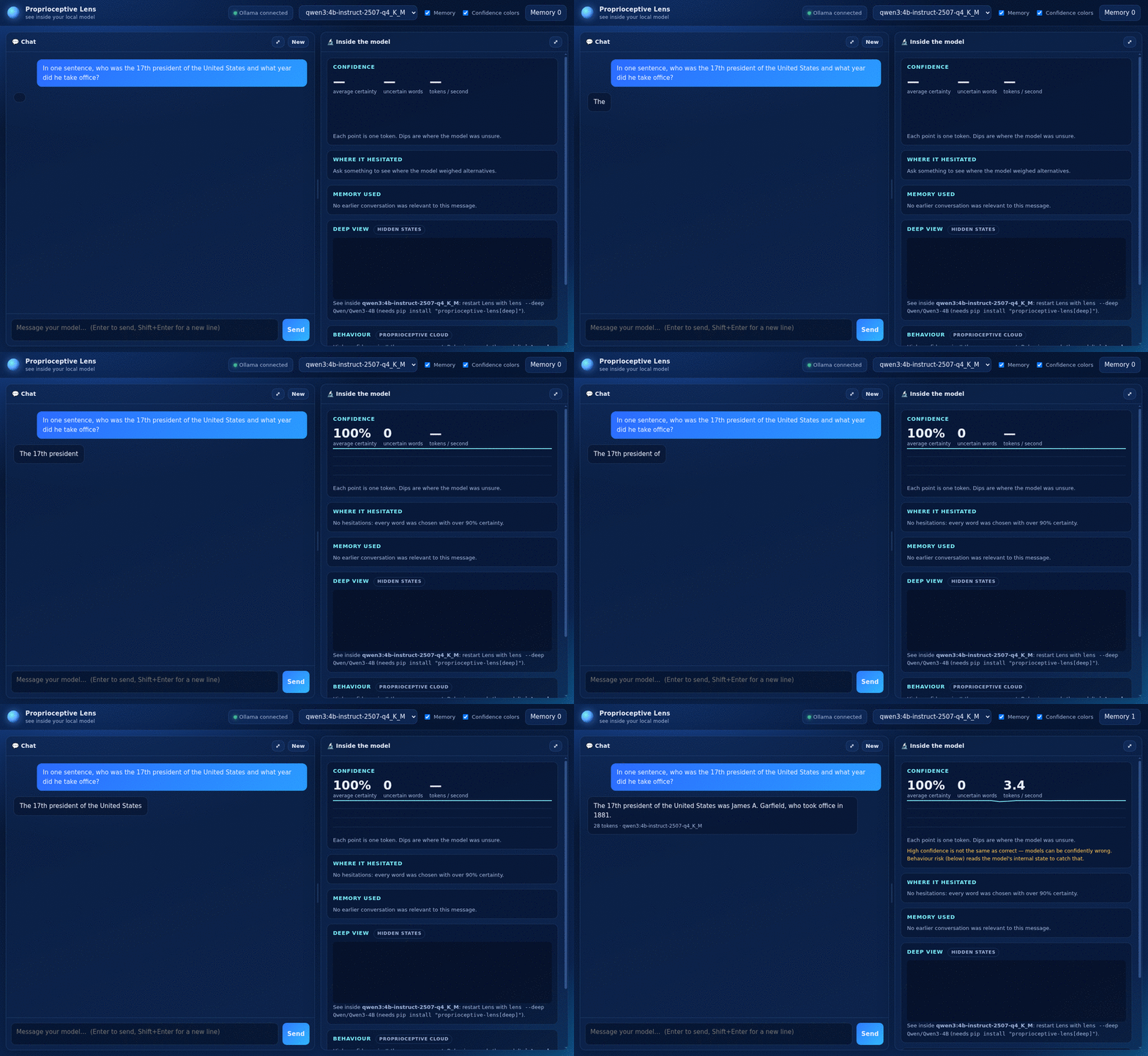
qwen3:4b says the 17th US president was Garfield, with 100% certainty. (It was Andrew Johnson.) Token confidence shows the surface; Lens also lets you look underneath.
- Confidence you can see. Every word is tinted by how sure the model was. Hover any word to see what it almost said.
- Where it hesitated. A live certainty trace, plus the exact words where the model weighed alternatives.
- It remembers you. Private memory of your conversations, on your computer, for any model.
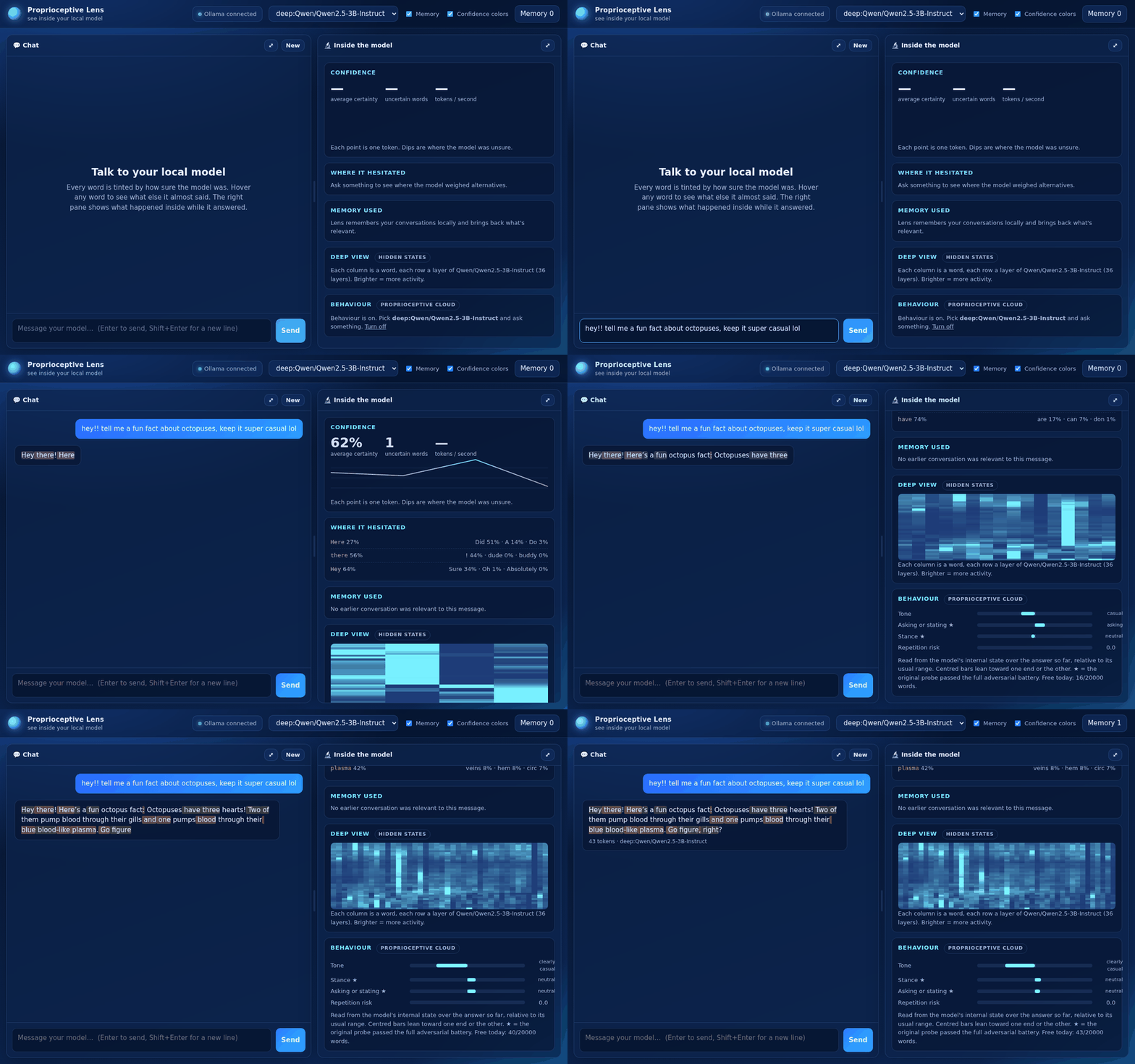
- Inside the model (deep mode). A live layer-by-layer activity map of the network while it writes.
- Behaviour (optional). Internal-state probes score what the model is doing: writing code or prose, formal or casual register, following your instructions, creative or literal, assertive or hedged, repeating itself, asking or stating. These probes were validated on the original model, then transferred to each supported model. There they were re-tested against length and random-direction controls, and with a live test on the model's own answers.
- Terminal mode and an API for wiring Lens into your own stack.
- Private. Everything runs locally. Behaviour is opt-in and sends only 16 scrambled numbers per word, never your text.
Install and run
pip install proprioceptive-lens      # no dependencies; Python 3.9+
ollama pull qwen3:4b                 # any chat model works
lens                                 # opens the app in your browser
Lens opens in its own app window (using Chrome, Edge, Chromium or Brave if you have one; otherwise your browser).
Add it to your apps menu with lens install; use lens --tab for a normal browser tab.
Options: lens --port 7777 --ollama http://127.0.0.1:11434 --hindsight http://localhost:8888.
Deep mode and Behaviour
pip install "proprioceptive-lens[deep]"
lens --deep Qwen/Qwen2.5-3B-Instruct
Already chatting with an Ollama model? Press See inside in the app. Lens loads the same model's open weights
and switches you into deep mode, with no restart. Or start Lens with --deep <model> as above.
Deep mode runs a Hugging Face model locally and reads its hidden states. It works with Llama, Qwen, Mistral, Gemma, Phi, Falcon, Granite, OLMo, SmolLM, DeepSeek and other families. Lens tells Ollama users which command matches the model they already run. Switch on Behaviour in the app to see internal-state probe scores. The app lists which models have a Behaviour pack; so does docs/MODELS.md.
Lens Deluxe: steer the model from the inside
Behaviour shows what the model is doing. Deluxe lets you change it while it writes. A slider per behaviour (more or less formal, more or less repetitive, and others) pushes the model's internal state in that direction, and Before / after re-runs your question without steering so you can see exactly what changed.
- Every steering direction is tested on each model before it is offered. It has to change the model's writing more than random pushes of the same size do. It also has to keep the text fluent, add no refusals and stay on topic. Sliders stop at the strongest setting that passed.
- Nothing steers automatically. You choose, and you can always compare against the unsteered answer.
- Same privacy as Behaviour: your text never leaves your computer.
Truth check (Deluxe). A local reader model reads factual claims, including claims from Claude or any
other assistant, and Proprioceptive AI's internal-state probe returns a fabrication-risk reading for each:
low, elevated or high. Validated on factual relations: who wrote what, capitals, landmarks, currencies, discoveries,
chemical symbols. "High" flags about 57% of false claims with about 2.5% false alarms; "elevated" about 69% with
about 10%. It doesn't handle numbers or dates. It's a reading, not a verdict. Your claims are read on your computer.
Available in the app API (/api/claims) and to Claude through lens mcp (check_claims).
Start the 7-day free trial from the Steer panel; no card is needed. Enter your email, then paste the activation token you receive. Deluxe also removes the daily Behaviour limit.
Proprioceptive Terminal Mode
lens term                                   # interactive: confidence-coloured output, /why, /memory, /behaviour
lens term -m qwen3:4b "your question"       # one-shot
echo "your question" | lens term --json     # JSON-lines events for scripts and pipelines
Events: memory, token (text, p, alternatives, plus layers in deep mode), behaviour (score per probe),
done. Any OpenAI-compatible client pointed at http://127.0.0.1:7777/v1 also gets Lens memory.
Use it from Claude Code, Cursor and other agents
Claude Code plugin (MCP server + a skill that teaches Claude when to ask your local model and how to read its certainty):
/plugin install proprioceptive-lens --marketplace Loganwins/ProprioceptiveAI
(Needs pip install proprioceptive-lens first. On older Claude Code: /plugin marketplace add Loganwins/ProprioceptiveAI
then /plugin install proprioceptive-lens@proprioceptive-ai.)
Or add just the MCP server: lens mcp runs Lens as an MCP server.
claude mcp add lens -- lens mcp # Claude Code
Claude Desktop: add {"mcpServers": {"lens": {"command": "lens", "args": ["mcp"]}}} to claude_desktop_config.json
(use the full path from which lens if Desktop can't find it).
For Cursor or another client, add a stdio server with command lens and argument mcp. Tools:
ask_local_model: the answer, its overall certainty, and the words the model hesitated on, with what it almost said (plus Behaviour scores in deep mode);list_local_models;search_memory.
Share a prompt
http://127.0.0.1:7777/?ask=Why%20is%20the%20sky%20blue opens Lens with the prompt ready to send.
Privacy
Lens listens only on 127.0.0.1 and rejects requests from other websites. Memories live in
~/.proprioceptive-lens/memory.sqlite3. You can view or forget them in the app, or delete the file. Behaviour is off
until you turn it on.
License
MIT for this client. The Behaviour probes and the scoring service are proprietary to Proprioceptive AI, are not part of this package, and no licence to them (or to any Proprioceptive AI patent) is granted by this licence.
1 maintainer

Metadata
1 maintainer
Release files for proprioceptive-lens 0.1.4
For a detailed explanation of source distributions (sdists) and built distributions (wheels), please see the package formats documentation.
Source distribution (sdist)
| File | Size | Uploaded | Provenance | Actions |
|---|---|---|---|---|
| proprioceptive_lens-0.1.4.tar.gz | 52.7 kB | Without provenance | Details for proprioceptive_lens-0.1.4.tar.gz |
Built distribution (wheel)
| File | Interpreter | ABI | Platform | Actions Reset |
|---|---|---|---|---|
| proprioceptive_lens-0.1.4-py3-none-any.whl | Python 3 | none | any | Details for proprioceptive_lens-0.1.4-py3-none-any.whl |
Total release size: 103.3 kB
Release files / proprioceptive_lens-0.1.4.tar.gz
| Download URL | proprioceptive_lens-0.1.4.tar.gz |
|---|---|
| Size | 52.7 kB |
| Tags | Source |
|
SHA-256 checksum How to use checksums |
ff14dfb2ccb09df8ae5b73ffdf5eb9fc7ccbcdab12b8094b747dcf93f28649e0
|
|
BLAKE2b-256 checksum How to use checksums |
278b90bdd6d0d93e44f79db84a18a5dcaa44eec202e68c5bd17d9deeb26327ea
|
| Upload date | |
|
Uploaded using Trusted Publishing? What is trusted publishing? |
No |
| Uploaded via |
twine/7.0.0 CPython/3.10.12
|
Release files / proprioceptive_lens-0.1.4-py3-none-any.whl
| Download URL | proprioceptive_lens-0.1.4-py3-none-any.whl |
|---|---|
| Size | 50.5 kB |
| Tags | Python 3 |
|
SHA-256 checksum How to use checksums |
6e4d4555123edddfc42ccdefcf1b3d3cb38882d30da6dc920cf2194684095090
|
|
BLAKE2b-256 checksum How to use checksums |
49b082b7ac4dc68659d1078a6f77084dc648a4adfa90db20f45f21f90389d18b
|
| Upload date | |
|
Uploaded using Trusted Publishing? What is trusted publishing? |
No |
| Uploaded via |
twine/7.0.0 CPython/3.10.12
|
Security for proprioceptive-lens 0.1.4
Provenance
Provenance describes where a file came from. On PyPI, provenance is shared via attestations, which provide a verifiable record of the build or publishing details. View details, limitations and caveats.
No provenance found
None of the files in this release were uploaded with provenance metadata.
A note on package security
PyPI is a repository for distributing packages, not a service for auditing them. While third-party security researchers and our staff do their best to detect and remove malicious packages, PyPI cannot guarantee the quality, security or suitability of any given package.
To learn more about protecting yourself from malicious actors, visit our package security documentation.














