
Proseview
A local dashboard for Markdown-first novel repositories. ✍️
Point it at a convention-structured manuscript. Get lexical health, pacing, character presence, and revision history from the files you already have — then read, edit, and annotate them on the same surface.
Core analysis stays on your machine: no account, subscription, database, or telemetry. AI features are opt-in; when you use one, Proseview sends the active document by default, plus any selection or attachments, through your installed agent CLI under that agent's login and data handling.
pipx install proseview
proseview --root /path/to/your/novel
Already writing in Obsidian, Vim, or another Markdown editor? Keep doing that.
Proseview reads the same .md files once they follow the scene layout below.




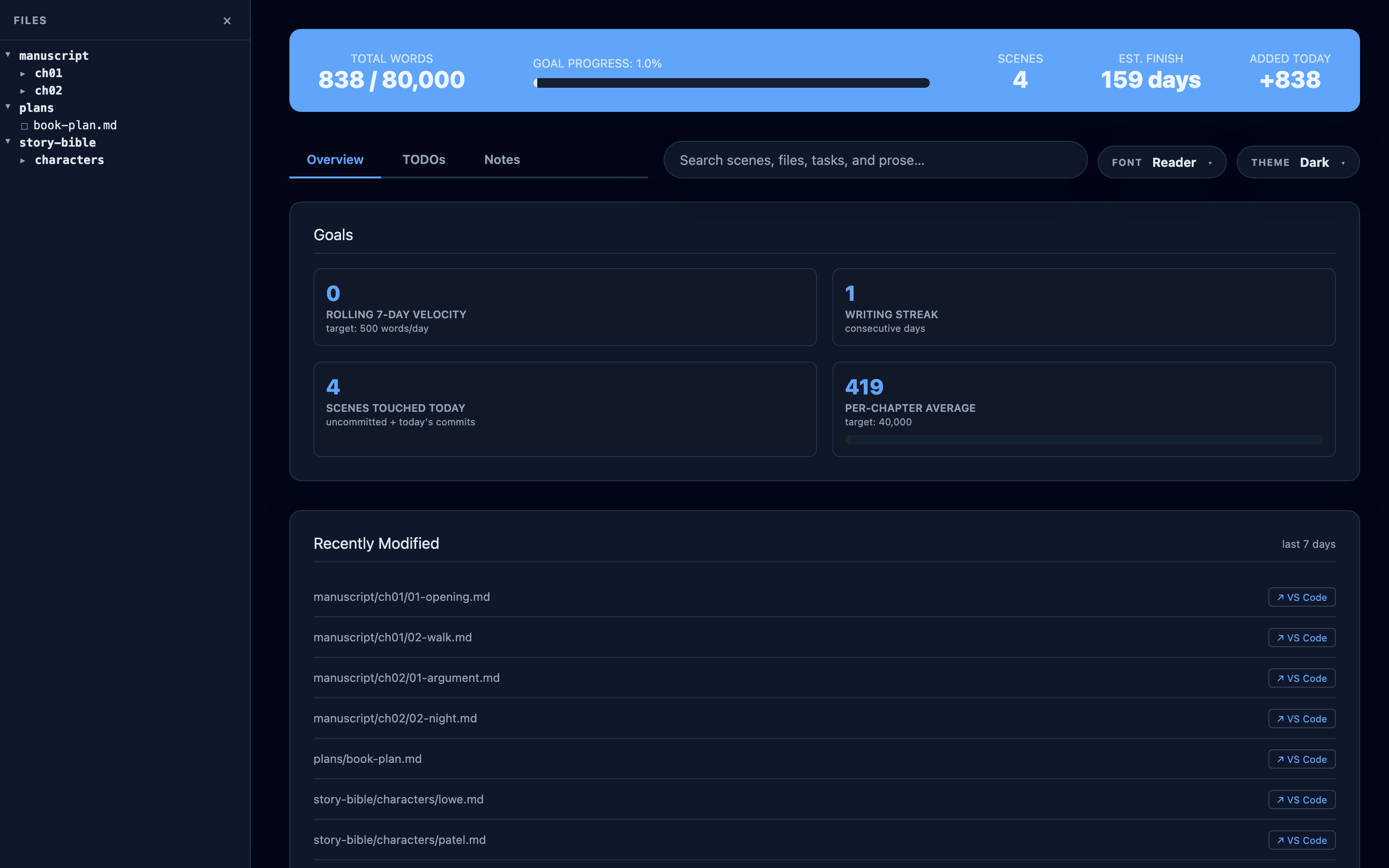
📸 A look around
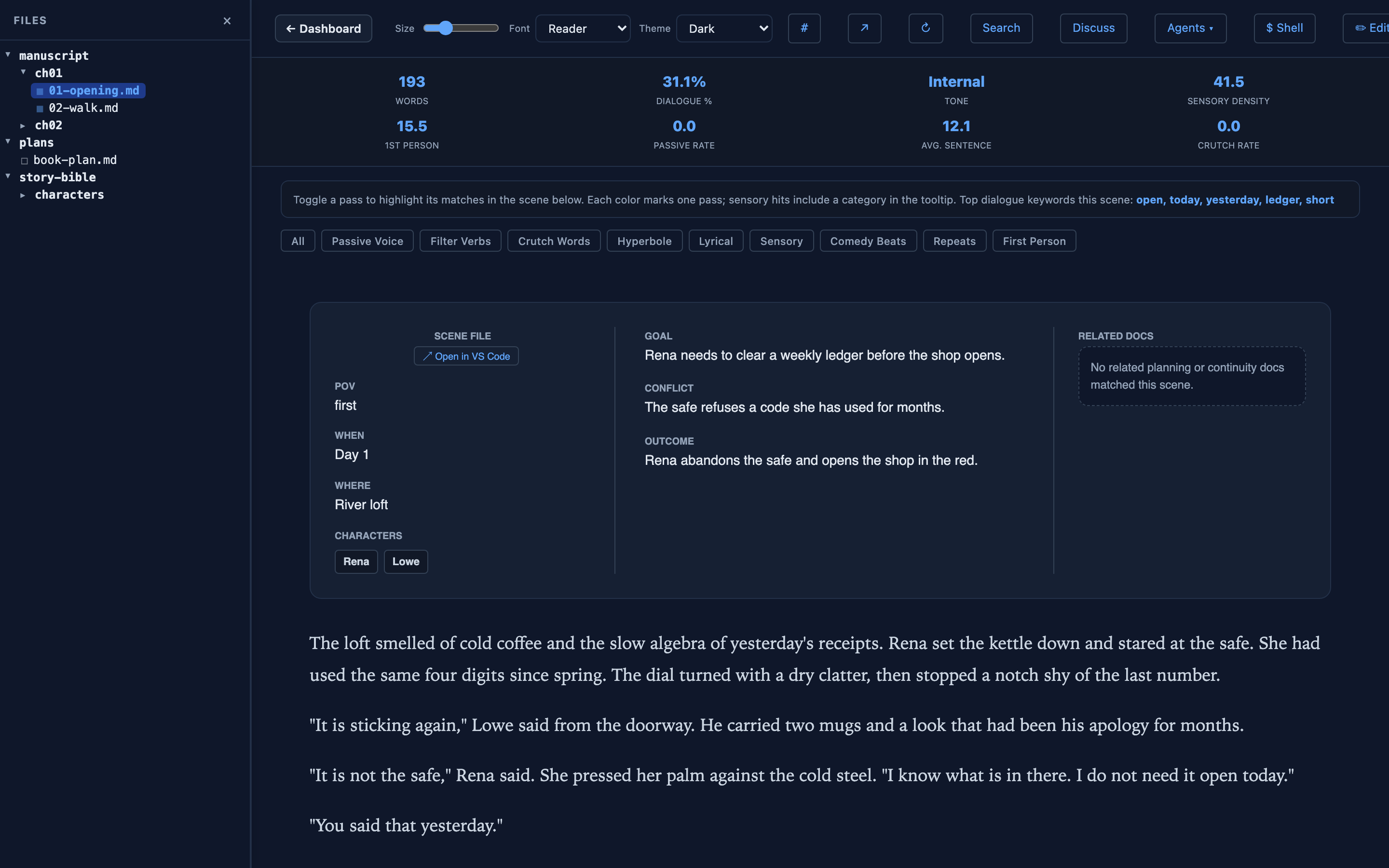
Read and revise, with editorial passes on
Nine prose passes highlight repetition, passive voice, filter verbs and more, right on the page you are reading.
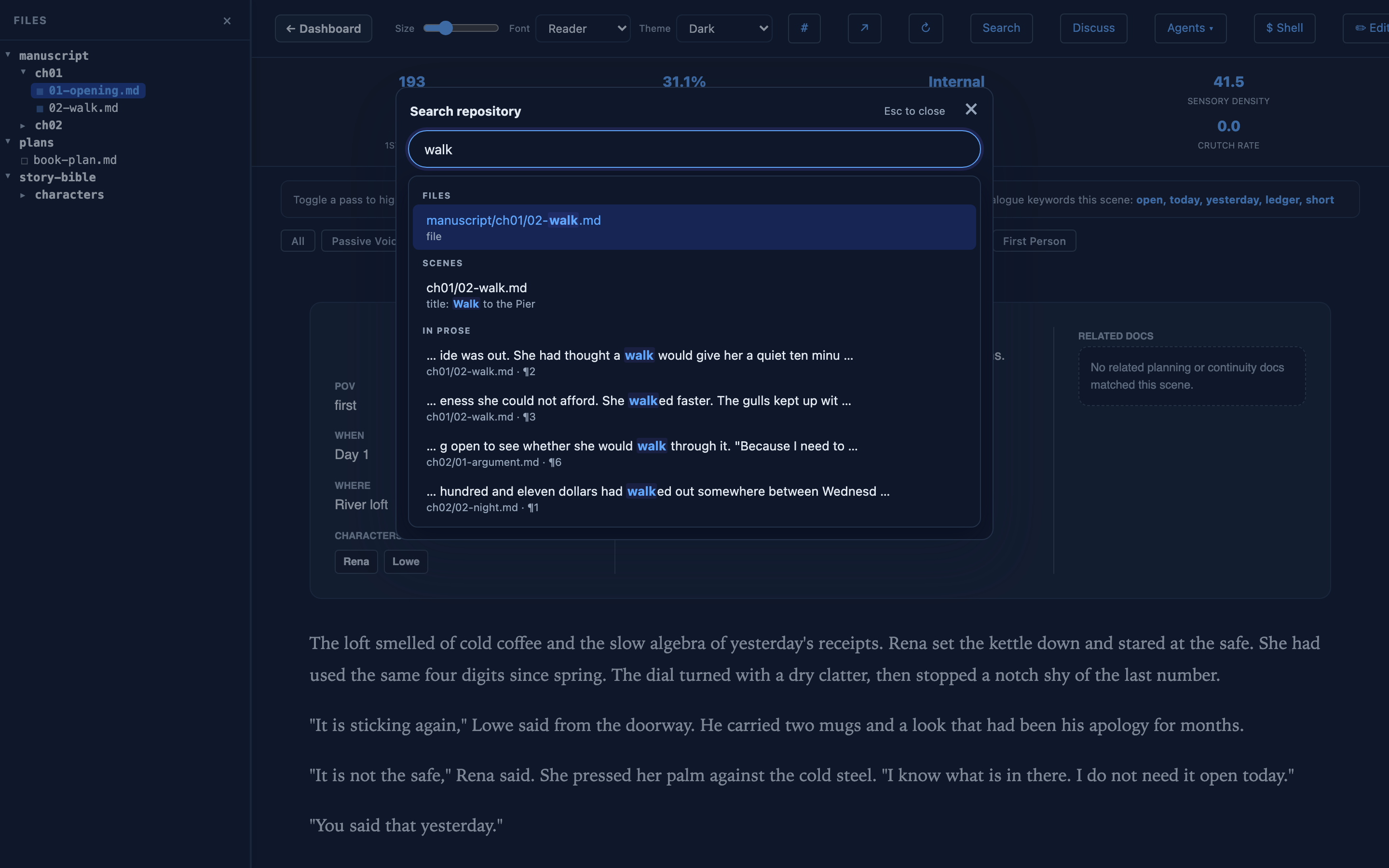
Search the whole repository
Mod-K from anywhere. File paths, scene metadata, TODOs, notes, and prose,
grouped by kind.
Analytics that mean something
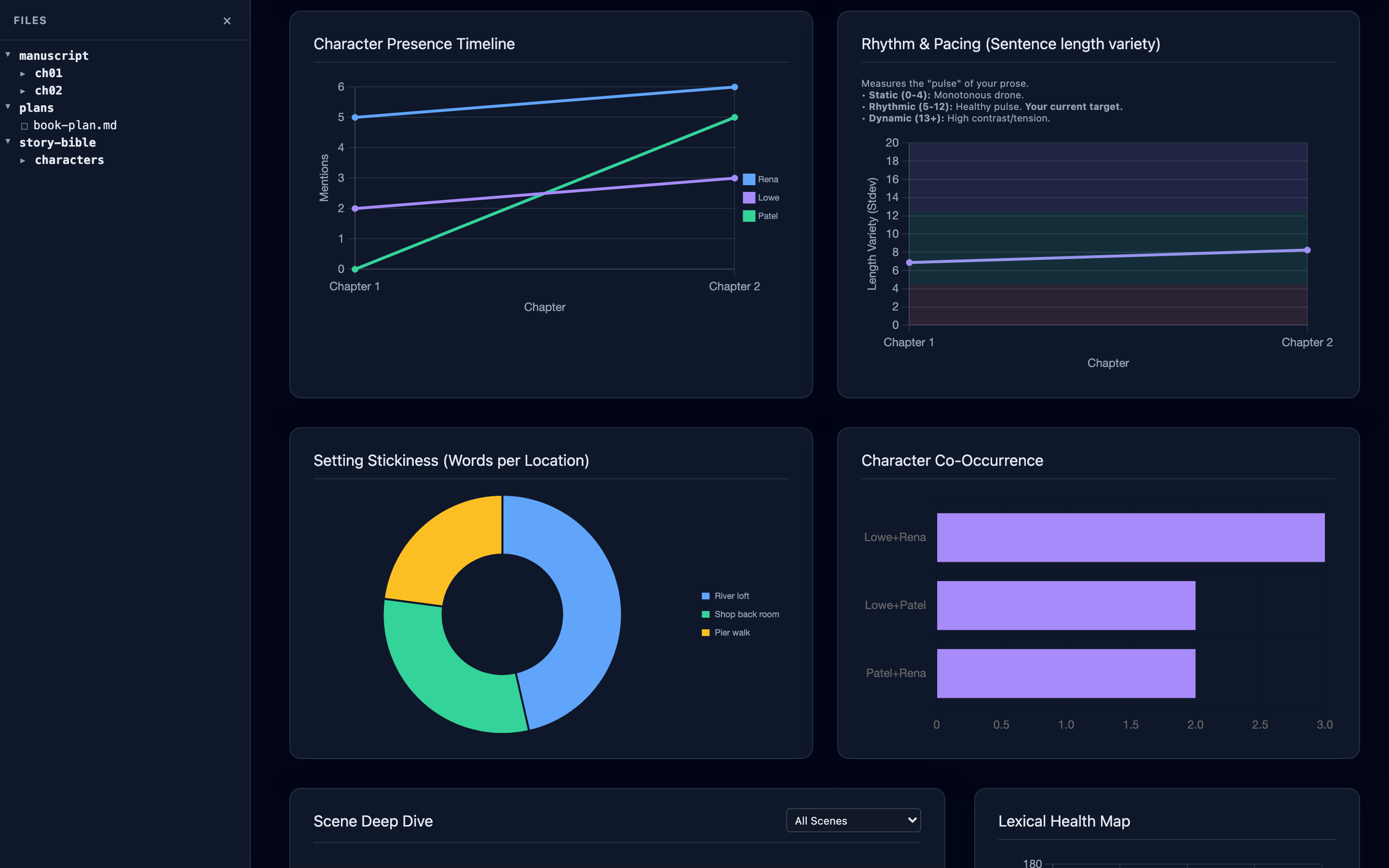
Screenshots use the bundled
fixtures/demo-repo(four scenes), so the charts are deliberately small. Your book fills them in.
✨ What you get
- 📊 Dashboard. Word count, chapter pacing, lexical health (MATTR / MTLD), sentence-rhythm variance, character presence, location stickiness, character co-occurrence, plus a sortable scene table.
- 📖 Reading view. Open a scene as a typographic page with a real reader font. The dashboard chrome gets out of the way.
- ✏️ WYSIWYG editor. ProseMirror-backed. Same surface as the reading
view, just with
Edittoggled on. Mod-S saves. Conflict guard checks the file mtime so a concurrent change in your editor never gets silently overwritten. - 🎨 Editorial highlights. Toggle nine prose passes on top of any scene: repetition, passive voice, filter verbs, crutch words, hyperbole, lyrical reach, sensory density, comedy beats, first-person rate. Each pass is a single click.
- 🗒️ Inline TODOs and Notes. Select a passage, drop a
TODOor a taggedNOTE(continuity / character / theme / question), and it lands in the file as a Markdown comment. Survives in git. - 🕰️ Timeline. The shape of the book, your storylines as lanes, and
reading order against the order events happen — so a scene read far from
where it happens is visible instead of inferred. Reads optional
thread:andday:frontmatter; each view hides itself when its field is absent. - 🔎 Repository search.
Mod-Kfrom anywhere. File paths, scene metadata, TODOs, notes, and prose, grouped by kind. Opening a result reveals it in the sidebar. - 📦 EPUB export.
proseview exportcompiles your scenes into a book, in the same order the dashboard counts them. Needspandocinstalled; nothing else does. - 🔁 Live reload. Save a file in your editor and the dashboard picks up the change over Server-Sent Events. No manual refresh.
- 🔗 Deep links. Every scene and file has a URL. Copy the address bar to share or revisit a view. Back / forward work.
- 🎨 Themes and fonts. Light, Dark, Docsify, Hopscotch. Reader, Literary, Inter, Georgia, Baskerville, Sans, Mono.
- 🧪 Tested. 400 tests: unit coverage of the analytics engine, scene parsing, save guards, history, and refresh behavior, plus end-to-end tiers that boot the real server and drive the real UI in a browser.
🤖 And AI, if you want it
Entirely optional, and it never runs on its own. Proseview has no model of its own and no API key of yours — it drives the agent CLIs already installed on your machine, under your login.
Select a passage and send it to Codex, Claude, or Gemini; open a document-aware Discuss conversation beside a scene; or use the built-in terminal (a real PTY) for anything else. Details below.
If you want none of this, ignore it. Everything above works without an agent installed.
🚀 Quick start
Requirements: Python 3.11+ on macOS or Linux. The server uses Unix-only
APIs (fcntl, and a real PTY for the terminal), so Windows needs WSL.
git clone https://github.com/ourarash/proseview.git
cd proseview
pip install -r requirements.txt

# Run the dashboard against your novel repo
python -m proseview --root /path/to/your/novel
A browser tab will open at http://localhost:7842. Press Ctrl-C to stop.
If you'd rather install proseview as a tool:
pip install -e .
proseview --root /path/to/your/novel
📁 What proseview expects
A Proseview scene is a lowercase .md file exactly one folder below the
configured manuscript directory. The default layout is:
my-novel/
├── manuscript/
│   ├── ch01/
│   │   ├── 01-opening.md
│   │   └── 02-meeting.md
│   └── ch02/
│       └── 01-aftermath.md
└── .proseview.yaml          # optional
Chapter folder names are up to you; folders and files are read in name order.
Root-level manuscript files, deeper nested files, README.md, and other
extensions such as .markdown are not indexed as scenes. You can change the
manuscript folder with manuscript_path, but the one-folder-deep scene layout
still applies. Git is optional for the core dashboard, but revision history,
goals, streaks, and recent changes require the root to be a Git worktree.
Scene files use simple frontmatter:
---
title: Opening
chapter: Chapter 1
status: draft
where: A bar in the West Village
when: Friday night, late
pov: Nima
characters:
  - Nima
  - Mira
goal: Nima needs to get the question on the table
conflict: He's afraid she already has someone
outcome: She agrees to dinner; he leaves rattled
todos:
  - Tighten the opening paragraph
---

# Opening

The bar was loud and the music was bad...
Every field is optional. Proseview reads what's there and falls back gracefully on what isn't. Frontmatter supports simple scalar values and block lists like the examples above; inline YAML lists are not interpreted as lists.
📝 Frontmatter contract
These are the keys proseview recognizes. Any other keys are passed through and ignored. Every field is optional.
Identity
title(string) header of the scene viewer; defaults to a Title-Case version of the filename stem.chapter(string) "Chapter" column in the scene table and the chapter rows of charts; defaults to the chapter folder name.status(string) color-coded status badge. Conventional values:draft,revision,done. Anything else renders as a generic chip; missing meansunknown.
Scene context
where(string) "Where" row in the scene card. Also feeds the Setting Stickiness chart (Words per Location).location(string) synonym forwhere(older convention).when(string) "When" row in the scene card. Free-form.pov(string) "POV" row in the scene card. Free-form.characters(list of strings) "Characters" row in the scene card; each name is clickable to open the bio if<characters_path>/<name>.mdexists. Also feeds the Character Presence and Co-occurrence charts.
Arc
goal(string) "Goal" row in the arc panel.conflict(string) "Conflict" row in the arc panel.outcome(string) "Outcome" row in the arc panel.
Story layer (optional)
thread(string) the storyline a scene belongs to —present,1943, whatever you call them. Scenes sharing a value share a lane in the Timeline tab. Up to eight threads render; the rest fold intoother.day(number) where the scene sits in story time. Counting up and counting down both work — Proseview detects the direction rather than assuming it. Scenes sharing a day keep their reading order.day: "Day 93"is read as93.
Both are optional and independent. With neither, the Timeline still shows the
shape of the book; with only thread, the lanes appear; with day on two or
more scenes, reading order can be compared with story order.
Tasks
todos(list of strings) each entry shows up as a frontmatter-level TODO in the Tasks panel. Inline<!-- TODO: ... -->comments inside the prose are picked up too and get a line anchor.
A scene with no frontmatter still renders, just with Unknown /
Not defined placeholders in the scene card and the file's stem as
its title.
📦 Export
proseview export --root /path/to/your/novel --author "Your Name"
# → output/your-novel.epub
Scenes are compiled in the same order the dashboard counts them: chapters become top-level sections, scenes become sub-sections, and pandoc builds the table of contents from that structure. Titles and chapters use frontmatter where present and fall back to the filename and folder, exactly as the scene table does.
Appendices
Append other folders after the manuscript — planning notes, an outline, a story bible — one appendix per folder, in the order you name them:
proseview export --list-appendix-folders     # what can I append?
proseview export --appendix plans --appendix outline
Each folder contributes the Markdown files sitting directly inside it. Nested
directories are left out, so an archive like plans/done/ stays out of the
book, and README.md is skipped. Appendix headings are pushed below the
table-of-contents depth so they do not compete with your chapters.
Options: --output, --title, --author, --language, --epub-version
(epub3 / epub2), --cover-image, repeatable --css, and repeatable
--appendix.
Requires pandoc (brew install pandoc
or apt install pandoc). Only EPUB export needs it; the dashboard runs without
it, and the export command explains how to install it when it is missing.
⚙️ Configuration
proseview works with zero config when your files match the default
manuscript/<chapter>/<scene>.md layout. Drop a .proseview.yaml at the repo
root if you want to customize:
# Where the manuscript lives. Default: manuscript/
manuscript_path: manuscript/

# Where character bios live. Default: story-bible/characters
characters_path: story-bible/characters

# Where AI skill prompts live. Default: skills
skills_path: skills

# Word-count goal for the finished book.
target_words: 80000

# Daily word goal (drives the "days to finish" estimate).
daily_target: 500

# Healthy band for local lexical variety (MATTR).
mattr_band: [0.74, 0.77]

# Healthy band for whole-scene lexical variety (MTLD).
mtld_band: [105, 130]

# Editor URL handler. One of: vscode, cursor, zed, positron, custom.
editor:
  scheme: vscode

# Folders shown in the file tree alongside the manuscript.
repo_tab:
  folders: [plans, continuity, outline, story-bible, docs, templates]

# Which frontmatter keys the Timeline reads. Defaults shown; point them at
# your own convention instead of renaming fields across the manuscript.
story:
  thread_field: thread
  day_field: day
Every key has a sensible default. Missing optional folders are skipped, but the configured manuscript directory is required.
🧠 The analytics
Lexical health is real, not vibes:
- 📐 MATTR (moving-average type-token ratio, window 100). Measures local vocabulary variety. Low = the same words inside a paragraph; high = constant rotation that may feel jittery.
- 📐 MTLD (measure of textual lexical diversity). Measures whole-scene variety. Low = the scene keeps circling the same ground; high = the scene keeps reaching.
- 📐 Sentence rhythm. Per-chapter standard deviation of sentence length. Static / Rhythmic / Dynamic zones are annotated on the chart.
- 📐 Dialogue percentage, passive voice rate, crutch-word rate, first-person density, sensory density, filter-verb rate, paragraph length.
Every scene gets a row in the deep-dive table; outliers get listed under Editorial Alerts with a one-line revision signal.
🤝 Working with AI
Four places where AI shows up, all opt-in:
-
Selection menu. Highlight any text in a scene. The pill that appears includes
Add TODO,Add Note, and (if the corresponding tools are installed locally)Run in CodexandSkills. Skills are reusable prompts you keep inskills/<name>/SKILL.md; they show up automatically in the menu. -
Agent menu. From the scene header, launch a conversation with Codex, Claude, or Gemini scoped to that file. The conversation runs in the in-browser terminal so you can keep reading the prose underneath while the agent works.
-
Discuss. Choose
Discussin a scene or text-file header for a document-aware conversation in the side dock. The document you are reading is attached to each question by default — drop its chip to omit it, or press@to attach other files and folders. Tool and file actions wait on approvals you can see.Discuss also has evidence-first continuity actions. Trace a canon change scans the configured manuscript and repository-tab folders, separates direct contradictions from ambiguous and likely intentional references, and cites the exact file, line, and passage for every finding. Nothing is edited during the scan. You can preserve an intentional exception, send one scene finding at a time through the existing proposal review, then rescan to verify the result. Check this scene's continuity runs the same guarded workflow with the active document as its focus.
Repository continuity scans are bounded to 200 supported text files, 4 MB of context, and 50 displayed findings. The impact report shows the actual files and bytes scanned, and warns when the finding limit is reached. These impact reports and their decisions are session-only in the current MVP.
Under the hood it starts a local
codex app-serveron demand and uses your existing Codex login, model, and history. Proseview stores a bounded list of thread IDs and display metadata for each document in your state directory, and discards raw reasoning — only Codex's own progress summaries reach the browser.Historylets you reopen, rename, export, or remove a previous conversation.New conversationstarts a blank discussion while keeping the previous one available there. -
TODOs as Markdown. Every TODO and Note is a plain
<!-- TODO: ... -->or<!-- NOTE[tag]: ... -->comment in the scene file. Your AI assistant can see them through the file, your repo can track them through git, and you can grep them.
🛣️ Roadmap
This is alpha. Things that are working and things that are coming:
- ✅ Live server, live reload, ProseMirror editor, highlights, TODOs, notes, deep links, in-browser terminal, agent menu, and document-aware Discuss conversations with Codex.
- ✅ Vendored front-end dependencies. chart.js, marked, xterm and
friends ship with the package and load from
/vendor/. ProseMirror modules are pinned to specific versions on esm.sh. - ✅ Modularized front-end. The JS lives in twelve topical files under
templates/assets/js/, concatenated at render time. - ✅
proseview initwrites a starter.proseview.yamlso a fresh novel repo gets a working configuration with one command. - ✅ Persisted UI prefs. Your highlight-pass toggles and theme choices survive scene navigation and reloads.
- ✅ AI proposal review. Suggested selection edits show the original and proposed text with explicit accept, reject, undo, and save steps.
- 🚧 Configurable agent list (Codex / Claude / Gemini are presets today).
- ✅ Evidence-first continuity and canon refactoring in Discuss, with cited impact reports, intentional exceptions, proposal handoff, and verification.
- 🚧 Frontmatter editor (status, where, todos) inside the scene viewer so you don't need to drop into your text editor for routine fields.
See plans/roadmap.md for the full punch list.
🧪 Development
pip install -e ".[dev]"
pytest
That runs the unit suite plus an HTTP end-to-end tier that boots a real
proseview subprocess and drives every endpoint — saves and the conflict
guard, TODOs and notes, the AI proposal bridge through the actual CLI, live
reload over SSE, and PTY terminals — asserting on bytes written to disk.
Discuss integration tests use a deterministic fake app-server and isolated
home/state directories; they never contact Codex, the network, or your profile.
~15 seconds, no extra dependencies.
A browser tier drives the real UI in Chromium (editor round-trip fidelity, the selection menu, highlight passes, deep links, agents, terminals, Discuss streaming/approvals/shared-dock behavior, and applying an AI proposal end to end). It's opt-in:
pip install -e ".[e2e]"
python -m playwright install chromium
pytest -m e2e_browser
Both tiers work on a throwaway copy of fixtures/demo-repo. See
CONTRIBUTING.md for details.
📜 License
MIT. See LICENSE.
1 maintainer

Download files
Download the file for your platform. If you're not sure which to choose, learn more about installing packages.
Source Distribution
Built Distribution
Filter files by name, interpreter, ABI, and platform.
If you're not sure about the file name format, learn more about wheel file names.
Copy a direct link to the current filters
File details
Details for the file proseview-0.1.2.tar.gz.
File metadata
- Download URL: proseview-0.1.2.tar.gz
- Upload date:
- Size: 430.6 kB
- Tags: Source
- Uploaded using Trusted Publishing? Yes
- Uploaded via: twine/7.0.0 CPython/3.13.14
File hashes
| Algorithm | Hash digest | |
|---|---|---|
| SHA256 |
8332a1b98c8272173740b2daac7139d402ff3ffb7e1a5f2f67a2d54214400fe7
|
|
| MD5 |
b9b7aaeb37eda3b631dbd99358c4f034
|
|
| BLAKE2b-256 |
9953354e6b7e40ebd77fec70dcfee4002d65ed14589c040b4a12dee0a4b5a05f
|
Provenance
The following attestation bundles were made for proseview-0.1.2.tar.gz:
Publisher:
release.yml on ourarash/proseview
-
Statement:
-
Statement type:
https://in-toto.io/Statement/v1 -
Predicate type:
https://docs.pypi.org/attestations/publish/v1 -
Subject name:
proseview-0.1.2.tar.gz -
Subject digest:
8332a1b98c8272173740b2daac7139d402ff3ffb7e1a5f2f67a2d54214400fe7 - Sigstore transparency entry: 2462639079
- Sigstore integration time:
-
Permalink:
ourarash/proseview@bac56360c29f5b64f5d7f1e54f2f081e8808b199 -
Branch / Tag:
refs/tags/v0.1.2 - Owner: https://github.com/ourarash
-
Access:
public
-
Token Issuer:
https://token.actions.githubusercontent.com -
Runner Environment:
github-hosted -
Publication workflow:
release.yml@bac56360c29f5b64f5d7f1e54f2f081e8808b199 -
Trigger Event:
push
-
Statement type:
File details
Details for the file proseview-0.1.2-py3-none-any.whl.
File metadata
- Download URL: proseview-0.1.2-py3-none-any.whl
- Upload date:
- Size: 394.7 kB
- Tags: Python 3
- Uploaded using Trusted Publishing? Yes
- Uploaded via: twine/7.0.0 CPython/3.13.14
File hashes
| Algorithm | Hash digest | |
|---|---|---|
| SHA256 |
16524a0f8481bb2c9ae1b17ece3fb413ca3871e51cc7fbf0c8f72b15a1e16b59
|
|
| MD5 |
453e56f914778e69e7bcef7508a422f7
|
|
| BLAKE2b-256 |
5219ee6c6b506a4568bbbad215a7e9c3a001f2127d21d1f95a04c415ccf128cb
|
Provenance
The following attestation bundles were made for proseview-0.1.2-py3-none-any.whl:
Publisher:
release.yml on ourarash/proseview
-
Statement:
-
Statement type:
https://in-toto.io/Statement/v1 -
Predicate type:
https://docs.pypi.org/attestations/publish/v1 -
Subject name:
proseview-0.1.2-py3-none-any.whl -
Subject digest:
16524a0f8481bb2c9ae1b17ece3fb413ca3871e51cc7fbf0c8f72b15a1e16b59 - Sigstore transparency entry: 2462639190
- Sigstore integration time:
-
Permalink:
ourarash/proseview@bac56360c29f5b64f5d7f1e54f2f081e8808b199 -
Branch / Tag:
refs/tags/v0.1.2 - Owner: https://github.com/ourarash
-
Access:
public
-
Token Issuer:
https://token.actions.githubusercontent.com -
Runner Environment:
github-hosted -
Publication workflow:
release.yml@bac56360c29f5b64f5d7f1e54f2f081e8808b199 -
Trigger Event:
push
-
Statement type:







