
Structure-conditioned protein sequence design using message passing neural networks

Project description
proteinmpnn - A cli adaptation of Kuhlman lab's fork
[!WARNING] This is a work-in-progress.
This repo contains a clean-up of Kuhlman lab's fork of ProteinMPNN, converting
it into an easy-to-use cli.
This modernization includes
- using
uvfor dependency and package management. - using
typerto construct a CLI with plenty of flavor.
Clone this repo and run
uv run proteinmpnn --help
Current features
- Running inference for a single
pdbusingproteinmpnn run-single. Use--helpto get a look into the optional arguments. This is meant to replace the single-protein analyses. - Computing conditional/unconditional probabilities of amino-acids per location. Check
proteinmpnn compute-probs --helpfor more context.
Other improvements on Kuhlman's fork
- The usual two-step sequence with
generate_json.pyand then running it is no longer necessary. - Unit testing using
pytest, as well as backwards compatibility test (making sure that we don't deviate from the original behavior). - Linting using
ruffto make the code more developer-friendly.
Original readme
This repo includes the Kuhlman Lab fork of ProteinMPNN. It includes all the functionality of the original ProteinMPNN repo (linked here), with the following additions:
- Improved input parsing for custom design runs
- Multi-state design support
- Additional utilities to provide integration with EvoPro
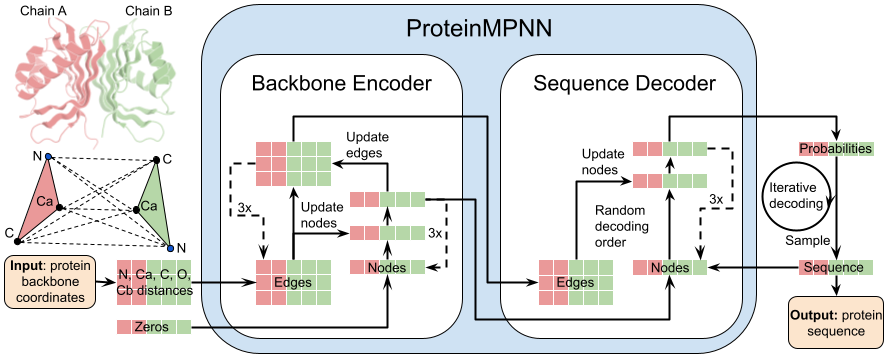
Installation:
git clone git@github.com:Kuhlman-Lab/proteinmpnn.git
cd proteinmpnn
mamba create env -f setup/proteinmpnn.yml
NOTE (July 2025):
ProteinMPNN uses CUDA 11.3, which is too old for the new H100 GPUs (CUDA 11.8+). This means it may hang if run from the default mpnn environment.
To fix this, we can generate a CUDA 12.4 environment as follows:
# Install original env without torch/cuda dependencies
mamba env create -f setup/proteinmpnn_cu12.4.yml -n mpnn_cu12.4

# Install torch/cuda 12.4 dependencies
pip install torch==2.4.0 torchvision==0.19.0 torchaudio==2.4.0 --index-url https://download.pytorch.org/whl/cu124
To use this, simply replace conda activate mpnn with conda activate mpnn_cu2.4 wherever present.
Usage Guidelines:
General Usage
The different input arguments available for each script can be viewed by adding -h to your python call (e.g., python generate_json.py -h).
ProteinMPNN accepts PDB files as input and produces FASTA files as output.
Unlike the original repo, our ProteinMPNN organizes the different input options (aka arguments) into .flag files:
json.flagsis used to specify design constraints, like fixed residues and symmetryproteinmpnn.flagsis used to specify prediction flags, like which sampling temperature and model variant to use.
In general, there are two steps to running ProteinMPNN:
- Run the
generate_json.pyscript and pass it thejson.flagsfile.
- This makes a new file called
proteinmpnn_res_specs.jsoncontaining parsed design information.
- Run the
run_protein_mpnn.pyscript and pass itproteinmpnn.flagsandproteinmpnn_res_specs.jsonto obtain the actual ProteinMPNN prediction.
Useful Flags
Used in json.flags:
--default_design_setting: this is an optional filter to allow/disallow certain residue types during design. By default, it is set to all, which allows all 20 amino acids. Possible settings include:
all-hydphob: exclude hydrophobic residues (CDEHKNPQRSTX)
all-hydphil: exclude hydrophilic residues (ACFGILMPVWYX)
all-CLD: exclude specific amino acids (in this case, Cys, Leu, and Asp)
L+polar: mix-and-match amino acids and categories (in this case, allow all polar amino acids and also Leu)
Used in proteinmpnn.flags:
--model_name: specifies which ProteinMPNN model checkpoint to use. Possible options include:
v_48_002: vanilla (default) model with k=48 neighbors and 0.02A noise
s_48_010: soluble protein model with k=48 neighbors and 0.1A noise
--sampling_temp: specifies the sampling temperature, which changes how diverse the generated sequences will be. Ranges from 0 to 1, inclusive. A temperature of 0 returns the "best" prediction every time (zero diversity), while a temperature of 1 will return completely random samples. Recommended range is 0.0 - 0.3 or so.
--dump_probs: if included, ProteinMPNN will save the predicted sequence probability table for each scaffold. This will be a numpy array of shape [L, 21], for a protein of length L. If multiple sequences are generated per scaffold, probabilities will be averaged before saving. A helper script for visualizing these tables is included at run/helper_scripts/other_tools/view_probs.py.
Example Cases
Example input and expected output files, as well as jobscripts and flag files, for many different design tasks are included in examples/. For a summary and explanation of each example, see examples/EXAMPLES.md. Currently supported protocols include:
- Monomer Design (with user-friendly parsing of designable residues)
- Binder Design
- Oligomer Design (with support for abitrary symmetries in homooligomers)
- Multi-state Design (with support for multiple complex design constraints)
Unit Testing
TODO
Code organization:
run/run_protein_mpnn.py- the main script to initialialize and run the model.run/generate_json.py- function to automatically generate json of design constraints.run/helper_scripts/- helper functions to parse PDBs, assign which chains to design, which residues to fix, adding AA bias, tying residues etc.examples/- simple example inputs/outputs and runscripts for different tasks.model_weights/- trained proteinmpnn model weights.v_48_...- vanilla proteinmpnn models trained at different noise levels.s_48_...- solublempnn models trained at different noise levels.ca_48_...- Ca-only models trained at different noise levels.
License
ProteinMPNN is distributed under an MIT license, which can be found at proteinmpnn/LICENSE. See license file for more details.
Release history Release notifications | RSS feed


Download files
Download the file for your platform. If you're not sure which to choose, learn more about installing packages.
Source Distribution
Built Distribution
Filter files by name, interpreter, ABI, and platform.
If you're not sure about the file name format, learn more about wheel file names.
Copy a direct link to the current filters
File details
Details for the file proteinmpnn_cli-0.1.0.tar.gz.
File metadata
- Download URL: proteinmpnn_cli-0.1.0.tar.gz
- Upload date:
- Size: 69.9 MB
- Tags: Source
- Uploaded using Trusted Publishing? No
- Uploaded via: uv/0.9.26 {"installer":{"name":"uv","version":"0.9.26","subcommand":["publish"]},"python":null,"implementation":{"name":null,"version":null},"distro":{"name":"macOS","version":null,"id":null,"libc":null},"system":{"name":null,"release":null},"cpu":null,"openssl_version":null,"setuptools_version":null,"rustc_version":null,"ci":null}
File hashes
| Algorithm | Hash digest | |
|---|---|---|
| SHA256 |
03ac2884510907f518123d63475565459770ddd3b3df15e840f44d4aeb104c34
|
|
| MD5 |
27df7a938c6ae2ccb6d86ebc8dc163d0
|
|
| BLAKE2b-256 |
0ab3e2d8596f8dc7737ff33d284eb351fc2e6ec095572efa4b4432e05290be51
|
File details
Details for the file proteinmpnn_cli-0.1.0-py3-none-any.whl.
File metadata
- Download URL: proteinmpnn_cli-0.1.0-py3-none-any.whl
- Upload date:
- Size: 70.3 kB
- Tags: Python 3
- Uploaded using Trusted Publishing? No
- Uploaded via: uv/0.9.26 {"installer":{"name":"uv","version":"0.9.26","subcommand":["publish"]},"python":null,"implementation":{"name":null,"version":null},"distro":{"name":"macOS","version":null,"id":null,"libc":null},"system":{"name":null,"release":null},"cpu":null,"openssl_version":null,"setuptools_version":null,"rustc_version":null,"ci":null}
File hashes
| Algorithm | Hash digest | |
|---|---|---|
| SHA256 |
44f3b77523ed3bd93fa296451d366e2fe8379f109742ec6d35b985bab1b3bfac
|
|
| MD5 |
e3388ee72aa447020a87197ce0dc54c8
|
|
| BLAKE2b-256 |
2220ad8d0431eae28ea166a37b35fbfcc81b664ed749f6db251e5a72ce1020d2
|






