

Records, verifies and issues trial records.




























Why
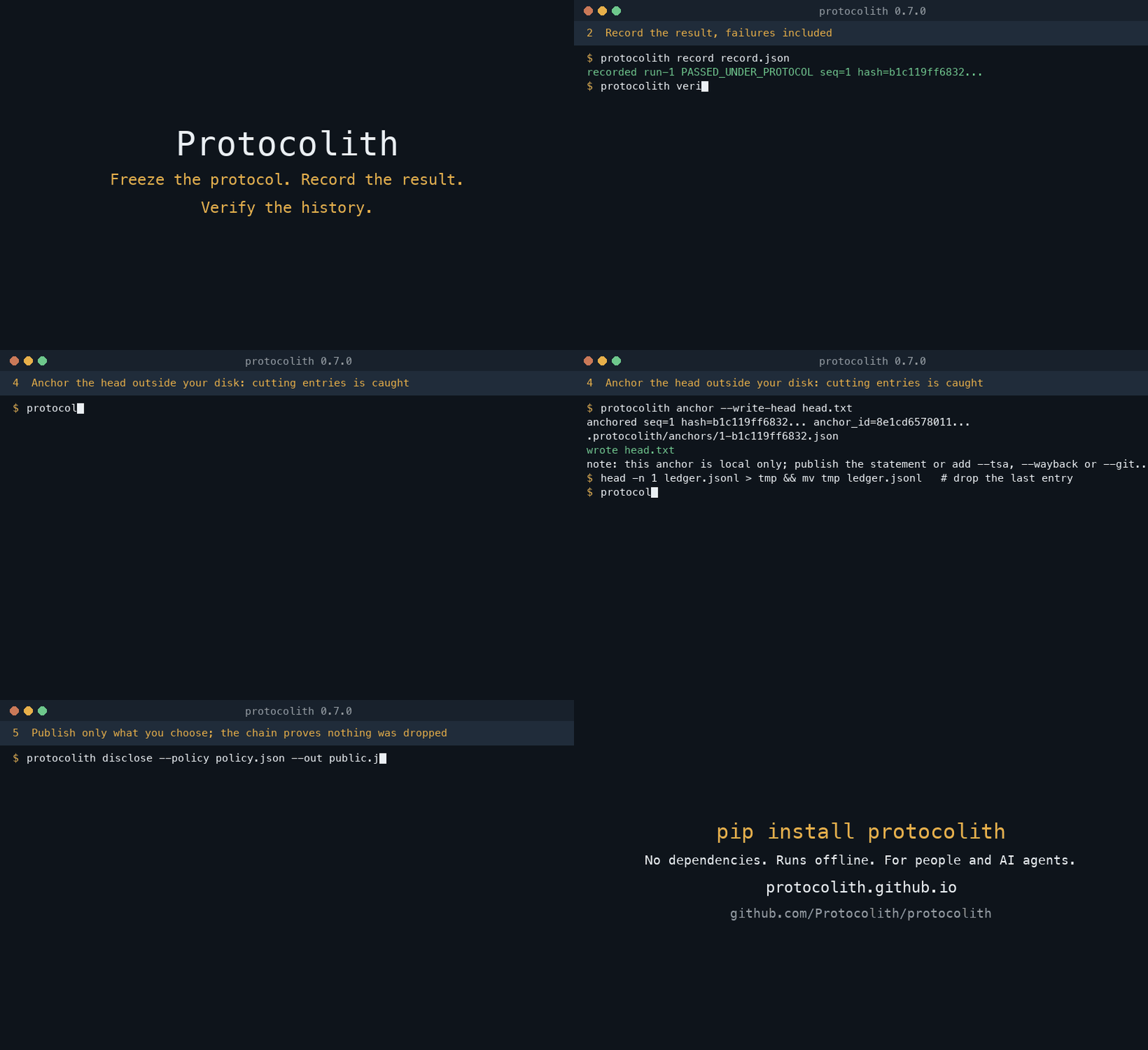
A result is easy to believe and hard to check when the protocol was written after the run, the history can be edited silently, or a failed run quietly disappears. Protocolith keeps a small local record that makes those three things visible: what was fixed beforehand, what happened, and whether the history still adds up.
It does not run experiments, fetch data or judge whether a protocol is a good one. It is a ledger with rules.
What it does
| Stage | Command | What is stored |
|---|---|---|
| 1. Freeze a protocol before the run | protocolith freeze protocol.json |
The protocol and its SHA-256 |
| 2. Record the outcome against that protocol | protocolith record record.json |
Status, outcome, source hashes, claim boundary |
| 3. Verify the hash-chained history | protocolith verify-ledger |
Nothing; it reports rule violations (R1 to R11) |
| 4. Issue a card from a verified record | protocolith issue SEQ |
A JSON and SVG card, plus an issue entry |
| 6. Disclose a view of the ledger | protocolith disclose --policy FILE |
A public file: each entry in full, as a summary, or hidden |
| 5. Anchor the head outside your disk | protocolith anchor |
An anchor statement; optional git tag, Wayback or RFC 3161 time-stamp |
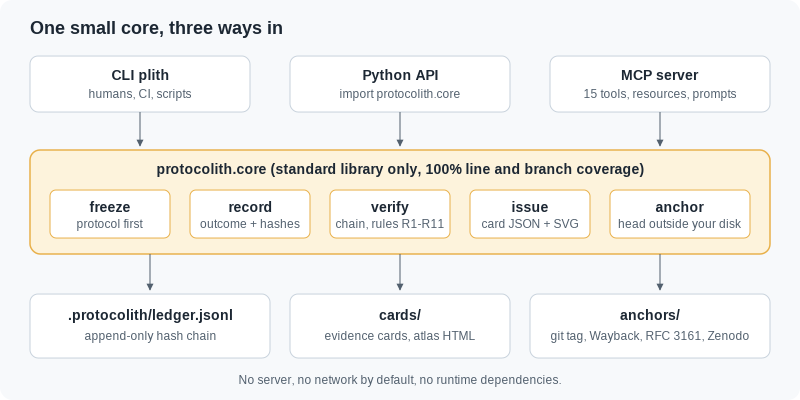
Everything lives in one append-only file, .protocolith/ledger.jsonl, one canonical JSON line per entry.
Each line contains the hash of the line before it. The core uses only the Python standard library.
Quickstart (2 minutes)
You need the repository checkout with its environment active (see Install). The example files are in
examples/quickstart/: protocol.json, record.json and the source results.txt.
source .venv/bin/activate          # Windows: .venv\Scripts\activate
mkdir demo && cd demo
cp ../examples/quickstart/protocol.json ../examples/quickstart/record.json ../examples/quickstart/results.txt .
protocolith freeze protocol.json
protocolith record record.json
protocolith verify-ledger
protocolith issue 1
protocolith log
protocolith head
Real output of one run (hashes and times differ in yours, because the entries contain the time):
$ protocolith freeze protocol.json
frozen QUICKSTART_D001 1 seq=0 hash=5bbd5c8c75437c20d77415469374ac990993803c1c9deed91ff6adf2f74714b2 protocol_sha256=802a1675aef8623a44d79272ca50c036ffc7c2d2ecd267ca440afdb19948369f
$ protocolith record record.json
recorded run-1 PASSED_UNDER_PROTOCOL seq=1 hash=...
$ protocolith verify-ledger
OK entries=2 head seq=1 hash=...
$ protocolith issue 1
issued record seq=1 card_sha256=...
.protocolith/cards/PLITH-QUICKSTART_D001-<date>-000001.json
.protocolith/cards/PLITH-QUICKSTART_D001-<date>-000001.svg
$ protocolith log
0 freeze <time> 5bbd5c8c7543 QUICKSTART_D001 1
1 record <time> e6fdb7f2c7f6 run-1 PASSED_UNDER_PROTOCOL
2 issue <time> 7e991c8d63f3 record_seq=1
$ protocolith head
seq=2 hash=7e991c8d63f3f661894015c450b41cdb3809af305af4f562f8224466314eecd7
The protocol_sha256 printed by freeze is already written into record.json; a record that names a hash
that was not frozen earlier is rejected (UNKNOWN_PROTOCOL). To see verification fail, change one character in
.protocolith/ledger.jsonl and run protocolith verify-ledger again: it prints the violated rules and exits with 1.
Exit codes: 0 ok, 1 the stored ledger does not verify, 2 the operation was rejected and nothing was written,
3 I/O or environment error. --json prints canonical JSON for every command. These steps are run by
tests/test_readme_examples.py.
Query the ledger
protocolith summary                  # what was done and which results are honest, in one call
protocolith log --status BLOCKED_SOURCE
protocolith show 1
Python API
from pathlib import Path

from protocolith import core

store = core.Store(".protocolith")
core.freeze(store, core.decode(Path("protocol.json").read_bytes()))
core.record(store, core.decode(Path("record.json").read_bytes()))

verdict = core.verify(store)
print(verdict.ok, verdict.count)          # True 2

result = core.issue(store, 1)
print(result["json_path"])
print(core.head(store))                   # {'count': 3, 'hash': '...', 'seq': 2}
Errors are exceptions with a stable code (core.InputError, core.EnvError, core.VerificationFailed).
See the Python API guide.
Atlas: browse the experiments
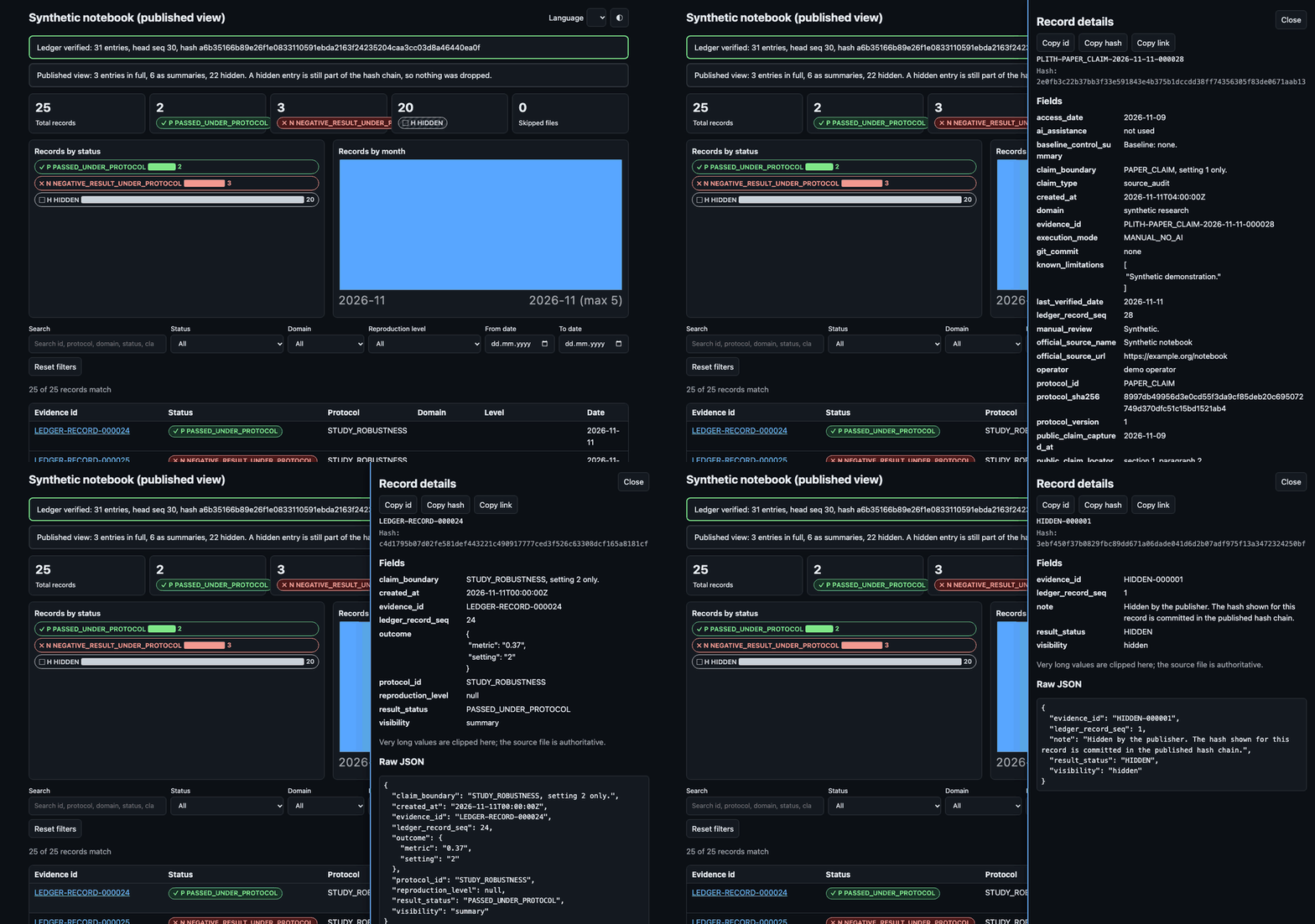
protocolith atlas builds one self-contained HTML page (inline CSS and JavaScript, no network, works from file://)
from the local ledger or a directory of evidence cards: summary tiles, a status chart and monthly timeline, search,
filters, a sortable paged table and a detail drawer with permalinks. Languages other than English come only from
files you supply. See the atlas guide.
protocolith atlas --out atlas.html            # the local ledger
protocolith atlas --cards docs/evidence_cards --out site/
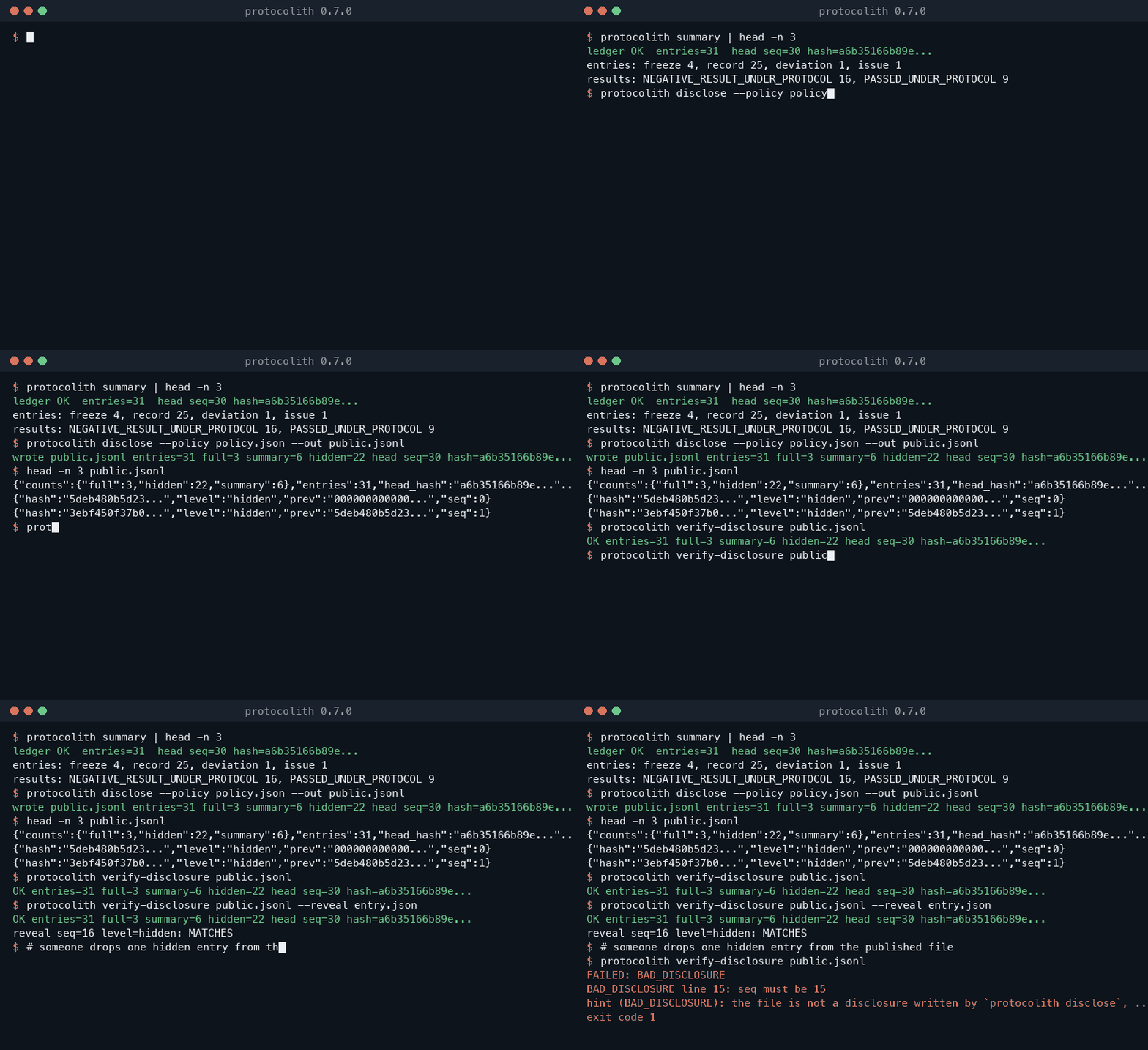
Publish what you choose: full, summary or hidden
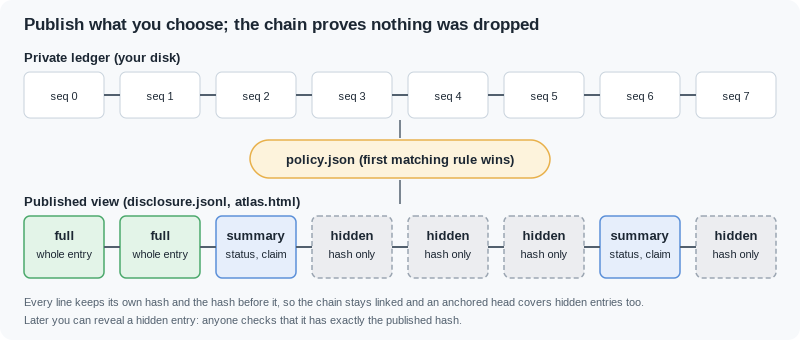
A researcher may keep thousands of entries and publish a few. protocolith disclose --policy policy.json writes a view of the
ledger in which each entry is shown in full, as a summary or hidden (only its place and hash). The chain stays intact,
so a reader sees how many entries exist and that none was dropped; the owner can reveal a hidden entry later and anyone checks it.
protocolith atlas --policy policy.json builds the matching browsable page. See the
guide and the example.
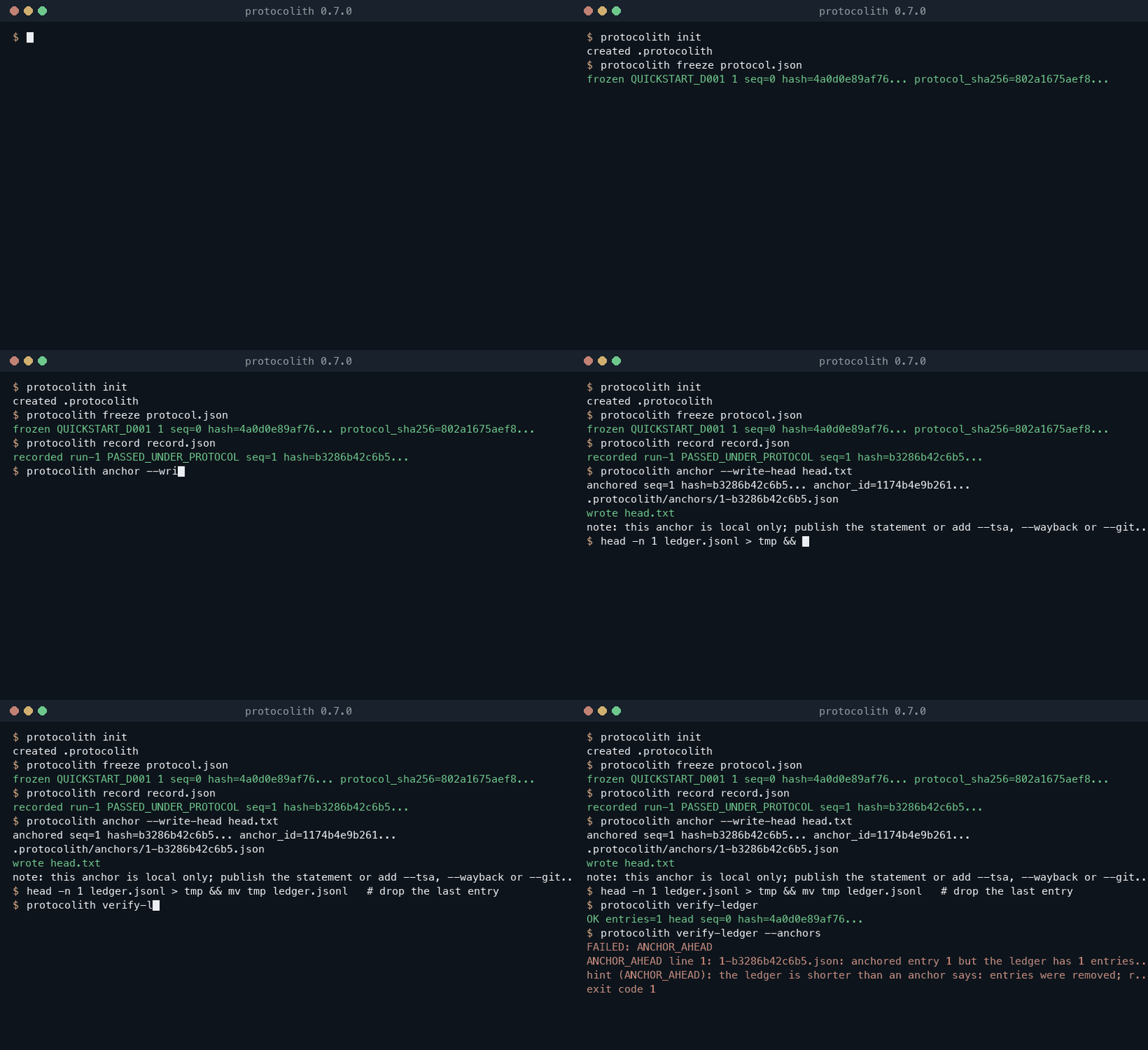
Anchor the head, and catch a cut-off ledger
A ledger is a file its owner writes, so plain verification cannot notice that the last entries were removed. An anchor puts the
head somewhere you cannot edit alone; verify-ledger --anchors then catches a rewrite (ANCHOR_MISMATCH) or a truncation
(ANCHOR_AHEAD). One 32-byte head covers every earlier entry, so ten thousand experiments need one anchor, not ten thousand
uploads. Details: anchor your results.
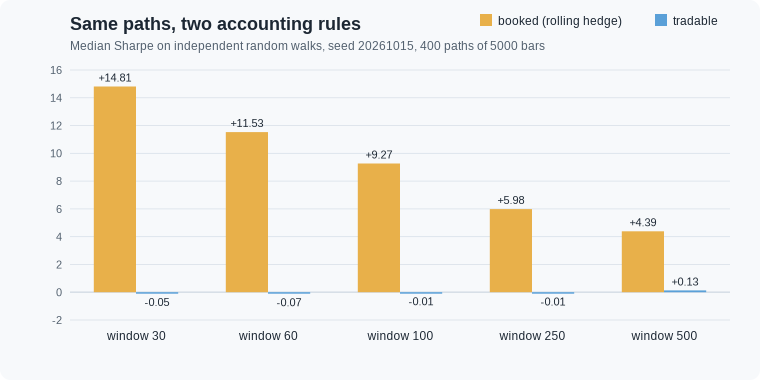
Example: a published study as a record
examples/phantom_mean_reversion/ holds a simulation study (rolling hedge ratios make a spread
backtest look profitable on random walks) as a frozen protocol, two anchors and a card. python3 reproduce.py re-runs it in
about five seconds and compares the output with the committed results (identical bytes here, equal to within rounding on other platforms). It is a retrospective record, and its
README says what that does and does not prove.
MCP client configuration
protocolith mcp is a stdio server with fifteen tools (protocolith_summary, protocolith_log, protocolith_show,
protocolith_schema, protocolith_capture, protocolith_atlas, protocolith_claim_check, protocolith_anchor, protocolith_disclose, protocolith_verify_disclosure, protocolith_freeze, protocolith_record,
protocolith_deviation, protocolith_verify, protocolith_issue) read-only resources (protocolith://summary, protocolith://ledger,
protocolith://schema/<name>) and the prompt research-agent-protocol, so an agent can discover the formats and the rules
itself; protocolith_claim_check tells it what it may and may not say about a result. It uses the network only when
protocolith_anchor is given a time-stamp URL, and writes only inside the store, apart from the atlas page and the disclosure file that protocolith_atlas and protocolith_disclose write inside the working directory. Add it to an MCP client:
{
  "mcpServers": {
    "protocolith": {
      "command": "protocolith",
      "args": ["mcp", "--store", "/path/to/project/.protocolith"]
    }
  }
}
See Use Protocolith from an AI agent and the MCP reference.
Install
From source today (Python 3.11 to 3.15; uv recommended):
git clone https://github.com/protocolith/protocolith.git
cd protocolith
uv sync
uv run protocolith --version      # or: source .venv/bin/activate
pip install protocolith installs the current release from PyPI (since 0.6.0).
The package has no required dependencies.
Platforms
macOS, Linux and Windows, Python 3.11 to 3.15, headless (no display, no network, no daemon). Appends are
protected by an advisory file lock (fcntl on POSIX, msvcrt on Windows) and are flushed with fsync.
Commands
| Command | Purpose |
|---|---|
freeze FILE [--supersedes SHA256] |
Freeze a protocol (a new version supersedes the old one) |
record FILE |
Record a run outcome |
deviation FILE |
Record a deviation from a frozen protocol |
verify-ledger [--expect-head SEQ:HASH] |
Check rules R1 to R11, and optionally an anchored head |
issue SEQ [--out DIR] |
Issue the card of a record |
summary [--protocol ID] |
Verdict, head, counts and a per-protocol table in one call |
log [--protocol ID] [--type T] [--status S] [--tail N] / head |
List (filtered) entries / print the last seq and hash |
show SEQ |
One entry with its protocol context |
capture [--file PATH ...] [--env] |
JSON fragment with environment and input file hashes for a record outcome |
schema [NAME] |
JSON Schema of the input bodies and the entry |
init |
Create an empty store (safe to repeat) |
repair --truncate-partial-tail |
Remove a partial last line left by a crash |
mcp |
Run the MCP server on stdio |
All take --store DIR (or PROTOCOLITH_STORE; default .protocolith) and, except mcp, --json. The alias
plith runs the same program. Full list, including the older card commands: docs/CLI.md.
Documentation
- Documentation site: https://protocolith.github.io/protocolith/docs/ (source in docs/, map in docs/docs-map.md)
- Getting started and concepts
- Core specification and conformance vectors
- Error codes, FAQ, roadmap, changelog
What Protocolith does not prove
- Internal consistency and ordering only. A valid ledger shows that every entry follows the rules and that no entry was changed or reordered without breaking the chain.
- No wall-clock proof. Timestamps are written by the machine that appends; the ledger only guarantees they never decrease. It does not show that an entry was made at the time it states.
- No protection against replacing a whole ledger. Someone who can rewrite the file can write a new, valid
one, or cut off its end. Publish or anchor the output of
protocolith headsomewhere you do not control alone (for example a signed git tag), then check against it withprotocolith verify-ledger --expect-head SEQ:HASH. See anchoring the head.protocolith anchorautomates this (a local anchor file, and optionally an RFC 3161 time-stamp, a Wayback snapshot or a git tag), andverify-ledger --anchorsdetects a rewritten or truncated ledger: see anchor your results. - It does not show that a protocol is sound, that data is true, or that a result generalises.
Earlier name and unrelated works
The project was published as ClaimBound Evidence until 0.5.0 and was renamed because unrelated works use a similar name. It is not a fork of or affiliated with them, and it makes no claim of priority. See RELATED_WORK_AND_INDEPENDENCE.md.
Contributing, security, license
- CONTRIBUTING.md, DCO.md, GOVERNANCE.md, AGENTS.md
- Report vulnerabilities as described in SECURITY.md; do not open a public issue for them. Questions: SUPPORT.md.
- Apache-2.0.
1 maintainer

Metadata
1 maintainer
Release files for protocolith 0.7.0
For a detailed explanation of source distributions (sdists) and built distributions (wheels), please see the package formats documentation.
Source distribution (sdist)
| File | Size | Uploaded | Provenance | Actions |
|---|---|---|---|---|
| protocolith-0.7.0.tar.gz | 151.5 kB | With provenance | Details for protocolith-0.7.0.tar.gz |
Built distribution (wheel)
| File | Interpreter | ABI | Platform | Actions Reset |
|---|---|---|---|---|
| protocolith-0.7.0-py3-none-any.whl | Python 3 | none | any | Details for protocolith-0.7.0-py3-none-any.whl |
Total release size: 320.0 kB
Release files / protocolith-0.7.0.tar.gz
| Download URL | protocolith-0.7.0.tar.gz |
|---|---|
| Size | 151.5 kB |
| Tags | Source |
|
SHA-256 checksum How to use checksums |
6302248d520f576eabef074d4dc484f920e9c8939345c267a2376d690a630c7a
|
|
BLAKE2b-256 checksum How to use checksums |
dd93325e2f224cc1abfde658bcbe23d5042cdace8cfa8a39ac6ee3bf99456c76
|
| Upload date | |
|
Uploaded using Trusted Publishing? What is trusted publishing? |
Yes |
| Uploaded via |
twine/7.0.0 CPython/3.13.16
|
Provenance
Provenance describes where a file came from. On PyPI, provenance is shared via attestations, which provide a verifiable record of the build or publishing details. View details, limitations and caveats.


PyPI Publish Attestation
PyPI verified that this artifact, at this checksum, originated from the publisher listed below.
Signed by GitHub Actions, verified by PyPI on Nov 18, 2026.
Transparency logRelease files / protocolith-0.7.0-py3-none-any.whl
| Download URL | protocolith-0.7.0-py3-none-any.whl |
|---|---|
| Size | 168.5 kB |
| Tags | Python 3 |
|
SHA-256 checksum How to use checksums |
b949f6eca44813426189c360c545b672aec009f72af2a9ad83b30049f1508d32
|
|
BLAKE2b-256 checksum How to use checksums |
b37fb86fd31b6e4a4badd7ab6504c21017b4a5655c925fc1a13da809e2cbdbe4
|
| Upload date | |
|
Uploaded using Trusted Publishing? What is trusted publishing? |
Yes |
| Uploaded via |
twine/7.0.0 CPython/3.13.16
|
Provenance
Provenance describes where a file came from. On PyPI, provenance is shared via attestations, which provide a verifiable record of the build or publishing details. View details, limitations and caveats.
PyPI Publish Attestation
PyPI verified that this artifact, at this checksum, originated from the publisher listed below.
Signed by GitHub Actions, verified by PyPI on Nov 18, 2026.
Transparency logSecurity for protocolith 0.7.0
Provenance
Provenance describes where a file came from. On PyPI, provenance is shared via attestations, which provide a verifiable record of the build or publishing details. View details, limitations and caveats.
Full provenance
Both files in this release have been uploaded with provenance metadata.
Attestation for protocolith-0.7.0.tar.gz
PyPI Publish Attestation
PyPI verified that this artifact, at this checksum, originated from the publisher listed below.
Signed by GitHub Actions, verified by PyPI on Nov 18, 2026.
Transparency logA note on package security
PyPI is a repository for distributing packages, not a service for auditing them. While third-party security researchers and our staff do their best to detect and remove malicious packages, PyPI cannot guarantee the quality, security or suitability of any given package.
To learn more about protecting yourself from malicious actors, visit our package security documentation.














