
PlanetaRY spanGLES: the bright-side of the light-curve of (ringed) exoplanets

Project description
Pryngles
PlanetaRY spaNGLES






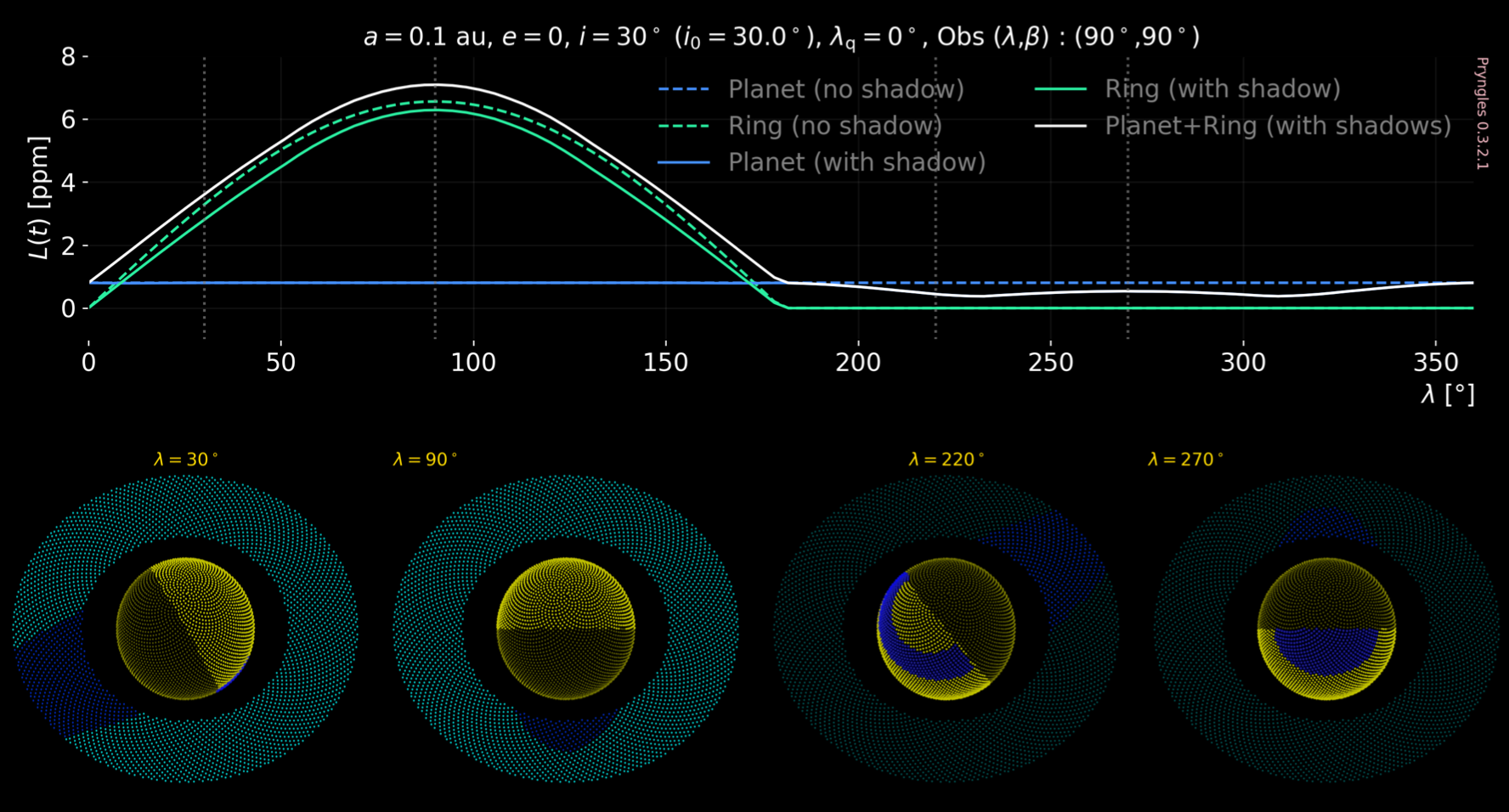
Pryngles is a Python package intended to produce useful
visualizations of the geometric configuration of a ringed exoplanet
(an exoplanet with a ring or exoring for short) and more importantly
to calculate the light-curve signatures produced by this kind of
planets. The model behind the package has been developed in an effort
to predict the signatures that exorings may produce not only in the
light-curve of transiting exoplanets (a problem that has been
extensively studied) but also in the light of stars having
non-transiting exoplanets.
This is an example of what can be done with Pryngles:
For the science behind the model please refer to the following papers:
Zuluaga, J.I., Sucerquia, M. & Alvarado-Montes, J.A. (2022), The bright side of the light curve: a general photometric model for non-transiting exorings, submitted (2022).
Sucerquia, M., Alvarado-Montes, J. A., Zuluaga, J. I., Montesinos, M., & Bayo, A. (2020), Scattered light may reveal the existence of ringed exoplanets. Monthly Notices of the Royal Astronomical Society: Letters, 496(1), L85-L90.
Download and install
pryngles is available in PyPI, https://pypi.org/project/pryngles/.
To install it, just execute:
pip install pryngles
If you prefer, you may download and install from the sources.
Quick start
Import the package and some useful utilities:
import pryngles as pr
from pryngles import Consts
Any calculation in Pryngles starts by creating a planetary system:
sys=pr.System()
Then we add objects to the planetary system using:
sys=pr.System()
S=sys.add(kind="Star",
          physics=dict(radius=Consts.rsun/sys.ul),
          optics=dict(limb_coeffs=[0.65])
         )
P=sys.add(kind="Planet",primary=S,
          orbit=dict(a=0.2,e=0.0),
          physics=dict(radius=Consts.rsaturn/sys.ul)
         )
R=sys.add(kind="Ring",primary=P,
          physics=dict(fi=1.5,fe=2.5,i=30*Consts.deg)
         )
O=sys.add(kind="Observer",
          optics=dict(lamb=90*Consts.deg,beta=90*Consts.deg)
         )
In the example before the planet has a ring extending from 1.5 to 2.5 planetary radius which is inclined 30 degrees with respect to the orbital plane. It has an orbit with semimajor axis of 0.2 and eccentricity 0.0.
Once the system is set we can ensamble a simulation, ie. creating an object able to produce a light-curve.
RP=sys.ensamble_system()
To see how the surface of the planet and the rings looks like run:
RP.plotRingedPlanet()
You may change the position of the star in the orbit and see how the appearance of the planet changes:
RP.changeStellarPosition(45*Consts.deg)
RP.plotRingedPlanet()
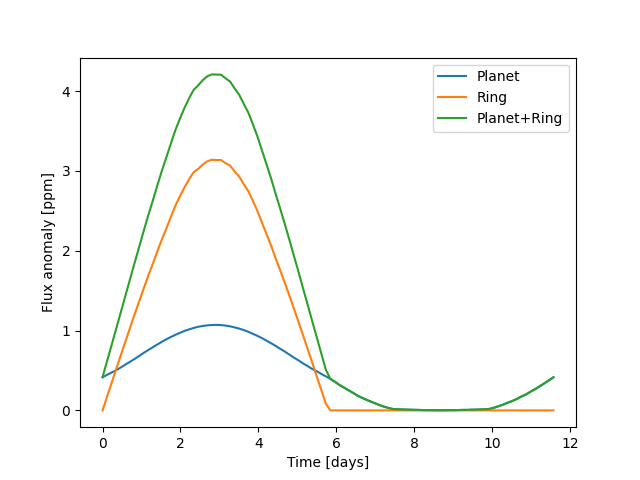
Below is the sequence of commands to produce your first light curve:
import numpy as np
RP.changeObserver([90*Consts.deg,30*Consts.deg])
lambs=np.linspace(+0.0*Consts.deg,+360*Consts.deg,100)
Rps=[]
Rrs=[]
ts=[]
for lamb in lambs:
    RP.changeStellarPosition(lamb)
    ts+=[RP.t*sys.ut/Consts.day]
    RP.updateOpticalFactors()
    RP.updateDiffuseReflection()
    Rps+=[RP.Rip.sum()]
    Rrs+=[RP.Rir.sum()]

ts=np.array(ts)
Rps=np.array(Rps)
Rrs=np.array(Rrs)

#Plot
import matplotlib.pyplot as plt
fig=plt.figure()
ax=fig.gca()
ax.plot(ts,Consts.ppm*Rps,label="Planet")
ax.plot(ts,Consts.ppm*Rrs,label="Ring")
ax.plot(ts,Consts.ppm*(Rps+Rrs),label="Planet+Ring")

ax.set_xlabel("Time [days]")
ax.set_ylabel("Flux anomaly [ppm]")
ax.legend();
And voilà!
Let's have some Pryngles.
Tutorials
We have prepared several Jupyter tutorials to guide you in the usage
of the package. The tutorials evolve as the package is being optimized.
- Quickstart. In this tutorial you will learn the basics about the package. Download, Google Colab.
Disclaimer
This is the disco version of Pryngles. We are improving the resolution and performance of the software for future releases.
What's new
-
0.5.x versions:
-
Preview method plotRingedPlanet modified to work under Google Colab.
-
Physical and astronomical constants included.
-
A new tutorial was included.
-
A major update in the classes to create and populate planetary system.
-
-
0.4.x versions:
- A new model to create and populate planetary system has been implemented.
-
0.3.x versions:
- A water mark with version number included.
- Version is now available in the version variable.
- Scattering formulae tested and verified.
- Package has been compared against similar packages (good agreement) but disclaimer has been done.
- New version number scheme: 0.x.y (x-major, y-minor release), 0.x.y.z (z test version).
- Major corrections in diffuse formulae.
-
0.2.1.x versions:
- Tutorial is now working in Google Colab.
- References were corrected.
- The home url was set as the PyPI web page.
- Non-linear (4th order) limb darkening included.
- Added the class
Extra. - Function to draw logo:
drawPryngles. - Added function
prynglesMark. - Now
__version__variable is available.
-
0.2.0.x versions:
- First official version of the package.
This package has been designed and written originally by Jorge I. Zuluaga, Mario Sucerquia & Jaime A. Alvarado-Montes (C) 2022
Release history Release notifications | RSS feed


Download files
Download the file for your platform. If you're not sure which to choose, learn more about installing packages.
Source Distribution
Built Distribution
Filter files by name, interpreter, ABI, and platform.
If you're not sure about the file name format, learn more about wheel file names.
Copy a direct link to the current filters
File details
Details for the file pryngles-0.5.2.tar.gz.
File metadata
- Download URL: pryngles-0.5.2.tar.gz
- Upload date:
- Size: 46.6 kB
- Tags: Source
- Uploaded using Trusted Publishing? No
- Uploaded via: twine/4.0.0 CPython/3.9.7
File hashes
| Algorithm | Hash digest | |
|---|---|---|
| SHA256 |
c2846d17837fb4dddace69eecd122fb4932fe5dc441c4619d910d9a6553a2450
|
|
| MD5 |
c0059d6fd5082a670f9804f6e8a30a5b
|
|
| BLAKE2b-256 |
aeb0694498de6336cb9ceb4681e4808750825d44d6c740a4b8a514792fe7645a
|
File details
Details for the file pryngles-0.5.2-py3-none-any.whl.
File metadata
- Download URL: pryngles-0.5.2-py3-none-any.whl
- Upload date:
- Size: 46.6 kB
- Tags: Python 3
- Uploaded using Trusted Publishing? No
- Uploaded via: twine/4.0.0 CPython/3.9.7
File hashes
| Algorithm | Hash digest | |
|---|---|---|
| SHA256 |
b9adf7ae13cf138c7997aa5eee0628895d3550bcec9bf769030dee488880fc4d
|
|
| MD5 |
5ae82e70de98d74a2b81c39b7f98aeb0
|
|
| BLAKE2b-256 |
108de6364aec7a331b498a55eeb16ed5883d1eaf3da731a8d70973dd16065aa3
|






