
Gaze estimation using MPIIGaze and MPIIFaceGaze
Verified details
These details have been verified by PyPIProject links
GitHub Statistics
Maintainers

Project description
A demo program of gaze estimation models (MPIIGaze, MPIIFaceGaze, ETH-XGaze)





This program runs gaze estimation on images and videos. By default, it uses the video from a webcam.


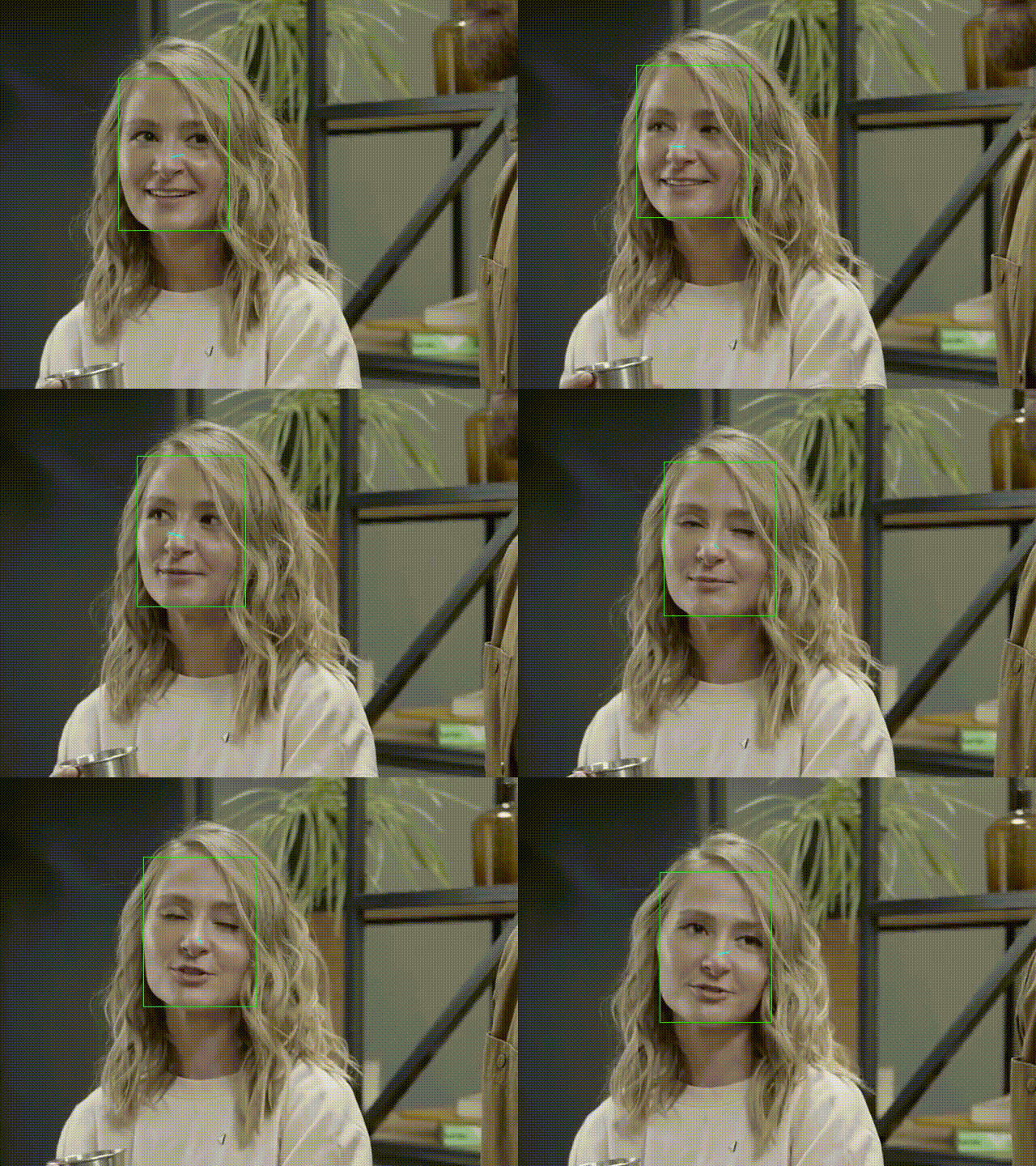

To train models on MPIIGaze and MPIIFaceGaze, use this repository. You can also use this repository to train a model on the ETH-XGaze dataset.
Quick start
This program has only been tested on Ubuntu.
Installation
pip install ptgaze
The default mediapipe face detector downloads its model file (face_landmarker.task) to ~/.ptgaze/mediapipe/ on first run. On Linux, mediapipe requires the GLES system libraries (sudo apt install libgles2 on Ubuntu).
The dlib-based face detectors (--face-detector dlib and --face-detector face_alignment_dlib) require the optional dlib dependency. dlib ships no prebuilt wheels, so installing it builds from source and needs CMake and a C++ compiler:
pip install ptgaze[dlib]
Run demo
ptgaze --mode eth-xgaze
Usage
usage: ptgaze [-h] [--config CONFIG]
              [--mode {mpiigaze,mpiifacegaze,eth-xgaze}]
              [--face-detector {dlib,face_alignment_dlib,face_alignment_sfd,mediapipe}]
              [--device {cpu,cuda}] [--image IMAGE] [--video VIDEO]
              [--camera CAMERA] [--output-dir OUTPUT_DIR] [--ext {avi,mp4}]
              [--no-screen] [--debug]

options:
  -h, --help            show this help message and exit
  --config CONFIG       Config file. When using a config file, all the other
                        commandline arguments are ignored. See
                        https://github.com/hysts/pytorch_mpiigaze_demo/blob/main/ptgaze/data/configs/eth-xgaze.yaml
  --mode {mpiigaze,mpiifacegaze,eth-xgaze}
                        With 'mpiigaze', MPIIGaze model will be used. With
                        'mpiifacegaze', MPIIFaceGaze model will be used. With
                        'eth-xgaze', ETH-XGaze model will be used.
  --face-detector {dlib,face_alignment_dlib,face_alignment_sfd,mediapipe}
                        The method used to detect faces and find face
                        landmarks (default: 'mediapipe')
  --device {cpu,cuda}   Device used for model inference.
  --image IMAGE         Path to an input image file.
  --video VIDEO         Path to an input video file.
  --camera CAMERA       Camera calibration file. See
                        https://github.com/hysts/pytorch_mpiigaze_demo/blob/main/ptgaze/data/calib/sample_params.yaml
  --output-dir OUTPUT_DIR, -o OUTPUT_DIR
                        If specified, the overlaid video will be saved to this
                        directory.
  --ext {avi,mp4}, -e {avi,mp4}
                        Output video file extension.
  --no-screen           If specified, the video is not displayed on screen,
                        and saved to the output directory.
  --debug
While processing an image or video, press the following keys in the window to show or hide intermediate results:
l: landmarksh: head poset: projected points of the 3D face modelb: face bounding boxn: normalized images fed to the model
Pretrained models
When run with --mode, the program downloads the pretrained weights from the Hugging Face Hub into the Hugging Face cache directory on first use:
| Mode | Model repo |
|---|---|
mpiigaze |
hysts/ptgaze-mpiigaze-resnet-preact |
mpiifacegaze |
hysts/ptgaze-mpiifacegaze-resnet-simple |
eth-xgaze |
hysts/ptgaze-eth-xgaze-resnet18 |
The weights are stored in the safetensors format, and ptgaze loads safetensors checkpoints only. If you have a .pth checkpoint trained with hysts/pytorch_mpiigaze, convert it once and point gaze_estimator.checkpoint in your config file to the converted file:
ptgaze-convert checkpoint.pth model.safetensors --mode mpiigaze
ptgaze-convert accepts both the {"model": state_dict} checkpoint layout and a bare state dict. With --mode, it also validates the state dict against the architecture used by that mode and records the mode in the file metadata.
Notes on data normalization
The preprocessing in this repository follows the data normalization scheme that was used to create the training data of each model (Zhang et al., TPAMI 2019, Section 4.2, Zhang et al., ETRA 2018). A few details are easy to miss:
- The normalized camera parameters in
ptgaze/data/normalized_camera_params/may look different from the values reported in the papers, but they are equivalent. The image warp depends only on the ratio of the focal length to the normalized distance, so, for example, the face parameters (focal length 1600, distance 1.0 m, 224x224 pixels) are equivalent to the ETH-XGaze normalization (960, 300 mm, 448x448) after downscaling. The values match the reference C++ implementation by the authors of the papers, OpenGaze. - The normalized head pose fed to the MPIIGaze model follows the dataset annotation convention: the pitch and yaw of the z-axis of the normalized head rotation matrix.
- The predicted gaze vector is converted back to the camera coordinate system with the rotation only, following the modified normalization of Zhang et al. (ETRA 2018) and OpenGaze. Note that the gaze labels of the MPIIGaze and MPIIFaceGaze datasets were generated with the original normalization, which also applies the scaling matrix to the gaze vector, so the outputs of these two models can contain a small systematic bias (on the order of a degree) when interpreted as 3D directions. The ETH-XGaze dataset uses the modified normalization and is not affected.
- These conventions are covered by the regression tests in
tests/, which compare the implementation against the label-generation code of the datasets.
References
- Zhang, Xucong, Seonwook Park, Thabo Beeler, Derek Bradley, Siyu Tang, and Otmar Hilliges. "ETH-XGaze: A Large Scale Dataset for Gaze Estimation under Extreme Head Pose and Gaze Variation." In European Conference on Computer Vision (ECCV), 2020. arXiv:2007.15837, Project Page, GitHub
- Zhang, Xucong, Yusuke Sugano, Mario Fritz, and Andreas Bulling. "Appearance-based Gaze Estimation in the Wild." Proc. of the IEEE Conference on Computer Vision and Pattern Recognition (CVPR), 2015. arXiv:1504.02863, Project Page
- Zhang, Xucong, Yusuke Sugano, Mario Fritz, and Andreas Bulling. "It's Written All Over Your Face: Full-Face Appearance-Based Gaze Estimation." Proc. of the IEEE Conference on Computer Vision and Pattern Recognition Workshops (CVPRW), 2017. arXiv:1611.08860, Project Page
- Zhang, Xucong, Yusuke Sugano, Mario Fritz, and Andreas Bulling. "MPIIGaze: Real-World Dataset and Deep Appearance-Based Gaze Estimation." IEEE Transactions on Pattern Analysis and Machine Intelligence 41 (2019). arXiv:1711.09017
- Zhang, Xucong, Yusuke Sugano, and Andreas Bulling. "Evaluation of Appearance-Based Methods and Implications for Gaze-Based Applications." Proc. ACM SIGCHI Conference on Human Factors in Computing Systems (CHI), 2019. arXiv, code
Project details
Verified details
These details have been verified by PyPIProject links
GitHub Statistics
Maintainers
Release history Release notifications | RSS feed


Download files
Download the file for your platform. If you're not sure which to choose, learn more about installing packages.
Source Distribution
Built Distribution
Filter files by name, interpreter, ABI, and platform.
If you're not sure about the file name format, learn more about wheel file names.
Copy a direct link to the current filters
File details
Details for the file ptgaze-0.3.0.tar.gz.
File metadata
- Download URL: ptgaze-0.3.0.tar.gz
- Upload date:
- Size: 29.9 kB
- Tags: Source
- Uploaded using Trusted Publishing? Yes
- Uploaded via: twine/6.1.0 CPython/3.13.12
File hashes
| Algorithm | Hash digest | |
|---|---|---|
| SHA256 |
5ad6093480f0992355c5ebe5281690a8f182050e3e7d278f9b1fbe337b723511
|
|
| MD5 |
6a5643a2e959635dfd28e6487fd204bb
|
|
| BLAKE2b-256 |
68750541b811e188c8e9349f1d684068824ea793b8433ae28c989d7f57f3d95c
|
Provenance
The following attestation bundles were made for ptgaze-0.3.0.tar.gz:
Publisher:
publish.yml on hysts/pytorch_mpiigaze_demo
-
Statement:
-
Statement type:
https://in-toto.io/Statement/v1 -
Predicate type:
https://docs.pypi.org/attestations/publish/v1 -
Subject name:
ptgaze-0.3.0.tar.gz -
Subject digest:
5ad6093480f0992355c5ebe5281690a8f182050e3e7d278f9b1fbe337b723511 - Sigstore transparency entry: 2078003777
- Sigstore integration time:
-
Permalink:
hysts/pytorch_mpiigaze_demo@7993db777ac0fae4f976213bfc4b1b8741ba164d -
Branch / Tag:
refs/tags/v0.3.0 - Owner: https://github.com/hysts
-
Access:
public
-
Token Issuer:
https://token.actions.githubusercontent.com -
Runner Environment:
github-hosted -
Publication workflow:
publish.yml@7993db777ac0fae4f976213bfc4b1b8741ba164d -
Trigger Event:
push
-
Statement type:
File details
Details for the file ptgaze-0.3.0-py3-none-any.whl.
File metadata
- Download URL: ptgaze-0.3.0-py3-none-any.whl
- Upload date:
- Size: 42.2 kB
- Tags: Python 3
- Uploaded using Trusted Publishing? Yes
- Uploaded via: twine/6.1.0 CPython/3.13.12
File hashes
| Algorithm | Hash digest | |
|---|---|---|
| SHA256 |
2ceb9e211b93659366422267a61d1bc6fc1088c64e24f8d009f0aafd422f9768
|
|
| MD5 |
499311e21b3a2d4e44d4c6bef56da6b7
|
|
| BLAKE2b-256 |
7e0dce54c9df3866c64844b31fea5d8ce81fe759e8384b7feb428eb8e83c07c4
|
Provenance
The following attestation bundles were made for ptgaze-0.3.0-py3-none-any.whl:
Publisher:
publish.yml on hysts/pytorch_mpiigaze_demo
-
Statement:
-
Statement type:
https://in-toto.io/Statement/v1 -
Predicate type:
https://docs.pypi.org/attestations/publish/v1 -
Subject name:
ptgaze-0.3.0-py3-none-any.whl -
Subject digest:
2ceb9e211b93659366422267a61d1bc6fc1088c64e24f8d009f0aafd422f9768 - Sigstore transparency entry: 2078004068
- Sigstore integration time:
-
Permalink:
hysts/pytorch_mpiigaze_demo@7993db777ac0fae4f976213bfc4b1b8741ba164d -
Branch / Tag:
refs/tags/v0.3.0 - Owner: https://github.com/hysts
-
Access:
public
-
Token Issuer:
https://token.actions.githubusercontent.com -
Runner Environment:
github-hosted -
Publication workflow:
publish.yml@7993db777ac0fae4f976213bfc4b1b8741ba164d -
Trigger Event:
push
-
Statement type:






