
pumllint


A semantic linter for PlantUML diagrams. PlantUML validates syntax but is,
by its own admission, a drawing tool rather than a modeling tool: it happily
renders inconsistent diagrams. pumllint fills that gap with modeling-hygiene
and governance rules, and exports findings to SonarQube without needing a
SonarQube plugin.
Zero runtime dependencies (PyYAML only if you use a YAML config). Python ≥ 3.11.
Quick start
pip install pumllint                         # or: pipx / uv tool install pumllint

pumllint diagrams/                           # lint a directory recursively
pumllint --list-rules                        # what can it check?
pumllint diagrams/ -f sonar -o pumllint-sonar.json
pumllint --profile codegen diagrams/         # + codegen-readiness rules
pumllint score diagrams/ --min-level 3       # maturity gate (see below)
pumllint fix diagrams/                       # auto-fix mechanical findings
pumllint trace diagrams/ --requirements reqs.txt   # requirement-coverage matrix
pumllint lsp                                 # editor diagnostics over LSP (stdio)
(python -m pumllint is equivalent wherever the console script is not on PATH.)
Exit codes: 0 clean, 1 findings at/above --fail-on (default major), 2 usage error — drop it straight into CI.
Windows and PowerShell
PowerShell and cmd.exe do not expand wildcards for native programs, so
pumllint expands them itself — pumllint *.puml and pumllint "diagrams/**/*.puml"
both work (quote patterns containing ** so PowerShell leaves them alone). A
pattern that matches nothing is an error, never a silent pass.
Save diagrams as UTF-8. PowerShell 5.1's > and Out-File write UTF-16 and
Set-Content writes the ANSI code page; pumllint reads UTF-8, and UTF-16/UTF-32
when the file carries a byte-order mark, but rejects ANSI-encoded files by name.
In PowerShell 7: ... | Out-File -Encoding utf8NoBOM diagram.puml.
When output is redirected or piped, Windows drops stdout to the console code
page, which cannot render ✔/✖. pumllint substitutes OK/FAIL rather than
failing; set $env:PYTHONUTF8 = "1" to keep the glyphs.
The opt-in syntax gate takes Windows paths as written —
syntax_command = 'java -jar C:\tools\plantuml.jar' is split without POSIX
escaping, so the backslashes survive — and finds a plantuml.bat or .cmd
wrapper on PATH, which subprocess alone would not.
Project status and stability
Beta, and deliberately still 0.x. The tool is feature-complete for its
declared scope, fully tested (a stdlib-only suite, an executable Gherkin spec,
a pinned-PlantUML syntax gate) and used in its own CI. It has now met
third-party diagrams twice — a read-only dialect census over 159 files from
five public repositories
(record, 2026-08-11) and a semantic audit
against a 24-diagram corpus that returned four real defects, all fixed in
v0.29.0 (record) — but neither is a standing
fixture: no foreign corpus is yet under continuous regression here, and that
adoption is gated (see ROADMAP.md, Arc D). The remaining roadmap
items are demand-driven, not missing pieces.
Stable — these are contracts, and breaking one is a deliberate, announced act:
- CLI commands, flags and exit codes
- Rule IDs and kebab-case names, and their config keys/options
- The
-f jsonreport shapes forlintandscore, pinned by the shipped JSON Schemas (see Report schemas)
May still move within 0.x:
- Score values for a given diagram. New rules and calibration work can
shift a diagram's level. Every shift is a diff-verified re-freeze of the
golden corpus, called out in the release notes — the golden test makes
silent drift impossible — but it can happen on a minor bump. If a build
gates on an absolute level, pin an exact version (
pumllint==X.Y.Z); if you want to track relative movement instead, use baseline / ratchet mode, which is designed for it. diagramTypevalues, an open set that grows as parsers are added.
What 1.0 waits on: not more features — evidence that the score contract
survives contact with a foreign corpus. Run
tools/pilot_census.py against a real corpus first
(read-only dialect census); that, plus a pilot, is the gate.
That status has a picture. On a Gartner-style quadrant of the
diagram-as-code checking field — positions computed from a published
rubric, not judged — pumllint holds the far edge of the vision axis alone
(no other checker of this artefact class carries a semantic rule layer
and a graded verdict) from below the execution midline, which is the
0.x posture above in chart form: the vision scores are shipped, the
execution scores are the ones only adoption can write. The Leaders
quadrant is empty across the whole field.
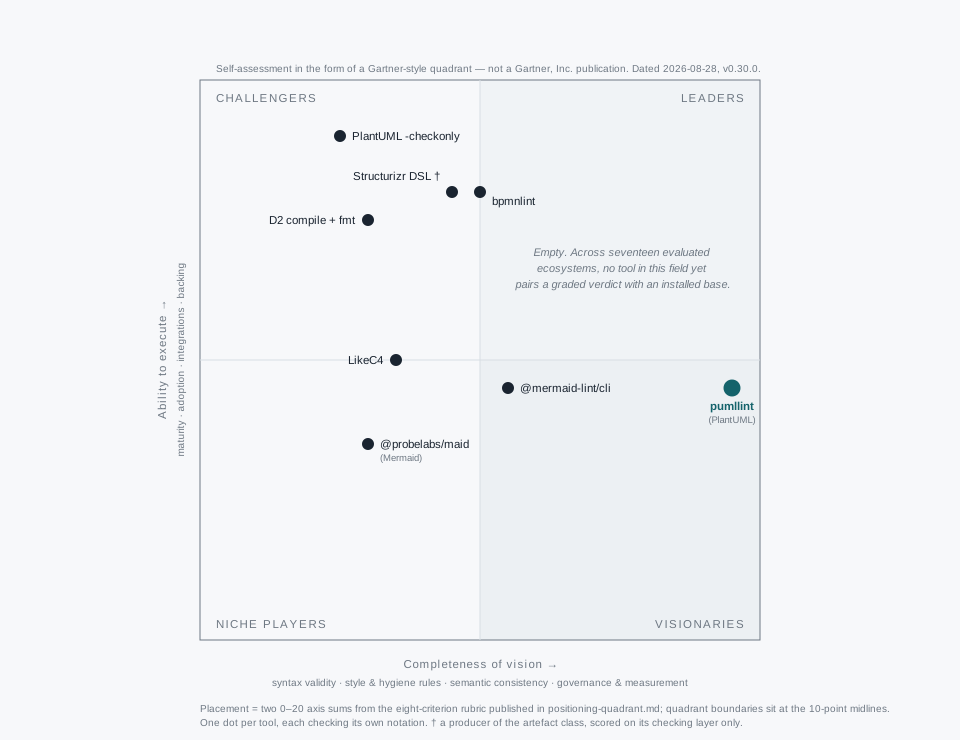
The rubric, the per-tool scores and the reading are in Positioning pumllint.
Documentation by audience
This README is the reference. docs/ has role-specific guides: why adopt it (management case, with the measured evidence), where the value lands in the SDLC (a value-stream assessment across the SAFe Continuous Delivery Pipeline), setup & CI integration (pipelines, ratchet, Sonar, badge), understanding findings & scores (for report readers and diagram authors), writing rules (a step-by-step programming guide with an end-to-end example, including how the executable Gherkin spec works), and using pumllint from a coding agent (the score → repair → re-score loop for AI agents implementing from diagrams), and linting business processes (ARIS/EPC processes expressed as activity diagrams — activity diagrams, not BPMN — with a copy-ready conventions gate and a worked example).
Maturity scoring
pumllint score aggregates rule findings into a 360° maturity level per
diagram — from 1 (Sketchy) to 5 (Method-complete) — plus a prescriptive
gap report listing exactly which findings block the next level:
order.puml [Order]: Level 3 (Disciplined) — 68/100
  To reach Level 4 (Precise):
    • DIM-CMP is 61, needs >= 70 — fix:
        SEQ102 major  order.puml:18  participant declaration has no role type

Model set: Level 3 (Disciplined) — 68/100 weighted across 1 diagram(s)
When no syntax check ran (no --check-syntax, no scoring.syntax_gate),
the text report says so — Syntax gate: not run — DIM-SYN unchecked … —
because the Level verdict otherwise silently assumes valid syntax.
Every report ends with a model-set summary: the worst per-diagram level
(the set is only as trustworthy as its weakest diagram) plus an
element-weighted composite across all scored diagrams. --min-level gates on
exactly that model-set level — it fails as soon as any diagram is below N.
python -m pumllint score diagrams/ --min-level 4     # CI gate: exit 1 below Level 4
python -m pumllint score diagrams/ --profile codegen # Level 5 requires this profile
python -m pumllint score diagrams/ --check-syntax    # also run plantuml -checkonly
Baseline / ratchet mode
On a brownfield model set, a fixed --min-level gate would demand a big-bang
cleanup. Ratchet instead: record today's per-diagram levels once, then fail CI
only when a diagram drops below its own baseline.
python -m pumllint score diagrams/ --baseline maturity.json   # 1st run records,
                                                              # later runs ratchet
python -m pumllint score diagrams/ --baseline maturity.json --update-baseline
                                                              # accept the status quo
Commit maturity.json. Its keys are paths relative to the file's own
directory, so the ratchet matches from any working directory and under any
spelling of the paths (diagrams/, an absolute path, . from inside
diagrams/), and a checkout at another location still matches — keep the
file where it is; moving it alone changes every key. Diagrams new since the
baseline always pass the ratchet (combine with --min-level to hold new work
to a floor); regressions are listed on stderr as
regression: <file>::<diagram>: Level 2 (baseline 3) and exit 1. A
version-1 file (pumllint ≤ 0.30.0 keyed on the recording run's own spelling)
is still read, and the next --update-baseline rewrites it in the version-2
form. --update-baseline merges by file: the entries of every file scored
this run are replaced, entries of files not scored are kept while the file
still exists and dropped once it is gone — so updating from one file, or
from pre-commit's staged list, does not shrink the baseline; a deleted
file's entries leave on the next update, a diagram removed from a file when
that file is next scored. It never gates — it accepts every regression in
the run — so keep it out of hooks and CI gates.
Ratchet-compare runs also annotate the report with trends — per diagram and for the model set:
order.puml [Order]: Level 4 (Precise) — 82/100  (Level 3 → 4 since last baseline)
checkout.puml: Level 3 (Disciplined) — 71/100  (new since baseline)
The json format carries the same machine-readably: each diagram (and
modelSet) gains "baseline": {"level": 3, "delta": 1} (null when not
ratcheting or new).
Maturity badge
-f badge renders the model-set level as
shields.io endpoint JSON:
python -m pumllint score diagrams/ -f badge -o badge.json
Publish badge.json anywhere raw-fetchable (the repo itself, gh-pages, a CI
artifact) and embed:

Colors follow the level: red (1) → orange (2) → yellow (3) → yellowgreen (4) → brightgreen (5).
HTML report
-f html renders the score run as a single self-contained page for
architect-facing reviews — the model-set verdict first, then per-diagram
cards sorted worst-first, each with its level, per-dimension score bars, the
prescriptive gap report, and baseline trends when ratcheting:
python -m pumllint score diagrams/ -f html -o maturity-report.html
No scripts, no external requests, no timestamps: the file renders offline and is byte-identical across runs over the same model set — publish it as a CI artifact, attach it to a review, or drop it in a wiki. In GitHub Actions:
- name: Maturity report
  uses: fdurieux/pumllint@v0.32.0
  with:
    command: score
    paths: docs/diagrams
    format: html
    output: maturity-report.html
- uses: actions/upload-artifact@v4
  with: { name: maturity-report, path: maturity-report.html }
A published example of this report — the bundled examples/
scored by the tool itself — lives at
https://fdurieux.github.io/pumllint/example-maturity-report.html
(docs/example-maturity-report.html, drift-guarded by
tests/test_pilot_example.py).
Why gate on it: below Level 2, generated code measurably breaks — 16–25 percentage points of executed correctness, across three generators and two vendors, resistant to prompt scaffolding. That headline rests on running the generated code against hand-written acceptance suites frozen before any scored run, not on an AI's opinion of it: an earlier judged wave put the score↔fidelity correlation at r ≈ 0.49, but the same programme then measured that judged fidelity does not track executed correctness at artifact granularity, and collapses entirely across a vendor boundary. Both results are published, failures included, in EVIDENCE.md. The gate keeps below-cliff diagrams out; it is an input filter, not a content certifier — a repaired diagram whose missing decisions were guessed still passes it, and generates worse code than leaving the diagram alone.
Level 5 means method-convention complete: the diagram-side preconditions for
faithful generation. It is bound to the codegen profile, which must be
active for the claim — a check on the profile in effect, not on which rules
fired. Because every shipped codegen rule is sequence-only, a non-sequence
diagram can reach Level 5 under --profile codegen with no codegen rule having
examined it; the opt-in c7_requires_applicable_rules flag closes that by also
requiring the profile to carry a rule applying to the diagram's type.
Scoring model, dimensions, thresholds, and calibration notes: SCORING.md.
All knobs are configurable under the scoring key (see pumllint.toml),
including that flag and deduplicate_findings (a base finding restated by its
codegen twin on the same line counts once).
Rules
| ID | Name | Default | What it catches |
|---|---|---|---|
| SEQ001 | undeclared-participant | critical | Participant used but never declared. Typo detector: PlantUML silently creates a phantom lifeline for Custmer -> Bank. |
| SEQ002 | unused-participant | minor | Declared participant that appears in no message. |
| SEQ003 | unbalanced-activation | major | activate never closed by deactivate/return (unterminated flow), or deactivate without prior activate. Understands ++/-- arrow shortcuts and destroy. |
| SEQ004 | unterminated-block | critical | alt/opt/loop/par/group/box without end. |
| SEQ005 | unlabelled-message | minor | Arrow with no label (dotted returns tolerated by default). |
| GEN001 | missing-title | minor | No title. |
| GEN002 | unnamed-diagram | info | @startuml without a name. |
| GEN003 | inline-skinparam | minor | Per-diagram styling instead of a central theme include. |
| GEN004 | participant-naming | minor | Names violating a configurable regex (per-kind overrides supported). |
| GEN005 | max-participants | minor | More elements than the type's budget — lifelines in a sequence diagram (default 9), declared actors plus use cases in a use-case diagram (default 15). max sets one budget for every type; per_type overrides it per diagram type. |
| GEN006 | owner-tag | minor | No ownership tag in title/header/footer/caption/notes. Needs a pattern; dormant otherwise. |
| GEN007 | requirement-link | minor | No requirement/ADR reference in name/title/notes. Needs a pattern; dormant otherwise. |
| GEN008 | note-density | minor | Structure narrated in notes instead of modelled (≥ min_notes, > max_ratio notes/element). |
| GEN009 | max-elements | minor | More semantic elements than max (default 60), any diagram type. |
| GEN010 | duplicate-diagram-name | minor | Two or more diagrams in one file share a name — PlantUML renders them to one output file, the last silently winning. |
| UC001 | orphan-actor-or-usecase | major | Use-case diagrams: actor or use case linked to nothing. |
| UC002 | usecase-actor-naming | minor | Use case not phrased verb-first (verb–object). Needs a verbs whitelist or a verb_pattern regex — a name passes on either; dormant otherwise. |
| UC003 | include-extend-direction | minor | <<include>>/<<extend>> arrow pointing the wrong way (judged via actor connectivity), or involving an actor. |
| SEQ006 | no-self-message | minor | Self-message; internal logic belongs in a note. Option allowed whitelists participants. |
| SEQ007 | unlabelled-block-condition | minor | alt/opt/loop/break/critical without a condition label. |
| SEQ008 | fragment-nesting-depth | minor | Combined fragments nested past max_nesting_depth (default 3) — extract a sub-diagram. |
| SEQ009 | unpaired-return | minor | Dashed return arrow (-->) that pairs with no preceding call. |
| SEQ010 | explicit-participant-order | info | Participant introduced by first use. Opt-in via require_explicit_order. |
| SEQ011 | max-messages | minor | More messages than max (default 30) — split per phase or ref over (which pumllint does not parse: lint the extracted file too). |
| ACT001 | missing-start | major | Activity diagram with actions but no start node. |
| ACT002 | missing-stop | major | Activity flow never reaches stop/end (unterminated flow). |
| ACT003 | unlabelled-decision-branch | minor | if (...) then / else without a (yes)/(no) branch label. |
| ACT004 | unterminated-construct | critical | if/while/repeat/fork/switch/partition never closed. |
| ACT005 | swimlane-naming | minor | Swimlane (` |
| ACT006 | verb-first-activity | minor | Activity not phrased verb-first. Needs a verbs whitelist or a verb_pattern regex — a name passes on either; dormant otherwise. ACT005/ACT006 together are the conventions gate for business processes drawn as activity diagrams — recipe in docs/business-processes.md. |
| CLS001 | class-naming | minor | Class/member names violating configurable patterns (default PascalCase classes, camelCase members; enum members exempt). |
| CLS002 | association-multiplicity | major | Association/aggregation/composition without a quoted multiplicity on both ends. |
| CLS003 | unlabelled-association | minor | Plain association with no role/verb label (: places). |
| CLS004 | inheritance-cycle | major | Cycle in the generalization/realization hierarchy — invalid UML that PlantUML happily renders. |
| CLS005 | max-members-per-class | minor | God-class smell: more members than max (default 15). |
| STA001 | single-initial-state | blocker | State machine without exactly one top-level [*] --> (composite-body initials don't count). |
| STA002 | unreachable-state | major | State with no incoming transition (self-loops don't count) — dead model content. |
| STA003 | unlabelled-transition | minor | Transition without an event [guard] / action label; [*] transitions exempt. |
Cross-diagram consistency pack (XD)
Active only when more than one diagram is linted, these build an entity
symbol table across the whole batch — the same entity must keep one identity
everywhere. XD001–003 compare sequence-diagram participants (kind,
stereotype, spelling); XD004–005 span diagram types: a class
OrderService <<service>> and a sequence lifeline orderService <<gateway>>
are one entity drifting apart, and the linter says so.
| ID | Name | Default | What it catches |
|---|---|---|---|
| XD001 | conflicting-participant-kind | major | Same participant declared participant here, database there — every conflicted site is flagged with the full variant set; the per-entity authoritative option pins the intended value (also on XD002/XD005). |
| XD002 | conflicting-participant-stereotype | minor | Same participant with disagreeing stereotypes across sequence diagrams. |
| XD003 | participant-name-case-collision | minor | Participant spellings differing only by case across sequence diagrams. |
| XD004 | cross-type-name-collision | minor | Entity spellings differing only by case across diagram types (participants, classifiers, swimlanes). |
| XD005 | cross-type-stereotype-conflict | minor | Entity stereotyped differently in the class model than in the interaction models. |
Two escape hatches, both per-entity: authoritative pins the intended value
on a real conflict, and distinct (its negative form, on every XD rule)
declares that two same-named entities are deliberately different things —
bounded contexts sharing a word — so no cross-diagram comparison applies.
One disclosure: pumllint never expands the preprocessor, so a diagram whose
declarations live behind !include parses with only implicit entities and
the XD pack goes quiet on it; the CLI then warns on stderr (exit codes and
scores untouched) that declarations may be hidden. Both mechanisms are
demonstrated on committed files in
a worked example (docs/xd-demo/), drift-guarded
by tests/test_xd_demo.py.
Codegen-readiness pack (profile: codegen)
Rules SEQ101–SEQ109 validate whether a sequence diagram is precise and
complete enough for an AI coding agent (or any downstream generator) to
implement it without inventing missing details. They are disabled by
default and activate with --profile codegen or profile: codegen in the
config. Ids SEQ100–SEQ199 are reserved for this range.
| ID | Name | Default | What it catches |
|---|---|---|---|
| SEQ101 | codegen-implicit-participant | blocker | Lifeline created implicitly on first use — the generator must guess what OrderSvc is. |
| SEQ102 | codegen-untyped-participant | major | Bare participant X with no typed keyword or <<stereotype>> — no mapping signal (actor → API boundary, database → repository, <<external>> → client stub). Option allowed_stereotypes closes the stereotype vocabulary (case-insensitive, every declared participant). |
| SEQ103 | codegen-prose-message | blocker | Call labels that aren't operation signatures: fetch the order details instead of findOrderById(orderId) — including prose hiding inside the parentheses (handle(the payment stuff)); name: Type params and quoted literals stay legal. |
| SEQ104 | codegen-missing-return | major | Synchronous call (->) with no reply arrow or return — return type left undefined. Async ->> is exempt. |
| SEQ105 | codegen-vague-guard | blocker | alt/opt/loop with an empty or vague guard (sometimes, if needed, …). else must carry a guard, or literal [else] in a two-branch alt. |
| SEQ106 | codegen-elision-marker | blocker | ..., TBD, TODO, etc, ???, and so on in labels, guards or notes — deliberately omitted behaviour the generator would fill with fiction. |
| SEQ107 | codegen-missing-failure-path | major | Call to an <<external>>/database/queue participant with no failure branch (alt error branch, break, or group error). |
| SEQ108 | codegen-activation-lifecycle | major | activate/deactivate not pairing as a well-formed per-lifeline stack — call nesting ambiguous. |
| SEQ109 | codegen-uninformative-reply | minor | Return drawn with a solid arrow, or a reply labelled ok/done/result instead of naming the returned value — breaks data-dependency inference. Option reply_pattern (regex) pins the reply shape, checked after the lexicon. |
The lexicons and shape options are configurable per rule (vague_terms,
tokens, failure_keywords, non_informative; SEQ103 also takes pattern,
arg_stop_words and max_arg_words; SEQ106 also takes kinds — which of
message, guard, note to scan, default all three; SEQ102 takes
allowed_stereotypes, a closed vocabulary; SEQ109 also takes reply_pattern,
a regex the reply label must match once the lexicon has passed it).
Every lexicon takes two levers. Setting the key itself (failure_keywords = [...])
replaces the shipped list, which is how you narrow one; setting
extra_<key> (extra_failure_keywords = [...]) adds to whatever is in
force, so opting into one more term does not cost you the defaults you did not
restate.
SEQ107 recognises a failure branch three ways, so the rule constrains modelling
rather than phrasing: the failure_keywords lexicon (error, failure,
timeout, exception, plus the absence family absent, missing, empty,
unavailable), a negated guard (not, !=, a leading !), or absence
phrasing (none/null/nil, or no <noun> as in [order has no stored rows]). Setting failure_keywords replaces the lexicon; the negation and
absence forms always apply. A branch must still carry at least one message or
return — a declared-but-empty failure branch models nothing.
Auto-fix
pumllint fix applies the mechanical fixes — the ones that are
deterministic and semantics-preserving, where nothing has to be invented:
| Finding | Fix |
|---|---|
| GEN002 unnamed-diagram | @startuml <name> derived from the file stem (ordinal suffix for multiple diagrams per file) |
| GEN001 missing-title | title <Humanized> inserted after @startuml |
| SEQ001/SEQ101 undeclared-participant | participant X declarations in first-use order, anchored after the existing declarations |
python -m pumllint fix diagrams/            # apply fixes in place
python -m pumllint fix diagrams/ --dry-run  # show the diff; exit 1 if fixes
                                            # are pending (CI check mode)
Fixes are driven by the linter's actual findings, so suppressed findings and
disabled rules are never "fixed", and the run is idempotent. The fixer also
inherits the linter's judgment calls: SEQ001 deliberately stays quiet in
files that declare no participants at all (ad-hoc sketches aren't punished),
so such files get no declaration fixes either — set
SEQ001: {only_if_any_declared: false} if you want sketches fixed too.
Everything else (labels, guards, multiplicities) stays a human decision —
the linter tells you what, but will not guess which. In GitHub Actions,
use command: fix with extra-args: --dry-run as a "fixes pending?" CI
check.
Requirement traceability
pumllint trace builds the coverage matrix between a requirements
inventory and the diagrams that reference it — all three directions:
which requirement IDs are realized by which diagrams, which IDs no
diagram references, which diagrams reference nothing. It also flags
unknown references (an ID cited by a diagram but absent from the
inventory — a typo, or a stale inventory):
Requirement coverage: 2/3 covered — 1 uncovered, 1 unknown reference(s), 1 unlinked diagram(s) — across 4 diagram(s)

REQ-101  ← orders/order_flow.puml [OrderFlow]:2, orders/refund.puml:3
REQ-103  ✖ uncovered

Unknown references (not in the inventory — a typo, or the inventory is stale):
  REQ-113  ← payments/charge.puml [Charge]:4

Unlinked diagrams (no requirement reference):
  sketches/idea.puml (sequence)
References are read from exactly the carriers the GEN007
(requirement-link) rule checks — the diagram name plus
title/header/footer/caption/notes — so the rule and the matrix can
never disagree; one configured convention serves both. The ID regex
comes from --pattern, falling back to the configured
rules.requirement-link.pattern.
The inventory comes from either or both of:
pumllint trace diagrams/ --requirements reqs.txt        # explicit ID list
pumllint trace diagrams/ --requirements-scan docs/specs # scan docs with the pattern
The list file is plain text — one ID per line; blank lines, full-line
# comments and inline # … comments are ignored (a # with no
whitespace before it stays part of the ID, so REQ#5 survives). An ID
containing whitespace draws a stderr warning — it can never match a
reference pattern — without changing the exit code.
Or JSON/YAML: an array of IDs — strings or objects carrying an id, so a
synchronized snapshot exported from a requirements/process repository
works unchanged (extra columns are ignored today; the JSON report's
id values are the stable join keys for a wider traceability matrix
later). --requirements-scan walks *.md/*.txt/*.adoc/*.rst and
extracts IDs by regex — so the two inventory sources parse differently:
a doc line yields the matched ID alone, while the same line moved into
a dedicated list file is taken verbatim as one ID.
Each file's name is matched as well as its text, so ID schemes that
live in the filename (ADR-0007-use-plantuml.md, REQ-123.md) are
found even when the body only carries a human title. This cannot
reconcile two different spellings of one ID: a tree of
0001-use-plantuml.md files holds 0001, not ADR-0001, so a pattern
written for the prose form matches nothing there — use --requirements
with an explicit list, or a pattern that matches both forms. An
inventory that ends up empty draws a stderr warning naming the source
and the pattern, without changing the exit code — otherwise every
correct reference is reported as unknown, which reads as an accusation
against the diagram.
CI gates are opt-in, one per direction — without them the command is report-only (exit 0):
pumllint trace diagrams/ --requirements reqs.txt \
  --fail-on-uncovered --fail-on-unlinked --fail-on-unknown-ref
-f json emits a machine-readable matrix pinned by a shipped schema
(pumllint schema trace). In GitHub Actions, use command: trace with
the inventory flags in extra-args.
Report schemas
The machine-readable reports are a public contract, pinned by JSON Schemas (draft 2020-12) shipped inside the package:
python -m pumllint schema lint    # the shape of `pumllint -f json`
python -m pumllint schema score   # the shape of `pumllint score -f json`
python -m pumllint schema trace   # the shape of `pumllint trace -f json`
Point any standard validator at them when building tooling on top of the output. pumllint's own test suite validates every report shape it can emit against these schemas — like the golden scores, the shape cannot drift silently. The badge and sonar formats are deliberately not covered: those shapes are shields.io's and SonarQube's contracts, not pumllint's.
In GitHub Actions, use command: schema with report: lint | score | trace
(paths and format inputs are ignored; output: writes the schema to a file).
Configuration
pumllint.yaml (or .toml / .json) is auto-detected in the working
directory, or passed with -c. Rules are keyed by ID or kebab-case name;
false disables, a mapping supplies options and/or a severity override:
rules:
  unnamed-diagram: false
  participant-naming:
    severity: major
    pattern: "^[A-Z][A-Za-z0-9]*$"
    per_kind:
      actor: "^[A-Z][a-z]+$"
  max-participants:
    max: 7
  # Traceability rules are dormant until you supply your project's convention:
  owner-tag:
    pattern: "(?i)owner\\s*:"
  requirement-link:
    pattern: "REQ-\\d+|ADR-\\d+"
A key nothing will read is disclosed on stderr and never changes the exit
code: an unknown top-level key, a rule id or name no rule carries, or an
option a rule does not take — maximum on max-elements, which takes
max, prints warning: config sets unknown option(s) 'maximum' for GEN009 (max-elements) — this rule takes: max. Every rule declares its legal
option keys in catalog.toml, and a test holds that declaration to what
the rule actually reads. In table form ([rules.GEN001] in TOML) the
disable spelling is enabled = false; severity and enabled are legal on
every rule. pumllint --list-rules shows what this config does to each
rule — disabled, profile-gated, escalated — and tags a convention rule that
has not been given its convention yet: [dormant: needs pattern].
Treat the config file with code-level trust, like a Makefile or a
pre-commit config: scoring.syntax_command names a command pumllint will
execute for the opt-in syntax gate, so do not run pumllint with an
auto-detected config inside a checkout you do not trust (see
SECURITY.md).
Profiles
A profile switches on profile-gated rule packs and may escalate severities of
existing rules. Select it with profile: in the config or --profile on the
CLI (the CLI wins):
profile: codegen
profiles:
  codegen:
    enable:            # optional: activate gated rules explicitly by id/name
      - SEQ101
      - SEQ102
    escalate:          # optional: severity overrides while the profile is active
      SEQ001: blocker  # e.g. undeclared participant becomes blocking
pumllint --profile codegen src/diagrams/ is enough on its own — rules
registered for a profile activate whenever that profile is selected; the
enable: list is only needed to pull in rules gated behind other profiles,
and escalate: to tighten the base catalog. Escalations win over rule-level
severity: settings — a profile is an opt-in quality gate.
Inline suppressions
Findings can be silenced at the source, eslint-style, with PlantUML
comments — reviewable and diff-friendly, unlike config-file exclusions:
' pumllint: disable=SEQ006, unlabelled-message   ← next line only
Batch -> Batch : self-trigger

' pumllint: disable-file=GEN003                  ← whole file
' pumllint: disable                              ← all rules, next line
Rules can be referenced by id or kebab-case name. CI can audit what is being
suppressed by running with --no-suppressions (or suppressions: false in
the config), which reports everything regardless of comments.
Suppressed findings never vanish silently from maturity scores: pumllint score annotates every affected diagram — 100/100 (3 suppressed) — and the
JSON report carries a suppressedCount per diagram and for the model set,
so a suppressed-clean diagram is always distinguishable from a clean one.
Architecture
pumllint/
├── model.py          # Diagram / Participant / Message / Violation dataclasses
│                     #   + call/reply pairing & activation-stack helpers
├── parser/           # line-oriented parser → semantic Diagram model
│   ├── sequence.py   #   sequence + use-case + suppression comments
│   ├── activity.py   #   new-style activity syntax (start/if/while/fork/…)
│   ├── class_.py     #   class diagrams (classifiers, members, relations)
│   └── state.py      #   state machines ([*], transitions, composites)
├── lsp.py            # Language Server Protocol front-end (stdio, stdlib only)
├── rules/            # rule packs; auto-discovered via @register decorator
│   ├── catalog.toml  #   declarative rule metadata (name/desc/severity/scope)
│   ├── sequence/     #   SEQ*  (participants.py, flows.py, codegen.py)
│   ├── activity/     #   ACT*  (structure.py)
│   ├── class_/       #   CLS*  (structure.py)
│   ├── state/        #   STA*  (structure.py)
│   └── common/       #   GEN*, UC*  (governance.py)
├── reporters/        # text / json / sonar / badge / html; auto-registered
│                     #   via @reporter
├── schemas/          # JSON Schemas — the `-f json` output contract
├── schema.py         #   loader + minimal validator (drift-guarded in tests)
├── engine.py         # config merge → rule instantiation → run
├── trace.py          # requirement↔diagram coverage matrix (`trace`)
├── config.py         # yaml / toml / json loading
└── cli.py            # argparse CLI, CI-friendly exit codes
Design choices for extensibility:
- Parser and rules are decoupled through the
Diagrammodel. Rules never see raw text, so parser improvements benefit every rule. - The parser recognizes a governance-relevant subset and ignores unknown lines — deliberately tolerant, because the PlantUML grammar is defined by its Java implementation and evolves constantly.
- Adding a rule = one class + one catalog entry. A rule class carries only
its
idand itscheck()algorithm; the declarative metadata (name, description, severity, scope, profiles) lives inrules/catalog.tomland is stamped onto the class by@register. Drop a module anywhere underpumllint/rules/—discover()walks the package, so there is nothing else to wire up:
# pumllint/rules/catalog.toml
[SEQ006]
name = "no-self-message"
description = "Self-messages hide logic that belongs in a note"
severity = "minor"
applies_to = ["sequence"]
profiles = []
from pumllint.rules import Rule, register

@register
class NoSelfMessage(Rule):
    id = "SEQ006"

    def check(self, diagram):
        for m in diagram.messages:
            if m.source and m.source == m.target:
                yield self.violation(diagram, m.line, f"Self-message on '{m.source}'")
- Adding an output format = one class decorated with
@reporter. - Profile-gated rules set
profiles = ["codegen"]in their catalog entry; the engine keeps them dormant until that profile is selected. Everything else (config, suppressions, reporters) works identically for gated rules. - New diagram types slot in as a parser extension plus a rule pack — exactly
how activity support (ACT001–004) was added in 0.2.0, class support
(CLS001–005) in 0.9.0 and state support (STA001–003) in 0.10.0; component
diagrams would follow the same pattern with
applies_to = ("component",).
Editor diagnostics (LSP)
pumllint lsp speaks the Language Server Protocol on stdio, publishing the
same findings as pumllint lint while you type — no new rules, no second
implementation, no third-party dependency.
pumllint lsp                              # stdio; started by your editor
pumllint lsp --config pumllint.toml       # explicit config (else auto-discovered)
pumllint lsp --fail-on critical           # raise the red line (see below)
pumllint lsp --profile codegen            # same flags as `lint` and `fix`
Severity mapping is tied to the CI gate. --fail-on is the same flag,
with the same choices and the same default (major), as pumllint lint:
| pumllint severity | LSP severity (default --fail-on major) |
|---|---|
blocker, critical, major |
Error — these fail CI |
minor |
Warning |
info |
Information |
So an editor error means CI will reject this, and nothing CI rejects shows up as a hint. Point both at the same threshold and the two cannot disagree.
Diagnostics are computed from the unsaved buffer, so findings update as you
edit rather than on save. A buffer with no @startuml block yields no
diagnostics, matching the CLI's treatment of such a file as not checked
rather than clean.
Editor configuration. Any LSP client works; the server needs no initialization options. For example, in Neovim:
vim.lsp.start({
  name = 'pumllint',
  cmd = { 'pumllint', 'lsp' },
  root_dir = vim.fs.dirname(vim.fs.find({ 'pumllint.toml', '.git' }, { upward = true })[1]),
})
For VS Code, point any generic LSP client extension at the command
pumllint lsp for the plantuml language id.
Quick fixes
The three mechanical fixes pumllint fix applies are offered as code actions
on the lightbulb — GEN002 diagram name, GEN001 title, SEQ001/SEQ101
participant declarations:
| Action | Kind |
|---|---|
Named diagram 'credit-check' |
quickfix |
Added title 'Credit check' |
quickfix |
Declare 2 missing participants (B, C) |
quickfix |
Fix all 3 pumllint findings |
source.fixAll.pumllint |
Applying them writes the same bytes as pumllint fix — that equivalence
is asserted by a differential test, because a lightbulb that disagrees with
the CLI is worse than no lightbulb.
Undeclared participants sharing one line are one action, not one per participant: they share a single anchor and a single edit, so separate entries would be a fiction.
The fix-all kind is namespaced (source.fixAll.pumllint), so a generic
"source.fixAll": true on-save setting does not silently author diagram
names for someone who never named this tool — though context.only matching
is hierarchical, so a client that asks for source.fixAll still gets it.
To fix on save in VS Code:
"editor.codeActionsOnSave": { "source.fixAll.pumllint": "explicit" }
Two deliberate limits. A buffer containing a separator Python splits on but
editors do not (a form feed, U+2028) gets no code actions — the line
numbers would disagree and a replace could overwrite the wrong line.
And unlike pumllint fix, a code action does not normalise line endings: the
CLI rewrites a mixed-ending file to one style, an edit changes only the lines
it touches.
Hover, completion and rename
All three are backed by something pumllint already knows, and stop where that knowledge stops.
Hover shows the rule behind a finding — id, kebab name, description,
severity, dimension, scope, profile gating, and the disable comment that
silences it. Every field is declared metadata from rules/catalog.toml, so
hover cannot drift from what the linter enforces. Hovering a rule key inside a
' pumllint: disable= comment explains what you switched off.
Completion offers the participants this buffer already mentions
(implicit lifelines marked, since declaring them is the fix), and the rule
catalogue inside a disable comment. It completes no PlantUML syntax —
the parser is deliberately partial and line-oriented, so a keyword list would
be invented rather than derived, and would go stale against upstream.
Rename renames a participant across the diagram. It updates declarations,
message endpoints and activate/destroy, and deliberately leaves prose
alone: the A in A -> B : notify A owner is a word in a sentence, and the
parser's own pattern captures endpoints separately from labels, which is why
it survives.
pumllint does not model note or ref targets, so rather than half-rename a diagram, rename verifies itself and refuses with a reason:
note over A          -> "'A' still appears on line 4 — pumllint does not track
                         note or ref targets, so renaming there is not safe
                         to automate"
rename A to B        -> "'B' is already a participant — rename would merge
                         two lifelines"
The check is not a heuristic: the edits are applied to a copy, the result is re-parsed, and the participant set must come back as the original with exactly one name swapped. Refusals arrive as a JSON-RPC error so the editor shows the reason, rather than as an empty edit that would read as "nothing to rename".
Outline
textDocument/documentSymbol gives a navigable outline of what the parser
understood — diagram roots, then participants, classes and members, states,
control-flow blocks, and messages nested inside the block they belong to:
loan-decision-activity                  activity
  start
  Receive application                   action
  if Complete dossier?
    Run credit scoring                  action
    if Score above threshold?
      Generate offer                    action
      else                              branch
The root of each diagram is backed by its @startuml line, which always
parses; the children are backed by type-specific parsing, which may not have.
So a diagram pumllint could not read still gets a named, navigable row
with detail: "unknown" — six such roots is the most useful outline available
for a C4-PlantUML file. And a diagram whose lifelines were all inferred from
arrows (what a component diagram looks like to this parser) is labelled
sequence (inferred) rather than silently presented as fact.
One caveat worth knowing. The protocol owns stdout, so pumllint lsp is
the one subcommand that prints no report there; diagnostics travel as
JSON-RPC and everything else goes to stderr. Exit codes still hold: 0 after
a clean shutdown/exit, 1 if the client disappears or exits without
shutting down.
CI integration (GitHub Actions)
The repo ships a composite action — it installs pumllint from the exact ref you pin and runs it:
- uses: actions/checkout@v4
- name: Lint PlantUML diagrams
  uses: fdurieux/pumllint@v0.32.0
  with:
    paths: docs/diagrams
- name: Maturity ratchet + floor
  uses: fdurieux/pumllint@v0.32.0
  with:
    command: score
    paths: docs/diagrams
    baseline: maturity.json
    min-level: "2"
Inputs mirror the CLI: command (lint|score), paths, config,
profile, format, output, fail-on (lint), min-level / baseline /
update-baseline (score), and extra-args for anything else.
Or call the CLI directly — e.g. to feed SonarQube:
- name: Lint PlantUML diagrams
  run: |
    python -m pumllint docs/diagrams --fail-on major \
      -f sonar -o pumllint-sonar.json
- name: SonarQube scan
  uses: SonarSource/sonarqube-scan-action@v4
  env:
    SONAR_TOKEN: ${{ secrets.SONAR_TOKEN }}
  with:
    args: >
      -Dsonar.externalIssuesReportPaths=pumllint-sonar.json
The sonar reporter emits the Generic Issue Import Format (the 10.3+
schema with rules + issues and clean-code impacts). SonarQube ingests it
via sonar.externalIssuesReportPaths — findings land in dashboards, quality
gates and PR decoration with no Java plugin to build or maintain.
Recommended companion step: run PlantUML's own -checkonly first for pure
syntax, then pumllint for semantics.
Pre-commit hooks
repos:
  - repo: https://github.com/fdurieux/pumllint
    rev: v0.32.0
    hooks:
      - id: pumllint                 # lint staged diagrams
      - id: pumllint-score
        args: [--min-level, "3"]     # maturity gate per commit
Both hooks receive the staged PlantUML files (.puml, .plantuml, .iuml,
.wsd). pumllint-score only gates when given --min-level N and/or
--baseline FILE via args; without them it just prints the report. Hook
environments are isolated — if your repo uses a pumllint.yaml config, add
additional_dependencies: [PyYAML] to the hook (toml/json configs need
nothing extra).
Tests
Two complementary entry points:
# 1. Unit + integration tests. Zero-dependency runner — no pytest needed;
#    ideal for offline/CI-minimal environments.
python tests/run_tests.py

# 2. Everything above PLUS the executable RULES.md spec (pytest-bdd).
#    Needs the optional `test` extra.
pip install -e ".[test]"
python -m pytest
run_tests.py collects only the top-level tests/test_*.py (unit tests,
rule checks, the catalog parity guard, and the feature/RULES.md sync guard) and
never imports pytest-bdd. The BDD layer lives under tests/bdd/ and runs only
under pytest.
Executable spec (RULES.md ↔ tests). The ```gherkin block under each
rule in RULES.md is the acceptance spec. tools/extract_features.py
generates tests/bdd/features/<ID>.feature from those blocks; pytest-bdd binds
them to a small canonical step vocabulary (tests/bdd/test_features.py) and runs
them against the real linter. Blocked/planned rules are @skip-tagged. A sync
test fails if the committed features drift from RULES.md — after editing a
Gherkin block, regenerate:
python tools/extract_features.py
License
GPL-3.0-or-later — see LICENSE. The tool is run, not linked: executing pumllint over your diagrams in CI, as a pre-commit hook, or from the CLI imposes no license obligations on your diagrams, your codebase, or the reports it produces — those are yours.
Licensing commitment (2026-07-29). This project will stay under GPL-3.0-or-later or, at most, move between OSI-approved open-source licenses. It will never be relicensed to a source-available or proprietary license, and neither this tool nor any service or MCP wrapper published from this repository will adopt AGPL. Decision record and rationale: ROADMAP.md § Settled questions and the pipeline fit evaluation.
1 maintainer

Metadata
1 maintainer
Release files for pumllint 0.32.0
For a detailed explanation of source distributions (sdists) and built distributions (wheels), please see the package formats documentation.
Source distribution (sdist)
| File | Size | Uploaded | Provenance | Actions |
|---|---|---|---|---|
| pumllint-0.32.0.tar.gz | 280.9 kB | With provenance | Details for pumllint-0.32.0.tar.gz |
Built distribution (wheel)
| File | Interpreter | ABI | Platform | Actions Reset |
|---|---|---|---|---|
| pumllint-0.32.0-py3-none-any.whl | Python 3 | none | any | Details for pumllint-0.32.0-py3-none-any.whl |
Total release size: 451.5 kB
Release files / pumllint-0.32.0.tar.gz
| Download URL | pumllint-0.32.0.tar.gz |
|---|---|
| Size | 280.9 kB |
| Tags | Source |
|
SHA-256 checksum How to use checksums |
6bbcbace14369aef8a7db430431832fd155cdd3288c826e277af79e701d230e2
|
|
BLAKE2b-256 checksum How to use checksums |
2a1e2eeb57294159cbd70d8fcd7bd73f58d4e9e2533ffa3a80d9bdeff2218c89
|
| Upload date | |
|
Uploaded using Trusted Publishing? What is trusted publishing? |
Yes |
| Uploaded via |
twine/7.0.0 CPython/3.13.14
|
Provenance
Provenance describes where a file came from. On PyPI, provenance is shared via attestations, which provide a verifiable record of the build or publishing details. View details, limitations and caveats.


PyPI Publish Attestation
PyPI verified that this artifact, at this checksum, originated from the publisher listed below.
Signed by GitHub Actions, verified by PyPI on Sep 4, 2026.
Transparency logRelease files / pumllint-0.32.0-py3-none-any.whl
| Download URL | pumllint-0.32.0-py3-none-any.whl |
|---|---|
| Size | 170.5 kB |
| Tags | Python 3 |
|
SHA-256 checksum How to use checksums |
ed81c8fefe0a8ab859a0ad6d341e9e7d784ca5058ecfee9e1fd8de6c668829a7
|
|
BLAKE2b-256 checksum How to use checksums |
e3d6e340674919251ff251676f0525a428288f062ac793fe81166a0d0f472b2c
|
| Upload date | |
|
Uploaded using Trusted Publishing? What is trusted publishing? |
Yes |
| Uploaded via |
twine/7.0.0 CPython/3.13.14
|
Provenance
Provenance describes where a file came from. On PyPI, provenance is shared via attestations, which provide a verifiable record of the build or publishing details. View details, limitations and caveats.
PyPI Publish Attestation
PyPI verified that this artifact, at this checksum, originated from the publisher listed below.
Signed by GitHub Actions, verified by PyPI on Sep 4, 2026.
Transparency logSecurity for pumllint 0.32.0
Provenance
Provenance describes where a file came from. On PyPI, provenance is shared via attestations, which provide a verifiable record of the build or publishing details. View details, limitations and caveats.
Full provenance
All 2 files in this release have been uploaded with provenance metadata.
Attestation for pumllint-0.32.0.tar.gz
PyPI Publish Attestation
PyPI verified that this artifact, at this checksum, originated from the publisher listed below.
Signed by GitHub Actions, verified by PyPI on Sep 4, 2026.
Transparency logA note on package security
PyPI is a repository for distributing packages, not a service for auditing them. While third-party security researchers and our staff do their best to detect and remove malicious packages, PyPI cannot guarantee the quality, security or suitability of any given package.
To learn more about protecting yourself from malicious actors, visit our package security documentation.














