

Cluster, rank and detect in time series.



Documentation · Quickstart · User guide · Tutorials · API · Changelog
milia groups series that behave alike, finds the cases most similar to a given one, and flags the days or windows that are not normal. It grew out of smart-meter and energy load profiles, which is its home domain, and its methods apply to other time series such as sensor, traffic, retail or clinical signals. Every learned component is a scikit-learn estimator, so it clones, pickles, tunes and composes in a Pipeline.
Milia is Swahili for stripes: a zebra is recognised in its herd by its stripe pattern, as a series is recognised among thousands.
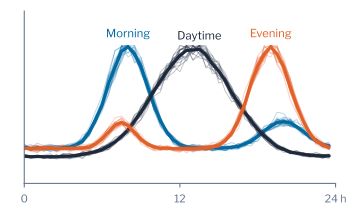
ClusterFind the herds.Group the series that behave alike, and see how far to trust the groups. |
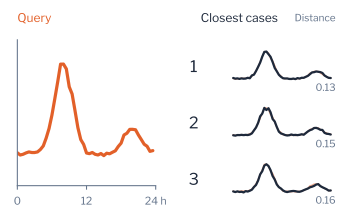
RankFind the look-alikes.Retrieve the most similar cases, and the action that worked for them. |
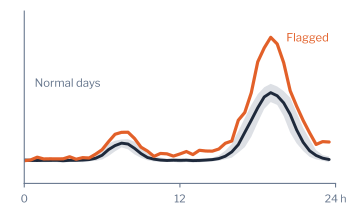
DetectSpot the odd stripe.Flag the days that are not normal, at a false-alarm rate that you set. |
Install
pip install pundamilia              # the distribution; import it as milia
pip install 'pundamilia[all]'       # with plots, tuning, tensor and the other extras
Quick start
from milia import make
from milia.data import synthetic, profiles
from milia.cluster import validation, selection

population = synthetic.generate(meters=60, days=90, steps=48)
shapes = profiles.shape(population.pivot)
scores = validation.sweep(shapes, range(2, 8), resampling=True)
k = selection.recommend(scores, strategy="trust")
labels = make("clusterer", "kmeans", n_clusters=k).fit_predict(shapes)
Anomalous days with a conformal guarantee on the share of normal days flagged:
from milia.anomaly.ensemble import Ensemble
from milia.features.window import vector

X = [vector(day) for day in profiles.tensor(population.pivot)[0]]
detector = Ensemble().fit(X[:60]).calibrate(X[60:80], alpha=0.1)
flags = detector.flag(X[80:])
Models are registered by module: milia.available("detector") lists them. The documentation has the user guide, the tutorials and the API reference.
Developer
Developed by Anthony Faustine (LinkedIn).
Citation
If you use milia in your work, please cite it:
@software{faustine2026milia,
  title  = {milia: cluster, rank and detect in time series},
  author = {Faustine, Anthony},
  year   = {2026},
  url    = {https://sambaiga.github.io/pundamilia-docs/}
}
Contributing
Open a pull request against main with a conventional-commit title. make test and make lint run the suite and the linters.
License
Apache-2.0.
1 maintainer

Metadata
1 maintainer
Release files for pundamilia 0.1.1
For a detailed explanation of source distributions (sdists) and built distributions (wheels), please see the package formats documentation.
Source distribution (sdist)
| File | Size | Uploaded | Provenance | Actions |
|---|---|---|---|---|
| pundamilia-0.1.1.tar.gz | 490.4 kB | With provenance | Details for pundamilia-0.1.1.tar.gz |
Built distribution (wheel)
| File | Interpreter | ABI | Platform | Actions Reset |
|---|---|---|---|---|
| pundamilia-0.1.1-py3-none-any.whl | Python 3 | none | any | Details for pundamilia-0.1.1-py3-none-any.whl |
Total release size: 737.1 kB
Release files / pundamilia-0.1.1.tar.gz
| Download URL | pundamilia-0.1.1.tar.gz |
|---|---|
| Size | 490.4 kB |
| Tags | Source |
|
SHA-256 checksum How to use checksums |
60f2d8f337dca110e4db56e9aea16307b92c2bb7fd2db073defff143c0fefdcc
|
|
BLAKE2b-256 checksum How to use checksums |
b53553a66a6e2d80c18b5583ec02312ddfd22dcc0d780734b27d6203b5ec9485
|
| Upload date | |
|
Uploaded using Trusted Publishing? What is trusted publishing? |
Yes |
| Uploaded via |
twine/7.0.0 CPython/3.13.16
|
Provenance
Provenance describes where a file came from. On PyPI, provenance is shared via attestations, which provide a verifiable record of the build or publishing details. View details, limitations and caveats.


PyPI Publish Attestation
PyPI verified that this artifact, at this checksum, originated from the publisher listed below.
Signed by GitHub Actions, verified by PyPI on Nov 13, 2026.
Transparency logRelease files / pundamilia-0.1.1-py3-none-any.whl
| Download URL | pundamilia-0.1.1-py3-none-any.whl |
|---|---|
| Size | 246.7 kB |
| Tags | Python 3 |
|
SHA-256 checksum How to use checksums |
95ac49220bec93b7b0f767aedee91c494cde96e8bbde0bd20b5e9889dce60709
|
|
BLAKE2b-256 checksum How to use checksums |
9382079f6fd0826d066bd2210c8644168d684cfc51f666c4df8227500b8076e1
|
| Upload date | |
|
Uploaded using Trusted Publishing? What is trusted publishing? |
Yes |
| Uploaded via |
twine/7.0.0 CPython/3.13.16
|
Provenance
Provenance describes where a file came from. On PyPI, provenance is shared via attestations, which provide a verifiable record of the build or publishing details. View details, limitations and caveats.
PyPI Publish Attestation
PyPI verified that this artifact, at this checksum, originated from the publisher listed below.
Signed by GitHub Actions, verified by PyPI on Nov 13, 2026.
Transparency logSecurity for pundamilia 0.1.1
Provenance
Provenance describes where a file came from. On PyPI, provenance is shared via attestations, which provide a verifiable record of the build or publishing details. View details, limitations and caveats.
Full provenance
Both files in this release have been uploaded with provenance metadata.
Attestation for pundamilia-0.1.1.tar.gz
PyPI Publish Attestation
PyPI verified that this artifact, at this checksum, originated from the publisher listed below.
Signed by GitHub Actions, verified by PyPI on Nov 13, 2026.
Transparency logA note on package security
PyPI is a repository for distributing packages, not a service for auditing them. While third-party security researchers and our staff do their best to detect and remove malicious packages, PyPI cannot guarantee the quality, security or suitability of any given package.
To learn more about protecting yourself from malicious actors, visit our package security documentation.














