
PWDriver (PyWebDriver)






Motivation
To simplify automation settings of each different platform, version, browser.
Support:
-
ChromeDriver
-
GeckoDriver
-
EdgeDriver (Chromium)
-
IEDriver -
...and Android, iOS (See With Appium section)
Usage
1. Install:
pip install pwdriver
2. Make 'config.ini' file and locate in your project directory.
config.ini look like this.
[automation]
;if using remote webdriver, then local be false and url required.
local=true
url=http://localhost:4444
;target: chrome, gecko, edge, safari
target=chrome
3. Import WebDriverFactory.
Now, we can launch webdriver.
from pwdriver.core import WebDriverFactory

driver = WebDriverFactory.launch()
Alternative Usage
This way doesn't make and doesn't use configuration file, but calls setup method of the driver in your test code.
with Chrome:
from selenium import webdriver
from pwdriver import core

core.setup_chromedriver()
driver = webdriver.Chrome()
with FireFox:
from selenium import webdriver
from pwdriver import core

core.setup_geckodriver()
driver = webdriver.Firefox()
with Edge:
from selenium import webdriver
from pwdriver import core

core.setup_edgedriver()
driver = webdriver.Edge()
Page object models
Page object models pattern makes our test cases more concise and readable.
The good news is, we can use Page Objects with this.
There is an example that searching for keyword on www.bing.com and verifying url, title.
For using this, we are going to create modules that page object classes and test cases.
Modules that page elements and locators already implemented, so nevermind.
Page Object Class
from selenium.webdriver.common.by import By

from pwdriver.page import BasePage


class BingPage(BasePage):
    def __init__(self, driver):
        super().__init__(driver)
        self._url = 'https://www.bing.com'
        self._locator = {
            'input': (By.CSS_SELECTOR, 'input#sb_form_q'),
            'search': (By.CSS_SELECTOR, 'label#search_icon')
        }

    def type_keyword(self, text) -> None:
        self._by('input').send_keys(text)

    def click_search(self) -> BasePage:
        self._by('search').click()
        return BingPage(BasePage)
Test case
from pwdriver.core import WebDriverFactory
from tests.pages.bing_page import BingPage

import unittest


class BrowserTest(unittest.TestCase):
    def setUp(self):
        self.driver = WebDriverFactory.launch()

    def tearDown(self):
        self.driver.quit()

    def test_something(self):
        page = BingPage(self.driver)
        page.get()
        keyword = 'chicken'
        page.type_keyword(keyword)
        page.submit_keyword()
        self.assertIn(f'https://www.bing.com/search?q={keyword}', self.driver.current_url)
        self.assertEqual(f'{keyword} - Search', self.driver.title)


if __name__ == '__main__':
    unittest.main()
Logging and Event listener
If we want to use logging or want to see what events occured in webdriver,
we can use get_logger() or EventListener().
See below example code.
Test
from selenium.webdriver.support.events import EventFiringWebDriver

from pwdriver.core import WebDriverFactory
from pwdriver.listener import EventListener
from pwdriver.util import get_logger

logger = get_logger('test')

core = WebDriverFactory.launch()
driver = EventFiringWebDriver(core, EventListener())
logger.info('WebDriver created.')
- Log level:
debug,info,warning,error,critical - WebDriver event:
navigate,execute script - WebElement event:
find,click,change value
With Appium
This package also includes wrapped appium's remote webdriver.
We could launch an appium driver using config.ini file that contains capabilities.
See below configuration and example code.
Configuration
[automation]
;if using appium, then local be false and url required.
local=false
url=http://localhost:4723
;target: android, ios
target=ios

[mobile]
;add capabilities for mobile testing.
platformVersion=15.5
deviceName=iPhone 13 mini
browserName=Safari
Test
from pwdriver.core import WebDriverFactory

driver = WebDriverFactory.launch()
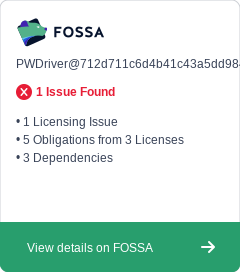
License
1 maintainer

Metadata
1 maintainer
Release files for pwdriver 0.27.3
For a detailed explanation of source distributions (sdists) and built distributions (wheels), please see the package formats documentation.
Source distribution (sdist)
| File | Size | Uploaded | Provenance | Actions |
|---|---|---|---|---|
| pwdriver-0.27.3.tar.gz | 9.7 kB | Without provenance | Details for pwdriver-0.27.3.tar.gz |
Built distribution (wheel)
| File | Interpreter | ABI | Platform | Actions Reset |
|---|---|---|---|---|
| pwdriver-0.27.3-py3-none-any.whl | Python 3 | none | any | Details for pwdriver-0.27.3-py3-none-any.whl |
Total release size: 19.3 kB
Release files / pwdriver-0.27.3.tar.gz
| Download URL | pwdriver-0.27.3.tar.gz |
|---|---|
| Size | 9.7 kB |
| Tags | Source |
|
SHA-256 checksum How to use checksums |
619b19d76924ddd2c65d19676212a72fbea0ab4bab7b4f8ceda6c7302f96c5c4
|
|
BLAKE2b-256 checksum How to use checksums |
3b1ec281ce44eee0ded0d54a480e8b2466827c84b21601cf27c65ba2e7d3371a
|
| Upload date | |
|
Uploaded using Trusted Publishing? What is trusted publishing? |
No |
| Uploaded via |
poetry/1.5.1 CPython/3.11.0 Linux/5.15.0-1041-azure
|
Release files / pwdriver-0.27.3-py3-none-any.whl
| Download URL | pwdriver-0.27.3-py3-none-any.whl |
|---|---|
| Size | 9.5 kB |
| Tags | Python 3 |
|
SHA-256 checksum How to use checksums |
ff6a338bed430b26c174b131587c4083e8f85e92497e9a53b92632ab302efd22
|
|
BLAKE2b-256 checksum How to use checksums |
a21a7fe2c8ba2a61172cc05c625d64fadeabd346ff9d326dd63b6ed78bc493a9
|
| Upload date | |
|
Uploaded using Trusted Publishing? What is trusted publishing? |
No |
| Uploaded via |
poetry/1.5.1 CPython/3.11.0 Linux/5.15.0-1041-azure
|
Security for pwdriver 0.27.3
Provenance
Provenance describes where a file came from. On PyPI, provenance is shared via attestations, which provide a verifiable record of the build or publishing details. View details, limitations and caveats.
No provenance found
None of the files in this release were uploaded with provenance metadata.
A note on package security
PyPI is a repository for distributing packages, not a service for auditing them. While third-party security researchers and our staff do their best to detect and remove malicious packages, PyPI cannot guarantee the quality, security or suitability of any given package.
To learn more about protecting yourself from malicious actors, visit our package security documentation.














