
Longxing Cao's Contact Molecular Surface has been ported to python to allow the next generation of protein designers to use it with ease. Contact Molecular Surface (contact ms) is based on Lawrence and Colman's 1993 paper where they calculate Shape Complementarity. The difference is that instead of returning a singular value denoting the shape complementarity, contact ms instead returns a distance-weighted surface area of the target molecule.
At it's core, contact ms is based on the following formula:
contact_ms = area * exp( -0.5 * distance**2)
Where area is the interfacial area on the target and distance is the distance between the binder and the target (from the molecular surfaces) at that point.
Here's an image from (Brian Coventry dissertation) explaining why contact ms is better than SASA or Shape Complementarity:
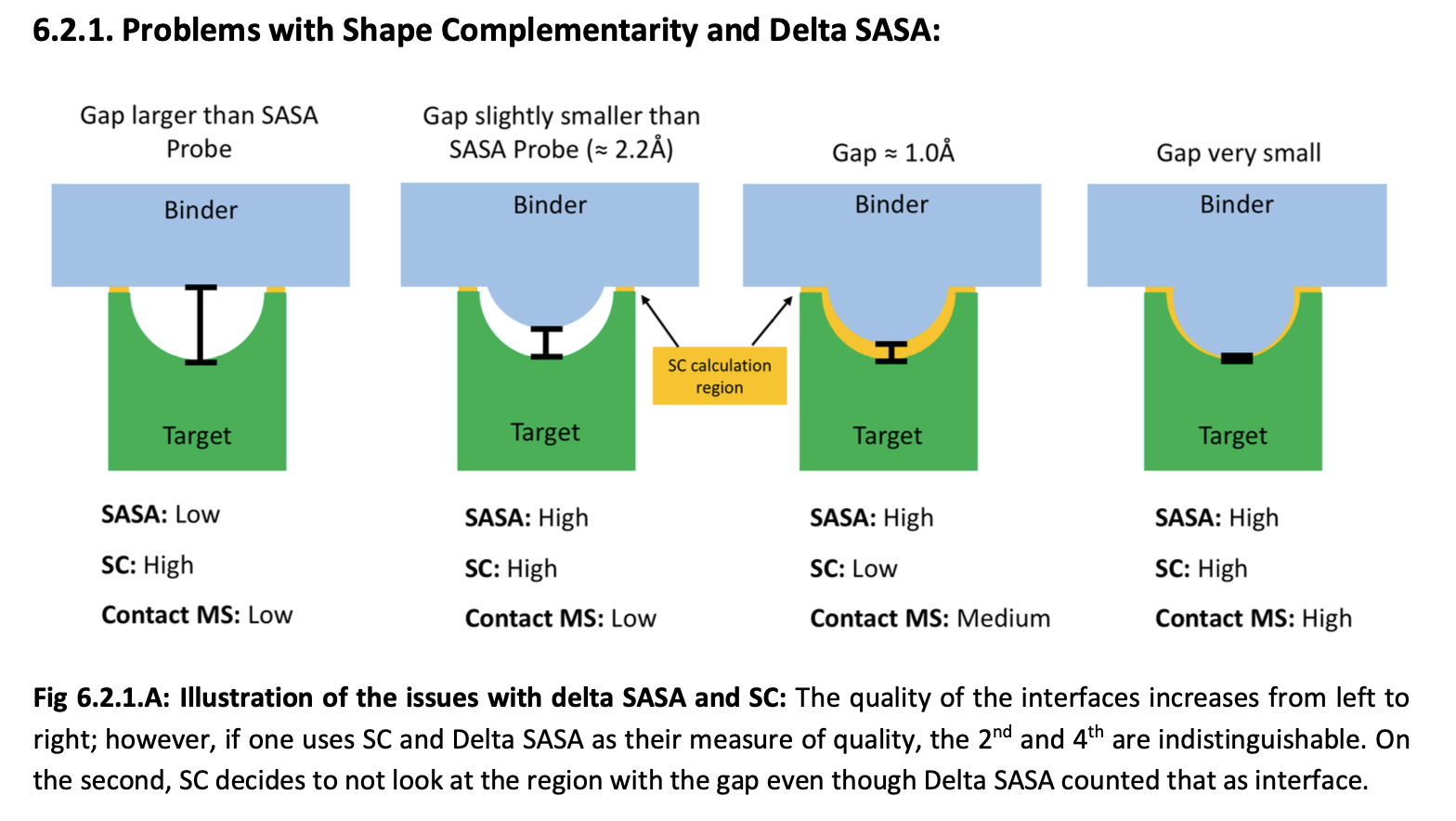
(Look up Brian Coventry Dissertation if you want the full story about it's pros and cons)
In terms of using this library, there are really only two functions you need:
from py_contact_ms import calculate_contact_ms, get_radii_from_names

# You'll have to figure out how to generate the following arrays
binder_xyz = xyz of binder heavy-atoms (non-hydrogen)
binder_res_names = list of residue name3 for each xyz (so like [ARG, ARG, ARG, LYS])
binder_atom_names = list of atom names for each xyz, stripped (so like [N, CA, C, O])
target_xyz = ...
target_res_names = ...
target_atom_names = ...

# Do not supply your own radii! CMS requires specific radii
binder_radii = get_radii_from_names(binder_res_names, binder_atom_names)
target_radii = get_radii_from_names(target_res_names, target_atom_names)

# Remember, contact_ms is only on the target side by convention
contact_ms, per_target_atom_cms, calc = calculate_contact_ms(binder_xyz, binder_radii, target_xyz, target_radii)

# If you also want the binder-side, you can do this (avoids recomputing everything)
binder_cms, per_binder_atom_cms = calc.calc_contact_molecular_surface(target_side=False)

# If you are doing small-molecule design, you may also want to know the maximum CMS possible (basically the surface area)
from py_contact_ms import calculate_maximum_possible_contact_ms
max_target_cms, max_target_cms_per_atom = calculate_maximum_possible_contact_ms(target_xyz, target_radii)
1 maintainer

Metadata
1 maintainer
Release files for py-contact-ms 0.1.1
For a detailed explanation of source distributions (sdists) and built distributions (wheels), please see the package formats documentation.
Source distribution (sdist)
| File | Size | Uploaded | |
|---|---|---|---|
| py_contact_ms-0.1.1.tar.gz | 1.1 MB | Details |
Built distribution (wheel)
| File | Interpreter | ABI | Platform | Reset |
|---|---|---|---|---|
| py_contact_ms-0.1.1-py3-none-any.whl | Python 3 | none | any | Details |
Total release size: 1.1 MB
Release files / py_contact_ms-0.1.1.tar.gz
| Download URL | py_contact_ms-0.1.1.tar.gz |
|---|---|
| Size | 1.1 MB |
| Tags | Source |
|
SHA-256 checksum How to use checksums |
0019b90119ad3eaa1775e454b2c1c772022f26e4ac707fcc6ce17e1b1f7a91d2
|
|
BLAKE2b-256 checksum How to use checksums |
6528a6b45e01422c07bdd05c2cb59b3736839d4c8c7eb0a2ef65df76979a1c31
|
| Upload date | |
|
Uploaded using Trusted Publishing? What is trusted publishing? |
Yes |
| Uploaded via |
twine/6.1.0 CPython/3.13.7
|
Provenance
Provenance describes where a file came from. On PyPI, provenance is shared via attestations, which provide a verifiable record of the build or publishing details. View details, limitations and caveats.


PyPI Publish Attestation
PyPI verified that this artifact, at this checksum, originated from the publisher listed below.
Signed by GitHub Actions, verified by PyPI on Mar 14, 2026.
Transparency logRelease files / py_contact_ms-0.1.1-py3-none-any.whl
| Download URL | py_contact_ms-0.1.1-py3-none-any.whl |
|---|---|
| Size | 22.0 kB |
| Tags | Python 3 |
|
SHA-256 checksum How to use checksums |
4d7a5872f70607541d7e54b4ca8b1797714910be9c1ddd82de987fc82b5e9e47
|
|
BLAKE2b-256 checksum How to use checksums |
b6a9aa891b3a13f62b6b429b65b69a22ebddf182602ffd4df79e7d3b8789b98a
|
| Upload date | |
|
Uploaded using Trusted Publishing? What is trusted publishing? |
Yes |
| Uploaded via |
twine/6.1.0 CPython/3.13.7
|
Provenance
Provenance describes where a file came from. On PyPI, provenance is shared via attestations, which provide a verifiable record of the build or publishing details. View details, limitations and caveats.
PyPI Publish Attestation
PyPI verified that this artifact, at this checksum, originated from the publisher listed below.
Signed by GitHub Actions, verified by PyPI on Mar 14, 2026.
Transparency log













