
Fastest Python draughts / checkers library (import: draughts). Bitboard move generation ~200x faster than pydraughts. PDN/FEN, alpha-beta engine, HUB protocol, web UI. 8 variants: International, American, Frisian, Russian, Brazilian, Antidraughts, Breakthrough, Frysk!
Verified details
These details have been verified by PyPIProject links
GitHub Statistics
Maintainers

Project description
py-draughts — fastest Python draughts & checkers library






py-draughts (import name: draughts) is a fast, modern Python library for draughts (also known as checkers). Bitboard-backed move generation, PDN/FEN parsing, built-in engines (the ML-trained TurboEngine plus a general-purpose SimpleEngine), a HUB protocol bridge for external engines like Scan and Kingsrow, an interactive web UI, and tensor exports for RL / ML — all in one package.
[!IMPORTANT] The fastest pure-Python draughts library: ~200x faster legal-move generation than pydraughts, with 8 supported variants and 260+ tests.
py-draughts vs pydraughts
| py-draughts | pydraughts | |
|---|---|---|
| Legal moves generation | 21.4 µs | 5.18 ms (243x slower) |
| Make move | 1.2 µs | 552.50 µs (460x slower) |
| Board init | 3.3 µs | 579.45 µs (176x slower) |
| FEN parse | 27.4 µs | 295.10 µs (11x slower) |
| Variants | 8 (Standard, American, Frisian, Russian, Brazilian, Antidraughts, Breakthrough, Frysk!) | 6 |
| Built-in AI engine | ✅ TurboEngine (learned eval) + SimpleEngine (all variants) | ❌ External only |
| Engine benchmarking suite | ✅ | ❌ |
| Web UI | ✅ FastAPI + interactive board | ❌ |
| SVG rendering | ✅ | ❌ |
| ML/RL helpers (tensors, masks) | ✅ | ❌ |
| Test suite | 260+ tests, real Lidraughts PDN replays | Limited |
| HUB protocol (Scan, Kingsrow) | ✅ | ✅ |
| Implementation | Bitboards (NumPy uint64) | Object lists |
Features: 8 variants • Built-in AI engine • External engines via HUB protocol (Scan, Kingsrow) • RL/ML ready (tensors, masks) • SVG rendering • Web UI
Installation
pip install py-draughts
Core
>>> import draughts
>>> board = draughts.Board()

>>> board.legal_moves
[Move: 31->27, Move: 31->26, Move: 32->28, ...]

>>> board.push_uci("31-27")
>>> board.push_uci("18-22")
>>> board.push_uci("27x18")
>>> board.push_uci("12x23")

>>> board
 . b . b . b . b . b
 b . b . b . b . b .
 . b . b . . . b . b
 . . . . b . b . b .
 . . . b . . . . . .
 . . . . . . . . . .
 . w . w . w . w . w
 w . w . w . w . w .
 . w . w . w . w . w
 w . w . w . w . w .

>>> board.pop()  # Unmake the last move
Move: 12->23

>>> board.turn
Color.WHITE
Make and unmake moves
>>> board.push_uci("32-28")  # Make a move
>>> board.pop()              # Unmake the last move
Move: 32->28
Show ASCII board
>>> board = draughts.Board()
>>> print(board)
 . b . b . b . b . b     .  1 .  2 .  3 .  4 .  5
 b . b . b . b . b .      6 .  7 .  8 .  9 . 10 .
 . b . b . b . b . b     . 11 . 12 . 13 . 14 . 15
 b . b . b . b . b .     16 . 17 . 18 . 19 . 20 .
 . . . . . . . . . .     . 21 . 22 . 23 . 24 . 25
 . . . . . . . . . .     26 . 27 . 28 . 29 . 30 .
 . w . w . w . w . w     . 31 . 32 . 33 . 34 . 35
 w . w . w . w . w .     36 . 37 . 38 . 39 . 40 .
 . w . w . w . w . w     . 41 . 42 . 43 . 44 . 45
 w . w . w . w . w .     46 . 47 . 48 . 49 . 50 .
Detects draws and game end
>>> board.is_draw
False
>>> board.is_threefold_repetition
False
>>> board.game_over
False
>>> board.result
'-'
FEN parsing and writing
>>> board.fen
'[FEN "W:W31,32,33,...:B1,2,3,..."]'

>>> board = draughts.Board.from_fen("W:WK10,K20:BK35,K45")
>>> board
 . . . . . . . B . .
 . . . . . . . . . .
 . . . . . . . . . .
 . . . . . . . . . .
 . . . . . . . . . .
 . . . . . . . . . .
 . . . . W . . . . .
 . . . . . . . . . .
 . . . . W . . . . .
 B . . . . . . . . .
PDN parsing and writing
>>> board = draughts.Board()
>>> board.push_uci("32-28")
>>> board.push_uci("18-23")
>>> board.pdn
'[GameType "20"]
[Variant "Standard (international) checkers"]
[Result "-"]
1. 32-28 18-23'

>>> board = draughts.Board.from_pdn('[GameType "20"]\n1. 32-28 19-23 2. 28x19 14x23')
Variants
| Variant | Class | Board | Flying Kings | Max Capture | Notes |
|---|---|---|---|---|---|
| Standard | StandardBoard |
10×10 | Yes | Required | International / FMJD rules |
| American | AmericanBoard |
8×8 | No | Not required | Men capture forward only |
| Frisian | FrisianBoard |
10×10 | Yes | Required (by value) | Diagonal + orthogonal captures |
| Russian | RussianBoard |
8×8 | Yes | Not required | Mid-capture promotion |
| Brazilian | BrazilianBoard |
8×8 | Yes | Required | International rules on 8×8 |
| Antidraughts | AntidraughtsBoard |
10×10 | Yes | Required | Lose all pieces (or get blocked) to win |
| Breakthrough | BreakthroughBoard |
10×10 | Yes | Required | First player to make a king wins |
| Frysk! | FryskBoard |
10×10 | Yes | Required (by value) | Frisian rules with 5 men per side |
>>> from draughts import (
...     StandardBoard,
...     AmericanBoard,
...     FrisianBoard,
...     RussianBoard,
...     BrazilianBoard,
...     AntidraughtsBoard,
...     BreakthroughBoard,
...     FryskBoard,
... )

>>> board = AmericanBoard()
>>> board
 . b . b . b . b
 b . b . b . b .
 . b . b . b . b
 . . . . . . . .
 . . . . . . . .
 w . w . w . w .
 . w . w . w . w
 w . w . w . w .
SVG Rendering
>>> import draughts
>>> board = draughts.Board()
>>> draughts.svg.board(board, size=400)  # Returns SVG string

>>> board = draughts.Board.from_fen("W:WK10,K20:BK35,K45")
>>> draughts.svg.board(board, size=400)

Engine
Two built-in engines.
TurboEngine (strongest, recommended)
For the standard international (10x10) board, TurboEngine combines Scan's
63-bit bitboard layout, a PVS search, and a machine-learned pattern evaluation
trained on Scan self-play — it is the strongest built-in engine:
>>> from draughts import Board, TurboEngine

>>> engine = TurboEngine(time_limit=0.5)  # or depth_limit=...
>>> move, score = engine.get_best_move(Board(), with_evaluation=True)
SimpleEngine (all variants)
SimpleEngine is a lightweight general-purpose engine — alpha-beta with
transposition tables and iterative deepening — that works on every variant
(TurboEngine is international-only):
>>> from draughts import Board, SimpleEngine

>>> engine = SimpleEngine(depth_limit=5)
>>> move, score = engine.get_best_move(Board(), with_evaluation=True)
>>> score
0.15
External Engines (Hub Protocol)
Use external engines like Scan via the Hub protocol:
>>> from draughts import Board, HubEngine

>>> with HubEngine("path/to/scan.exe", time_limit=1.0) as engine:
...     board = Board()
...     move, score = engine.get_best_move(board, with_evaluation=True)
...     print(f"Best: {move}, Score: {score}")
Best: 32-28, Score: 0.15
Compatible engines:
- Scan - World champion level, supports 10x10
- Kingsrow - Multiple variants, endgame databases
- Any engine implementing the Hub protocol
Engine Benchmarking
Compare engines against each other with comprehensive statistics:
>>> from draughts import Benchmark, SimpleEngine

>>> stats = Benchmark(
...     SimpleEngine(depth_limit=4),
...     SimpleEngine(depth_limit=6),
...     games=20
... ).run()

>>> print(stats)
============================================================
  BENCHMARK: SimpleEngine (d=4) vs SimpleEngine (d=6)
============================================================
  RESULTS: 2-12-6 (W-L-D)
  SimpleEngine (d=4) win rate: 25.0%
  Elo difference: -191
  ...
Writing Your Own AI
Build custom agents with neural networks, MCTS, or any algorithm:
>>> from draughts import Board, BaseAgent, AgentEngine, Benchmark

>>> class GreedyAgent(BaseAgent):
...     def select_move(self, board):
...         return max(board.legal_moves, key=lambda m: len(m.captured_list))

>>> board = Board()
>>> agent = GreedyAgent()
>>> move = agent.select_move(board)

# Use with Benchmark
>>> stats = Benchmark(agent.as_engine(), SimpleEngine(depth_limit=4), games=10).run()
ML-ready features:
>>> board.to_tensor()        # (4, 50) tensor for neural networks
>>> board.legal_moves_mask() # Boolean mask for policy outputs
>>> board.features()         # Material, mobility, game phase
>>> clone = board.copy()     # Fast cloning for tree search
Example: a neural net that learns to play
examples/train_value_net.py trains a small
evaluation network (~630K parameters) for 10x10 International draughts on a
laptop CPU — no GPU. It is taught by the world-class Scan
engine over the Hub protocol, using the same data recipe as chess NNUE nets:
- Data. Scan plays games from random openings; we keep only quiet positions (no capture pending), each with Scan's evaluation and the game's result, and deduplicate them.
- Target. Blend the squashed engine eval with the game result — a WDL label.
- Features. Hand the small MLP a few scalars it can't extract from raw bits — material balance and parity ("the move") — next to the board planes.
- Augment + train. Double the data with the board's 180° rotation (a valid symmetry), weight decisive positions more, and regress with early stopping.
- Play with a negamax + alpha-beta search that has quiescence: it never evaluates a position with a pending capture, so every leaf is quiet — the distribution the net was trained on.
The lesson: representation beats optimisation. Once the data was clean, the net plateaued — more data and training tricks (EMA, LR schedules) barely moved it. The jump at fixed size and speed came from what the net sees: adding material and parity features (a flat MLP can't recover a sum or a mod‑2 count from 200 raw bits) plus the 180° augmentation. Same ~630K params, ~0.2 s/move (25–40 games each):
| Opponent | Result (W–L–D) | Verdict |
|---|---|---|
SimpleEngine(depth=2) |
22–2–1 | dominates |
SimpleEngine(depth=4) |
27–2–11 | dominates (was 15–3–12 without features) |
SimpleEngine(depth=6) |
11–9–5 | now ahead of a depth‑6 search |
Load the trained weights and play:
import torch
import torch.nn as nn
from draughts.boards.standard import Board  # 10x10 International

def board_features(x):   # material + parity — what a flat MLP can't see in raw bits
    c = x.sum(2); om, ok, pm, pk = c[:, 0], c[:, 1], c[:, 2], c[:, 3]; total = c.sum(1)
    return torch.stack([om/15, ok/5, pm/15, pk/5, (om + 3*ok - pm - 3*pk)/15,
                        (ok - pk)/5, total/40, total % 2, (om + ok) % 2,
                        om % 2, pm % 2], dim=1)

class ValueNet(nn.Module):                    # ~630K params
    def __init__(self, h=512):
        super().__init__()
        self.body = nn.Sequential(
            nn.Linear(4*50 + 11, h), nn.ReLU(), nn.Dropout(0.3),
            nn.Linear(h, h), nn.ReLU(), nn.Dropout(0.3),
            nn.Linear(h, h), nn.ReLU(),
            nn.Linear(h, 1), nn.Tanh(),
        )
    def forward(self, x):
        flat = x.reshape(x.shape[0], -1)
        return self.body(torch.cat([flat, board_features(x)], dim=1)).squeeze(-1)

net = ValueNet(); net.load_state_dict(torch.load("examples/value_net_standard.pt")); net.eval()

@torch.no_grad()
def evaluate(board):                          # score for the side to move
    return float(net(torch.from_numpy(board.to_tensor()).unsqueeze(0)))

@torch.no_grad()
def search(board, depth, alpha=-1e9, beta=1e9):
    moves = board.legal_moves
    if not moves:
        return -1.0                           # side to move has lost
    quiet = not moves[0].captured_list
    if depth <= 0 and quiet:
        return evaluate(board)                # only ever score quiet leaves
    depth = depth if not quiet else depth - 1  # quiescence: captures are "free"
    best = -2.0
    for m in moves:
        child = board.copy(); child.push(m)
        best = max(best, -search(child, depth, -beta, -alpha))
        alpha = max(alpha, best)
        if alpha >= beta:
            break
    return best

def after(board, move):
    child = board.copy(); child.push(move); return child

board = Board()
# 3-ply search: play the move that leaves the opponent worst off.
best = max(board.legal_moves, key=lambda m: -search(after(board, m), 2))
board.push(best)
The example script packages this as a ValueAgent
(a normal BaseAgent) and a Benchmark harness. To retrain, download Scan
(SCAN_EXE=/path/to/scan.exe) and run python examples/train_value_net.py; without
Scan it falls back to the built-in engine as a weaker teacher.
Aside: unlike chess, a 10x10 draughts board has no left-right mirror symmetry on its playable squares (reflecting columns flips square colour), so there is no free spatial data augmentation — the only board symmetry is a 180° rotation, which the side-to-move-relative tensor already encodes.
Server
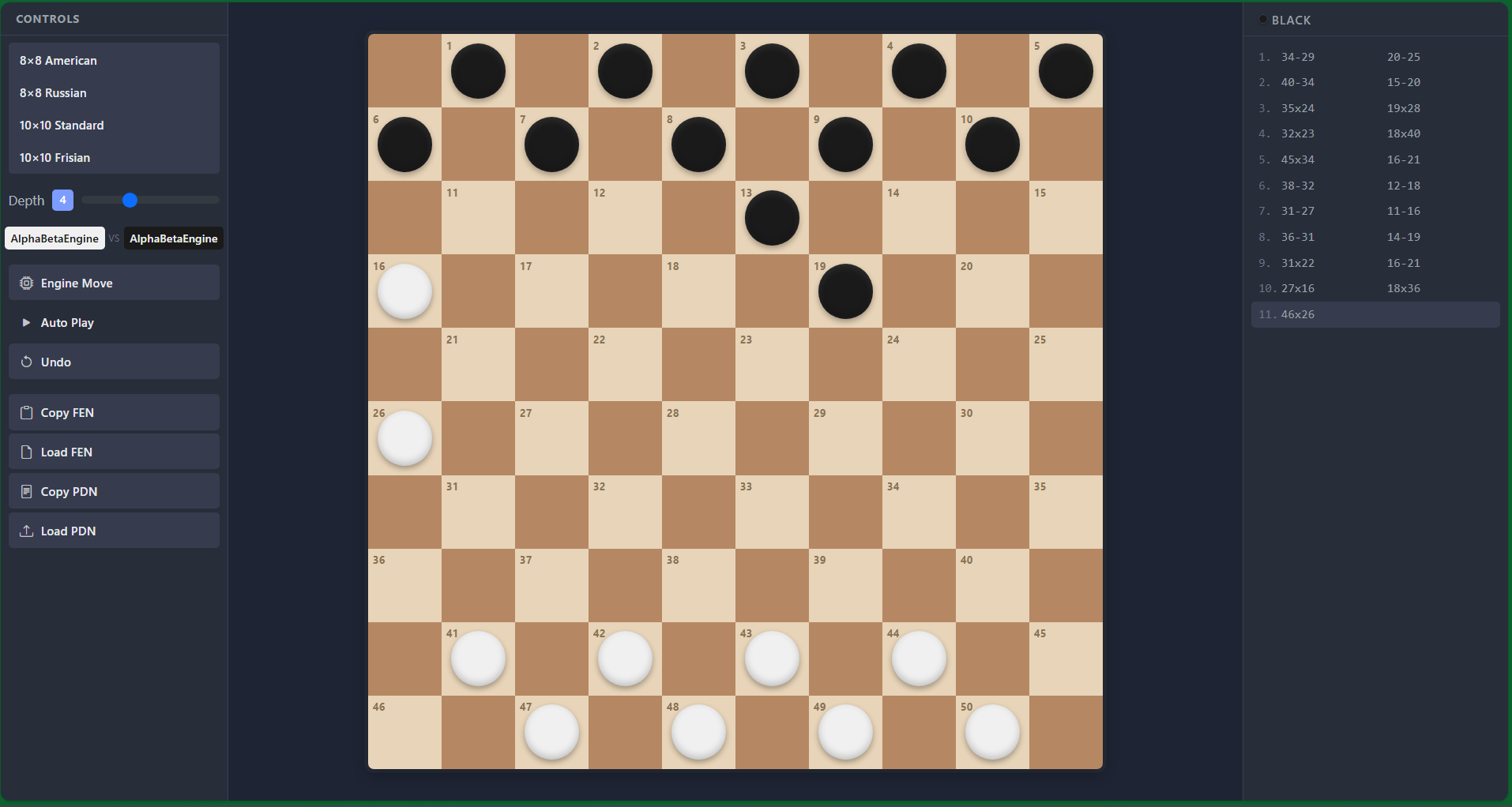
Interactive web interface for playing and engine testing:
from draughts import Board, Server, SimpleEngine, HubEngine

server = Server(
    board=Board(),
    white_engine=SimpleEngine(depth_limit=6),
    black_engine=HubEngine("path/to/scan.exe", time_limit=1.0)
)
server.run() # Open http://localhost:8000
Performance
Legal moves generation in ~10-30 microseconds:
| Operation | py-draughts | pydraughts | Speedup |
|---|---|---|---|
| Board init | 3.30 µs | 579.45 µs | 176x faster |
| FEN parse | 27.40 µs | 295.10 µs | 11x faster |
| Legal moves | 21.35 µs | 5.18 ms | 243x faster |
| Make move | 1.20 µs | 552.50 µs | 460x faster |

Engine search at various depths:
| Depth | Time | Nodes |
|---|---|---|
| 5 | 274 ms | 3,263 |
| 6 | 619 ms | 7,330 |
| 7 | 2.20 s | 21,642 |
| 8 | 6.55 s | 98,987 |

Testing
Comprehensive test suite with 260+ tests covering all variants and edge cases:
pytest test/ -v
Tests include:
- Move generation - Push/pop roundtrips, legal move validation
- Real game replays - PDN games from Lidraughts for all variants
- Edge cases - Complex king captures, promotion mid-capture, draw rules
- Engine correctness - Hash stability, transposition tables, board immutability
- All 8 variants - Standard, American, Frisian, Russian, Brazilian, Antidraughts, Breakthrough, Frysk!
Contributing
Contributions welcome! Please open an issue or submit a pull request.
License
py-draughts is licensed under the GPL 3.
Project details
Verified details
These details have been verified by PyPIProject links
GitHub Statistics
Maintainers
Release history Release notifications | RSS feed


Download files
Download the file for your platform. If you're not sure which to choose, learn more about installing packages.
Source Distribution
Built Distribution
Filter files by name, interpreter, ABI, and platform.
If you're not sure about the file name format, learn more about wheel file names.
Copy a direct link to the current filters
File details
Details for the file py_draughts-1.9.0.tar.gz.
File metadata
- Download URL: py_draughts-1.9.0.tar.gz
- Upload date:
- Size: 213.9 kB
- Tags: Source
- Uploaded using Trusted Publishing? Yes
- Uploaded via: twine/6.1.0 CPython/3.13.12
File hashes
| Algorithm | Hash digest | |
|---|---|---|
| SHA256 |
29f8346896ddbb98314a1d38c6e94b6cb7108fbb8f6070bbe68993d75773353e
|
|
| MD5 |
d902e4089613c5df7aa67484366cd1d0
|
|
| BLAKE2b-256 |
18a8ff12d42832711ec18f4bfa1b5352bcc97a6b3e0878bd951287d1c92ad88f
|
Provenance
The following attestation bundles were made for py_draughts-1.9.0.tar.gz:
Publisher:
python-publish.yml on miskibin/py-draughts
-
Statement:
-
Statement type:
https://in-toto.io/Statement/v1 -
Predicate type:
https://docs.pypi.org/attestations/publish/v1 -
Subject name:
py_draughts-1.9.0.tar.gz -
Subject digest:
29f8346896ddbb98314a1d38c6e94b6cb7108fbb8f6070bbe68993d75773353e - Sigstore transparency entry: 2183390149
- Sigstore integration time:
-
Permalink:
miskibin/py-draughts@402aab0f8937469cb31368986667a8f225e176d7 -
Branch / Tag:
refs/heads/main - Owner: https://github.com/miskibin
-
Access:
public
-
Token Issuer:
https://token.actions.githubusercontent.com -
Runner Environment:
github-hosted -
Publication workflow:
python-publish.yml@402aab0f8937469cb31368986667a8f225e176d7 -
Trigger Event:
workflow_run
-
Statement type:
File details
Details for the file py_draughts-1.9.0-py3-none-any.whl.
File metadata
- Download URL: py_draughts-1.9.0-py3-none-any.whl
- Upload date:
- Size: 221.7 kB
- Tags: Python 3
- Uploaded using Trusted Publishing? Yes
- Uploaded via: twine/6.1.0 CPython/3.13.12
File hashes
| Algorithm | Hash digest | |
|---|---|---|
| SHA256 |
2699452289b644286b8ad2f51bc93b2166bb8a89ffea47e826dceb4dd41b423e
|
|
| MD5 |
e2cc2296b07a701446c4f80eced7da85
|
|
| BLAKE2b-256 |
b6fef860d6e92af21a8c93f75e2c8f4829d5b2683a1af55b5a122541cbeb43cb
|
Provenance
The following attestation bundles were made for py_draughts-1.9.0-py3-none-any.whl:
Publisher:
python-publish.yml on miskibin/py-draughts
-
Statement:
-
Statement type:
https://in-toto.io/Statement/v1 -
Predicate type:
https://docs.pypi.org/attestations/publish/v1 -
Subject name:
py_draughts-1.9.0-py3-none-any.whl -
Subject digest:
2699452289b644286b8ad2f51bc93b2166bb8a89ffea47e826dceb4dd41b423e - Sigstore transparency entry: 2183390369
- Sigstore integration time:
-
Permalink:
miskibin/py-draughts@402aab0f8937469cb31368986667a8f225e176d7 -
Branch / Tag:
refs/heads/main - Owner: https://github.com/miskibin
-
Access:
public
-
Token Issuer:
https://token.actions.githubusercontent.com -
Runner Environment:
github-hosted -
Publication workflow:
python-publish.yml@402aab0f8937469cb31368986667a8f225e176d7 -
Trigger Event:
workflow_run
-
Statement type:






