
Bayesian IRT models in Python

Project description


py-irt
Bayesian IRT models in Python
Overview
This repository includes code for fitting Item Response Theory (IRT) models using variational inference.
At present, the one parameter logistic (1PL) model, aka Rasch model, two parameter logistic model (2PL) and four parameter logistic model (4PL) have been implemented. The user can specify whether vague or hierarchical priors are used. The three-parameter logistic model is in the pipeline and will be added when available.
License
py-irt is licensed under the MIT license.
Installation
py-irt is now available on PyPi!
Pre-reqs
pip install py-irt
OR
Install Poetry
git clone https://github.com/nd-ball/py-irt.git
cd py-irt
poetry install
Usage
Once you install from PyPI, you can use the following command to fit an IRT
model on the scored predictions of a dataset. For example, if you were to run py-irt with the 4PL model on the scored predictions of different transformer models on the SQuAD dataset, you'd do this:
py-irt train 4pl ~/path/to/dataset/eg/squad.jsonlines /path/to/output/eg/test-4pl/
FAQ
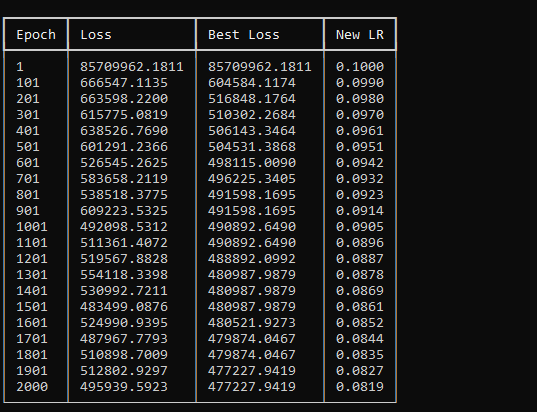
- What kind of output should I expect on running the command to train an IRT model?
You should see something like this when you run the command given above:
- I tried installing py-irt using pip from PyPI. But when I try to run the command
py-irt train 4pl ~/path/to/dataset/eg/squad.jsonlines /path/to/output/eg/test-4pl/, I get an error that saysbash: py-irt: command not found. How do I fix this?
The CLI interface was implemented in PyPi version 0.2.1. If you are getting this error try updating py-irt:
pip install --upgrade py-irt
Alternatively, you can install the latest version from github:
git clone https://github.com/nd-ball/py-irt.git
cd py-irt
mv ~/py-irt/py_irt/cli.py ~/py-irt/
python cli.py train 4pl ~/path/to/dataset/eg/squad.jsonlines /path/to/output/eg/test-4pl/
- How do I evaluate a trained IRT model?
If you have already trained an IRT model you can use the following command:
py-irt evaluate 4pl ~/path/to/data/best_parameters.json ~/path/to/data/test_pairs.jsonlines /path/to/output/eg/test-4pl/
Where test_pairs.jsonlines is a jsonlines file with the following format:
{"subject_id": "ken", "item_id": "q1"}
{"subject_id": "ken", "item_id": "q2"}
{"subject_id": "burt", "item_id": "q1"}
{"subject_id": "burt", "item_id": "q3"}
If you would like to both train and evaluate a model you can use the following command:
py-irt train-and-evaluate 4pl ~/path/to/data/squad.jsonlines /path/to/output/eg/test-4pl/
By default this will train a model with 90% of the provided data and evaluate with the remaining 10%.
To change this behavior you can add --evaluation all to the command above.
The model will train and evaluate against all of the data.
Citations
If you use this code, please consider citing the following papers:
@inproceedings{lalor2019emnlp,
  author    = {Lalor, John P and Wu, Hao and Yu, Hong},
  title     = {Learning Latent Parameters without Human Response Patterns: Item Response Theory with Artificial Crowds},
  year      = {2019},
  booktitle = {Proceedings of the 2019 Conference on Empirical Methods in Natural Language Processing},
}
@inproceedings{rodriguez2021evaluation,
  title={Evaluation Examples Are Not Equally Informative: How Should That Change NLP Leaderboards?},
  author={Rodriguez, Pedro and Barrow, Joe and Hoyle, Alexander Miserlis and Lalor, John P and Jia, Robin and Boyd-Graber, Jordan},
  booktitle={Proceedings of the 59th Annual Meeting of the Association for Computational Linguistics and the 11th International Joint Conference on Natural Language Processing (Volume 1: Long Papers)},
  pages={4486--4503},
  year={2021}
}
Implementation is based on the following paper:
@article{natesan2016bayesian,
  title={Bayesian prior choice in IRT estimation using MCMC and variational Bayes},
  author={Natesan, Prathiba and Nandakumar, Ratna and Minka, Tom and Rubright, Jonathan D},
  journal={Frontiers in psychology},
  volume={7},
  pages={1422},
  year={2016},
  publisher={Frontiers}
}
Contributing
This is research code. Pull requests and issues are welcome!
Questions?
Let me know if you have any requests, bugs, etc.
Email: john.lalor@nd.edu
Release history Release notifications | RSS feed


Download files
Download the file for your platform. If you're not sure which to choose, learn more about installing packages.
Source Distribution
Built Distribution
Filter files by name, interpreter, ABI, and platform.
If you're not sure about the file name format, learn more about wheel file names.
Copy a direct link to the current filters
File details
Details for the file py_irt-0.6.2.tar.gz.
File metadata
- Download URL: py_irt-0.6.2.tar.gz
- Upload date:
- Size: 21.3 kB
- Tags: Source
- Uploaded using Trusted Publishing? No
- Uploaded via: poetry/1.8.2 CPython/3.12.2 Windows/11
File hashes
| Algorithm | Hash digest | |
|---|---|---|
| SHA256 |
1142b22aa9f999cf72c02fcc0bc9a1f9d580ebce61465c448a4ff476ff5b2b1d
|
|
| MD5 |
8df6c106549840c5517fa31ce73ace0d
|
|
| BLAKE2b-256 |
cd710c12ec8e63d243584761059ca3075ec7c0f0dddb091c4c4cf6acfb5a44e4
|
File details
Details for the file py_irt-0.6.2-py3-none-any.whl.
File metadata
- Download URL: py_irt-0.6.2-py3-none-any.whl
- Upload date:
- Size: 41.5 kB
- Tags: Python 3
- Uploaded using Trusted Publishing? No
- Uploaded via: poetry/1.8.2 CPython/3.12.2 Windows/11
File hashes
| Algorithm | Hash digest | |
|---|---|---|
| SHA256 |
02ccc38925908009efb281a7caeeb3370e477788194aba5d14e58a7a719246a2
|
|
| MD5 |
e39d1606a85c67dc0adf15c779ac6ffa
|
|
| BLAKE2b-256 |
8988bbb60c3ef830542b68f791c91681518d5c3ae56e517da4dbe64b8fd14604
|






