
Empirical wave runup models implemented in Python

Project description
Empirical wave runup models implemented in Python for coastal engineers and scientists.





Contents
Installation
Installation of py-wave-runup can be done with uv or pip:
# Using uv (recommended)
uv add py-wave-runup

# Using pip
pip install py-wave-runup
Usage
The following wave runup models are available for use:
models.Stockdon2006: The most commonly cited and widely used runup model.
models.Power2018: Based on the Gene-Expression Programming technique.
models.Holman1986: Incorporated wave setup using Duck, NC measurements.
models.Nielsen2009: Based on runup measurements from NSW, Australia.
models.Ruggiero2001: Based on runup measurements from dissipative Orgeon beaches.
models.Vousdoukas2012: Based on runup from European Atlantic coast
models.Senechal2011: Based on extreme storm condition at Truc Vert, France
models.Beuzen2019: Gaussian Process (GP) runup model
models.Passarella2018: Genetic Programming (infragravity and total) swash model
To get calculate runup, setup and swash, define your offshore conditions in your selected runup model then you can access each parameter:
from py_wave_runup import models

model_sto06 = models.Stockdon2006(Hs=4, Tp=12, beta=0.1)

model_sto06.R2     # 2.54
model_sto06.setup  # 0.96
model_sto06.sinc   # 2.06
model_sto06.sig    # 1.65
Documentation
Documentation is located at https://py-wave-runup.readthedocs.io.
Background
Wave runup refers to the final part of a wave’s journey as it travels from offshore onto the beach. It is observable by anyone who goes to the beach and watches the edge of the water “runup” and rundown the beach. It is comprised of two components:
setup: the height of the time averaged superelevation of the mean water level above the Still Water Level (SWL)
swash: the height of the time varying fluctuation of the instantaneous water level about the setup elevation
Setup, swash and other components of Total Water Level (TWL) rise are shown in this handy figure below.
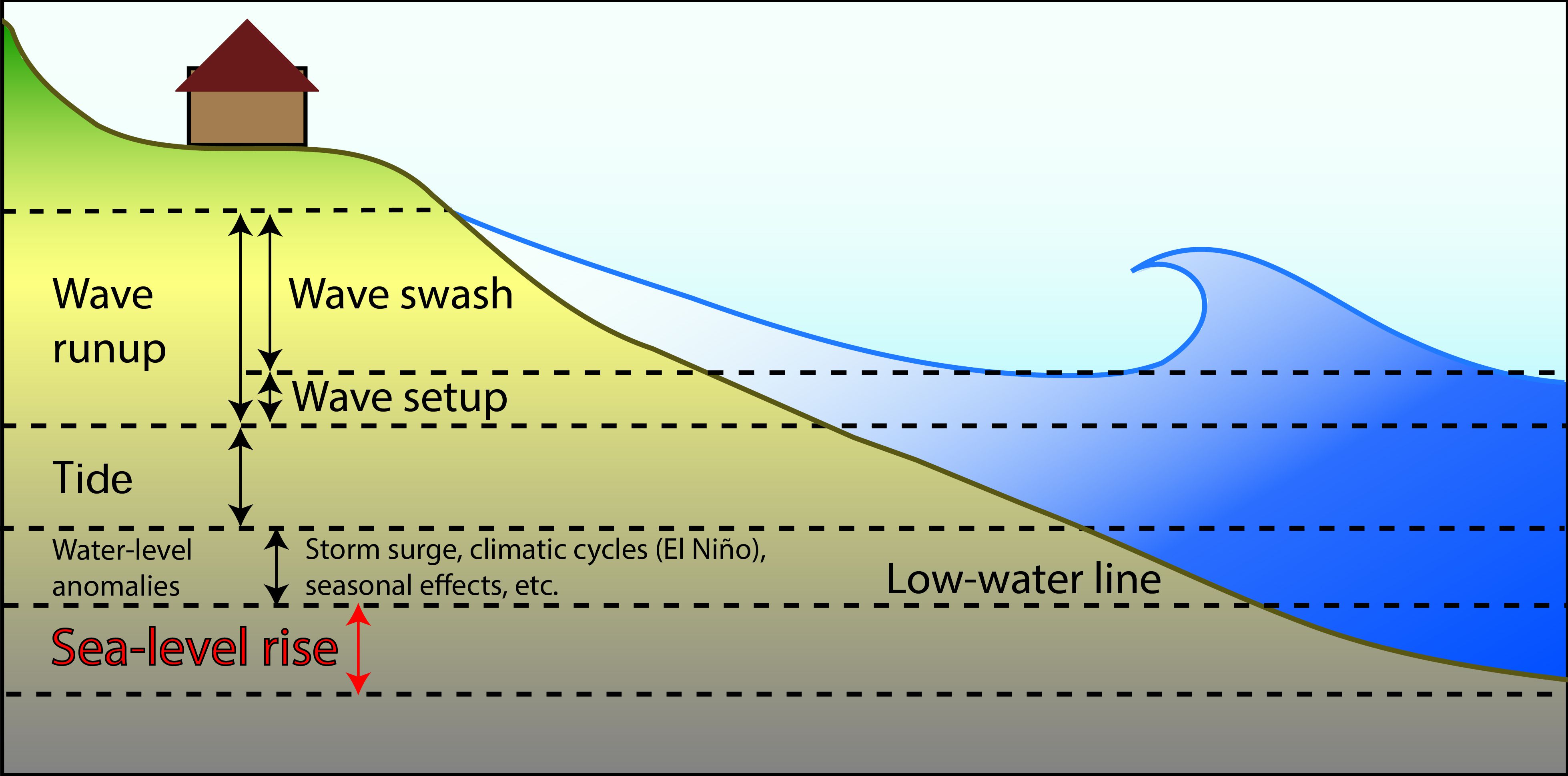
Figure from Vitousek et al. (2017) [1]
Wave runup can contribute a significant portion of the increase in TWL in coastal storms causing erosion and inundation. For example, Stockdon et al. (2006) [2] collated data from numerous experiments, some of which showed wave runup 2% excedence heights in excess of 3 m during some storms.
Given the impact such a large increase in TWL can have on coastlines, there has been much research conducted to try improve our understanding of wave runup processes. Although there are many processes which can influence wave runup (such as nonlinear wave transformation, wave reflection, three-dimensional effects, porosity, roughness, permeability and groundwater) [3], many attempts have been made to derive empirical relatinoships based on easily measurable parameters. Typically, empirical wave runup models include:
Hs: significant wave height
Tp: peak wave length
beta: beach slope
This python package attempts to consolidate the work done by others in this field and collate the numerous empirical relationships for wave runup which have been published.
Contributing
As there are many different empirical wave models out there, contributions are most welcome. If you don’t feel confident about changing the code yourself, feel free to open a Github issue and let us know what could be added. Otherwise, follow the steps below to create a Pull Request:
Create the development environment:
Using uv (recommended): uv sync --dev
For pip: pip install -e ".[dev]"
Create your feature branch (git checkout -b feature/fooBar)
Install pre-commit hooks for automatic formatting (uv run pre-commit install)
Add your code!
Add and run tests (uv run pytest)
Update and check documentation compiles (uv run sphinx-build -M html ".\docs" ".\docs\_build")
Commit your changes (git commit -am 'Add some fooBar')
Push to the branch (git push origin feature/fooBar)
Create a new Pull Request
Publishing
To build and publish the package to PyPI:
# Build the package
uv build

# Check the package (optional)
uv run --active twine check dist/*

# Publish to Test PyPI first (recommended)
uv publish --publish-url https://test.pypi.org/legacy/

# Publish to PyPI
uv publish
Citation
If this package has been useful to you, please cite the following DOI: https://doi.org/10.5281/zenodo.2667464
License
Distributed under the GNU General Public License v3.
References
Release history Release notifications | RSS feed


Download files
Download the file for your platform. If you're not sure which to choose, learn more about installing packages.
Source Distribution
Built Distribution
Filter files by name, interpreter, ABI, and platform.
If you're not sure about the file name format, learn more about wheel file names.
Copy a direct link to the current filters
File details
Details for the file py_wave_runup-0.1.12.tar.gz.
File metadata
- Download URL: py_wave_runup-0.1.12.tar.gz
- Upload date:
- Size: 1.1 MB
- Tags: Source
- Uploaded using Trusted Publishing? No
- Uploaded via: uv/0.8.20
File hashes
| Algorithm | Hash digest | |
|---|---|---|
| SHA256 |
49935b83ce5cceb68b8984ecae736c14db3e27cec626798028c7f099d9456faf
|
|
| MD5 |
091220f1fb3d012346f779b17648d6fd
|
|
| BLAKE2b-256 |
173469a9cd2aacff56fd103c268aaff96e699363572f4b2193f417d2d0b5a06f
|
File details
Details for the file py_wave_runup-0.1.12-py3-none-any.whl.
File metadata
- Download URL: py_wave_runup-0.1.12-py3-none-any.whl
- Upload date:
- Size: 741.7 kB
- Tags: Python 3
- Uploaded using Trusted Publishing? No
- Uploaded via: uv/0.8.20
File hashes
| Algorithm | Hash digest | |
|---|---|---|
| SHA256 |
25f0197c38d6ac62f9f037089066978019cf1e93a6e6280e949f450746a44d21
|
|
| MD5 |
b6a19a87370b719b2cf9e575e231b6f1
|
|
| BLAKE2b-256 |
ed61e11b8b54278f7f8e104bc1d658286f3ee0eb87e7d4f9f4498ff342a051cd
|






