
py4cli
- Python for Command Line Interface development ( scalable argument parser ).
- Argument Parser for developing Command Line Tools, that is scalable as per need.
- Check out the example code in repo ( https://github.com/Palani-SN/py4cli ) for reference.
Installation
- use pip command to install the library, refer pypi page : https://pypi.org/project/py4cli/
python -m pip install py4cli
Minimal
- minimal arg parser that can pass on the cli arguments to parse_args class method arguments as per the declarative type definition. (works fine on windows & linux)
- Sample code as shown below can read arguments in specified type as per function signature. (refer use_minimal.py under EXAMPLES/)
from py4cli.minimal import arg_parser

# Multiple arguments example

class multi_args(arg_parser):

    # example parse_args template function with multiple arguments of different types
    def parse_args(self,
            inp_int: int = 6,
            inp_float: float = 6.0,
            inp_str: str = "Six",
            inp_list: list = [6, 6.0, "Six"],
            inp_dict: dict = {'int': 6, 'float': 6.0, 'str': "Six"},
            inp_bool: bool = False) -> dict:
        """
        Six arguments of different data type can be passed
        any value of the respective data type can be passed for specific argument. for defaults refer above
        the function returns a dict containing all the arguments and its values.

        cmds :
            1. python <__file__> 10 10.0 "Seven" "[10, 10.0, 'Seven']" "{'int':10, 'float':10.0, 'str':'Seven'}" True
            2. python <__file__> -inp_int=10 -inp_float=10.0 -inp_str="Seven" -inp_list="[10, 10.0, 'Seven']" -inp_dict="{'int':10, 'float':10.0, 'str':'Seven'}" -inp_bool=True
        """
        return {
                'inp_int': inp_int,
                'inp_float': inp_float,
                'inp_str': inp_str,
                'inp_list': inp_list,
                'inp_dict': inp_dict,
                'inp_bool': inp_bool
            }

if __name__ == '__main__':

    import sys
    import json

    print(sys.argv)
    obj = multi_args()
    print("")
    if obj.returned:
        out_dict = obj.returned.copy()
        print(json.dumps(out_dict, indent=2, sort_keys=True), type(obj.returned))
    else:
        print(obj.returned, type(obj.returned))
- To get help on how to use the script, execute python use_minimal.py -h or python use_minimal.py --help which will generate the doc content based on the comments in script as shown below.
(examples) D:\GitRepos\py4cli\EXAMPLES>python use_minimal.py --help
['use_minimal.py', '--help']

 | > def parse_args
 |
 |  Description :
 |
 |    example parse_args template function with multiple arguments of different types
 |
 |  Arguments :
 |
 |   -inp_int: int = 6
 |   -inp_float: float = 6.0
 |   -inp_str: str = 'Six'
 |   -inp_list: list = [6, 6.0, 'Six']
 |   -inp_dict: dict = {'int': 6, 'float': 6.0, 'str': 'Six'}
 |   -inp_bool: bool = False
 |
 |  Usage :
 |
 |    Six arguments of different data type can be passed
 |    any value of the respective data type can be passed for specific argument. for defaults refer above
 |    the function returns a dict containing all the arguments and its values.
 |
 |    cmds :
 |      1. python D:\GitRepos\py4cli\EXAMPLES\use_minimal.py 10 10.0 "Seven" "[10, 10.0, 'Seven']" "{'int':10, 'float':10.0, 'str':'Seven'}" True
 |      2. python D:\GitRepos\py4cli\EXAMPLES\use_minimal.py -inp_int=10 -inp_float=10.0 -inp_str="Seven" -inp_list="[10, 10.0, 'Seven']" -inp_dict="{'int':10, 'float':10.0, 'str':'Seven'}" -inp_bool=True
 |
 | -> dict (Returnable)

None <class 'NoneType'>
- The commands specified can be used to alter the values as command line arguments to the script.
output

(examples) D:\GitRepos\py4cli\EXAMPLES>python use_minimal.py
['use_minimal.py']

{
  "inp_bool": false,
  "inp_dict": {
    "float": 6.0,
    "int": 6,
    "str": "Six"
  },
  "inp_float": 6.0,
  "inp_int": 6,
  "inp_list": [
    6,
    6.0,
    "Six"
  ],
  "inp_str": "Six"
} <class 'dict'>

(examples) D:\GitRepos\py4cli\EXAMPLES>python use_minimal.py 100 100.0 "parse args example function call" "[1, 2, 3, 4, 5, 6]"
['use_minimal.py', '100', '100.0', 'parse args example function call', '[1, 2, 3, 4, 5, 6]']

{
  "inp_bool": false,
  "inp_dict": {
    "float": 6.0,
    "int": 6,
    "str": "Six"
  },
  "inp_float": 100.0,
  "inp_int": 100,
  "inp_list": [
    1,
    2,
    3,
    4,
    5,
    6
  ],
  "inp_str": "parse args example function call"
} <class 'dict'>

(examples) D:\GitRepos\py4cli\EXAMPLES>python use_minimal.py -inp_int=100 -inp_float=100.0 -inp_str="parse args example function call" -inp_list="[1, 2, 3, 4, 5, 6]"
['use_minimal.py', '-inp_int=100', '-inp_float=100.0', '-inp_str=parse args example function call', '-inp_list=[1, 2, 3, 4, 5, 6]']

{
  "inp_bool": false,
  "inp_dict": {
    "float": 6.0,
    "int": 6,
    "str": "Six"
  },
  "inp_float": 100.0,
  "inp_int": 100,
  "inp_list": [
    1,
    2,
    3,
    4,
    5,
    6
  ],
  "inp_str": "parse args example function call"
} <class 'dict'>

(examples) D:\GitRepos\py4cli\EXAMPLES>python use_minimal.py 100 100.0 -inp_str="parse args example function call" -inp_list="[1, 2, 3, 4, 5, 6]"
['use_minimal.py', '100', '100.0', '-inp_str=parse args example function call', '-inp_list=[1, 2, 3, 4, 5, 6]']

{
  "inp_bool": false,
  "inp_dict": {
    "float": 6.0,
    "int": 6,
    "str": "Six"
  },
  "inp_float": 100.0,
  "inp_int": 100,
  "inp_list": [
    1,
    2,
    3,
    4,
    5,
    6
  ],
  "inp_str": "parse args example function call"
} <class 'dict'>
Moderate
- Vertically scalable version of minimal arg parser, aimed at use case like, hyper parameter tuning.
- Sample code as shown below can read arguments in specified type as per function signature. (refer use_moderate.py under EXAMPLES/)
from py4cli.moderate import arg_parser

# Multiple arguments example

class vscaled_args(arg_parser):

    # example multi_args template function with multiple arguments of different types
    def multi_args1(self,
            inp_int: int = 6,
            inp_float: float = 6.0,
            inp_str: str = "Six",
            inp_list: list = [6, 6.0, "Six"],
            inp_dict: dict = {'int': 6, 'float': 6.0, 'str': "Six"},
            inp_bool: bool = False) -> dict:
        """
        Six arguments of different data type can be passed
        any value of the respective data type can be passed for specific argument. for defaults refer above
        the function returns a dict containing all the arguments and its values.

        cmds :
            1. python <__file__> ~<__func__> 10 10.0 "Seven" "[10, 10.0, 'Seven']" "{'int':10, 'float':10.0, 'str':'Seven'}" True
            2. python <__file__> ~<__func__> -inp_int=10 -inp_float=10.0 -inp_str="Seven" -inp_list="[10, 10.0, 'Seven']" -inp_dict="{'int':10, 'float':10.0, 'str':'Seven'}" -inp_bool=True
        """
        return {
                'inp_int': inp_int,
                'inp_float': inp_float,
                'inp_str': inp_str,
                'inp_list': inp_list,
                'inp_dict': inp_dict,
                'inp_bool': inp_bool
            }

    # example multi_args template function with multiple arguments of different types
    def multi_args2(self,
            inp_int: int = 6,
            inp_float: float = 6.0,
            inp_str: str = "Six",
            inp_list: list = [6, 6.0, "Six"],
            inp_dict: dict = {'int': 6, 'float': 6.0, 'str': "Six"},
            inp_bool: bool = False) -> dict:
        """
        Six arguments of different data type can be passed
        any value of the respective data type can be passed for specific argument. for defaults refer above
        the function returns a dict containing all the arguments and its values.

        cmds :
            1. python <__file__> ~<__func__> 10 10.0 "Seven" "[10, 10.0, 'Seven']" "{'int':10, 'float':10.0, 'str':'Seven'}" True
            2. python <__file__> ~<__func__> -inp_int=10 -inp_float=10.0 -inp_str="Seven" -inp_list="[10, 10.0, 'Seven']" -inp_dict="{'int':10, 'float':10.0, 'str':'Seven'}" -inp_bool=True
        """
        return {
                'inp_int': inp_int,
                'inp_float': inp_float,
                'inp_str': inp_str,
                'inp_list': inp_list,
                'inp_dict': inp_dict,
                'inp_bool': inp_bool
            }

if __name__ == '__main__':

    import sys
    import json

    print(sys.argv)
    obj = vscaled_args()
    print("")
    if obj.returned:
        out_dict = obj.returned.copy()
        print(json.dumps(out_dict, indent=2, sort_keys=True), type(obj.returned))
    else:
        print(obj.returned, type(obj.returned))
- To get help on how to use the script, execute python use_moderate.py -h or python use_moderate.py --help which will generate the doc content based on the comments in script as shown below.
(examples) D:\GitRepos\py4cli\EXAMPLES>python use_moderate.py
['use_moderate.py']
Methods available for use, is listed below
[
  "~multi_args1",
  "~multi_args2"
]

None <class 'NoneType'>

(examples) D:\GitRepos\py4cli\EXAMPLES>python use_moderate.py --help
['use_moderate.py', '--help']

 | > def multi_args1
 |
 |  Description :
 |
 |    example multi_args template function with multiple arguments of different types
 |
 |  Arguments :
 |
 |   -inp_int: int = 6
 |   -inp_float: float = 6.0
 |   -inp_str: str = 'Six'
 |   -inp_list: list = [6, 6.0, 'Six']
 |   -inp_dict: dict = {'int': 6, 'float': 6.0, 'str': 'Six'}
 |   -inp_bool: bool = False
 |
 |  Usage :
 |
 |    Six arguments of different data type can be passed
 |    any value of the respective data type can be passed for specific argument. for defaults refer above
 |    the function returns a dict containing all the arguments and its values.
 |
 |    cmds :
 |      1. python D:\GitRepos\py4cli\EXAMPLES\use_moderate.py ~multi_args1 10 10.0 "Seven" "[10, 10.0, 'Seven']" "{'int':10, 'float':10.0, 'str':'Seven'}" True
 |      2. python D:\GitRepos\py4cli\EXAMPLES\use_moderate.py ~multi_args1 -inp_int=10 -inp_float=10.0 -inp_str="Seven" -inp_list="[10, 10.0, 'Seven']" -inp_dict="{'int':10, 'float':10.0, 'str':'Seven'}" -inp_bool=True
 |
 | -> dict (Returnable)

 | > def multi_args2
 |
 |  Description :
 |
 |    example multi_args template function with multiple arguments of different types
 |
 |  Arguments :
 |
 |   -inp_int: int = 6
 |   -inp_float: float = 6.0
 |   -inp_str: str = 'Six'
 |   -inp_list: list = [6, 6.0, 'Six']
 |   -inp_dict: dict = {'int': 6, 'float': 6.0, 'str': 'Six'}
 |   -inp_bool: bool = False
 |
 |  Usage :
 |
 |    Six arguments of different data type can be passed
 |    any value of the respective data type can be passed for specific argument. for defaults refer above
 |    the function returns a dict containing all the arguments and its values.
 |
 |    cmds :
 |      1. python D:\GitRepos\py4cli\EXAMPLES\use_moderate.py ~multi_args2 10 10.0 "Seven" "[10, 10.0, 'Seven']" "{'int':10, 'float':10.0, 'str':'Seven'}" True
 |      2. python D:\GitRepos\py4cli\EXAMPLES\use_moderate.py ~multi_args2 -inp_int=10 -inp_float=10.0 -inp_str="Seven" -inp_list="[10, 10.0, 'Seven']" -inp_dict="{'int':10, 'float':10.0, 'str':'Seven'}" -inp_bool=True
 |
 | -> dict (Returnable)

None <class 'NoneType'>
- The commands specified can be used to alter the values as command line arguments to the script. The methods can be selected with appropriate arguments as per definition, and the order of execution of the methods is also controllable. For illustration purpose only two methods [multi_args1, multi_args2] is defined which can be scaled to number of functions, as much as python supports.
output

(examples) D:\GitRepos\py4cli\EXAMPLES>python use_moderate.py ~multi_args1 100 100.0 "multi_args1 example function call" "[1, 2, 3, 4, 5, 6]" ~multi_args2 -inp_int=100 -inp_float=100.0 -inp_str="multi_args2 example function call" -inp_list="[1, 2, 3, 4, 5, 6]"
['use_moderate.py', '~multi_args1', '100', '100.0', 'multi_args1 example function call', '[1, 2, 3, 4, 5, 6]', '~multi_args2', '-inp_int=100', '-inp_float=100.0', '-inp_str=multi_args2 example function call', '-inp_list=[1, 2, 3, 4, 5, 6]']

{
  "multi_args1": {
    "inp_bool": false,
    "inp_dict": {
      "float": 6.0,
      "int": 6,
      "str": "Six"
    },
    "inp_float": 100.0,
    "inp_int": 100,
    "inp_list": [
      1,
      2,
      3,
      4,
      5,
      6
    ],
    "inp_str": "multi_args1 example function call"
  },
  "multi_args2": {
    "inp_bool": false,
    "inp_dict": {
      "float": 6.0,
      "int": 6,
      "str": "Six"
    },
    "inp_float": 100.0,
    "inp_int": 100,
    "inp_list": [
      1,
      2,
      3,
      4,
      5,
      6
    ],
    "inp_str": "multi_args2 example function call"
  }
} <class 'dict'>
Maximal
- Horizontally scalable version of minimal arg parser, aimed at use case like, workflow development for testing & debug needs.
- Sample code as shown below can read yml or json file configurations in specified type as per function signature. (refer use_maximal.py under EXAMPLES/)
from py4cli.maximal import cnf_parser

# Multiple arguments example

class vscaled_args(cnf_parser):

    # example multi_args template function with multiple arguments of different types
    def multi_args1(self,
            inp_int: int = 6,
            inp_float: float = 6.0,
            inp_str: str = "Six",
            inp_list: list = [6, 6.0, "Six"],
            inp_dict: dict = {'int': 6, 'float': 6.0, 'str': "Six"},
            inp_bool: bool = False) -> dict:
        """
        Six arguments of different data type can be passed
        any value of the respective data type can be passed for specific argument. for defaults refer above
        the function returns a dict containing all the arguments and its values.
        """
        return {
                'inp_int': inp_int,
                'inp_float': inp_float,
                'inp_str': inp_str,
                'inp_list': inp_list,
                'inp_dict': inp_dict,
                'inp_bool': inp_bool
            }

    # example multi_args template function with multiple arguments of different types
    def multi_args2(self,
            inp_int: int = 6,
            inp_float: float = 6.0,
            inp_str: str = "Six",
            inp_list: list = [6, 6.0, "Six"],
            inp_dict: dict = {'int': 6, 'float': 6.0, 'str': "Six"},
            inp_bool: bool = False) -> dict:
        """
        Six arguments of different data type can be passed
        any value of the respective data type can be passed for specific argument. for defaults refer above
        the function returns a dict containing all the arguments and its values.
        """
        return {
                'inp_int': inp_int,
                'inp_float': inp_float,
                'inp_str': inp_str,
                'inp_list': inp_list,
                'inp_dict': inp_dict,
                'inp_bool': inp_bool
            }

if __name__ == '__main__':

    import sys
    import json

    print(sys.argv)
    obj = vscaled_args()
    print("")
    if obj.returned:
        out_dict = obj.returned.copy()
        print(json.dumps(out_dict, indent=2, sort_keys=False), type(obj.returned))
    else:
        print(obj.returned, type(obj.returned))
- To get help on how to use the script, execute python use_maximal.py -h or python use_maximal.py --help which will generate the doc content based on the comments in script as shown below.
(examples) D:\GitRepos\py4cli\EXAMPLES>python use_maximal.py --help
['use_maximal.py', '--help']
class : vscaled_args

 | > def multi_args1
 |
 |  Description :
 |
 |    example multi_args template function with multiple arguments of different types
 |
 |  Arguments :
 |
 |   -inp_int: int = 6
 |   -inp_float: float = 6.0
 |   -inp_str: str = 'Six'
 |   -inp_list: list = [6, 6.0, 'Six']
 |   -inp_dict: dict = {'int': 6, 'float': 6.0, 'str': 'Six'}
 |   -inp_bool: bool = False
 |
 |  Usage :
 |
 |    Six arguments of different data type can be passed
 |    any value of the respective data type can be passed for specific argument. for defaults refer above
 |    the function returns a dict containing all the arguments and its values.
 |
 | -> dict (Returnable)

 | > def multi_args2
 |
 |  Description :
 |
 |    example multi_args template function with multiple arguments of different types
 |
 |  Arguments :
 |
 |   -inp_int: int = 6
 |   -inp_float: float = 6.0
 |   -inp_str: str = 'Six'
 |   -inp_list: list = [6, 6.0, 'Six']
 |   -inp_dict: dict = {'int': 6, 'float': 6.0, 'str': 'Six'}
 |   -inp_bool: bool = False
 |
 |  Usage :
 |
 |    Six arguments of different data type can be passed
 |    any value of the respective data type can be passed for specific argument. for defaults refer above
 |    the function returns a dict containing all the arguments and its values.
 |
 | -> dict (Returnable)

OrderedDict() <class 'collections.OrderedDict'>
- The commands specified can be used to alter the values as yml or json file to the script. The methods can be selected with appropriate arguments as per definition, and the order of execution of the methods is also controllable. For illustration purpose only two methods [multi_args1, multi_args2] is defined which can be scaled to number of functions, as much as python supports.
output

(py4cli) D:\GitRepos\py4cli\EXAMPLES>python use_maximal.py use_max.yml
['use_maximal.py', 'use_max.yml']

{
  "multi_args1": {
    "inp_int": 100,
    "inp_float": 100.0,
    "inp_str": "Hello from YML, to multi_args1",
    "inp_list": [
      1,
      2,
      3,
      4,
      5,
      6
    ],
    "inp_dict": {
      "Hello": "World",
      "from": "YML"
    },
    "inp_bool": true
  },
  "multi_args2": {
    "inp_int": 100,
    "inp_float": 100.0,
    "inp_str": "Hello from YML, to multi_args2",
    "inp_list": [
      1,
      2,
      3,
      4,
      5,
      6
    ],
    "inp_dict": {
      "Hello": "World",
      "from": "YML"
    },
    "inp_bool": true
  }
} <class 'collections.OrderedDict'>
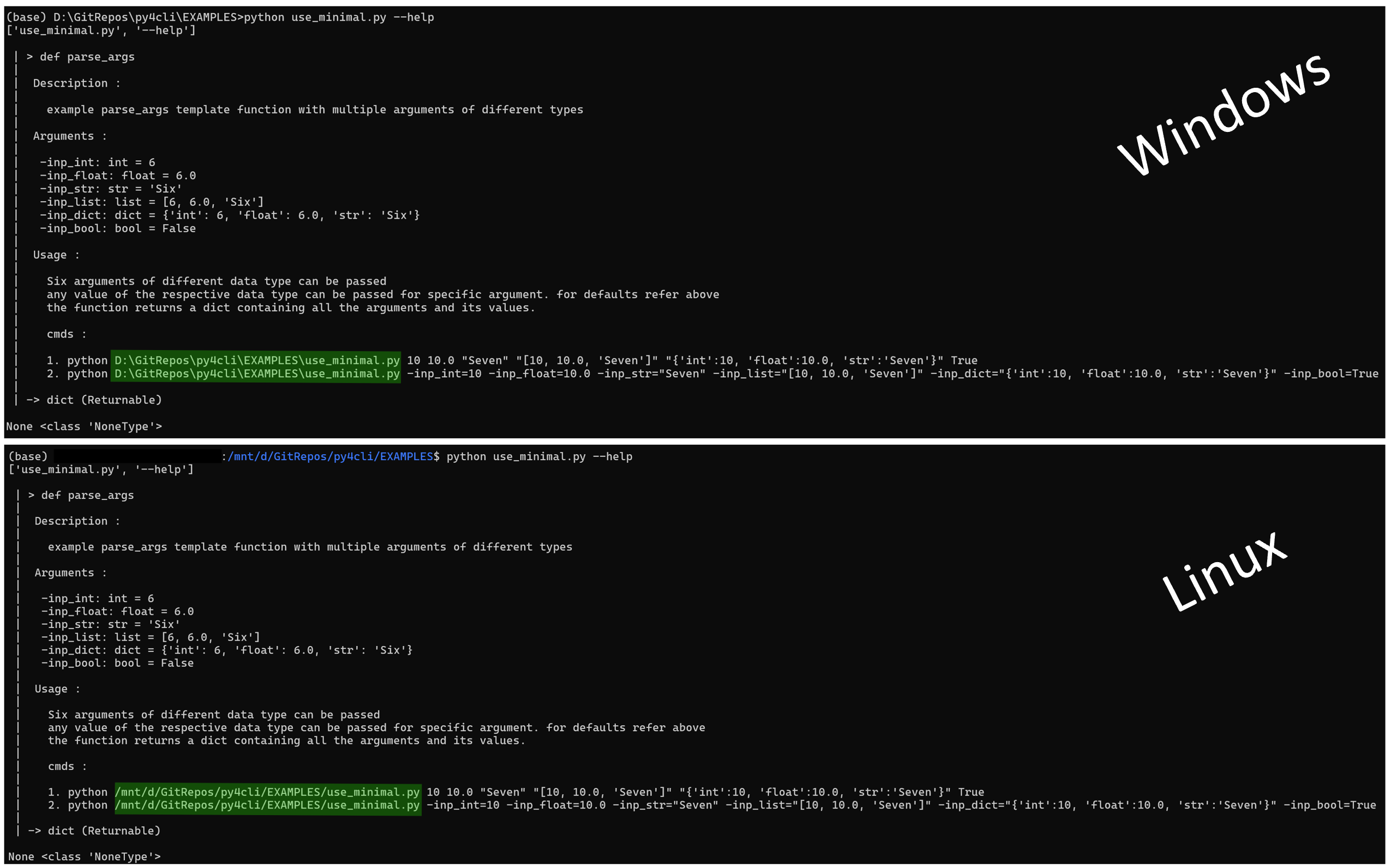
supported in windows & linux :
- The file path will be dynamically adjusted based on platforms
1 maintainer

Release files for py4cli 0.0.8
For a detailed explanation of source distributions (sdists) and built distributions (wheels), please see the package formats documentation.
Source distribution (sdist)
| File | Size | Uploaded | |
|---|---|---|---|
| py4cli-0.0.8.tar.gz | 556.6 kB | Details |
Release files / py4cli-0.0.8.tar.gz
| Download URL | py4cli-0.0.8.tar.gz |
|---|---|
| Size | 556.6 kB |
| Tags | Source |
|
SHA-256 checksum How to use checksums |
540b84d11f7633b607450519ec00476d78e33d7b397039e6b5f7653946139d3f
|
|
BLAKE2b-256 checksum How to use checksums |
f97318efc6fafc0042242282994d5958cc5bef7abe0631d600854c6dcbab81e9
|
| Upload date | |
|
Uploaded using Trusted Publishing? What is trusted publishing? |
No |
| Uploaded via |
twine/3.4.2 importlib_metadata/6.7.0 pkginfo/1.10.0 requests/2.31.0 requests-toolbelt/1.0.0 tqdm/4.66.2 CPython/3.7.16
|














