
pyBumpHunter






This is a python version of the BumpHunter algorithm, see arXiv:1101.0390, G. Choudalakis, designed to find localized excess (or deficit) of events in a 1D or 2D distribution.
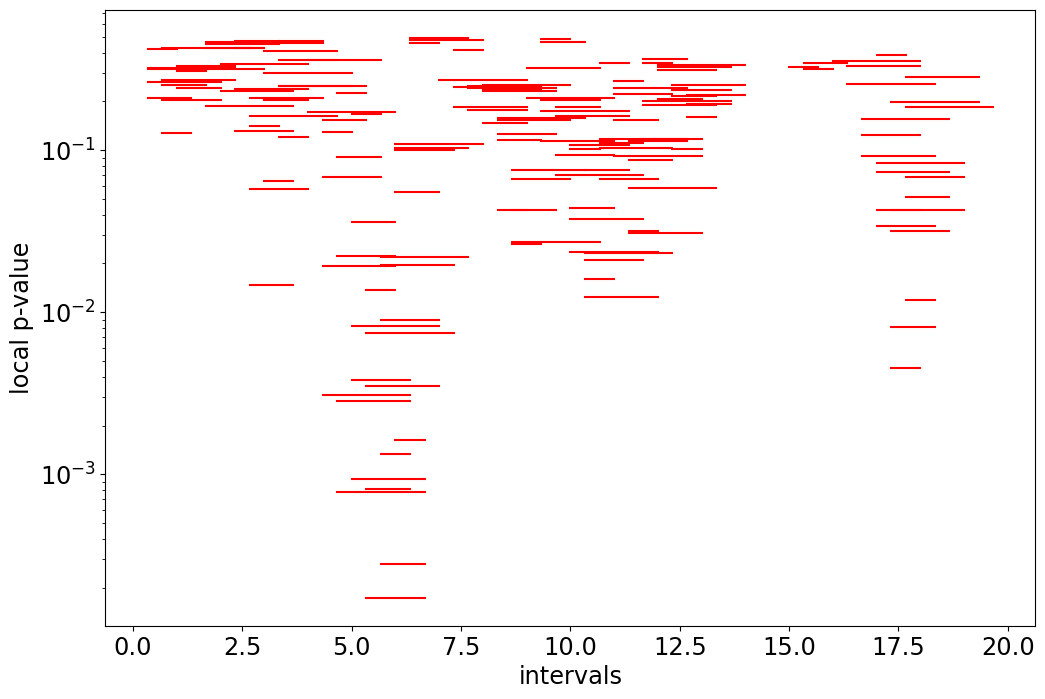
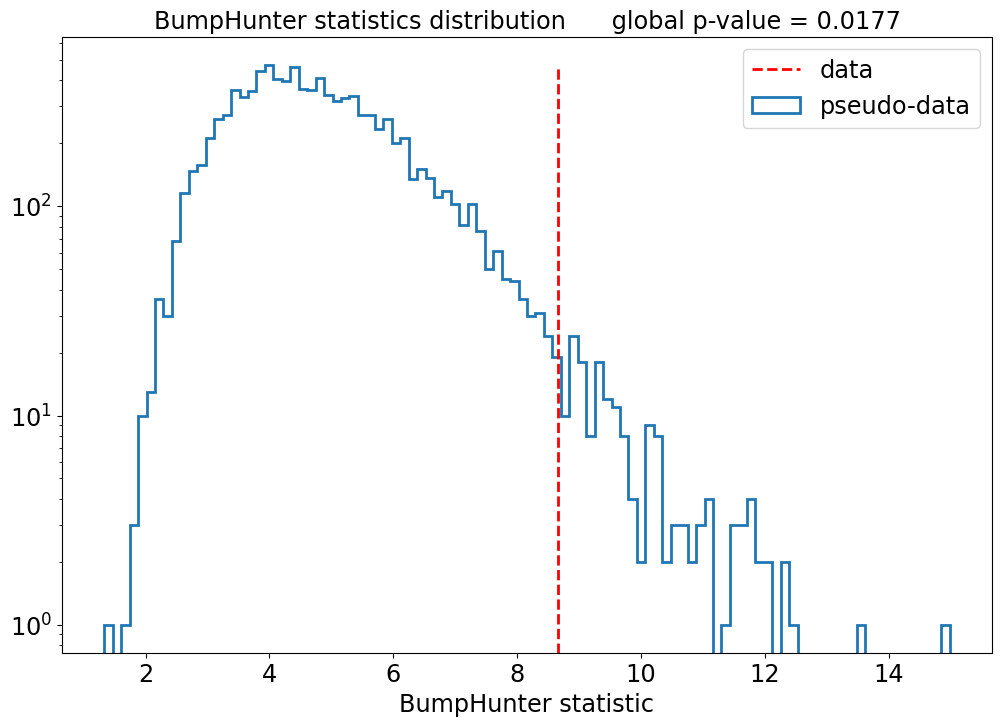
The main BumpHunter function will scan a data distribution using variable-width window sizes and calculate the p-value of data with respect to a given background distribution in each window. The minimum p-value obtained from all windows is the local p-value. To cope with the "look-elsewhere effect" a global p-value is calculated by performing background-only pseudo-experiments.
The BumpHunter algorithm can also perform signal injection tests where more and more signal is injected in toy data until a given signal significance (global) is reached (signal injection not available in 2D yet).
Content
- pyBumpHunter : The pyBumpHunter package
- example : Folder containing a set of example scripts and notebooks
- example/results : Folder containing the outputs of example scripts
- test : Folder containing the testing scripts (based on pytest)
- data/data.root : Toy data used in the examples and tests
- data/gen_data.C : Code used to generate the toy data with ROOT
Dependencies
Requires Python >= 3.9.
BumpHunter depends on the following python libraries :
- numpy
- scipy
- matplotlib
pyBumpHunter wiki
Examples
The examples provided in example.py and test.ipynb require the uproot package in order to read the data from a ROOT software file.
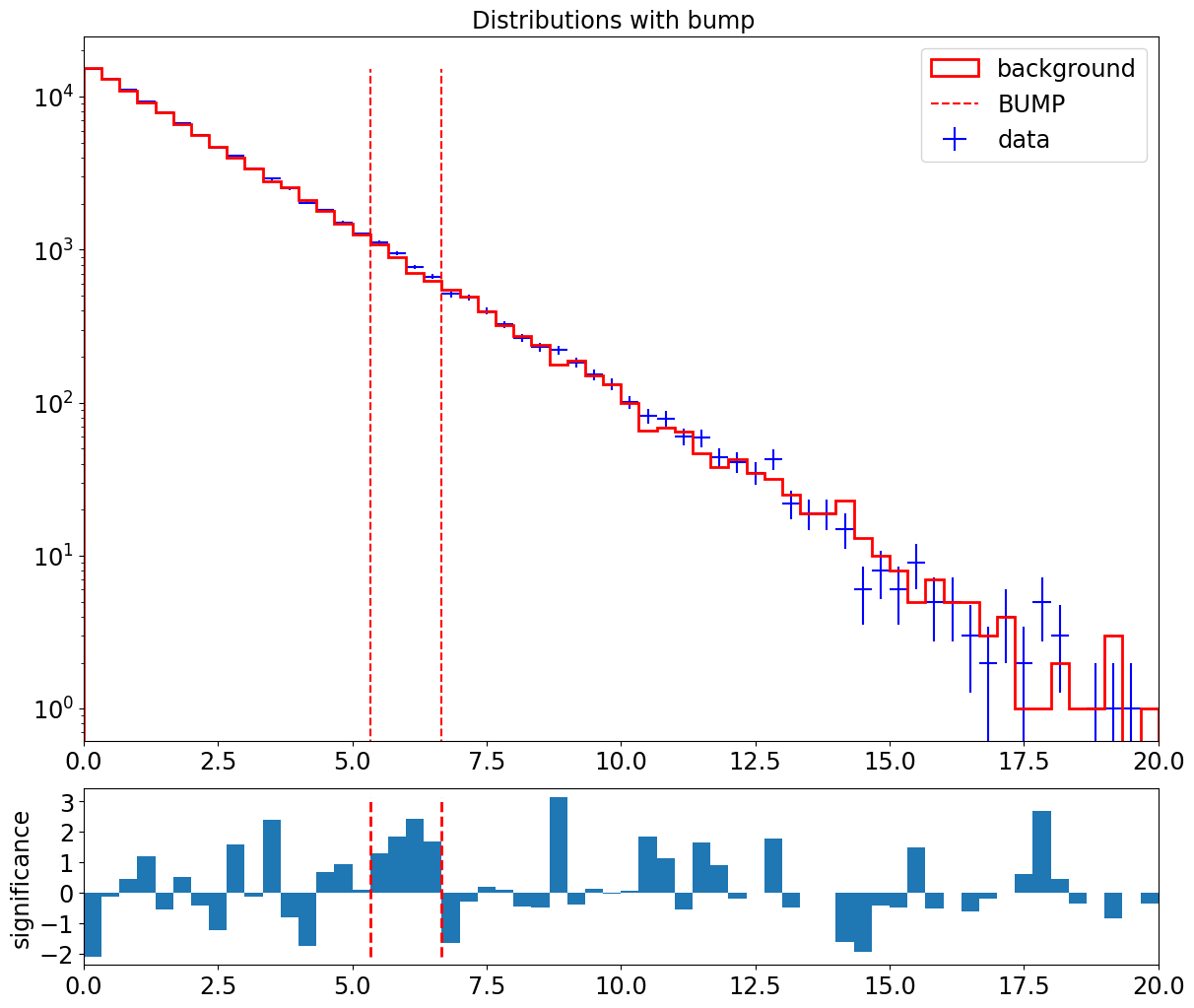
The data provided in the example consists of three histograms: a steeply falling 'background' distribution in a [0,20] x-axis range, a 'signal' gaussian shape centered on a value of 5.5, and a 'data' distribution sampled from background and signal distributions, with a signal fraction of 0.15%. The data file is produced by running gen_data.C in ROOT.
In order to run the example script, simply type python3 example.py in a terminal.
You can also open the example notebook with jupyter or binder.
- Bump hunting:
- Tomography scan:
- Test statistics and global p-value:
See the wiki for a detailed overview of all the features offered by pyBumpHunter.
To do list
- Run BH on 2D histograms
Authors and contributors
Louis Vaslin (main developper), Julien Donini
Thanks to Samuel Calvet for his help in cross-checking and validating pyBumpHunter against the (internal) C++ version of BumpHunter developped by the ATLAS collaboration.
2 maintainers


Release files for pyBumpHunter 0.5.1
For a detailed explanation of source distributions (sdists) and built distributions (wheels), please see the package formats documentation.
Source distribution (sdist)
| File | Size | Uploaded | |
|---|---|---|---|
| pybumphunter-0.5.1.tar.gz | 2.2 MB | Details |
Built distribution (wheel)
| File | Interpreter | ABI | Platform | Reset |
|---|---|---|---|---|
| pybumphunter-0.5.1-py3-none-any.whl | Python 3 | none | any | Details |
Total release size: 4.4 MB
Release files / pybumphunter-0.5.1.tar.gz
| Download URL | pybumphunter-0.5.1.tar.gz |
|---|---|
| Size | 2.2 MB |
| Tags | Source |
|
SHA-256 checksum How to use checksums |
3aa13130f6b8552d2025491aaa1e1a90ccceeda42079dd0d6745e83860860b89
|
|
BLAKE2b-256 checksum How to use checksums |
334e17938e615c84bb887358273a04742554749a2f337cd435f1e299ece8b6fa
|
| Upload date | |
|
Uploaded using Trusted Publishing? What is trusted publishing? |
No |
| Uploaded via |
twine/7.0.0 CPython/3.13.13
|
Release files / pybumphunter-0.5.1-py3-none-any.whl
| Download URL | pybumphunter-0.5.1-py3-none-any.whl |
|---|---|
| Size | 2.2 MB |
| Tags | Python 3 |
|
SHA-256 checksum How to use checksums |
4cc4b0dd97ce3b65878d35b27f963dc51e911cc99150ac36b9b1d370fff3d7bf
|
|
BLAKE2b-256 checksum How to use checksums |
5b5bb6e9899895d15819011c351fce3d36f0de72d5fc31ee1d56b2af558f9571
|
| Upload date | |
|
Uploaded using Trusted Publishing? What is trusted publishing? |
No |
| Uploaded via |
twine/7.0.0 CPython/3.13.13
|














