
A Python package for the analysis of Diffusing Wave Spectroscopy and tracer bead microrheology data.

Project description



pyDWS - Expanding the reach of diffusing wave spectroscopy and tracer bead microrheology
Welcome to the repository for pyDWS, a Python package implementing the two-cell Echo diffusing wave spectroscopy (DWS) scheme.
This package provides:
-
A calibration-free method to blend and merge Echo and two-cell DWS data
-
Exponential spectrum fitting to enhance data quality, particularly at very short times
-
Stable corrections for bead and fluid inertia, significantly improving microrheology data quality at high frequencies
pyDWS is based on:
M. Helfer, C. Zhang, and F. Scheffold, "Expanding the reach of diffusing wave spectroscopy and tracer bead microrheology," arXiv:2502.14973 (2025), https://doi.org/10.48550/arXiv.2502.14973.
Introduction
Diffusing Wave Spectroscopy (DWS) is an extension of standard dynamic light scattering (DLS), applied to soft materials that are turbid or opaque. The propagation of light is modeled using light diffusion, characterized by a light diffusion coefficient that depends on the transport mean free path l* of the medium. DWS is highly sensitive to small particle displacements or other local fluctuations in the scattering properties and can probe subnanometer displacements. Analyzing the motion of beads in a viscoelastic matrix, known as one-bead microrheology, is one of the most common applications of DWS. Despite significant advancements since its invention in 1987, including two-cell and multi-speckle DWS, challenges such as merging single and multi-speckle data and limited accuracy for short correlation times persist.
With this package, we address these key challenges in the implementation of the two-cell Echo DWS measurement scheme and propose two major improvements.
First, we introduce a calibration-free method to blend and merge Echo and two-cell DWS measurements. Second, we show that an unbiased fit of the intensity correlation function (ICF) at short times significantly improves data quality in this regime.
Building on this approach, we also demonstrate that a stable correction for bead and fluid inertia can be applied, further enhancing the reliability of microrheology data at short times.
Requirements
This package is compatible with Python ≥ 3.10 and depends on the following libraries:
matplotlib >= 3.10.5numpy >= 2.3.2pandas >= 2.3.1scikit-learn >= 1.7.1scipy >= 1.16.1statsmodels >= 0.14.5
Installation
You can install pyDWS directly from PyPI using pip:
pip install pyDWS
Examples
We provide example workflows for wormlike micellar and microgel samples via Jupyter notebooks in the examples folder, illustrating how this package can be used.
The example datasets are available in the data folder. All measurements were performed using the following setup:
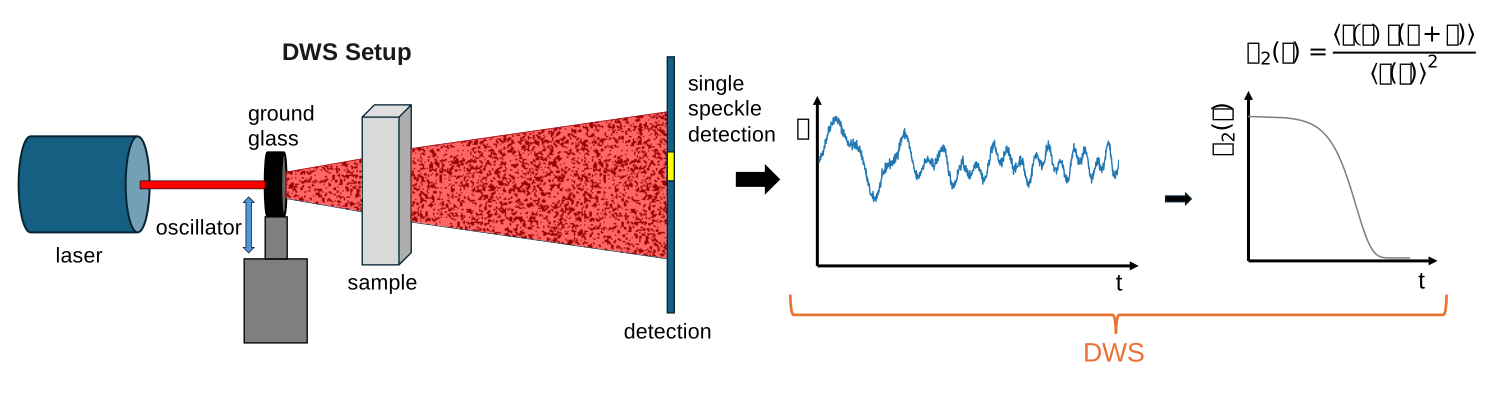
From the intensity fluctuations, the correlator outputs the intensity correlation function (ICF), g₂(t) - 1.
The two-cell measurements were performed at a frequency of 13 mHz, and the echo measurements at 25 Hz, both with an amplitude of 3 Vᵣₘₛ. The actual frequency during the Echo measurement is 24.9997 Hz, which is slightly lower than the set frequency because of the inertia of the oscillator.
-
Parameters Values Sample An aqueous solution of cetylpyridinium chloride and sodium salicylate (100 mM CPyCl–60 mM NaSal). The sample is mixed with polystyrene beads to a final concentration slightly below 1% by volume. l* 330 μm n_water 1.33 λ 633 nm L (Cuvette thickness) 2 mm a (bead radius) 210 nm ρ_b (bead density) 1050 kg/m³ (polystyrene bead mass density) ρ (medium density) 1000 kg/m³ (water) T 20 °C -
Parameters Values Sample pNIPAM microgel in MilliQ water with 5 mol% crosslinker BIS φ ~18 wt% l* 325 μm n_water 1.33 λ 633 nm L (Cuvette thickness) 5 mm a (bead radius) 293 nm (size of the microgel itself) T 28 °C
Reference
If you use pyDWS in your research, please cite:
M. Helfer, C. Zhang, and F. Scheffold,
"Expanding the reach of diffusing wave spectroscopy and tracer bead microrheology,"
arXiv:2502.14973 (2025).
https://doi.org/10.48550/arXiv.2502.14973
Release history Release notifications | RSS feed


Download files
Download the file for your platform. If you're not sure which to choose, learn more about installing packages.
Source Distribution
Built Distribution
Filter files by name, interpreter, ABI, and platform.
If you're not sure about the file name format, learn more about wheel file names.
Copy a direct link to the current filters
File details
Details for the file pydws-0.2.0.tar.gz.
File metadata
- Download URL: pydws-0.2.0.tar.gz
- Upload date:
- Size: 22.4 kB
- Tags: Source
- Uploaded using Trusted Publishing? No
- Uploaded via: twine/6.1.0 CPython/3.13.5
File hashes
| Algorithm | Hash digest | |
|---|---|---|
| SHA256 |
2b763199e4d0adc2cffb9d14d325504afe0d0551376ffaed0cab7f5bc3ee4f6c
|
|
| MD5 |
795305bcac2a6e6f38663c42450710bb
|
|
| BLAKE2b-256 |
e4200b3ee1433432d37cec19584479a010bac88668e9c0fb0cb9c0611fb7368f
|
File details
Details for the file pydws-0.2.0-py3-none-any.whl.
File metadata
- Download URL: pydws-0.2.0-py3-none-any.whl
- Upload date:
- Size: 23.2 kB
- Tags: Python 3
- Uploaded using Trusted Publishing? No
- Uploaded via: twine/6.1.0 CPython/3.13.5
File hashes
| Algorithm | Hash digest | |
|---|---|---|
| SHA256 |
b60a0e346c5b7039c22795b5f20bfab7b3f64192185e4f0328235068eb3350d2
|
|
| MD5 |
5db53c8a982048aa646ede1bde374c04
|
|
| BLAKE2b-256 |
45779307dfcf4261b280062a6c0b9af3790afbc77351f847e80fc901918d8d39
|






